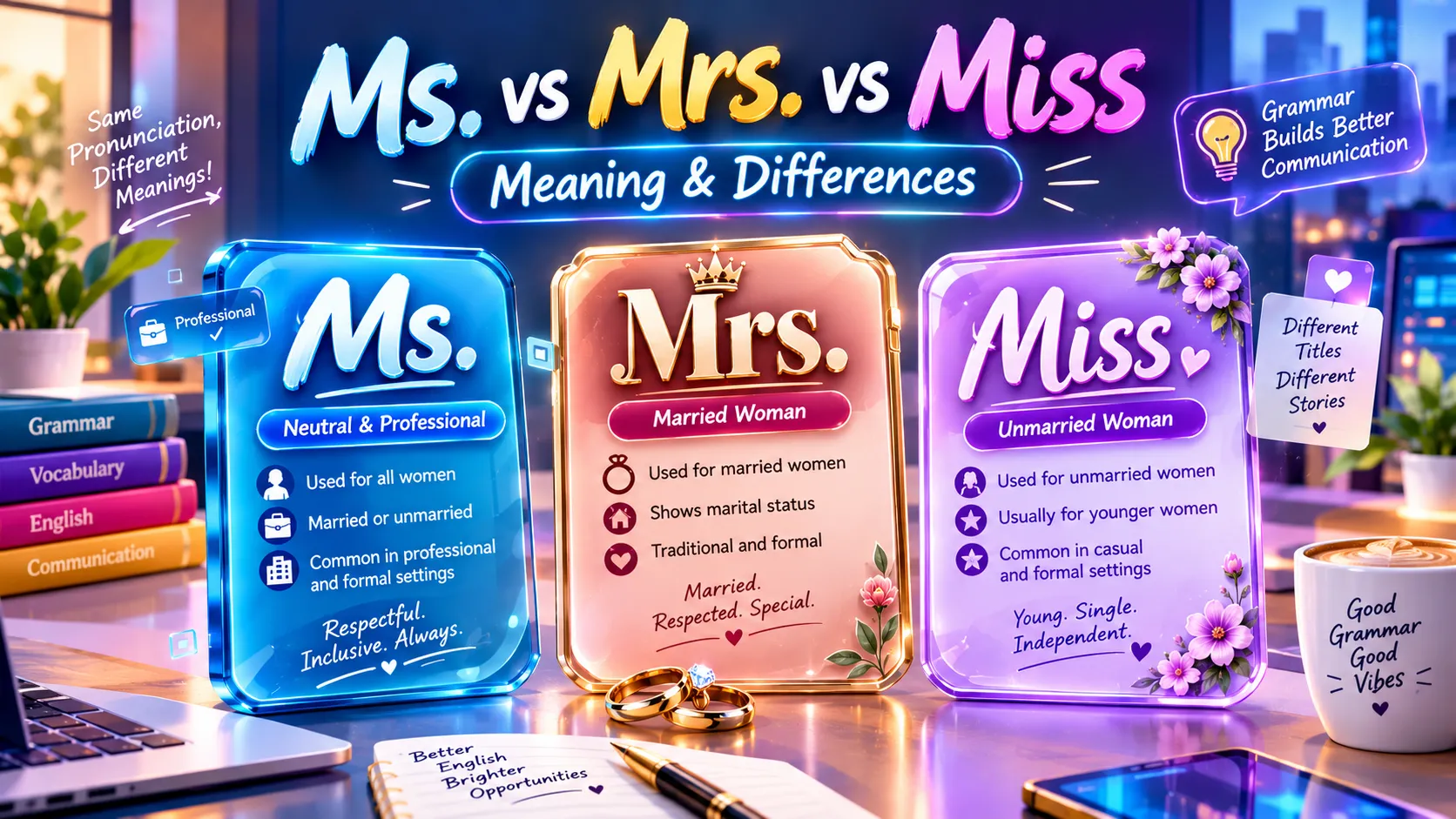
Ms. vs Mrs. vs Miss: These three titles refer to women, but they differ in meaning, usage, and marital status. Ms. works for a woman regardless of whether she is married; Mrs. traditionally refers to a married woman, and Miss traditionally refers to an unmarried woman or a girl. Choosing the correct title helps you address people respectfully in emails, letters, invitations, and professional conversations.
In this guide, you’ll learn the differences between Ms., Mrs., and Miss, how to pronounce each title, when to use them, and which one works best in formal and professional situations.
Ms. vs Mrs. vs Miss: Quick Comparison
| Title | Meaning | Traditional usage | Pronunciation |
| Ms. | A title for a woman regardless of marital status | Any woman who prefers this title | Miz |
| Mrs. | Traditionally a title for a married woman | Married women who use this title | Missiz |
| Miss | Traditionally a title for an unmarried woman or a girl | Unmarried women, girls, and some teachers | Miss |
The easiest rule to remember: Use Ms. when you don’t know a woman’s marital status or when you want to avoid referring to it. Use Mrs. or Miss when you know that the person prefers that title.
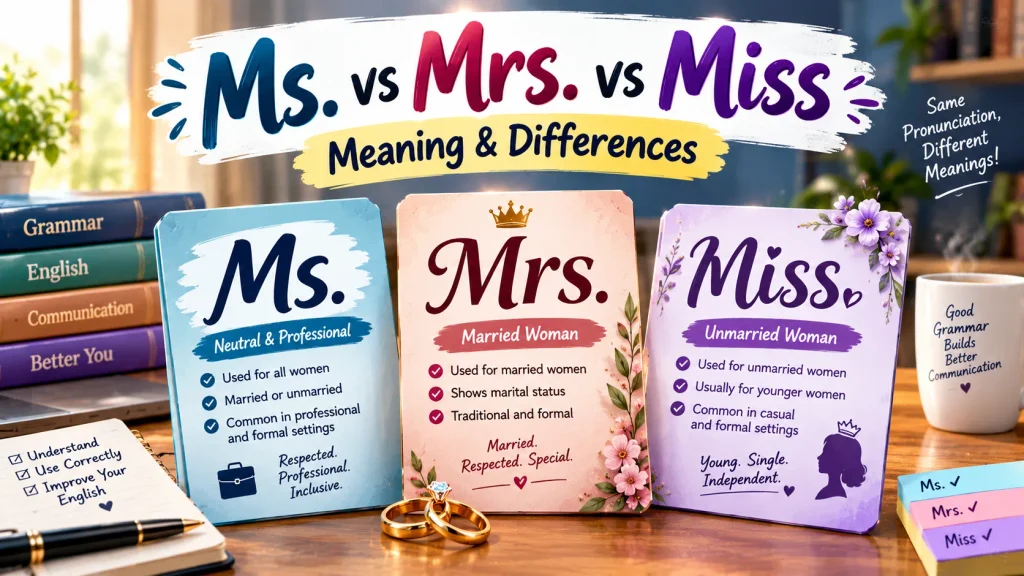
What Does Ms. Mean?
Ms. is a title used before a woman’s surname or full name without indicating whether she is married.
For example:
- Ms. Johnson works at the local library.
- Please contact Ms. Sarah Williams for more information.
- Dear Ms. Brown, thank you for your application.
Ms. is especially common in workplaces, business correspondence, schools, and formal introductions because it does not make marital status relevant.
When Should You Use Ms.?
Use Ms. in these situations:
- Professional emails: When addressing a female colleague, client, or manager.
- Formal letters: When you do not know whether the recipient is married.
- Business communication: When you want a neutral, respectful title.
- Unknown marital status: When you have no reliable information about the person’s preference.
- Personal preference: When a woman specifically asks you to use Ms.
Example: Dear Ms. Taylor, I am writing to confirm our meeting on Monday.
Ms. is often the safest default when you need a title but do not know the recipient’s preference.
Explore More: https://wordminto.com/advisor-vs-adviser/
What Does Mrs. Mean?
Mrs. is traditionally a title for a married woman. It usually appears before her surname or full name.
For example:
- Mrs. Smith teaches mathematics.
- Mrs. Emily Carter attended the conference.
- Please send the invitation to Mrs. Wilson.
Traditionally, some married women use their spouse’s surname, but many keep their original surnames. A woman’s title does not determine which surname she uses.
When Should You Use Mrs.?
Use Mrs. when:
- A married woman prefers this title.
- You are addressing someone who has introduced herself as Mrs.
- An invitation or formal document specifies this title.
- You know the recipient’s preference from previous correspondence.
Example: Dear Mrs. Anderson, thank you for inviting us to your event.
Remember that marriage alone does not mean every woman prefers Mrs. Some married women use Ms. instead.
Explore More: https://wordminto.com/lay-or-lie/
What Does Miss Mean?
Miss is traditionally a title for an unmarried woman or a girl. It appears before a surname, full name, or sometimes a first name.
For example:
- Miss Davis is waiting outside.
- Miss Olivia Brown won the competition.
- Miss Emma teaches our English class.
In some schools and communities, people also use Miss when addressing a female teacher, even if they do not know her marital status.
When Should You Use Miss?
Use Miss when:
- An unmarried woman prefers this title.
- You are addressing a girl in a traditional formal setting.
- A teacher or other professional uses Miss as her preferred title.
- The person has specifically asked you to use Miss.
Example: Miss Parker will explain the assignment tomorrow.
However, do not assume that every unmarried woman wants to be called Miss. Ms. is often a more neutral choice in modern professional communication.
Explore More: https://wordminto.com/layed-or-laid/
What Is the Main Difference Between Ms., Mrs., and Miss?
The main difference is how each title relates to marital status.
Ms. does not indicate marital status. It works for women regardless of whether they are married.
Mrs. traditionally indicates a married woman. However, individual preference determines whether she uses it.
Miss traditionally indicates an unmarried woman or a girl. Some women also retain Miss as their preferred title throughout adulthood.
Consider these examples:
- Ms. Taylor: Taylor’s marital status is not indicated.
- Mrs. Taylor: Taylor uses the traditional title for a married woman.
- Miss Taylor: Taylor uses the traditional title associated with unmarried women, or the title is used in a setting where Miss is customary.
You cannot reliably determine a woman’s marital status from Ms. alone.
Explore More: https://wordminto.com/borrow-or-lend/
Ms. vs Mrs.: Which One Should You Use?
Ms. and Mrs. are both common in formal and professional settings, but they communicate different things traditionally.
Use Ms. when you want to address a woman without referring to her marital status. Use Mrs. when she prefers that title.
Examples:
- Ms. Davis: A professional title that does not specify marital status.
- Mrs. Davis: A title traditionally associated with a married woman.
Suppose you are sending an email to a client named Jennifer Davis. You do not know whether she is married. In that situation, Dear Ms. Davis is generally a better choice than assuming she uses Mrs.
If Jennifer signs her emails as Mrs. Davis, follow her preference.
Miss vs Ms.: What Is the Difference?
Miss traditionally identifies an unmarried woman or a girl, whereas Ms. does not indicate marital status.
Examples:
- Miss Adams: Traditionally suggests an unmarried woman.
- Ms. Adams: Does not communicate whether Adams is married.
In modern workplaces, Ms. often works better because it avoids assumptions about marriage. Miss remains appropriate when someone prefers it or when a traditional form of address calls for it.
Easy memory tip: Ms. is neutral; Miss traditionally refers to an unmarried woman.
Explore More: https://wordminto.com/affect-or-effect/
Miss vs Mrs.: What Is the Difference?
Miss and Mrs. traditionally distinguish between unmarried and married women.
Examples:
- Miss Green: Traditionally an unmarried woman.
- Mrs. Green: Traditionally a married woman.
Both titles may appear in schools, formal invitations, and personal correspondence. However, personal preferences vary, so you should not rely on marital status alone to select a title.
For professional communication, Ms. can be the simplest option when you do not know what the recipient prefers.
How Do You Pronounce Ms., Mrs., and Miss?
The three titles have different pronunciations.
| Title | Pronunciation | Simple guide |
| Ms. | /mɪz/ | Miz |
| Mrs. | /ˈmɪsɪz/ | Miss-iz |
| Miss | /mɪs/ | Miss |
Ms. sounds like “miz,” with a voiced final sound.
Mrs. usually sounds like “missiz” in everyday English.
Miss rhymes with “this” and “kiss.”
Although Mrs. contains the letters “rs,” speakers do not pronounce it as “miss-ers” in standard everyday usage.
Should You Write Ms, Ms., Mrs, Mrs., Miss, or Miss.?
Punctuation depends partly on the title and the style of English you follow.
In American English, writers commonly use periods after abbreviations such as Ms. and Mrs. In British English, writers often omit those periods and write Ms and Mrs.
Miss is a complete title rather than an abbreviation, so writers generally use it without a period.
Examples:
- American English: Ms. Johnson, Mrs. Brown, Miss Taylor
- British English: Ms Johnson, Mrs Brown, Miss Taylor
Choose one punctuation style and use it consistently throughout your document.
Explore More: https://wordminto.com/then-vs-than/
How Do You Use Ms., Mrs., and Miss in Emails?
The best title depends on the recipient’s preference and the context.
Formal Email Examples
When you do not know the recipient’s preference:
Dear Ms. Wilson,
Thank you for your email. I will review the documents and respond shortly.
Best regards,
Alex
When the recipient prefers Mrs.:
Dear Mrs. Thompson,
Thank you for confirming the appointment. I look forward to meeting you.
Best regards,
Alex
When the recipient prefers Miss:
Dear Miss Parker,
Thank you for sharing the details. I will prepare the materials before the meeting.
Best regards,
Alex
In modern business communication, you can also use the recipient’s full name or first name when appropriate. If you know the person’s professional title, such as Dr., use that title when suitable.
Can You Use Ms. for a Married Woman?
Yes. A married woman can use Ms. if she prefers it.
Ms. does not indicate that a woman is unmarried. It simply avoids specifying marital status.
For example:
- Ms. Carter is married.
- Ms. Ahmed is unmarried.
- Ms. Robinson prefers not to disclose her marital status.
All three examples are correct uses of Ms.
Do not assume that a woman must switch from Ms. to Mrs. after marriage. Her preferred form of address is what matters.
Explore More: https://wordminto.com/breath-vs-breathe/
Can You Use Mrs. for an Unmarried Woman?
Traditionally, Mrs. refers to a married woman, so you should not automatically use it for an unmarried woman.
However, titles can reflect personal preferences and individual circumstances. If a person explicitly asks you to use Mrs., respect that preference rather than making assumptions based on her relationship status.
When you are unsure, Ms. is generally the most neutral option.
What Title Should You Use for a Divorced or Widowed Woman?
A divorced or widowed woman may use Ms., Mrs., or another preferred form of address.
There is no universal rule requiring her to use a particular title.
- Ms.: Suitable when she wants a title that does not indicate marital status.
- Mrs.: Suitable when she continues to prefer this title.
- Miss: Suitable when she specifically prefers it, although it traditionally refers to unmarried women.
For example, a widowed woman may continue to use Mrs. Smith, change to Ms. Smith, or use another name professionally.
Always respect her choice instead of assuming that a change in marital status requires a change in title.
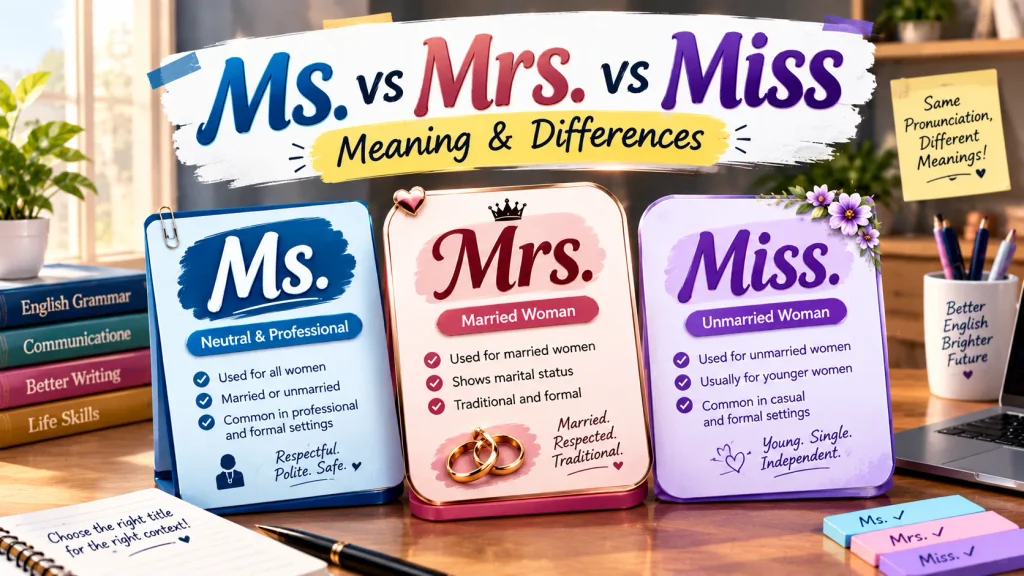
What Title Should You Use for a Female Teacher?
The appropriate title depends on the teacher’s preference, school customs, and local conventions.
Examples:
- Ms. Johnson teaches English.
- Mrs. Brown teaches science.
- Miss Davis teaches mathematics.
Some schools traditionally use Miss for female teachers, regardless of their marital status. Other schools use Ms. or the teacher’s professional title.
If you are unsure, check the school’s official information or ask the teacher how she prefers to be addressed.
What Title Should You Use on a Wedding Invitation?
Wedding invitations often use Ms., Mrs., or Miss according to the recipient’s preference and the formality of the event.
Examples:
- Ms. Emily Johnson
- Mrs. Sarah Wilson
- Miss Olivia Davis
For a married couple, you can also address each person individually, depending on the invitation style.
If you do not know the recipient’s preferred title, using her full name without a title may be a practical alternative.
Modern invitations do not need to follow every traditional rule. Respectful, accurate addressing matters more than assumptions about marital status.
Common Mistakes When Using Ms. vs Mrs. vs Miss
Avoid these common errors:
1. Assuming Ms. means unmarried.
Ms. works for married and unmarried women.
2. Assuming every married woman uses Mrs.
Some married women prefer Ms.
3. Assuming Miss is appropriate for every unmarried adult.
Personal preference and context matter.
4. Using Mrs. without knowing the recipient’s preference.
Marriage does not automatically determine the title someone wants.
5. Pronouncing Ms. as “miss.”
The standard pronunciation is “miz.”
6. Adding a period after Miss in ordinary usage.
Miss is generally written without a period.
7. Confusing titles with surnames.
Ms., Mrs., and Miss come before a name; they do not replace the person’s actual name.
8. Changing a woman’s title based on assumptions.
Ask or follow the form of address she already uses.
Ms. vs Mrs. vs Miss: Example Sentences
Review these sentences to see how the titles work in context.
- Ms. Clark will lead the meeting tomorrow.
- Mrs. Evans sent us an invitation.
- Miss Turner teaches our English class.
- Please address the letter to Ms. Roberts.
- Mrs. Khan manages the department.
- Miss Adams won the school competition.
- Ms. Lee works with our marketing team.
- Mrs. Miller prefers formal correspondence.
- Miss Olivia helped organize the event.
- Ms. Ahmed will contact you next week.
Each title is grammatically correct in its example. The appropriate choice in real life depends on the person’s preferred title and the situation.
People Also Ask
Ms. is appropriate for both married and unmarried women. It does not indicate marital status.
Mrs. traditionally refers to married women. However, people may have individual preferences that differ from traditional conventions.
No. Miss traditionally refers to an unmarried woman or a girl, while Ms. does not indicate marital status.
Ms. is often the most neutral choice in professional communication because it does not refer to marital status. However, you should use another title when the recipient expresses a different preference.
Ms. is pronounced “miz,” with a voiced final sound. Miss is pronounced “miss.”
Traditionally, Miss refers to an unmarried woman or a girl. However, individuals may choose their preferred titles, so follow the person’s stated preference.
Conclusion
The difference between Ms. vs Mrs. vs Miss comes down to traditional usage and personal preference.
- Ms. works regardless of marital status.
- Mrs. traditionally refers to a married woman.
- Miss traditionally refers to an unmarried woman or a girl.
When you do not know which title a woman prefers, Ms. is usually the most neutral choice. When she has already specified a title, use it. This simple approach helps you communicate respectfully and avoid assumptions in professional and personal situations.











2 thoughts on “Ms. vs Mrs. vs Miss: What’s the Difference? Meaning, Rules & Examples”