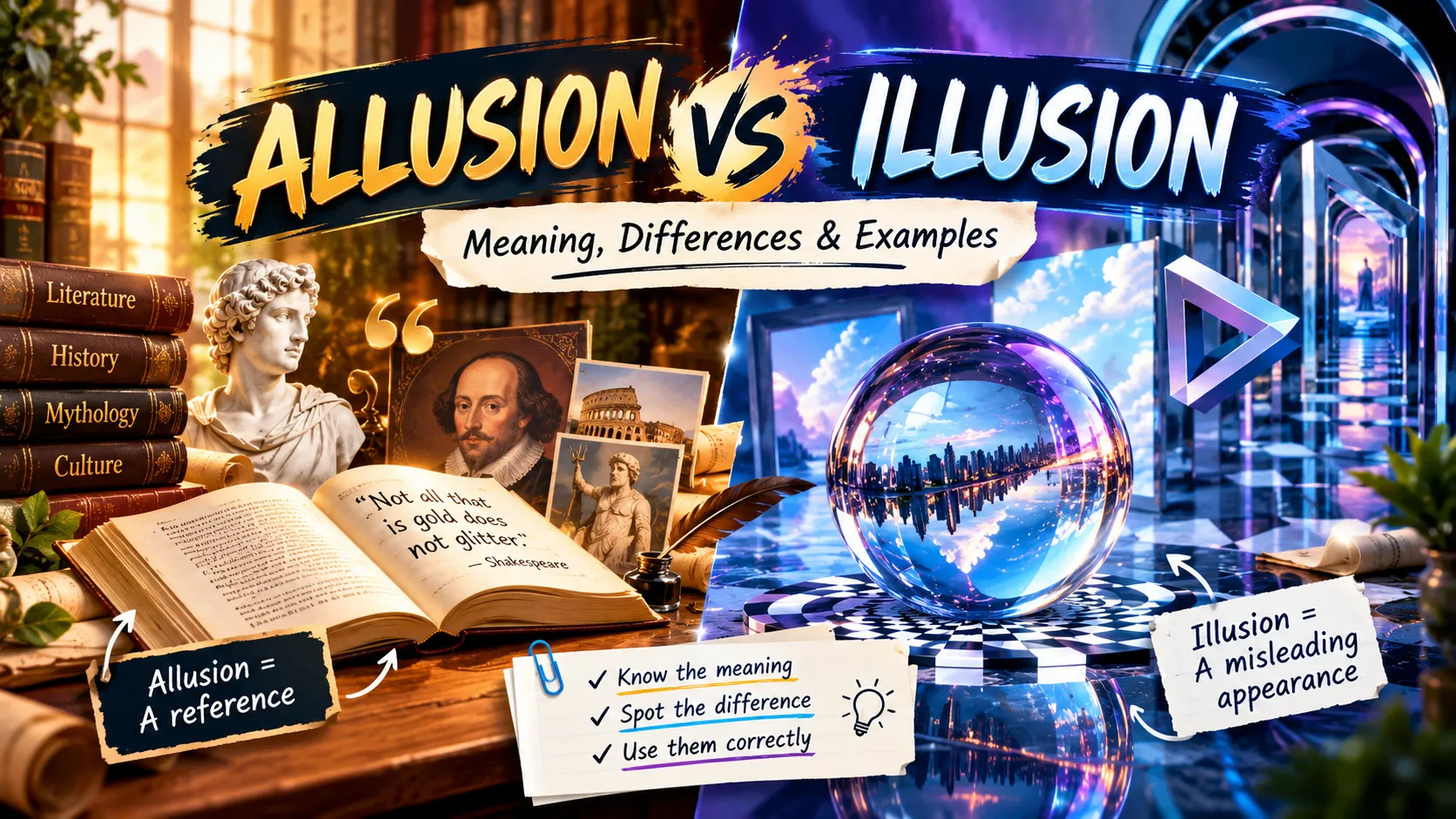
Allusion vs Illusion: These two words look and sound similar, but they have different meanings. An allusion refers to an indirect reference to a person, event, book, or idea, while an illusion refers to something that appears real but is not, or a misleading perception.
For example, a writer might make an allusion to Shakespeare in a novel, while a magician might create an illusion that makes a person appear to disappear.
Understanding the difference between allusion and illusion helps you choose the correct word in academic writing, literature, everyday conversations, and professional communication.
Quick Answer: Allusion vs Illusion
| Word | Meaning | Example |
| Allusion | An indirect reference to something | The poem contains an allusion to Greek mythology. |
| Illusion | A false or misleading perception | The magician created the illusion of a floating table. |
Easy way to remember:
- Allusion = A reference.
- Illusion = An appearance that deceives or misleads.
What Does Allusion Mean?
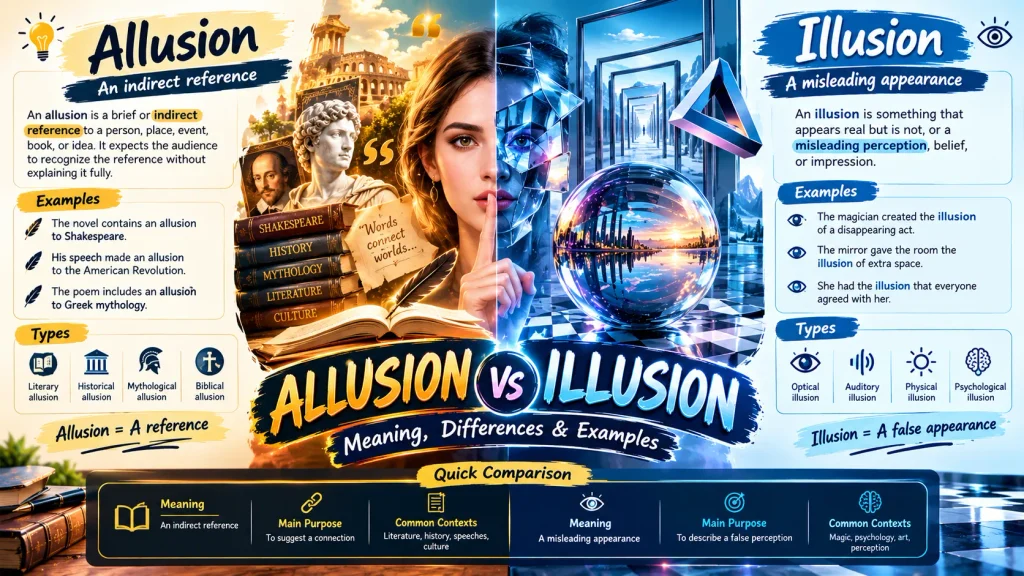
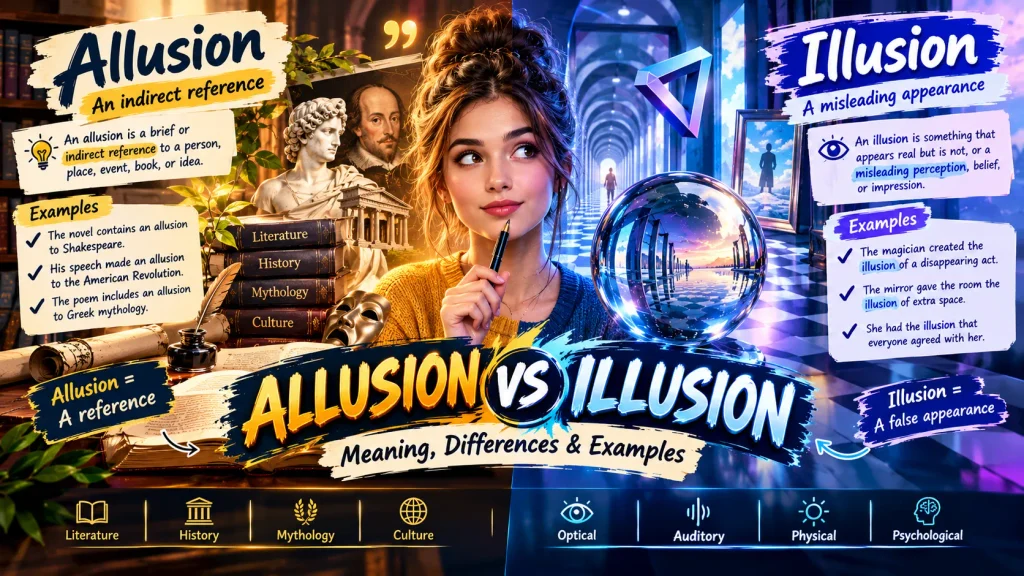
An allusion is an indirect or brief reference to a person, place, event, literary work, historical moment, or cultural idea. A speaker or writer uses an allusion when they expect the audience to recognize the reference without explaining it fully.
Writers often use allusions to add meaning, create connections, express emotions, or make their writing more engaging.
Examples of Allusion in Sentences
- The teacher made an allusion to Shakespeare during the literature lesson.
- His speech contained an allusion to the American Revolution.
- The novel includes an allusion to Greek mythology.
- She described her difficult journey as an allusion to the labors of Hercules.
- The song makes an allusion to a famous biblical story.
In each sentence, allusion refers to an indirect reference rather than something that tricks the senses.
Types of Allusion
1. Literary allusion: A reference to a famous book, poem, play, or fictional character.
Example: The character’s tragic decision is an allusion to Romeo and Juliet.
2. Historical allusion: A reference to a historical person or event.
Example: The politician’s speech included an allusion to the fall of the Berlin Wall.
3. Mythological allusion: A reference to a myth, god, hero, or legendary figure.
Example: Calling him a Hercules alludes to the strength of the Greek hero.
4. Biblical allusion: A reference to a person, event, or story from the Bible.
Example: The story’s forbidden fruit is an allusion to the Garden of Eden.
What Does Illusion Mean?
An illusion is something that appears real but differs from reality. It can involve a misleading visual experience, a false belief, or an incorrect impression.
Illusions often appear in magic shows, optical puzzles, art, psychology, and everyday situations.
Examples of Illusion in Sentences
- The magician created the illusion of making a coin disappear.
- The straight lines in the picture create an optical illusion.
- The mirror gave the room the illusion of extra space.
- He lived under the illusion that everyone agreed with him.
- The sunset created the illusion that the sky was on fire.
In these examples, illusion describes a misleading appearance, impression, or belief.
Types of Illusion
1. Optical illusion: A visual effect that makes something appear different from what it actually is.
Example: The drawing creates an optical illusion of movement.
2. Auditory illusion: A sound that a person perceives differently from the actual sound.
Example: The recording created an auditory illusion that made the voice seem distant.
3. Physical illusion: An effect caused by light, reflection, or other physical conditions.
Example: A mirage creates the illusion of water on a hot road.
4. Psychological illusion: A false impression or belief about reality.
Example: She had the illusion that success would solve every problem.
Allusion vs Illusion: Key Differences
Although the two words share similar spellings, they serve different purposes.
| Feature | Allusion | Illusion |
| Meaning | An indirect reference | A misleading appearance or belief |
| Main purpose | To suggest a connection | To describe a false perception |
| Common contexts | Literature, history, speeches, culture | Magic, psychology, art, perception |
| Example phrase | An allusion to mythology | An optical illusion |
| Memory clue | Reference | Deception or false impression |
Allusion vs Illusion Examples
Compare these sentences to understand how each word works.
1
- Correct: The author made an allusion to Cinderella.
- Meaning: The author indirectly referred to the famous fairy tale.
- Incorrect: The author made an illusion to Cinderella.
2
- Correct: The artist created an illusion of depth.
- Meaning: The artwork made a flat surface appear three-dimensional.
- Incorrect: The artist created an allusion of depth.
3
- Correct: His comment was an allusion to a historical event.
- Meaning: His comment indirectly referred to the event.
- Incorrect: His comment was an illusion to a historical event.
4
- Correct: The magician performed an illusion that amazed the audience.
- Meaning: The magician created a deceptive effect.
- Incorrect: The magician performed an allusion that amazed the audience.
5
- Correct: The poem contains an allusion to Greek mythology.
- Meaning: The poem indirectly references a mythological story or figure.
- Incorrect: The poem contains an illusion to Greek mythology.
How to Remember Allusion vs. Illusion
Use these simple memory tricks to avoid confusing the words.
1. Remember “Allusion = Alludes to Something”
The word allusion relates to the verb allude, which means to refer to something indirectly.
Example: The speaker alluded to a famous historical event.
Therefore, the speaker made an allusion to that event.
2. Remember “Illusion = It Isn’t What It Seems”
An illusion makes something appear different from reality.
Example: The magician created an illusion of a disappearing person.
The person did not actually disappear; the trick created that impression.
3. Focus on the Meaning
Ask yourself one simple question:
- Does the word describe a reference to something? Use allusion.
- Does the word describe a misleading appearance or belief? Use illusion.
This test works in most everyday and academic situations.
Common Mistakes With Allusion and Illusion
Writers sometimes confuse these words because they have similar spellings and pronunciations. The following mistakes are easy to correct.
Mistake 1: Using illusion when you mean reference
Incorrect: The writer included an illusion to Shakespeare.
Correct: The writer included an allusion to Shakespeare.
Why? The writer indirectly refers to Shakespeare rather than creating a misleading appearance.
Mistake 2: Using allusion when you mean false perception
Incorrect: The mirror created an allusion of a larger room.
Correct: The mirror created the illusion of a larger room.
Why? The mirror changes the room’s perceived appearance.
Mistake 3: Confusing an illusion with an allusion in literature
Incorrect: The novel’s main character is an illusion to a Greek hero.
Correct: The novel’s main character is an allusion to a Greek hero.
Why? In this context, the character serves as an indirect reference to a mythological figure. More naturally, you could say, “The character is an allusion to a Greek hero.”
Allusion vs. Illusion in Literature
Both words appear in literary discussions, but they describe different concepts.
An allusion allows an author to connect a story with another work, person, or event without explaining the connection directly. For example, a writer might describe a character as having a “Midas touch” to allude to the Greek myth of King Midas.
An illusion describes a false appearance, mistaken belief, or deceptive impression within a story. For example, a character might believe that a stranger supports them, only to discover that the stranger has deceived them.
Here is the main difference:
- Allusion: A literary technique that refers indirectly to another source.
- Illusion: A misleading perception or false impression that may appear as a theme or plot element in literature.
Allusion vs. Illusion in Everyday English
These words also appear in conversations and general writing.
Allusion examples:
- Her joke was an allusion to a popular television show.
- The speaker made an allusion to his childhood.
- The advertisement contains an allusion to a famous movie.
Illusion examples:
- The curtains created the illusion of a taller window.
- He had the illusion that money could buy happiness.
- The stage lighting created the illusion of a nighttime sky.
Use allusion when you refer indirectly to something recognizable. Use illusion when something creates a misleading impression.
Is Allusion a Noun or a Verb?
Allusion is a noun. It names an indirect reference.
Example: The poem contains an allusion to ancient Rome.
The related verb is allude.
Example: The poem alludes to ancient Rome.
These words are related, but they have different grammatical roles.
Is Illusion a Noun or a Verb?
Illusion is a noun. It names a false appearance, perception, or belief.
Example: The painting creates an illusion of movement.
The related verb is illude, which means to deceive or mislead, although it is uncommon in modern everyday English.
More commonly, English speakers use verbs such as deceive, mislead, or fool.
Example: The magician deceived the audience with a clever trick.
Explore More: https://wordminto.com/active-vs-passive-voice/
Synonyms of Allusion and Illusion
Synonyms can help you understand each word’s meaning, but they do not always work as exact replacements.
| Allusion synonyms or related terms | Illusion synonyms or related terms |
| Reference | Misconception |
| Indirect reference | False impression |
| Hint | Delusion |
| Mention | Deceptive appearance |
| Suggestion | Optical effect |
Important: Reference is usually the closest simple alternative to allusion. For illusion, the best synonym depends on the context. For example, optical effect may fit a visual trick, while false belief may fit a mistaken assumption.
Practice Exercise: Allusion or Illusion?
Choose the correct word to complete each sentence.
- The author made an ______ to the story of Romeo and Juliet.
- The magician created the ______ that the rabbit had vanished.
- Her speech included an ______ to a famous historical event.
- The painting creates the ______ of movement.
- He mistakenly believed that success would bring him endless happiness; it was an ______.
Answers and Explanations
- Allusion — The author indirectly references a literary work.
- Illusion — The magician creates a deceptive appearance.
- Allusion — The speech indirectly refers to a historical event.
- Illusion — The painting makes a static image appear to move.
- Illusion — The person holds a mistaken belief about happiness.
People Also Ask
An allusion is an indirect reference to a person, event, story, or idea. An illusion is a misleading appearance, perception, or belief. For example, a reference to Shakespeare is an allusion, while a magician’s disappearing act creates an illusion.
Use allusion to something when you mean an indirect reference.
Example: The speech contains an allusion to ancient history.
Use illusion of something when you mean a misleading appearance or impression.
Example: The lighting creates the illusion of daylight.
“The new student was a real Einstein.” This sentence alludes to Albert Einstein and suggests that the student is highly intelligent.
A road that appears wet on a hot day may create a mirage. This is an example of an optical illusion caused by atmospheric conditions.
They have similar pronunciations, but they begin with different vowel sounds in standard English. Allusion begins with a short “uh” sound, while illusion begins with an “ih” sound. Pronunciation can vary by accent.
Yes. An illusion can contribute to a literary theme or plot, particularly when a character misunderstands reality or experiences deception. However, allusion is the term for the specific literary technique of indirectly referencing another source.
Allude means to refer to something indirectly. Elude means to escape, avoid, or remain difficult to understand.
Example: The writer alluded to a mystery that continued to elude the detectives.
Conclusion
The difference between allusion and illusion comes down to reference versus perception. An allusion indirectly points to a person, event, story, or idea, while an illusion creates a misleading appearance or describes a false belief.
Remember this simple rule: An allusion refers to something; an illusion makes something seem different from reality.
Once you understand this distinction, you can use both words confidently in essays, literature, professional writing, and everyday conversations.











2 thoughts on “Allusion vs Illusion: What’s the Difference? Meaning, Usage & Examples”