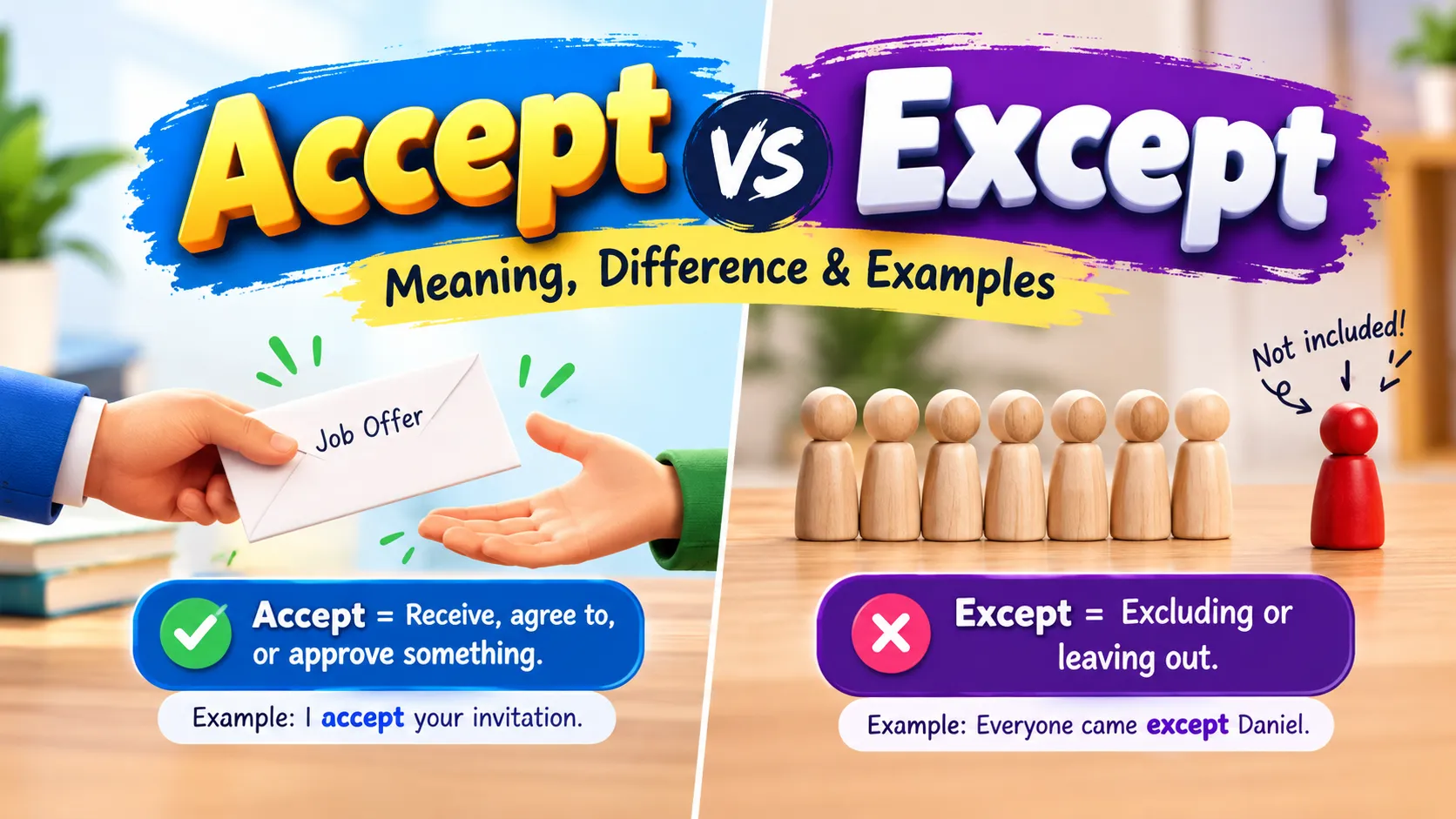
Accept vs Except: Accept and except look similar, but they have different meanings and grammatical functions. Accept means to receive, agree to, or approve something, while except means to exclude someone or something. Understanding the difference helps you avoid common spelling and grammar mistakes in everyday conversations, academic writing, and professional communication.
For example, you might accept a job offer, but you might invite everyone to a party except your coworker.
Although these words differ by only one letter, you cannot use them interchangeably. This guide explains their meanings, pronunciation, grammatical roles, usage rules, examples, and common mistakes to help you choose the correct word.
Accept vs Except: Quick Difference
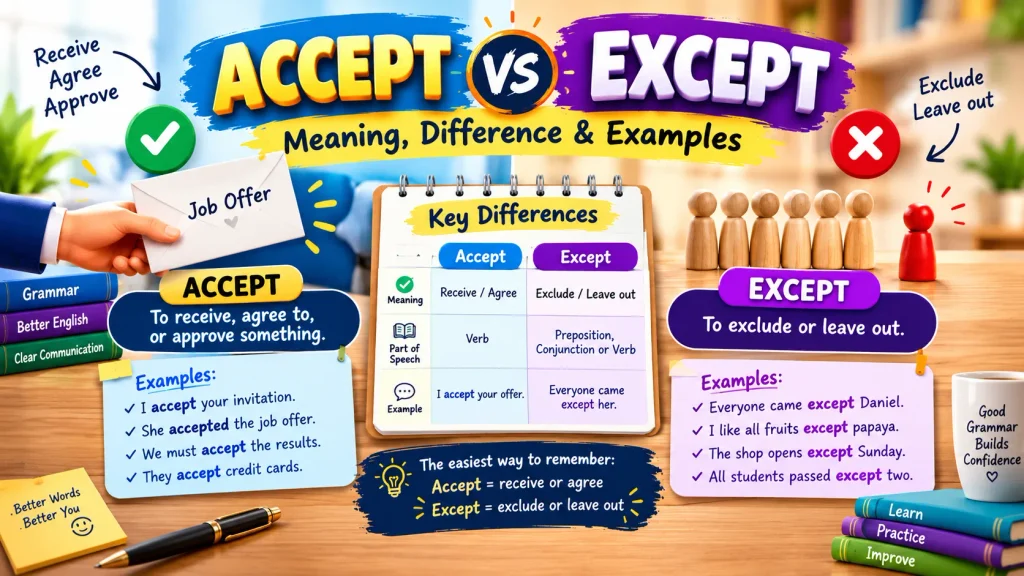
| Word | Meaning | Part of Speech | Example |
| Accept | To receive, agree to, or approve | Verb | I accept your invitation. |
| Except | Excluding or leaving out | Preposition, conjunction, or verb | Everyone came except Daniel. |
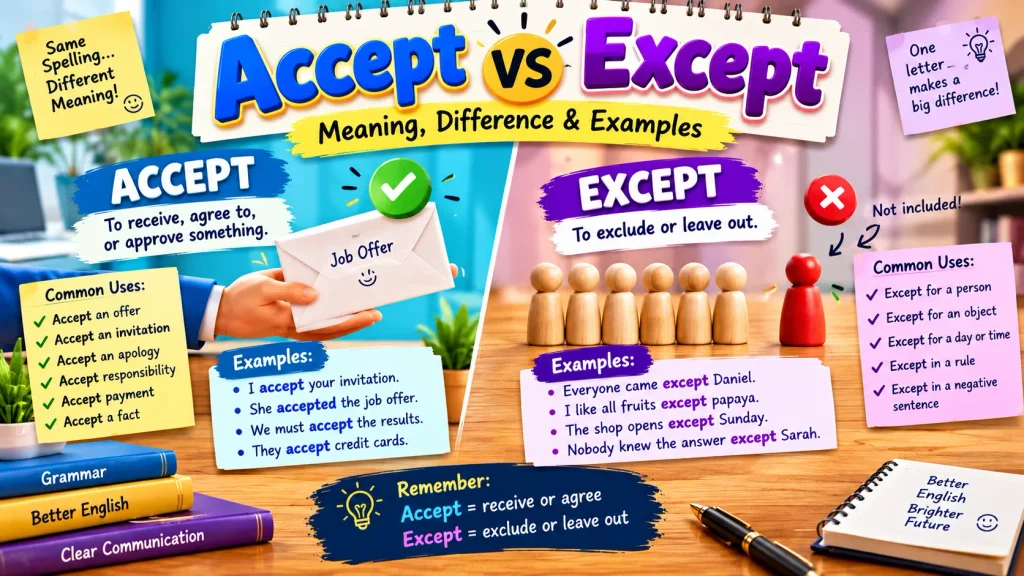
The easiest way to remember the difference: Use accept when someone receives or agrees to something. Use except when you leave someone or something out.
What Does Accept Mean?
Accept is a verb that means to receive something willingly, agree to an offer, approve an idea, or recognize a situation as true.
People use this word in personal conversations, workplaces, schools, businesses, and formal writing.
Examples of Accept in Sentences
- I accept your apology.
- She accepted the job offer yesterday.
- He accepted the invitation to the wedding.
- The university accepted her application.
- We must accept the results of the competition.
- They accept credit cards at this store.
- I cannot accept such an unfair decision.
- She accepted responsibility for the mistake.
In each sentence, accept expresses receiving, agreeing, approving, or acknowledging something.
Common Uses of Accept
1. Accept an offer
Use accept when someone agrees to an offer or opportunity.
Example: He accepted the offer to work abroad.
2. Accept an invitation
Use the word when someone agrees to attend an event.
Example: Maria accepted my invitation to dinner.
3. Accept an apology
Use accept when someone receives an apology and chooses to forgive or acknowledge it.
Example: I accept your apology, but I need more time to rebuild trust.
4. Accept responsibility
Use the word when someone acknowledges their role in an action or situation.
Example: The manager accepted responsibility for the team’s failure.
5. Accept a fact or situation
Use accept when someone recognizes something as true or unavoidable.
Example: We must accept that plans sometimes change.
6. Accept payment
Use accept when a person or business receives money or another form of payment.
Example: This restaurant accepts mobile payments.
Explore More: https://wordminto.com/smh-meaning/
What Does Except Mean?
Except generally means excluding, other than, or with the exclusion of. It identifies a person, thing, or situation that does not belong to a particular group.
It commonly appears when someone describes a group and identifies an exception.
Examples of Except in Sentences
- Everyone attended the meeting except John.
- I like all fruits except papaya.
- The shop opens every day except Sunday.
- All students passed the exam except two.
- You can use any color except red.
- The whole family came except my brother.
- The library is open every day except public holidays.
- Nobody knew the answer except Sarah.
In these examples, except identifies someone or something that the statement excludes.
Common Uses of Except
1. Except for a person
Use except to exclude someone from a group.
Example: Everyone received a certificate except Ahmed.
2. Except for an object or thing
Use it when something does not belong to a group.
Example: I packed everything except my charger.
3. Except for a day or time
Use the word to identify a day or period that does not follow the usual rule.
Example: The gym opens daily except Friday.
4. Except in a rule or instruction
Use except to describe a restriction.
Example: All visitors may enter except those without identification.
5. Except in a negative sentence
Use except to identify the only person or thing that satisfies a condition.
Example: Nobody called me except my sister.
Explore More: https://wordminto.com/lmfao-meaning/
Accept vs Except: Key Differences
The main difference involves meaning and grammatical function. Accept describes an action, while except usually introduces an exclusion.
| Feature | Accept | Except |
| Basic meaning | Receive or agree | Exclude or leave out |
| Main grammatical role | Verb | Preposition or conjunction; sometimes a verb |
| Typical use | Offers, invitations, apologies, responsibility | Groups, rules, lists, exceptions |
| Example | I accept the invitation. | Everyone came except Ali. |
| Opposite idea | Reject or refuse | Include |
| Memory clue | Accept an offer | Exclude an item |
Remember that accept and except do not share the same meaning, even when they appear in similar sentences.
Accept vs Except: Grammar Rules
Learning the grammatical roles of both words makes it easier to choose the correct one.
Rule 1: Use Accept as a Verb
A verb expresses an action or state. Accept describes an action involving receiving, agreeing, approving, or acknowledging.
Examples:
- I accept your proposal.
- They accept online applications.
- She accepted the challenge.
- We will accept the final decision.
You can change its form according to tense:
- Present: accept
- Third-person singular: accepts
- Past tense: accepted
- Present participle: accepting
Examples:
- He accepts my advice.
- She accepted the invitation.
- They are accepting new members.
Rule 2: Use Except to Introduce an Exclusion
Use except when you want to identify something that does not belong to a group or does not follow a general statement.
Examples:
- Everyone agreed except Mark.
- I eat every vegetable except spinach.
- All the rooms are ready except Room 5.
In these sentences, except separates the excluded item from the rest.
Rule 3: Use Except That to Introduce an Exception
The expression except that introduces a qualification or an exception to a statement.
Examples:
- I would buy the car, except that it costs too much.
- The plan looks perfect, except that we lack the necessary equipment.
- She would have attended, except that she was ill.
This structure often explains why a general statement does not completely apply.
Rule 4: Use Accept With a Direct Object
Accept often takes a noun or pronoun that identifies what someone receives or agrees to.
Examples:
- She accepted the award.
- I accept your explanation.
- They accepted our invitation.
- He accepted the responsibility.
You can also use accept without a direct object when the context makes the meaning clear.
Example: I offered him a seat, but he refused to accept.
Rule 5: Use Except for Exclusions From Lists
When a sentence includes a general category, except identifies an item outside that category.
Examples:
- All the books are available except the new edition.
- Every employee attended except those on leave.
- You may choose any seat except the front row.
This construction works well in everyday communication and formal instructions.
Explore More: https://wordminto.com/advisor-vs-adviser/
Accept vs Except Examples in Sentences
Compare these examples to understand how the words work in context.
Accept Examples
- I accept your invitation to the party.
- She accepted the scholarship.
- The company accepts applications online.
- He accepted my explanation.
- We accept different opinions.
- They accepted the terms of the agreement.
- My parents accepted my decision.
- The school accepts students from different backgrounds.
- She will accept the award tomorrow.
- Please accept my sincere apologies.
Except Examples
- Everyone passed the test except David.
- I enjoy every subject except chemistry.
- All shops are closed except the pharmacy.
- Nobody attended except the organizers.
- You can borrow any book except this one.
- We work every day except Sunday.
- All the answers were correct except the last one.
- The entire team agreed except the captain.
- Everything was ready except the food.
- Everyone was invited except our neighbors.
Accept vs Except in Everyday English
These words appear in different situations throughout daily life.
At Work
- Accept: I accepted the new position.
- Except: Everyone joined the meeting except the director.
At School
- Accept: The teacher accepted my assignment.
- Except: All students completed the exercise except two.
In Shopping
- Accept: This store accepts digital payments.
- Except: All items are on sale except electronics.
Relationships
- Accept: I accept you for who you are.
- Except: Everyone came to dinner except my best friend.
In Travel
- Accept: The airline accepted my booking.
- Except: All flights departed on time except ours.
These examples show that the correct word depends on whether the sentence describes receiving or agreeing, or identifies an exclusion.
Explore More: https://wordminto.com/anyway-vs-anyways/
Accept vs Except: Common Mistakes
Writers often confuse these words because their spellings and pronunciations are similar. However, their meanings remain distinct.
Mistake 1: Using Except Instead of Accept
Incorrect: I except your apology.
Correct: I accept your apology.
Why? The sentence describes receiving or acknowledging an apology, so it needs the verb accept.
Mistake 2: Using Accept Instead of Except
Incorrect: Everyone came accept James.
Correct: Everyone came except James.
Why? James is the person excluded from the group, so except is correct.
Mistake 3: Confusing Accept With Except in Instructions
Incorrect: You can choose any option accept the last one.
Correct: You can choose any option except the last one.
Why? The sentence excludes one option rather than describing agreement.
Mistake 4: Using Accept When Describing a Group Exception
Incorrect: All employees attended accept Sarah.
Correct: All employees attended except Sarah.
Why? Sarah did not attend, so the sentence needs an exclusion word.
Mistake 5: Writing Except When Describing Agreement
Incorrect: He excepted the invitation.
Correct: He accepted the invitation.
Why? Accepted is the past tense of accept. The verb except can mean to exclude, but it does not mean to agree to an invitation.
Explore More: https://wordminto.com/toward-vs-towards/
Accept vs Except: Easy Memory Tricks
Use these simple techniques to remember the difference.
1. Accept an Offer
Connect accept with receiving something.
Examples:
- Accept an invitation.
- Accept an award.
- Accept an apology.
- Accept a responsibility.
If someone receives, agrees to, or acknowledges something, choose accept.
2. Except Means Exclude
Connect except with leaving something out.
Examples:
- Everyone except me.
- Every day except Monday.
- All colors except black.
- All options except one.
If the sentence removes a person or thing from a group, choose except.
3. Remember the Opposites
The opposite of accept is often reject or refuse.
The opposite idea of except is include.
Compare:
- I accept the offer. → I reject the offer.
- Everyone came except John. → Everyone came, including John.
4. Try the Sentence Substitution Test
Replace the word with a simpler expression.
If receive or agree to fits, use accept.
If excluding or leaving out fits, use except.
Examples:
- I ___ the gift. → I receive the gift. → Accept
- Everyone attended ___ Tom. → Everyone attended, excluding Tom. → Except
Accept vs Except vs Expect
A third word, expect, also looks and sounds similar. It means to think that something will happen or to believe that someone should do something.
| Word | Meaning | Example |
| Accept | Receive or agree to | I accept your offer. |
| Except | Exclude or leave out | Everyone came except Ben. |
| Expect | Anticipate or believe something will happen | I expect rain tomorrow. |
Examples of Expect
- I expect him to arrive soon.
- We expect good results.
- She expects a reply today.
- They expect the package tomorrow.
Quick tip: You accept an offer, exclude someone with except, and expect something to happen.
Accept vs Except vs Exclude
Although except and exclude have related meanings, they serve different grammatical roles.
- Accept: Receive or agree to something.
- Except: Leave out or identify an exception.
- Exclude: Deliberately prevent someone or something from being included.
Examples:
- The manager accepted my request.
- Everyone attended except the manager.
- The manager excluded one applicant from the final list.
Use exclude when you want to emphasize the action of keeping someone or something out. Use except to identify the exception within a statement.
Accept vs Except: Practice Exercises
Choose the correct word in each sentence.
- I gladly ________ your invitation.
- Everyone passed the exam __________ Jack.
- The store does not ___________ cash payments.
- All the students attended ___________ two.
- She decided to __________ the job offer.
- I like every flavor __________ mint.
- Please _________ my sincere thanks.
- We visit the park every day _________ Monday.
- The company will _______ your application.
- Nobody knew the answer __________ Maria.
- You can select any seat __________ the front row.
- He refused to __________ responsibility for the mistake.
- All the lights were on _________________ the one in the kitchen.
- They agreed to ___________ the proposal.
- Every participant received a gift _______________ the last person.
Answers and Explanations
- Accept — The speaker agrees to the invitation.
- Except — Jack is excluded from the group.
- Accept — The store receives or takes payments.
- Except — Two students are excluded from the statement.
- Accept — She agrees to the offer.
- Except — Mint is excluded from the preferred flavors.
- Accept — The phrase expresses receiving or acknowledging thanks.
- Except — Monday is excluded from the routine.
- Accept — The company receives the application.
- Except — Maria is the only person who knew the answer.
- Except — The front row is excluded.
- Accept — The sentence refers to taking responsibility.
- Except — One kitchen light is excluded from the statement.
- Accept — They agree to the proposal.
- Except — The last person did not receive a gift.
People Also Ask
Accept means to receive, agree to, or approve something. Except means to exclude someone or something.
Example: I accept your invitation, but everyone is invited except John.
Use accept as a verb when someone receives, agrees to, or acknowledges something.
Example: She accepted the job offer.
Use except to identify a person or thing that does not belong to a group.
Example: Everyone enjoyed the movie except my brother.
Yes. Accept is a verb that means to receive, agree to, approve, or acknowledge something.
Example: They accept credit cards.
Except commonly functions as a preposition or conjunction. It can also function as a verb, meaning to exclude.
Examples:
Preposition: Everyone came except Sarah.
Conjunction: I would go, except that I am busy.
Verb: The rule excepts certain cases from its requirements.
No. They have different meanings and grammatical functions. Using one in place of the other can change the meaning of a sentence or create a grammatical error.
Final Thoughts
Accept and except have similar spellings but different meanings. Use accept when someone receives, agrees to, or acknowledges something. Use except when you identify a person, object, or situation that does not belong to a group.
Remember these two simple examples:
- Accept: I accept your invitation.
- Except: Everyone attended except John.
Once you connect accept with receiving and except with excluding, you can use both words confidently in conversations, schoolwork, emails, and professional writing.











1 thought on “Accept vs Except: What’s the Difference? Meaning, Rules & Examples”