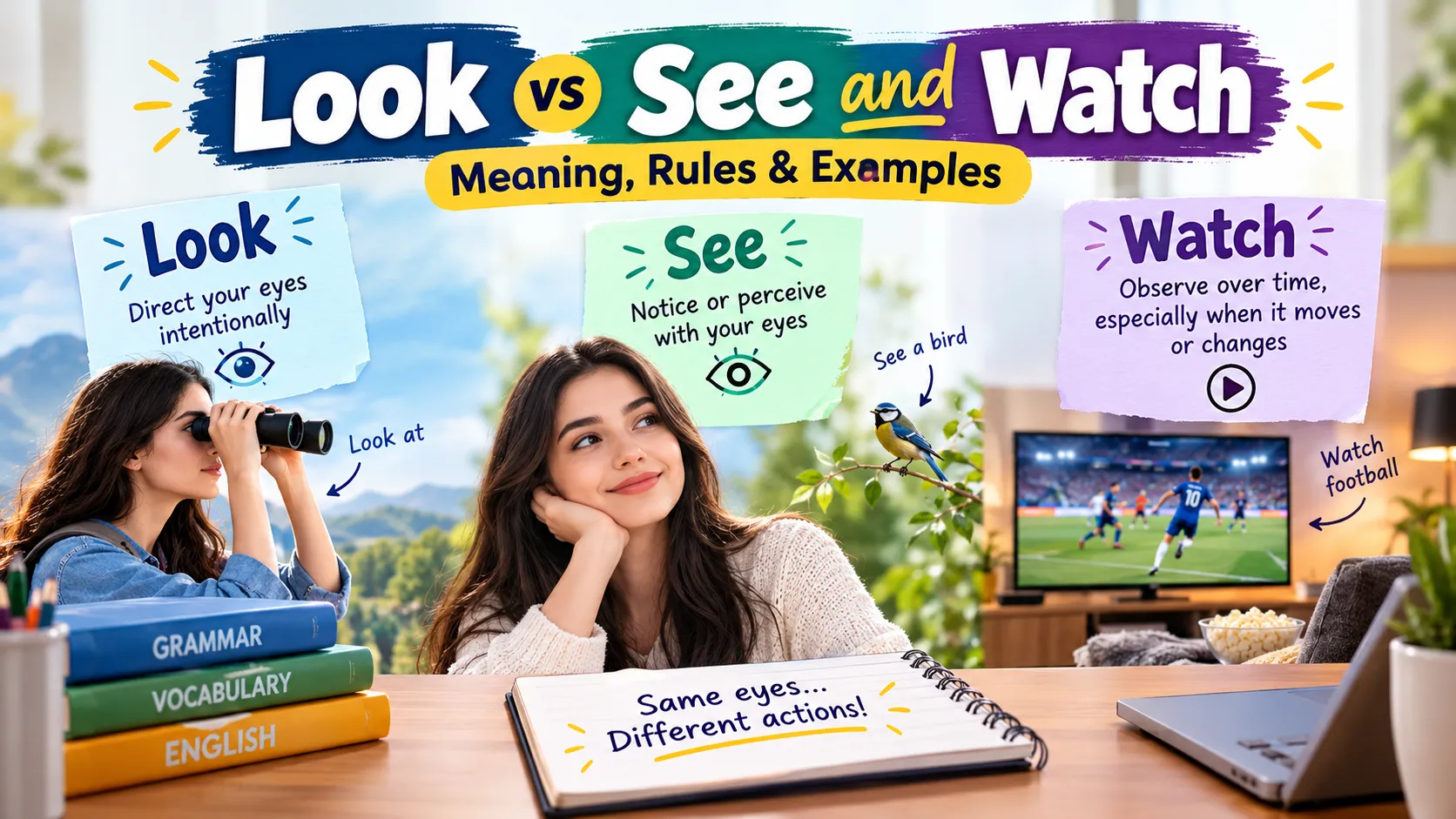
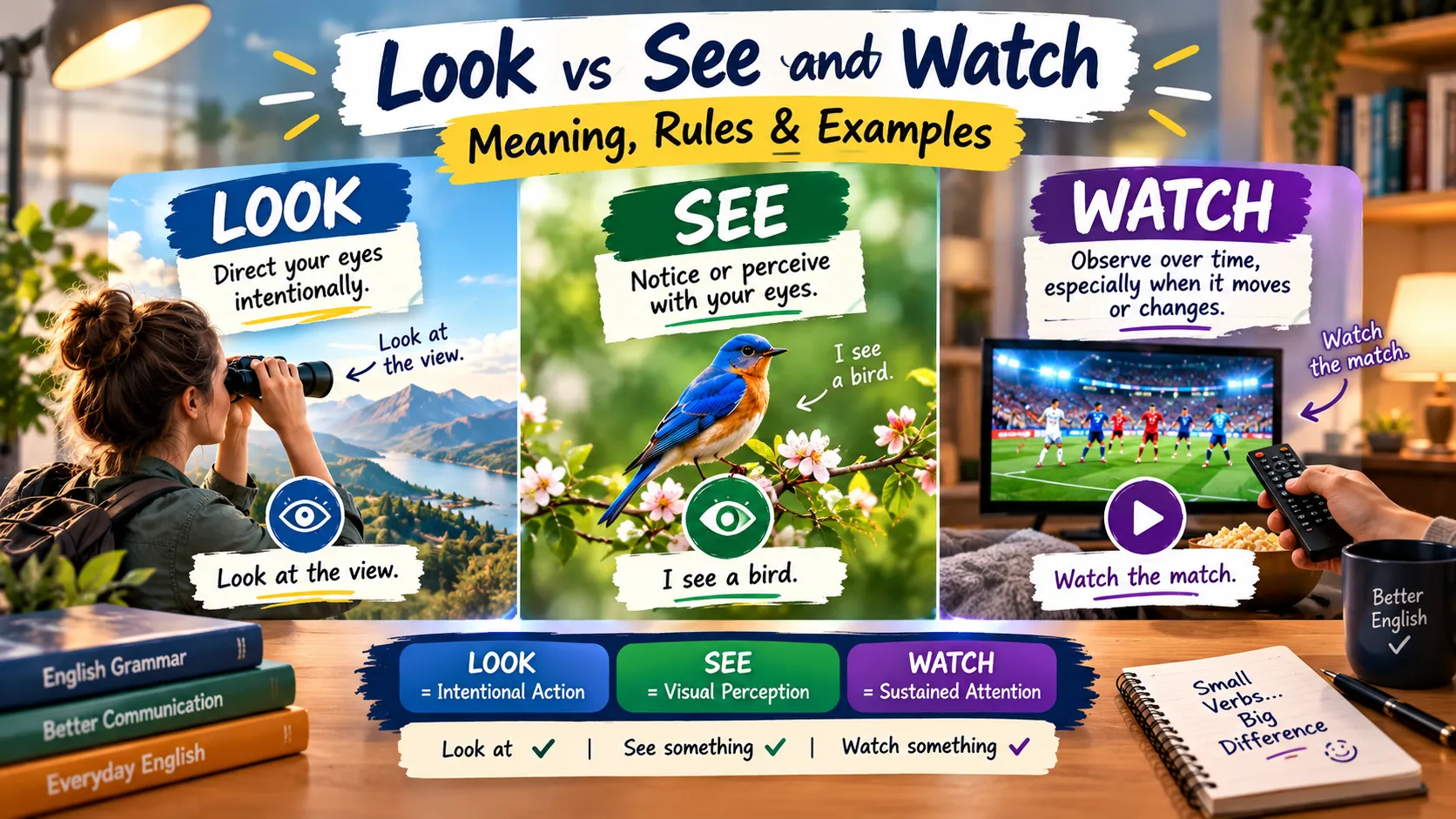
Look vs See and Watch: These three verbs relate to using your eyes, but they describe different actions. Look means to direct your eyes toward something intentionally, see means to notice or perceive something with your eyes, and watch means to observe something for a period of time, especially when it moves or changes.
For example, you look at a picture, see a bird in a tree, and watch a bird fly away. Although these verbs sometimes overlap, understanding their differences helps you choose the correct word in everyday conversations, academic writing, and professional communication.
In this guide, you will learn the meanings, grammar rules, sentence structures, common mistakes, and practical examples of look, see, and watch.
Look vs See and Watch: Quick Difference
| Verb | Meaning | Common Structure | Example |
| Look | Direct your eyes intentionally | Look at + object | Look at that painting. |
| See | Notice something with your eyes | See + object | I see a bird. |
| Watch | Observe something over time | Watch + object | We watch football. |
The main difference involves intention and duration. You look when you deliberately direct your attention, see when you perceive something, and watch when you pay attention to an activity or event over time.
What Does Look Mean?
Look means to direct your eyes toward someone or something intentionally. You use this verb when you want to examine something, find an object, or focus your attention in a particular direction.
Examples of Look in Sentences
- Look at the beautiful sunset.
- She looked at the notice on the door.
- Please look at the board.
- He looked out of the window.
- I am looking for my missing keys.
- Look carefully before you cross the road.
- The teacher looked at the students.
- She looked in her bag for her phone.
Grammar Rules for Look
1. Use look at before a direct object when you direct your eyes toward something.
Correct: Look at this picture.
Incorrect: Look this picture.
2. Use look for when you try to find something.
Correct: I am looking for my wallet.
Incorrect: I am looking my wallet.
3. Use look after when you mean to take care of someone or something.
Example: She looks after her younger brother.
4. Use look like when you compare someone’s appearance with another person or thing.
Example: You look like your father.
5. Use look out when you warn someone about danger.
Example: Look out! A car is coming.
Remember that look can describe appearance as well as the action of directing your eyes. For example, “You look tired” means that someone appears tired.
Explore More: https://wordminto.com/grammatical-agreement/
What Does See Mean?
See means to perceive something with your eyes or become aware of something through vision. Unlike look, see does not necessarily involve a deliberate action.
For example, you might see a friend while walking to school without expecting to meet them.
Examples of See in Sentences
- I can see the mountains from my window.
- She saw a butterfly in the garden.
- Did you see my message?
- We saw a rainbow after the rain.
- I cannot see anything in the dark.
- He saw his teacher at the market.
- Can you see the difference between these words?
- I saw a cat cross the road.
Grammar Rules for See
1. Use see directly before an object.
Correct: I see a bird.
Incorrect: I see at a bird.
2. Use see when you notice something unexpectedly.
Example: I saw an old friend at the shopping mall.
3. Use can see to describe the ability to perceive something visually.
Example: I can see the screen clearly.
4. Use see someone when you mean meet or visit someone.
Example: I need to see my doctor tomorrow.
5. Use see a film or see a show when you mean experience or attend a performance.
Example: We saw a wonderful film at the cinema last night.
Forms of the Verb See
| Verb Form | Example |
| Base form | I see the bird. |
| Third-person singular | She sees the bird. |
| Past simple | I saw the bird. |
| Past participle | I have seen the bird. |
| Present participle | I am seeing the doctor tomorrow. |
In ordinary sentences about visual perception, English usually uses the simple present form “I see” rather than “I am seeing.” However, the progressive form works in other meanings, such as visiting a doctor or dating someone.
Explore More: https://wordminto.com/predicate-in-grammar/
What Does Watch Mean?
Watch means to look at something attentively for a period of time. It often describes activities involving movement, change, or a sequence of events.
You watch television, a football match, a video, or children playing because you follow what happens over time.
Examples of Watch in Sentences
- I watch television every evening.
- We watched a football match yesterday.
- She is watching a video on her phone.
- The children watched the birds flying.
- He watched the bus leave the station.
- They watched the sunset together.
- Please watch the road while you drive.
- I enjoy watching people play chess.
Grammar Rules for Watch
1. Use watch directly before an object.
Correct: I watch movies on weekends.
Incorrect: I watch at movies on weekends.
2. Use watch when you follow an activity or event over time.
Example: We watched the players during the match.
3. Use watch + object + -ing form to describe observing an ongoing activity.
Example: I watched the children playing in the park.
4. Use watch out for when you tell someone to stay alert for a possible danger or problem.
Example: Watch out for slippery steps.
5. Use watch over when you mean supervise or protect someone.
Example: The lifeguard watched over the swimmers.
Forms of the Verb Watch
| Verb Form | Example |
| Base form | I watch television. |
| Third-person singular | She watches television. |
| Past simple | I watched television. |
| Past participle | I have watched the program. |
| Present participle | I am watching television. |
Explore More: https://wordminto.com/allusion-vs-illusion/
Look vs See vs Watch: Detailed Comparison
| Feature | Look | See | Watch |
| Main idea | Direct your eyes | Perceive or notice | Observe over time |
| Intention | Usually deliberate | Often unintentional | Usually deliberate |
| Duration | Often brief, but can continue | No specific duration | Usually sustained |
| Movement | Not necessary | Not necessary | Common, but not essential |
| Preposition before an object | Usually at | None | None |
| Common example | Look at the map. | I see a map. | Watch the match. |
Look vs See and Watch
These are general patterns rather than absolute rules. Context can change the meaning, and some situations allow more than one verb.
Look vs See: What Is the Difference?
See and Look both relate to vision, but they emphasize different things.
Look emphasizes the action of directing your eyes. See emphasizes the result of visual perception.
Compare these sentences:
- Look at the sky. You are directing someone’s attention toward the sky.
- I can see the sky. You are describing what your eyes can perceive.
- She looked at the sign but did not see the warning. She directed her eyes toward the sign but failed to notice the warning.
More Examples of Look vs See
- Look at the dog! It is running toward us.
- I can see a dog near the gate.
- He looked at his phone but did not see my message.
- Look at the board and tell me what you see.
- I looked everywhere, but I could not see my glasses.
Easy rule: Look describes directing your eyes; see describes noticing or perceiving something.
Explore More: https://wordminto.com/active-vs-passive-voice/
See vs Watch: What Is the Difference?
Watch and See differ mainly in how much attention you give to an event and how you describe the experience.
See often describes noticing something or experiencing an event. Watch emphasizes following the event over time.
Compare these sentences:
- I saw a bird fly away. This reports what I noticed.
- I watched the bird fly away. This emphasizes my attention to the bird’s movement.
- We saw a film at the cinema. This describes the cinema experience.
- We watched a film at home. This emphasizes the activity of viewing the film.
Both “see a film” and “watch a film” are correct in appropriate contexts. We commonly use “see a film” when discussing cinema attendance or the experience of a film, and “watch a film” when emphasizing the viewing activity.
More Examples of See vs Watch
- I saw an accident on my way to work.
- We watched the accident unfold from a safe distance.
- She saw her favorite actor at the airport.
- She watched her favorite actor’s interview online.
- Did you see the goal during the match?
- Did you watch the entire match?
Easy rule: Use see for noticing or experiencing; use watch for following an event or activity over time.
Explore More: https://wordminto.com/apostrophe-rules/
Look vs Watch: What Is the Difference?
Look usually emphasizes directing your eyes toward something, while watch emphasizes sustained attention to what happens.
Compare these sentences:
- Look at the train. Direct your eyes toward the train.
- Watch the train. Follow the train as it moves.
- Look at the children. Direct your attention toward them.
- Watch the children. Observe what they do, possibly to supervise them.
More Examples of Look vs Watch
- Look at that airplane in the sky.
- Watch the airplane as it lands.
- She looked at the clock.
- She watched the clock’s second hand move.
- Look at the players on the field.
- Watch the players during the final minutes.
Easy rule: Use look when you direct your gaze and watch when you follow an action or process.
When Should You Use Look, See, or Watch?
Choose the verb according to the situation.
Use Look When You Direct Your Eyes
- Look at this photograph.
- Look carefully at the instructions.
- She looked through the window.
- I am looking for my notebook.
Use See When You Notice or Perceive Something
- I saw a shooting star last night.
- Can you see the sign?
- We saw our neighbors at the store.
- I cannot see clearly without my glasses.
Uses: Watch When You Follow an Activity
- We watched the cricket match.
- He watches the news every morning.
- She watched the children build a sandcastle.
- They watched the clouds move across the sky.
Explore More: https://wordminto.com/ms-vs-mrs-vs-miss/
Look, See, and Watch in Everyday Situations
Watching Television and Videos
Use watch when you describe the activity of viewing television or a video.
Examples:
- I watch the news every morning.
- She watched a tutorial on YouTube.
- We are watching a documentary.
You can also use see when you mean that you viewed or experienced a particular program or film.
Example: Have you seen that new documentary?
Attending Films and Performances
Use see when you discuss attending a film at the cinema or experiencing a theatrical performance.
Examples:
- We saw a film last night.
- I want to see the new play.
- Have you seen that musical?
Use watch when you emphasize the viewing activity, such as watching a film on television or at home.
Example: We watched a film together after dinner.
Looking at Photographs and Documents
Use look at when you direct your attention toward a photograph, report, document, or screen.
Examples:
- Look at this family photograph.
- Please look at the report before the meeting.
- He looked at the map to find the station.
Use see when you discuss noticing something in the material.
Example: Did you see the mistake in the report?
Sports and Games
Use watch when you follow a sporting event as it unfolds.
Examples:
- We watched the cricket match on television.
- She watches tennis every weekend.
- They watched the final over closely.
Use see when you discuss attending or experiencing a match, or when you notice a particular moment.
Examples:
- We saw a match at the stadium.
- Did you see that amazing catch?
People and Animals
Use look at when you direct your gaze toward a person or animal.
Example: Look at that puppy!
Use see when you notice a person or animal.
Example: I saw a puppy outside my house.
Use watch when you observe its behavior.
Example: We watched the puppy play with a ball.
Explore More: https://wordminto.com/conscience-or-conscious/
Common Mistakes with Look, See, and Watch
Look vs See and Watch
English learners often confuse these verbs because they share a connection with eyesight. The following examples show how to correct common errors.
| Incorrect Sentence | Correct Sentence | Explanation |
| Look this picture. | Look at this picture. | Use at before the object of look. |
| I see at a bird. | I see a bird. | See takes a direct object. |
| I watch at television. | I watch television. | Watch takes a direct object. |
| I watched everywhere for my keys. | I looked everywhere for my keys. | Look describes searching. |
| I watched a stranger on the street by accident. | I saw a stranger on the street by accident. | See fits an unexpected observation. |
| I am seeing television now. | I am watching television now. | Watch describes the viewing activity. |
| I watched my watch to check the time. | I looked at my watch to check the time. | Look at describes directing your eyes toward it. |
| I saw the children playing for an hour. | I watched the children playing for an hour. | Watch emphasizes sustained observation. |
Note that “see the children playing” is also grammatical. It simply does not emphasize the duration of observation as strongly as “watch the children playing.”
Useful Expressions with Look, See, and Watch
These verbs also appear in common expressions with meanings that go beyond literal eyesight.
With Look
- Look for: Try to find something. Example: I am looking for my keys.
- Look after: Take care of someone or something. Example: She looks after her grandmother.
- Look at: Direct your eyes toward something. Example: Look at the board.
- Look into: Investigate something. Example: The manager will look into the complaint.
- Look forward to: Feel excited about something in the future. Example: I look forward to meeting you.
- Look out: Be careful. Example: Look out! The floor is wet.
- Look like: Have a particular appearance. Example: You look like your sister.
Expressions with See
- See off: Say goodbye to someone who is leaving. Example: We went to the station to see him off.
- See through: Recognize the truth behind something deceptive. Example: She saw through his excuse.
- See to: Deal with or take responsibility for something. Example: I will see to the arrangements.
- See eye to eye: Agree with someone. Example: They do not always see eye to eye.
- See a doctor: Visit a doctor. Example: You should see a doctor if the symptoms continue.
- See the point: Understand the reason or value of something. Example: I see your point.
Expressions with Watch
- Watch out: Be careful. Example: Watch out! A bicycle is coming.
- Watch over: Supervise or protect someone. Example: The nurse watched over the patient.
- Watch for: Stay alert for something. Example: Watch for the next bus.
- Watch your step: Be careful where you walk or how you act. Example: Watch your step on the stairs.
- Watch closely: Observe carefully. Example: Watch closely as I demonstrate the technique.
- Watch your language: Be careful about the words you use. Example: Please watch your language in class.
Practice Exercises: Look vs See vs Watch
Choose the correct verb form to complete each sentence.
- ______ at the board and read the sentence.
- I ______ a beautiful rainbow yesterday.
- We ______ the cricket match every Sunday.
- She is ______ for her missing keys.
- Did you ______ the accident on your way home?
- They ______ the children playing in the garden for an hour.
- Please ______ at the map before we leave.
- I cannot ______ anything because the room is too dark.
- He ______ television while eating dinner.
- I ______ at my watch to check the time.
Answers and Explanations
- Look — You direct your eyes toward the board.
- Saw — You noticed the rainbow.
- Watch — You follow the match as it unfolds.
- Looking — “Look for” means trying to find something.
- See — The question asks whether you noticed the accident. “Did you see” uses the base form after did.
- Watched — The sentence emphasizes sustained observation.
- Look — “Look at” introduces the object of your gaze.
- See — See describes visual perception.
- Watches — The simple present describes a regular activity.
- Looked — “Looked at my watch” describes directing your eyes toward it.
People Also Ask
All three can occur in grammatical sentences, but they do not work identically. Use “watch a movie” to emphasize viewing it, “see a movie” to discuss experiencing or attending a film, and “look at a movie poster” when directing your eyes toward the poster.
Use watch TV when you mean viewing television programs. Use look at the TV when you mean directing your eyes toward the television set itself.
Examples:
I watch TV after dinner.
Look at the TV; the screen is cracked.
Not always. See often describes noticing something or experiencing an event, while watch emphasizes sustained attention. “I saw a bird” and “I watched a bird” can both be correct, but they communicate different levels of attention.
Look commonly requires the preposition at before its object when it describes directing your eyes toward something. Watch normally takes a direct object without a preposition.
Examples:
Look at the picture.
Watch the video.
Look → looked
See → saw
Watch → watched
Examples:
I looked at the map.
I saw a deer.
I watched the match.
Final Summary: Look vs See vs Watch
Look, see, and watch all relate to vision, but each verb emphasizes a different action.
- Look: Direct your eyes intentionally. Example: Look at the picture.
- See: Notice or perceive something with your eyes. Example: I see a bird.
- Watch: Observe an activity or event over time. Example: Watch the bird fly.
Remember this simple formula: Look = direct your eyes; See = notice; Watch = observe over time.
Apply these rules in your conversations, reading, and writing to use all three verbs naturally and accurately.











2 thoughts on “Look vs See and Watch: What’s the Difference? Meaning, Rules & Examples”