Parallel Structure Examples: Parallel structure, also called parallelism or parallel construction, is an important English grammar rule that makes sentences clear, balanced, and easy to read. It requires writers to use the same grammatical pattern for ideas that have equal importance in a sentence.
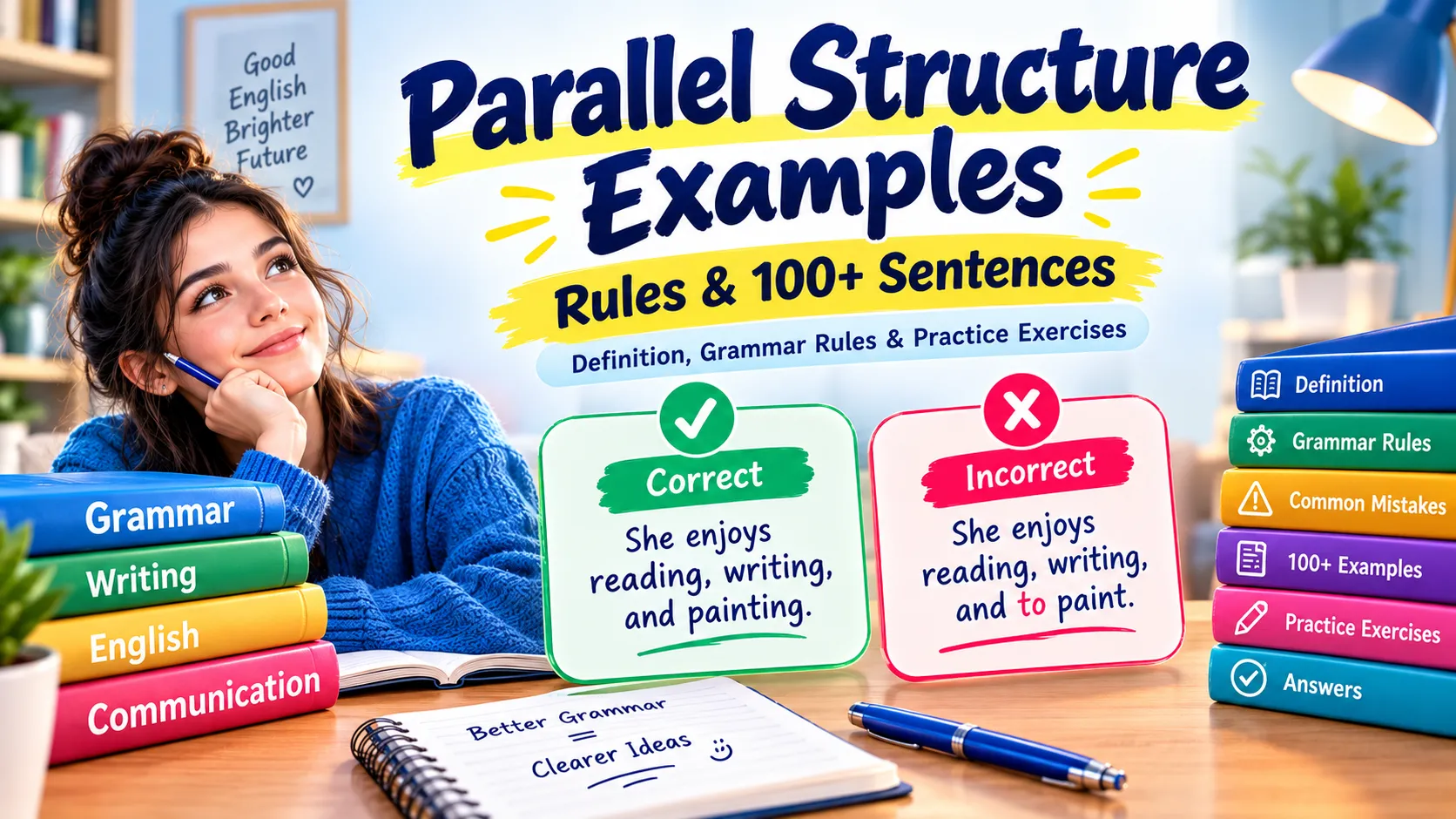
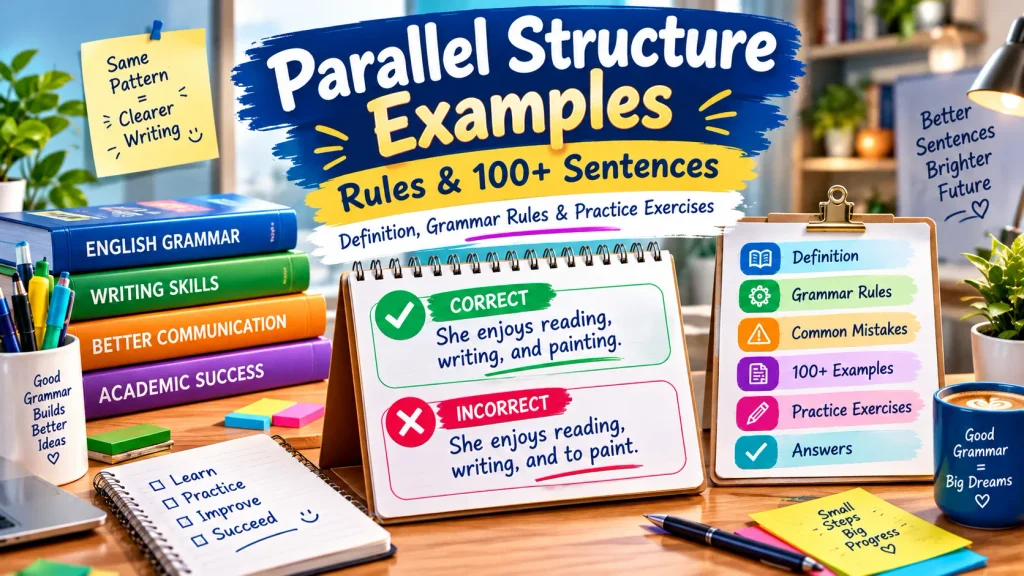
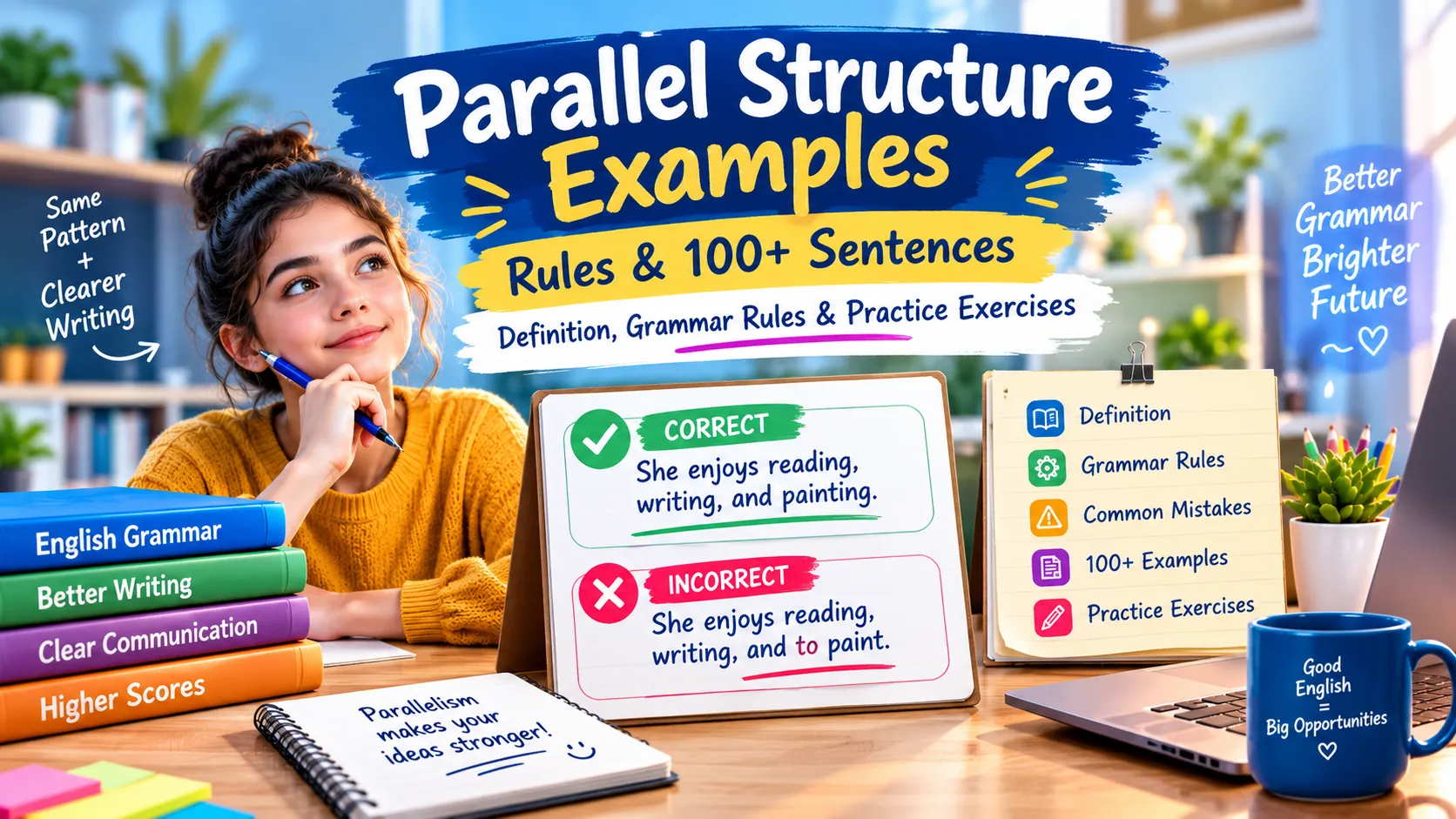
For example, “She enjoys reading, writing, and painting” uses parallel structure because all three activities follow the same -ing form. However, “She enjoys reading, writing, and to paint” breaks parallel structure because the final item uses an infinitive instead of a gerund.
Understanding parallel structure helps students, teachers, ESL learners, and professional writers improve their grammar and writing style. This guide explains the meaning of parallel structure, its rules, common mistakes, and more than 100 examples to help you recognize and use parallel construction correctly.
What Is Parallel Structure in Grammar?
Parallel structure is a grammatical principle that requires two or more words, phrases, or clauses in the same sentence to follow a consistent grammatical pattern.
Writers use parallel structure to connect related ideas, emphasize important points, and create a natural rhythm. It commonly appears in lists, comparisons, compound sentences, speeches, essays, and professional writing.
Example of parallel structure:
- She likes swimming, running, and cycling.
The sentence uses three gerunds: swimming, running, and cycling.
Example of incorrect parallel structure:
- She likes swimming, running, and to cycle.
The sentence mixes gerunds with an infinitive. To maintain parallel structure, write:
- She likes swimming, running, and cycling.
Parallel structure does not require every word in a sentence to have the same grammatical form. It requires corresponding elements to follow matching patterns.
Explore More: https://wordminto.com/grammatical-agreement/
Why Is Parallel Structure Important?
Parallel structure improves the quality of writing in several ways.
- Clarity: Matching grammatical patterns make relationships between ideas easier to understand.
- Readability: Balanced sentences help readers process information quickly.
- Consistency: Parallel construction keeps lists and comparisons grammatically uniform.
- Emphasis: Repeated structures highlight important ideas.
- Rhythm: Parallel phrases create a smooth, memorable flow.
- Professionalism: Correct parallelism strengthens essays, reports, presentations, and business communication.
For example:
Incorrect: The manager wants to improve productivity, reducing costs, and customer satisfaction.
Correct: The manager wants to improve productivity, reduce costs, and increase customer satisfaction.
The corrected sentence uses infinitive verb forms consistently.
Basic Rules of Parallel Structure
Follow these rules to maintain parallel structure in English.
1. Use the Same Grammatical Form in Lists
When you list three or more items, use the same grammatical form for each item.
Incorrect: He enjoys reading, to swim, and cycling.
Correct: He enjoys reading, swimming, and cycling.
All three items use gerunds.
2. Keep Verbs in Matching Forms
Use consistent verb forms when describing related actions.
Incorrect: She opened the door, enters the room, and sat down.
Correct: She opened the door, entered the room, and sat down.
The corrected sentence uses the simple past tense throughout.
3. Make Adjectives Parallel
Use adjectives in corresponding positions when describing the same subject.
Incorrect: The lesson was interesting, useful, and helped us learn.
Correct: The lesson was interesting, useful, and informative.
The corrected sentence uses three adjectives.
4. Keep Phrases in the Same Pattern
Related phrases should follow the same grammatical construction.
Incorrect: He succeeded by working hard, through patience, and because he practiced.
Correct: He succeeded through hard work, patience, and practice.
The corrected version presents three parallel noun phrases.
5. Maintain Parallel Structure After Coordinating Conjunctions
Conjunctions such as and, but, and or often connect grammatically equivalent elements.
Incorrect: She wants to study medicine and becoming a doctor.
Correct: She wants to study medicine and become a doctor.
The two verb phrases follow the same pattern.
6. Use Parallel Structure with Correlative Conjunctions
Correlative conjunctions work in pairs. Common examples include:
- Either … or
- Neither … nor
- Both … and
- Not only … but also
- Whether … or
Incorrect: She is not only intelligent but also works hard.
Correct: She is not only intelligent but also hardworking.
The corrected sentence places adjectives after both parts of the conjunction.
Another correct option is: She not only studies hard but also participates in class.
7. Keep Comparisons Grammatically Balanced
Comparisons should match corresponding elements clearly.
Incorrect: I prefer reading books to watch television.
Correct: I prefer reading books to watching television.
Both activities use gerunds.
8. Maintain Parallel Structure in Infinitive Phrases
When a series uses infinitives, keep the pattern consistent.
Incorrect: He plans to travel, to learn French, and visiting museums.
Correct: He plans to travel, to learn French, and to visit museums.
All three items use infinitives.
9. Use Parallel Structure in Clauses
Related clauses should follow matching grammatical patterns when the context calls for them.
Incorrect: She believes that honesty matters, that kindness is important, and people should show respect.
Correct: She believes that honesty matters, that kindness is important, and that people should show respect.
The repeated that introduces all three clauses.
10. Keep Headings and Bullet Points Consistent
Parallelism also improves the organization of headings and lists.
Inconsistent list:
- Improving your writing
- Grammar rules
- How to edit a sentence
- Proofreading carefully
Parallel list:
- Improving your writing
- Learning grammar rules
- Editing sentences
- Proofreading carefully
Each item begins with a gerund.
Explore More: https://wordminto.com/predicate-in-grammar/
Parallel Structure Examples in Simple Sentences
These examples show how parallel structure works in everyday English.
- She likes reading, writing, and drawing.
- He runs quickly, jumps high, and swims well.
- They enjoy cooking, dancing, and singing.
- I need to study, to practice, and to prepare.
- The room was clean, bright, and spacious.
- She speaks clearly, confidently, and politely.
- We bought apples, oranges, and bananas.
- He is honest, hardworking, and reliable.
- The children laughed, played, and shouted.
- My goals are to learn, to grow, and to succeed.
Each sentence groups words or phrases with matching grammatical forms.
Explore More: https://wordminto.com/allusion-vs-illusion/
Parallel Structure Examples in Lists
Lists provide some of the clearest examples of parallel construction.
Correct Parallel Lists
- The course teaches reading, writing, and speaking.
- She enjoys hiking, camping, and fishing.
- We need paper, pencils, and notebooks.
- He is smart, friendly, and patient.
- The company values honesty, creativity, and teamwork.
- The assignment requires researching, analyzing, and presenting.
- You can walk, cycle, or drive.
- The recipe includes chopping vegetables, boiling water, and adding spices.
- Her responsibilities include scheduling meetings, preparing reports, and answering emails.
- The program helps students think critically, communicate effectively, and solve problems.
Incorrect and Correct List Examples
| Incorrect sentence | Correct sentence |
| She likes to read, writing, and to paint. | She likes reading, writing, and painting. |
| He is kind, generous, and helps others. | He is kind, generous, and helpful. |
| We need to plan, budgeting, and saving. | We need to plan, budget, and save. |
| The job involves writing reports, answering calls, and to organize files. | The job involves writing reports, answering calls, and organizing files. |
| They value honesty, working hard, and respect. | They value honesty, hard work, and respect. |
Explore More: https://wordminto.com/active-vs-passive-voice/
Parallel Structure Examples with Gerunds
A gerund is a verb ending in -ing that functions as a noun. Writers frequently use gerunds in parallel lists.
- She enjoys reading, writing, and traveling.
- Learning, practicing, and reviewing improve memory.
- Swimming, running, and cycling build endurance.
- He spends his weekends cooking, gardening, and painting.
- I prefer walking, cycling, and taking the train.
- Teaching, mentoring, and supporting students require patience.
- Saving, investing, and budgeting can improve financial habits.
- Listening, questioning, and responding are essential communication skills.
- The project involves collecting data, analyzing results, and preparing a report.
- She improved her English by reading regularly, listening carefully, and speaking confidently.
Key rule: When a list begins with gerunds, keep the remaining items in the same form if they serve the same grammatical function.
Parallel Structure Examples with Infinitives
An infinitive commonly consists of to followed by a base verb, as in to learn or to improve.
- I want to learn, to grow, and to succeed.
- She hopes to travel, to explore, and to discover new cultures.
- He plans to study, to work, and to save money.
- We need to listen, to understand, and to respond.
- They decided to leave, to return later, and to continue the discussion.
- My goal is to improve my grammar, to expand my vocabulary, and to write clearly.
- The teacher encouraged us to read carefully, to think critically, and to ask questions.
- She wants to become a doctor, to help patients, and to serve her community.
- The company aims to reduce waste, to improve efficiency, and to increase productivity.
- He promised to arrive early, to finish the work, and to submit the report.
English often allows the word to appear only before the first verb in a series. For example, “I want to learn, grow, and succeed” also uses correct parallel structure.
Explore More: https://wordminto.com/apostrophe-rules/
Parallel Structure Examples with Adjectives
Adjectives describe people, places, objects, and ideas.
Parallel adjectives make descriptions concise and balanced.
- The movie was exciting, entertaining, and memorable.
- She is intelligent, confident, and creative.
- The room looked spacious, bright, and comfortable.
- The instructions were clear, simple, and helpful.
- His explanation was accurate, detailed, and convincing.
- The weather was cold, windy, and unpleasant.
- The new phone is lightweight, powerful, and affordable.
- Her writing is clear, engaging, and persuasive.
- The solution was practical, effective, and inexpensive.
- The team remained focused, motivated, and determined.
P.Structure Examples with Verbs
Parallel verbs create consistency when a sentence describes several actions.
- She entered the room, greeted everyone, and took her seat.
- He washed the dishes, cleaned the kitchen, and swept the floor.
- The student opened the book, read the chapter, and answered the questions.
- They planned the event, invited the guests, and arranged the decorations.
- The manager reviewed the report, identified the problem, and suggested a solution.
- The dog barked, jumped, and ran toward the gate.
- We researched the topic, gathered evidence, and wrote the essay.
- She checked the figures, corrected the errors, and submitted the document.
- The scientist observed the results, recorded the data, and presented the findings.
- The company redesigned the website, improved navigation, and simplified checkout.
These examples use matching verb forms within each sequence.
Parallel Structure Examples with Correlative Conjunctions
Correlative conjunctions connect equivalent words, phrases, or clauses. Their paired structure makes parallelism especially important.
Both … And
- Both the teacher and the students enjoyed the activity.
- She is both intelligent and hardworking.
- He both writes articles and edits manuscripts.
- The course is both practical and informative.
- They both planned the event and organized the materials.
Either … Or
- You can either call me or send me an email.
- Either the manager or the assistant will handle the request.
- She will either study medicine or pursue engineering.
- We can either leave now or wait until tomorrow.
- You must either accept the offer or decline it.
Neither … Nor
- He is neither lazy nor careless.
- She neither complained about the delay nor blamed the team.
- Neither the students nor the teacher was ready to leave.
- The plan was neither practical nor affordable.
- They neither confirmed the booking nor explained the cancellation.
Not Only … But Also
- She is not only talented but also disciplined.
- He not only teaches grammar but also writes educational articles.
- The workshop not only improved our skills but also increased our confidence.
- The new system is not only faster but also more reliable.
- The campaign not only attracted visitors but also increased engagement.
Whether … Or
- Whether you agree or disagree, you should explain your reasoning.
- She could not decide whether to stay or to leave.
- Whether we travel by train or by bus, we will arrive before noon.
- He wondered whether the answer was correct or incorrect.
- Whether you study alone or work with a group, regular practice matters.
Remember: Place the same type of grammatical element after each part of a correlative conjunction whenever the construction requires it.
Explore More: https://wordminto.com/capitalization-rules-in-english/
Parallel Structure Examples in Comparisons
Parallel structure helps readers compare equivalent actions, qualities, or situations.
- I prefer reading to watching television.
- She enjoys teaching more than managing.
- He values honesty more than wealth.
- Running outdoors is as enjoyable as cycling through the park.
- Learning a language requires as much patience as practicing a musical instrument.
- The new method is more efficient than the old method.
- Writing clearly is just as important as speaking confidently.
- She would rather walk than drive.
- They prefer working independently to collaborating on every task.
- The second explanation was clearer than the first.
Incorrect vs. Correct Comparisons
Incorrect: She prefers reading books to watch movies.
Correct: She prefers reading books to watching movies.
Incorrect: Learning grammar is easier than to memorize vocabulary.
Correct: Learning grammar is easier than memorizing vocabulary.
Incorrect: He would rather work at home than working in an office.
Correct: He would rather work at home than work in an office.
The best correction depends on the intended comparison, but corresponding elements should follow compatible grammatical patterns.
Parallel Structure Examples in Compound Sentences
Compound sentences connect independent clauses or related ideas. Parallel construction can strengthen the relationship between those ideas.
- She studies hard, and she practices regularly.
- He wanted to travel, but he needed to save money.
- The team planned carefully, and the team executed confidently.
- We can finish today, or we can continue tomorrow.
- The company reduced expenses, and it increased efficiency.
- She enjoys teaching, and she loves learning.
- The manager reviewed the proposal, and the director approved it.
- They wanted to help, but they lacked the necessary resources.
- He prepared the presentation, and she organized the supporting documents.
- The students completed the assignment, and the teacher graded their work.
Parallelism between independent clauses is often a stylistic choice rather than a strict requirement. Use it when it improves clarity or emphasis.
Parallel Structure Examples in Clauses
A clause contains a subject and a verb. Parallel clauses often repeat a similar grammatical pattern.
- She believes that honesty matters, that kindness helps, and that respect builds trust.
- He said that he would arrive early, that he would bring the documents, and that he would contact the manager.
- We know that practice improves performance, that feedback corrects mistakes, and that patience supports progress.
- The teacher explained that grammar creates structure, that punctuation guides readers, and that vocabulary conveys meaning.
- She realized that she needed more time, that she had overlooked an important detail, and that she should review the entire report.
- The report shows that sales increased, that costs decreased, and that customer satisfaction improved.
- I hope that you will attend, that you will participate, and that you will share your ideas.
- They argued that the policy was unfair, that the process was inefficient, and that the decision lacked transparency.
- The research suggests that sleep improves memory, that exercise supports concentration, and that regular breaks reduce fatigue.
- He understood that he had made a mistake, that he needed to apologize, and that he should correct the problem.
Explore More: https://wordminto.com/ms-vs-mrs-vs-miss/
Parallel Structure Examples in Academic Writing
Academic writing benefits from parallelism because it presents complex ideas in a consistent, organized form.
- The study aims to identify the causes, examine the effects, and evaluate possible solutions.
- Researchers collected the data, analyzed the results, and interpreted the findings.
- The theory explains how people learn, how they retain information, and how they apply knowledge.
- The investigation focused on accuracy, reliability, and validity.
- Students must understand the concepts, apply the methods, and evaluate the outcomes.
- The article reviews previous research, identifies existing gaps, and proposes future directions.
- The experiment measured temperature, recorded pressure, and calculated volume.
- Effective teaching requires subject knowledge, classroom management, and clear communication.
- The findings indicate that exercise improves endurance, strengthens muscles, and supports cardiovascular health.
- The research questions address student motivation, teacher effectiveness, and classroom engagement.
Parallel structure can improve academic style, but writers should prioritize accuracy and logical meaning over mechanical repetition.
P.Structure Examples in Business Writing
Parallel construction makes business communication more direct and professional.
- Our goals are to increase revenue, reduce costs, and improve customer satisfaction.
- The team manages planning, execution, and evaluation.
- We value innovation, integrity, and collaboration.
- The company develops products, serves customers, and supports communities.
- The manager is responsible for hiring employees, training staff, and evaluating performance.
- Our strategy focuses on attracting new customers, retaining existing clients, and expanding market share.
- The report identifies risks, evaluates opportunities, and recommends actions.
- Employees must communicate clearly, respond promptly, and work collaboratively.
- The new platform simplifies navigation, speeds up transactions, and improves accessibility.
- The project requires careful planning, effective coordination, and consistent monitoring.
Parallel Structure Examples in Speeches and Writing
Speakers and writers often use parallelism to create emphasis, rhythm, and memorable phrases.
- We must learn from the past, act in the present, and prepare for the future.
- She came to listen, to learn, and to lead.
- We seek justice, demand fairness, and defend equality.
- Success requires effort, encourages patience, and rewards persistence.
- A good leader inspires confidence, encourages cooperation, and accepts responsibility.
- We will work together, grow together, and succeed together.
- The goal is not simply to win but to improve.
- We need less confusion, more communication, and better cooperation.
- Think clearly, speak honestly, and act responsibly.
- Great writing informs the mind, engages the reader, and inspires action.
Parallel structure frequently appears in rhetoric because repeated grammatical patterns make ideas easier to remember.
Famous Examples of Parallel Structure
Several well-known quotations illustrate the rhetorical power of parallelism.
- “Government of the people, by the people, for the people.” — Abraham Lincoln, Gettysburg Address.
- “I came, I saw, I conquered.” — A traditional English rendering of Julius Caesar’s famous statement.
- “Ask not what your country can do for you—ask what you can do for your country.” — John F. Kennedy, Inaugural Address.
These examples use repetition and balanced phrasing to emphasize relationships between ideas. The first repeats prepositional phrases, the second repeats subject–verb patterns, and the third balances contrasting clauses.
Common Parallel Structure Mistakes
Writers often break parallel structure when they mix grammatical forms in lists, comparisons, and paired constructions.
Mistake 1: Mixing Gerunds and Infinitives
Incorrect: She likes reading, to dance, and singing.
Correct: She likes reading, dancing, and singing.
Mistake 2: Mixing Nouns and Verbs
Incorrect: His duties include filing documents, answering calls, and customer service.
Correct: His duties include filing documents, answering calls, and providing customer service.
Mistake 3: Mixing Adjectives and Clauses
Incorrect: The candidate was confident, experienced, and spoke clearly.
Correct: The candidate was confident, experienced, and articulate.
Another option is: The candidate showed confidence, demonstrated experience, and spoke clearly.
Mistake 4: Using Correlative Conjunctions Incorrectly
Incorrect: She is not only a talented singer but also dances beautifully.
Correct: She is not only a talented singer but also a skilled dancer.
Another option is: She not only sings beautifully but also dances gracefully.
Mistake 5: Using Inconsistent Verb Tenses
Incorrect: He entered the office, checks his email, and started working.
Correct: He entered the office, checked his email, and started working.
Mistake 6: Making Comparisons Unequal
Incorrect: The new laptop is faster than the old model’s battery.
Correct: The new laptop is faster than the old laptop.
The correction compares two equivalent items.
Mistake 7: Writing Inconsistent Bullet Points
Incorrect:
- To improve writing
- Reading more books
- Practice grammar
- Editing carefully
Correct:
- Improving writing
- Reading more books
- Practicing grammar
- Editing carefully
Mistake 8: Using Uneven Infinitive Phrases
Incorrect: The organization aims to educate children, improving healthcare, and to protect the environment.
Correct: The organization aims to educate children, improve healthcare, and protect the environment.
Mistake 9: Mixing Active and Passive Constructions Without a Reason
Incorrect: The editor corrected the errors, revised the introduction, and the conclusion was rewritten.
Correct: The editor corrected the errors, revised the introduction, and rewrote the conclusion.
A passive construction is not automatically wrong, but consistent active phrasing makes this series clearer.
Mistake 10: Forgetting the Second Correlative Element
Incorrect: She likes both reading and to write.
Correct: She likes both reading and writing.
The conjunction pair both … and connects two gerunds.
How to Identify Parallel Structure in a Sentence
Use this simple process to recognize parallel construction.
- Find the connected elements. Look for lists, conjunctions, comparisons, or repeated phrases.
- Identify their grammatical forms. Determine whether each element functions as a noun, verb, adjective, phrase, or clause.
- Compare the patterns. Check whether the connected elements use compatible grammatical structures.
- Correct mismatched forms. Rewrite any item that breaks the intended pattern.
- Read the sentence aloud. Listen for awkward or unbalanced phrasing.
Example:
Original: The student hopes to improve writing, learning grammar, and to speak fluently.
1: Identify the three connected actions.
2: The sentence mixes an infinitive, a gerund, and another infinitive.
3: Make all three actions parallel.
Correct: The student hopes to improve writing, learn grammar, and speak fluently.
This revision uses consistent infinitive verb forms after hopes to.
Parallel Structure vs Repetition
Parallel structure and repetition often work together, but they are not identical.
P.structure repeats a grammatical pattern.
Example: She likes reading, writing, and painting.
Repetition repeats a word, phrase, sound, or idea.
Example: We will learn today, we will improve tomorrow, and we will succeed in the future.
The second example combines parallel clause structures with repetition of we will. Writers can use parallelism without repeating the same words, and they can repeat words without creating full grammatical parallelism.
Parallel Structure vs Faulty Parallelism
Parallel structure describes balanced grammatical construction. Faulty parallelism occurs when corresponding elements use inconsistent forms without a grammatical or stylistic reason.
| Parallel structure | Faulty parallelism |
| She likes to read, to write, and to draw. | She likes to read, writing, and to draw. |
| He is calm, patient, and polite. | He is calm, patience, and polite. |
| We planned, organized, and completed the event. | We planned, organizing, and completed the event. |
| The job requires accuracy, speed, and reliability. | The job requires accuracy, working quickly, and reliability. |
| She wants to teach, to inspire, and to guide. | She wants to teach, inspiring others, and to guide. |
Faulty parallelism can make sentences confusing, awkward, or difficult to follow.
When Should You Use Parallel Structure?
Use parallel structure whenever you want to connect ideas that play the same grammatical role.
- Essays: Organize arguments and supporting points.
- Business reports: Present objectives, findings, and recommendations.
- Academic writing: Describe research methods and results.
- Speeches: Create rhythm and emphasize key messages.
- Lists: Make related items easy to scan.
- Comparisons: Clarify similarities and differences.
- Presentations: Keep headings and bullet points consistent.
- Everyday communication: Express related actions clearly.
However, do not force identical patterns when they distort the intended meaning. Grammatical clarity should always come first.
Parallel Structure Practice Exercises
Test your understanding by correcting the following sentences. Each sentence contains a parallelism error or an opportunity to improve grammatical consistency.
- She enjoys reading, to swim, and cycling.
- He is intelligent, hardworking, and shows kindness.
- The job requires writing reports, answering emails, and to organize files.
- We need to plan carefully, budgeting wisely, and save money.
- She wants either to study medicine or becoming a teacher.
- The manager reviewed the proposal, checks the figures, and approved the budget.
- My goals are learning English, to improve my writing, and speaking confidently.
- The course is interesting, informative, and teaches practical skills.
- He prefers walking to drive.
- The organization aims to educate children, improving healthcare, and to protect wildlife.
- She is not only a talented musician but also writes excellent songs.
- They value honesty, being responsible, and teamwork.
- The student opened the textbook, reads the chapter, and answered the questions.
- Our priorities include reducing waste, lower costs, and improving efficiency.
- Whether you travel by train or driving a car, you should plan ahead.
Parallel Structure Exercises: Answers
- She enjoys reading, swimming, and cycling.
- He is intelligent, hardworking, and kind.
- The job requires writing reports, answering emails, and organizing files.
- We need to plan carefully, budget wisely, and save money.
- She wants either to study medicine or to become a teacher.
- The manager reviewed the proposal, checked the figures, and approved the budget.
- My goals are to learn English, to improve my writing, and to speak confidently.
- The course is interesting, informative, and practical.
- He prefers walking to driving.
- The organization aims to educate children, improve healthcare, and protect wildlife.
- She is not only a talented musician but also an excellent songwriter.
- They value honesty, responsibility, and teamwork.
- The student opened the textbook, read the chapter, and answered the questions.
- Our priorities include reducing waste, lowering costs, and improving efficiency.
- Whether you travel by train or drive a car, you should plan ahead.
Some sentences allow more than one correct revision. Choose the version that preserves the intended meaning and maintains grammatical consistency.
People Also Ask
Parallel structure is the use of matching grammatical forms for related words, phrases, or clauses in a sentence. For example, “She enjoys reading, writing, and painting” uses parallel gerunds.
“She likes swimming, running, and cycling” is a simple example. Each item uses a gerund, so the sentence follows a consistent grammatical pattern.
Parallel structure is also called parallelism or parallel construction. These terms describe the use of balanced grammatical patterns in related sentence elements.
Parallel structure improves clarity, readability, consistency, and rhythm. It also helps writers organize lists, make comparisons, and emphasize related ideas.
Faulty parallelism occurs when connected elements use inconsistent grammatical forms. For example, “He likes reading, writing, and to swim” mixes gerunds with an infinitive. “He likes reading, writing, and swimming” corrects the problem.
Correlative conjunctions such as both … and, either … or, and not only … but also connect corresponding elements. For example, “She is both creative and hardworking” uses two adjectives.
Conclusion
Parallel structure is a fundamental English grammar principle that helps writers express related ideas in balanced, consistent, and readable sentences. It applies to words, phrases, clauses, lists, comparisons, and correlative conjunctions.
To use parallel structure correctly, identify the elements that belong together and keep their grammatical forms consistent. Avoid mixing gerunds with infinitives, nouns with verbs, or mismatched phrases in a single series. Practice with the examples and exercises in this guide to improve your grammar, academic writing, and everyday communication.
The key principle is simple: When ideas serve the same grammatical purpose, express them in matching grammatical forms whenever the construction calls for parallelism.










