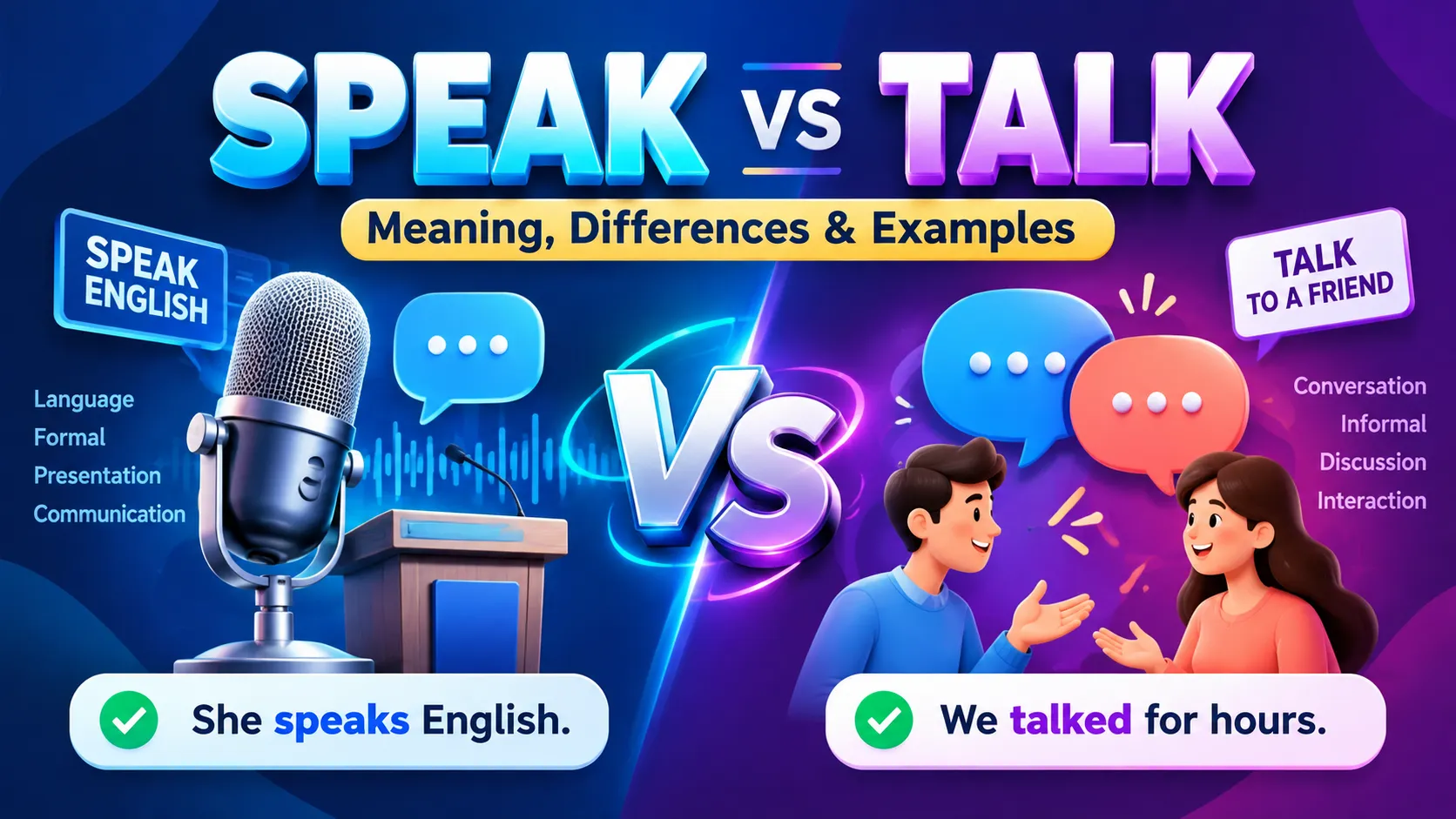
Speak vs Talk: Both verbs describe communication, but they differ in emphasis and usage. Speak often focuses on the ability to use a language, delivering information, or communicating in a formal situation. Talk usually emphasizes a conversation or an informal exchange of ideas between people.
For example, you might speak English, speak to a manager, or talk with a friend. Although these verbs sometimes overlap, understanding their differences helps you choose the right word in everyday conversations, academic writing, and professional communication.
In this guide, you will learn the meanings of speak and talk, their grammar rules, common expressions, practical examples, and the situations in which you can use them interchangeably.
Speak vs Talk: Quick Difference
| Feature | Speak | Talk |
| Main meaning | To communicate using words or a language | To have a conversation or discuss something |
| Typical tone | Often formal or neutral | Often informal or conversational |
| Language ability | Commonly used | Less common |
| Formal situations | Very common | Also possible |
| Conversations | Possible | Especially common |
| Common expression | Speak English | Talk to a friend |
| Prepositions | Speak to, speak with, speak about | Talk to, talk with, talk about |
| Example | She speaks French fluently. | She talks to her sister every day. |
Quick rule: Use speak when you emphasize language, delivering a message, or formal communication. Use talk when you emphasize a conversation, discussion, or informal interaction.
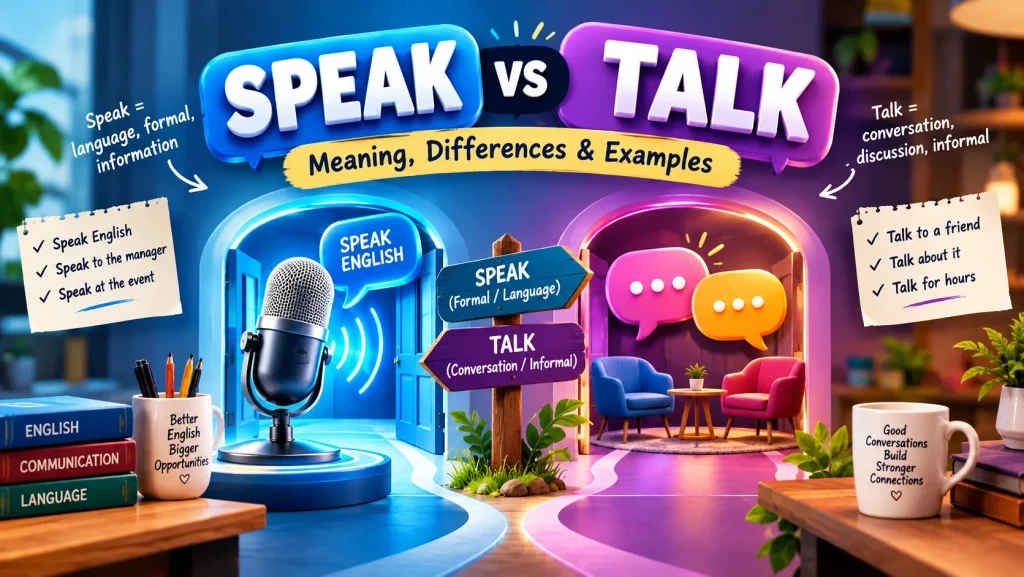
What Does Speak Mean?
Speak is a verb that means to communicate using words, express thoughts verbally, or use a particular language. It can also describe delivering a speech or addressing an audience.
People often use speak in formal, professional, academic, and language-related contexts.
Examples of Speak in Sentences
- I speak English and Urdu.
- She speaks clearly during meetings.
- The principal will speak at the ceremony.
- May I speak to the manager?
- He spoke about his experience at the conference.
- We need to speak about an important issue.
In each example, speak emphasizes verbal communication, language ability, or delivering information.
Common Expressions With Speak
- Speak English: She speaks English fluently.
- Speak clearly: Please speak clearly so everyone can understand you.
- Speak publicly: He feels nervous when he speaks publicly.
- Speak to someone: I need to speak to my teacher.
- Speak about something: The professor spoke about climate change.
- Speak up: Please speak up; I cannot hear you.
- Speak your mind: You should feel comfortable speaking your mind.
Explore More: https://wordminto.com/me-vs-i/
What Does Talk Mean?
Talk is a verb that means to communicate with someone through conversation. It often describes an exchange of ideas, opinions, feelings, information, or experiences.
People commonly use talk in everyday conversations, friendly interactions, discussions, and informal situations. However, it also appears in professional and serious contexts.
Examples of Talk in Sentences
- I talk to my friends every evening.
- They talked about their future plans.
- We need to talk about your performance.
- She is talking with her mother on the phone.
- The students talked about the assignment.
- Can I talk to you for a minute?
In these examples, talk emphasizes the act of having a conversation or discussing a subject.
Common Expressions With Talk
- Talk to someone: I talked to my neighbor yesterday.
- Talk with someone: She talked with her colleagues after the meeting.
- Talk about something: We talked about our vacation.
- Talk over something: Let’s talk over the proposal before deciding.
- Talk back: The child talked back to his father.
- Talk things through: They talked things through and resolved the disagreement.
- Talk sense: Someone needs to talk sense into him.
Explore More: https://wordminto.com/look-vs-see-and-watch/
Speak vs Talk: Key Differences Explained
1. Speak vs Talk About Language Ability
Use speak when you describe someone’s ability to use a language.
Examples:
- She speaks Spanish fluently.
- My brother speaks three languages.
- Do you speak Arabic?
- They speak English at work.
Although people sometimes use talk to describe using a language, speak is the more natural choice when discussing language proficiency.
Less natural: She talks Spanish fluently.
More natural: She speaks Spanish fluently.
2. Speak vs Talk in Conversations
Use talk when you emphasize a conversation between people. Use speak when you focus more on the act of communicating or addressing someone.
Examples:
- I talked to Sarah for two hours.
- I spoke to Sarah about the meeting.
- They talked about their childhood memories.
- The director spoke to the employees about the new policy.
Both verbs can describe conversations, so the distinction depends on emphasis rather than an absolute grammar rule.
3. Speak vs Talk in Formal Situations
Speak often sounds more formal when someone addresses an audience, makes an announcement, or communicates in an official capacity.
Examples:
- The president will speak at the event.
- The lawyer spoke to the judge.
- The professor spoke about the research findings.
However, talk also works in formal settings, especially when people discuss ideas or exchange information.
Examples:
- The researchers talked about their findings.
- The team talked with the client about the project.
- We need to talk about the contract.
4. Speak vs Talk on the Phone
Both verbs work when describing telephone conversations.
Examples:
- I spoke to my mother last night.
- I talked to my mother last night.
- Can I speak to John, please?
- I was talking to my friend when you called.
The phrase “Can I speak to John, please?” often sounds more polite or formal when asking for someone on the phone. The phrase “I was talking to John” sounds natural in everyday conversation.
5. Speak vs Talk About Serious Issues
Both verbs can describe serious discussions, but talk often emphasizes working through an issue together.
Examples:
- We need to talk about our relationship.
- I want to speak to you about your behavior.
- They talked through their problems.
- The manager spoke to the employee about the complaint.
Choose the verb that best matches the situation and the emphasis you want to convey.
Explore More: https://wordminto.com/grammatical-agreement/
Speak To vs Speak With
Both speak to and speak with are grammatically correct.
- Speak to: Often emphasizes addressing someone or delivering information.
- Speak with: Often emphasizes a conversation or mutual exchange.
Examples:
- I need to speak to the principal about my grades.
- I spoke with the principal about my grades.
- The doctor spoke to the patient about the test results.
- The doctor spoke with the patient about treatment options.
These differences are not strict rules. In everyday English, many speakers use both expressions interchangeably.
Talk To vs Talk With
Both talk to and talk with are correct and common.
- Talk to: Often describes addressing someone or initiating a conversation.
- Talk with: Often highlights a two-way conversation.
Examples:
- I need to talk to my boss.
- I talked with my boss about the schedule.
- She talked to her son about his homework.
- She talked with her son about his future.
The distinction depends on context. Neither preposition always indicates a one-way or two-way conversation.
Speak About vs Talk About
Both expressions introduce a subject, but they can create slightly different impressions.
Speak about often sounds more formal, especially when someone presents information to an audience.
Examples:
- The scientist spoke about renewable energy.
- She spoke about her achievements at the ceremony.
Talk about often sounds more conversational and works well for informal discussions.
Examples:
- We talked about our weekend plans.
- They talked about their favorite movies.
Both expressions are correct in formal and informal English, depending on the context.
Speak and Talk: Verb Forms
Both speak and talk are verbs, but their forms differ.
| Verb form | Speak | Talk |
| Base form | speak | talk |
| Third-person singular | speaks | talks |
| Present participle | speaking | talking |
| Simple past | spoke | talked |
| Past participle | spoken | talked |
Examples:
- I speak English every day.
- She speaks English at work.
- We are speaking with the teacher.
- He spoke to me yesterday.
- They have spoken about the problem.
- I talk to my friends regularly.
- She talks to her sister every night.
- We are talking about our plans.
- He talked to the manager yesterday.
- They have talked about the issue.
Remember that speak is an irregular verb: its past form is spoke, and its past participle is spoken. Talk is a regular verb: its past form and past participle are both talked.
Speak vs Talk in Different Situations
| Situation | More natural expression | Example |
| Describing language ability | Speak | I speak German. |
| Addressing an audience | Speak | She will speak at the conference. |
| Casual conversation | Talk | We talked for hours. |
| Asking for someone on the phone | Speak to | May I speak to David? |
| Discussing weekend plans | Talk about | We talked about our trip. |
| Delivering official information | Speak | The director spoke to the staff. |
| Resolving a disagreement | Talk through | Let’s talk through this problem. |
| Asking for a private conversation | Talk to / Speak to | Can I talk to you privately? |
| Discussing a topic with a friend | Talk about | We talked about our favorite books. |
| Communicating professionally | Either | I spoke with the client. / I talked with the client. |
Common Mistakes With Speak and Talk
Mistake 1: Using Talk for Language Ability
Incorrect: She talks French fluently.
Correct: She speaks French fluently.
Use speak to describe proficiency in a language.
Mistake 2: Assuming Speak Is Always Formal
Incorrect assumption: You can only use speak in formal situations.
Correct: I speak to my sister every day.
Speak works in casual conversations, too.
Mistake 3: Assuming Talk Is Always Informal
Incorrect assumption: You cannot use talk in professional situations.
Correct: We need to talk about the project timeline.
Talk works naturally in workplaces, meetings, and serious discussions.
Mistake 4: Treating Speak To and Speak With as Completely Different
Incorrect assumption: Speak to always means one-way communication, while speak with always means two-way communication.
Correct: Both expressions can describe a conversation.
The difference often reflects emphasis, personal preference, or regional usage rather than a strict grammar rule.
Mistake 5: Confusing Talk With Speak in Every Context
Incorrect: The professor talked at the conference about the findings. (Not necessarily incorrect, but it may not emphasize a formal presentation as clearly.)
More natural for a formal presentation: The professor spoke at the conference about the findings.
Choose the verb that best expresses the intended meaning.
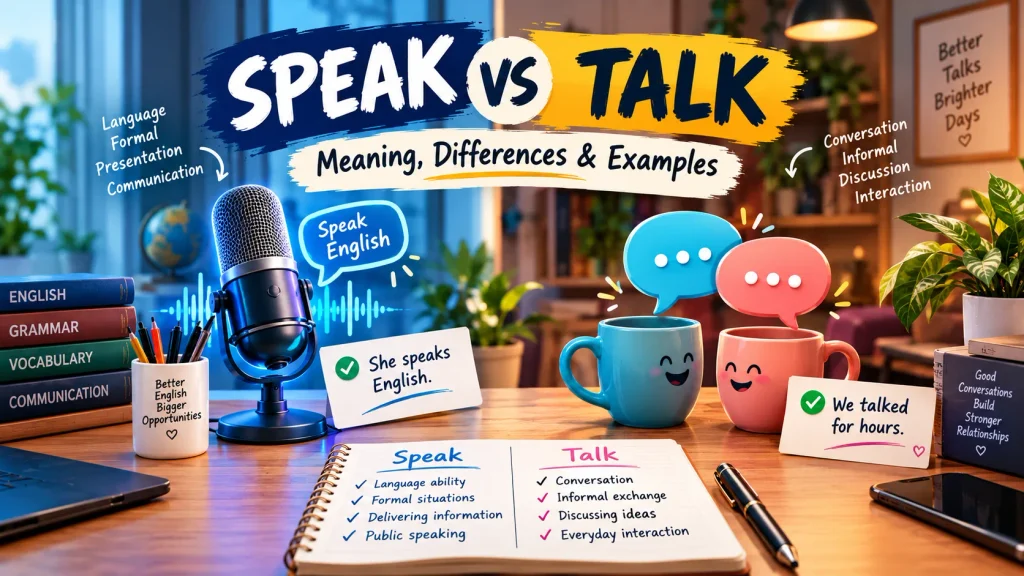
Speak vs Talk Examples in Everyday English
Here are additional examples to help you understand how native and fluent English speakers use both verbs.
Everyday Conversations
- I want to talk to you about something important.
- She speaks politely to everyone.
- We talked about our school days.
- He speaks very clearly.
- They are talking in the living room.
- Can I speak to you for a moment?
- My parents talk to me about my future.
- She spoke to her friend after class.
Workplace and Academic Examples
- The manager spoke to the employees about the changes.
- We talked about the budget during the meeting.
- The professor spoke at an international conference.
- I need to talk with my supervisor.
- The students talked about their research projects.
- She speaks confidently during presentations.
- The team talked through several possible solutions.
- The guest speaker spoke about effective communication.
Questions Using Speak and Talk
- Do you speak Italian?
- Can I talk to you later?
- Who spoke at the event?
- What are you talking about?
- Did you speak with your teacher?
- Have you talked to your parents?
- Can you speak more slowly?
- What did they talk about yesterday?
Is It Better to Say “Speak to Me” or “Talk to Me”?
Both expressions are correct, but they can communicate slightly different intentions.
Speak to me can sound more formal, serious, or direct.
Example: “Please speak to me if you have any concerns.”
Talk to me often sounds more conversational, friendly, or emotionally supportive.
Example: “If something is bothering you, you can talk to me.”
However, context and tone matter more than the verb alone. Either phrase can sound friendly, serious, polite, or authoritative depending on how you use it.
Is “Speak With” More Polite Than “Talk To”?
Not necessarily. Both expressions can sound polite.
Examples:
- May I speak with the director?
- May I talk to the director?
- Could I speak to you for a moment?
- Could I talk with you for a moment?
In formal situations, speak with and speak to may sound more conventional, but talk to is also perfectly acceptable. Politeness depends largely on your wording, tone, and relationship with the listener.
Can You Use Speak and Talk Interchangeably?
Yes. You can use speak and talk interchangeably in many contexts, particularly when you describe communicating with another person.
Examples:
- I spoke to my friend yesterday.
- I talked to my friend yesterday.
Both sentences are correct.
However, you cannot replace one with the other in every situation.
For example:
- Correct: She speaks Japanese.
- Unnatural in the intended language-proficiency sense: She talks Japanese.
Similarly, give a talk is a common expression for delivering a presentation, while speak a language is the standard expression for language proficiency.
The key is to consider the context, collocation, and intended meaning.
Practice Exercise: Speak vs Talk
Choose the correct verb to complete each sentence. In some sentences, both verbs may work, but select the most natural answer for the intended meaning.
- She can _____ four languages fluently.
- I want to _____ to you about our plans.
- The professor will _____ at the conference tomorrow.
- We _____ about our vacation last night.
- Can I _____ to the manager, please?
- They are _____ about the new project.
- He _____ English at home and Urdu at school.
- We need to _____ things through before making a decision.
- She _____ to her friend yesterday.
- The guest will _____ about the importance of education.
Answers and Explanations
- Speak — Use speak for language ability.
- Talk — Talk to you naturally introduces a conversation.
- Speak — Speak at a conference commonly describes a formal presentation.
- Talked — Talked about is natural for discussing vacation plans.
- Speak — Speak to the manager is a conventional, polite request.
- Talking — Talking about emphasizes an ongoing discussion.
- Speaks — Use speaks to describe language use.
- Talk — Talk things through means discuss an issue carefully.
- Talked — Talked to her friend naturally describes a conversation.
- Speak — Speak about works naturally when a guest addresses an audience.
People Also Ask
Speak often emphasizes language ability, delivering information, or formal communication. Talk often emphasizes conversation, discussion, or informal interaction. Both verbs can describe communication between people.
Generally, speak can sound more formal than talk, particularly in presentations, official communication, and professional settings. However, both verbs work in formal and informal contexts.
Say “speak English.” This is the standard expression when describing the ability to use English. For example, “He speaks English fluently.”
Both are correct. Talk to often emphasizes addressing someone, while talk with can emphasize a mutual conversation. In everyday English, they frequently have the same meaning.
Both are grammatically correct. Use either expression when addressing someone or having a conversation. The choice often depends on context, regional preference, and style.
Yes. “I want to speak with you” is grammatically correct. It can sound professional, polite, or serious depending on the context.
Conclusion
The difference between Speak vs Talk comes down to emphasis and context. Speak commonly describes language ability, formal communication, and addressing an audience. Talk commonly describes conversations, discussions, and exchanges of ideas.
Remember these simple examples:
- Speak English: She speaks English fluently.
- Speak at an event: He will speak at the conference.
- Talk to someone: I talked to my friend.
- Talk about something: We talked about our plans.
Both verbs overlap in many situations, so you do not need to treat them as completely separate. Focus on the intended meaning, choose natural expressions, and use the verb that fits the context.










