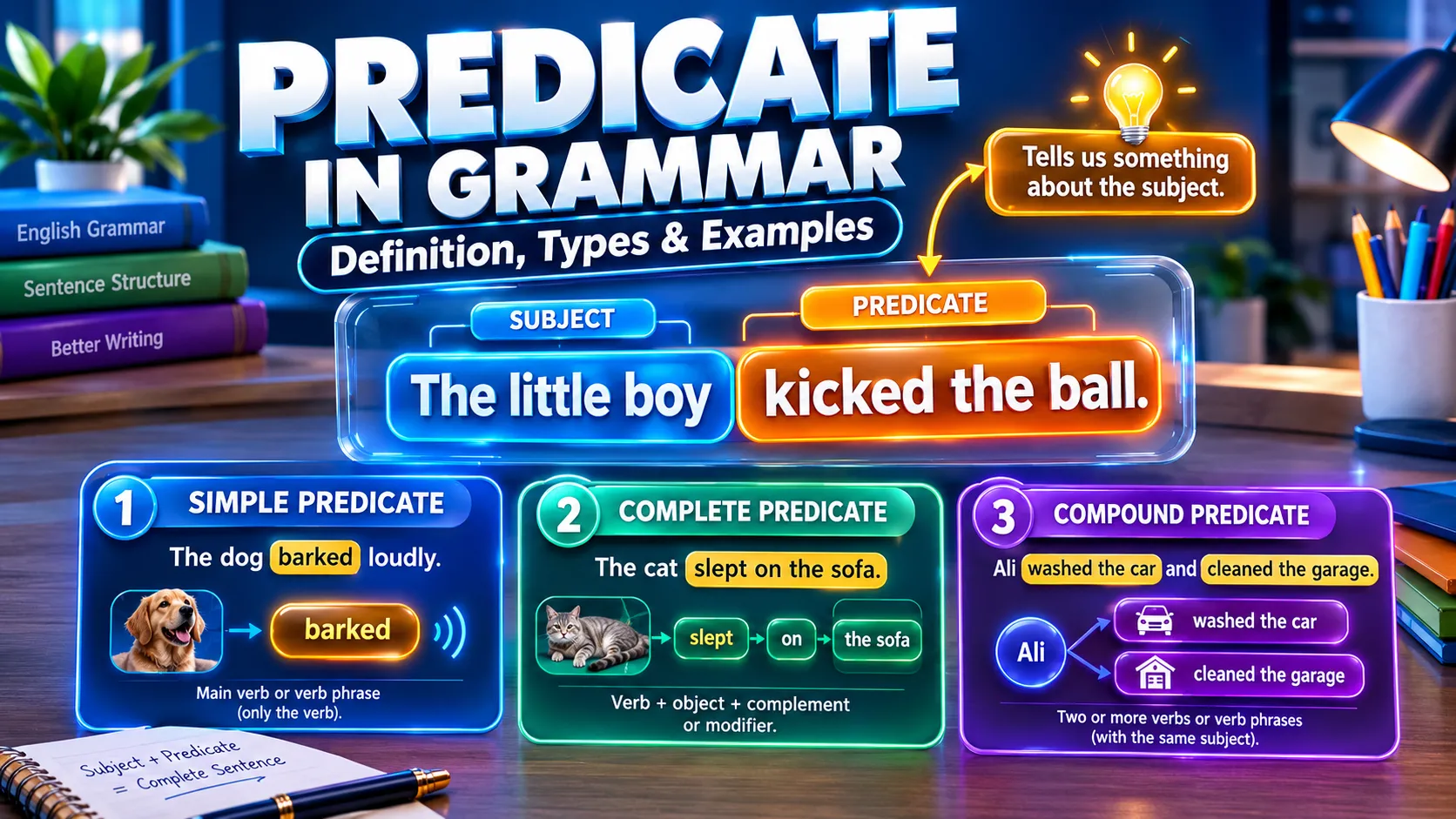
Predicate in Grammar: A Predicate in Grammar is the part of a sentence that tells us something about the subject. It usually contains a verb and may include objects, complements, and modifiers that complete the meaning of the sentence.
For example, in the sentence “Sarah reads books every evening,” “reads books every evening” is the predicate because it tells us what Sarah does.
Understanding predicates helps students identify sentence parts, construct grammatically correct sentences, and improve their English writing. In this guide, you will learn the definition of a predicate, its types, the difference between a subject and a predicate, and how to identify predicates with examples and practice exercises.
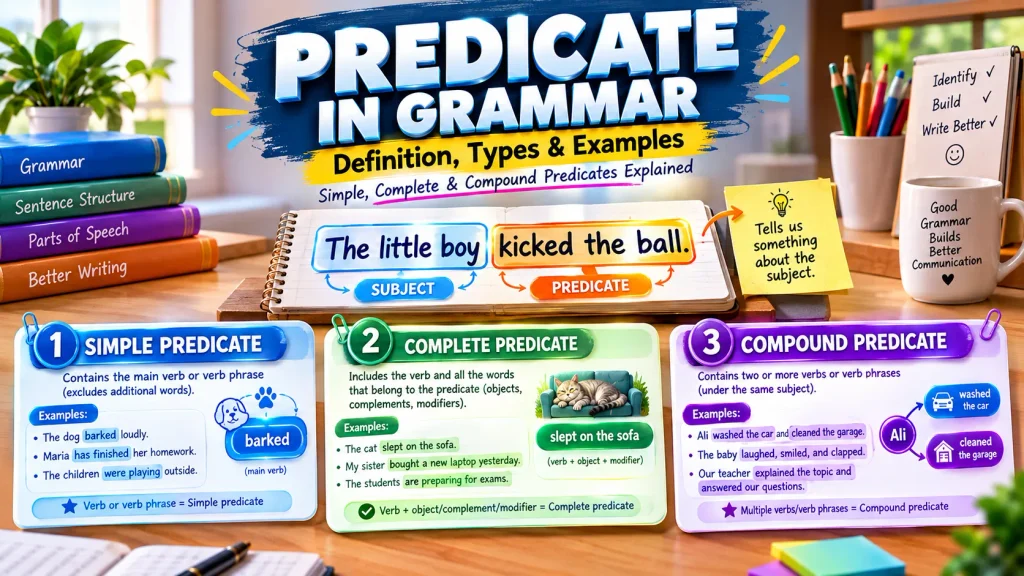
What Is a Predicate in Grammar?
A predicate is the part of a sentence or clause that says something about the subject. It contains a verb or verb phrase and may include other words that describe an action, state, condition, or relationship.
Examples:
- The baby is sleeping peacefully.
- My brother plays football after school.
- The flowers look beautiful.
- Our teacher explained the lesson clearly.
In each example, the bold words form the predicate. They tell us what the subject does, what condition it experiences, or what describes it.
A complete sentence usually contains a subject and a predicate, although commands often omit the subject because the reader or listener understands it.
For example:
- Open the window.
The subject “you” remains understood, and “open the window” functions as the predicate.
What Are the Two Main Parts of a Sentence?
Most complete English sentences contain two main parts: the subject and the predicate.
| Sentence Part | Function | Example |
| Subject | Identifies who or what the sentence discusses | The little boy |
| Predicate | Tells something about the subject | kicked the ball |
| Complete sentence | Combines the subject and predicate | The little boy kicked the ball. |
The subject identifies the person, place, thing, or idea that the sentence discusses. The predicate tells us what that subject does, experiences, or is.
Example: The birds are singing in the garden.
- Subject: The birds
- Predicate: are singing in the garden
- Verb phrase: are singing
Remember that the predicate includes the verb, but it can also include the words that complete or modify the verb’s meaning.
Explore More: https://wordminto.com/allusion-vs-illusion/
What Are the Types of Predicates?
English grammar commonly teaches three useful types of predicates: simple predicates, complete predicates, and compound predicates.
1. Simple Predicate
A simple predicate contains the main verb or verb phrase that expresses what the subject does or experiences. It excludes additional words that modify or complete the verb.
Examples:
- The dog barked loudly.
- Maria has finished her homework.
- The children were playing outside.
- My father will arrive tomorrow.
In these sentences, the simple predicates are “barked,” “has finished,” “were playing,” and “will arrive.”
A simple predicate can contain multiple words when auxiliary verbs help form the main verb phrase.
2. Complete Predicate
A complete predicate includes the verb and all the words that belong to the predicate, such as objects, complements, and modifiers.
Examples:
- The cat slept on the sofa.
- My sister bought a new laptop yesterday.
- The students are preparing for their final exams.
- The sky became dark before the storm.
The complete predicates include “slept on the sofa,” “bought a new laptop yesterday,” “are preparing for their final exams,” and “became dark before the storm.”
The complete predicate gives more information than the simple predicate because it includes the words that expand the verb’s meaning.
3. Compound Predicate
A compound predicate contains two or more verbs or verb phrases that share the same subject.
Examples:
- Ali washed the car and cleaned the garage.
- The baby laughed, smiled, and clapped.
- Our teacher explained the topic and answered our questions.
- The athlete ran quickly and jumped over the hurdle.
Each sentence has one subject but more than one action or predicate element.
A compound predicate differs from a compound sentence. A compound predicate joins multiple actions under one subject, whereas a compound sentence joins two or more independent clauses.
Compound predicate: Emma cooked dinner and washed the dishes.
Compound sentence: Emma cooked dinner, and Jack washed the dishes.
The first example has one subject performing two actions. The second has two independent clauses, each with its own subject and predicate.
Explore More: https://wordminto.com/active-vs-passive-voice/
What Is the Difference Between a Simple Predicate and a Complete Predicate?
A simple predicate identifies the main verb or verb phrase. A complete predicate includes that verb phrase and the additional words that belong to it.
Consider this sentence:
The young girl sang a beautiful song at the concert.
- Subject: The young girl
- Simple predicate: sang
- Complete predicate: sang a beautiful song at the concert
Here are more examples:
| Sentence | Simple Predicate | Complete Predicate |
| The dog ran across the field. | ran | ran across the field |
| My mother is cooking dinner. | is cooking | is cooking dinner |
| The students solved the problem quickly. | solved | solved the problem quickly |
| The old man walked slowly down the street. | walked | walked slowly down the street |
These distinctions help students analyze sentences more accurately.
What Is the Difference Between a Subject and a Predicate?
The subject and predicate perform different functions in a sentence. The subject tells us who or what the sentence discusses, while the predicate tells us something about that subject.
| Subject | Predicate |
| The sun | shines brightly. |
| My best friend | lives in London. |
| The children | are playing outside. |
| Our school | organizes annual sports competitions. |
| The coffee | tastes delicious. |
Quick rule: Ask “Who or what?” to find the subject. Then ask what the sentence says about that subject to identify the predicate.
For example, in “The mechanic repaired my bicycle,” ask, “Who repaired my bicycle?” The answer is “the mechanic,” which identifies the subject. The remaining part, “repaired my bicycle,” forms the predicate.
Explore More: https://wordminto.com/apostrophe-rules/
How to Identify a Predicate in a Sentence
You can identify a predicate by following these steps.
Step 1: Find the Verb
Look for the word or phrase that expresses an action, state, or condition.
Example: The children played in the park.
The verb is “played.”
Step 2: Identify the Subject
Ask who or what performs the action or experiences the condition.
Who played in the park?
Answer: The children.
Step 3: Find the Complete Predicate
Identify the verb and the other words that tell us about the subject.
Complete predicate: played in the park.
Step 4: Check for Additional Verbs
Look for a compound predicate if the same subject performs more than one action.
Example: The children played in the park and climbed the trees.
Compound predicate: played in the park and climbed the trees.
Tip: Do not assume that the predicate always appears after the subject. Questions and sentences with inverted word order may place parts of the predicate before the subject.
For example: “Has your brother arrived?”
The predicate is “has arrived,” and the subject is “your brother.”
Explore More: https://wordminto.com/capitalization-rules-in-english/
Examples of Predicates in Different Sentences
The following examples show how predicates work in everyday English.
| Sentence | Subject | Predicate |
| Birds fly in the sky. | Birds | fly in the sky |
| She is very intelligent. | She | is very intelligent |
| My father drives carefully. | My father | drives carefully |
| The children have finished their work. | The children | have finished their work |
| The soup smells delicious. | The soup | smells delicious |
| Our team won the match yesterday. | Our team | won the match yesterday |
| The teacher gave us homework. | The teacher | gave us homework |
| The baby has been sleeping for two hours. | The baby | has been sleeping for two hours |
| The train arrived late. | The train | arrived late |
| My friends and I enjoyed the movie. | My friends and I | enjoyed the movie |
These examples demonstrate that a predicate can describe an action, a state of being, a condition, or an experience.
What Is a Predicate in Different Sentence Types?
Predicates appear in statements, questions, commands, and exclamations. Their position and structure can change depending on the sentence type.
1. Predicate in Declarative Sentences
A declarative sentence makes a statement. The predicate generally follows the subject.
Examples:
- The baby is hungry.
- My cousin studies English.
- The shop closes at nine o’clock.
Predicates: “is hungry,” “studies English,” and “closes at nine o’clock.”
2. Predicate in Interrogative Sentences
An interrogative sentence asks a question. Auxiliary verbs often appear before the subject.
Examples:
- Are you ready?
- Did Sarah call you?
- Where does your brother work?
The predicates are “are ready,” “did call you,” and “does work” in their respective grammatical structures. In the last example, “where” functions as an interrogative adverb rather than part of the core predicate under a simplified school-grammar analysis.
Question structure can make predicates harder to identify because the auxiliary verb may precede the subject.
3. Predicate in Imperative Sentences
An imperative sentence gives a command, instruction, or request. It usually has an understood subject, “you.”
Examples:
- Close the door.
- Please speak slowly.
- Finish your homework before dinner.
The predicates are “close the door,” “speak slowly,” and “finish your homework before dinner.” The subject “you” remains implied.
4. Predicate in Exclamatory Sentences
An exclamatory sentence expresses strong emotion or emphasis.
Examples:
- What a beautiful day it is!
- How quickly the time passes!
- That was an incredible performance!
The predicates are “is,” “passes,” and “was an incredible performance,” respectively, although the first two examples use marked word order.
Explore More: https://wordminto.com/accept-vs-except/
What Is a Predicate in a Compound Sentence?
A compound sentence contains at least two independent clauses. Each independent clause has its own subject and predicate, although some subjects or verbs may be shared or omitted in coordinated structures.
Examples:
- I finished my homework, and my sister prepared dinner.
- The rain stopped, but the streets remained wet.
- Jack wanted to go outside, so he opened the door.
In the first sentence:
- First subject: I
- First predicate: finished my homework
- Second subject: my sister
- Second predicate: prepared dinner
In the second sentence:
- First subject: The rain
- First predicate: stopped
- Second subject: the streets
- Second predicate: remained wet
Do not confuse a compound sentence with a compound predicate. A compound sentence contains multiple independent clauses, while a compound predicate contains multiple verbs or verb phrases associated with one subject.
Explore More: https://wordminto.com/who-vs-whom/
What Is a Predicate in a Complex Sentence?
A complex sentence contains one independent clause and at least one dependent clause. Both clauses have predicate structures, but only the independent clause can stand alone as a complete sentence.
Examples:
- I stayed home because it was raining.
- When the bell rang, the students left the classroom.
- She smiled because she received good news.
In “I stayed home because it was raining”:
- Independent clause: I stayed home.
- Independent-clause predicate: stayed home.
- Dependent clause: because it was raining.
- Dependent-clause predicate: was raining.
Identifying predicates in complex sentences helps learners understand clause boundaries and sentence structure.
What Is a Predicate Nominative?
A predicate nominative is a noun or noun phrase that follows a linking verb and identifies or renames the subject.
Examples:
- Ahmed is a doctor.
- My sister became the team captain.
- The winner was Maria.
In the first example:
- Subject: Ahmed
- Linking verb: is
- Predicate nominative: a doctor
The predicate nominative does not describe an action. Instead, it identifies the subject.
A predicate nominative forms part of the predicate, but it is not the same as the entire predicate.
Explore More: https://wordminto.com/lmfao-meaning/
What Is a Predicate Adjective?
A predicate adjective is an adjective that follows a linking verb and describes the subject.
Examples:
- The sky looks blue.
- The children seem tired.
- This cake tastes delicious.
- The room became quiet.
In these sentences, “blue,” “tired,” “delicious,” and “quiet” function as predicate adjectives.
Compare these two sentences:
- The happy child smiled. — “Happy” modifies the noun “child.”
- The child seems happy. — “Happy” functions as a predicate adjective.
Both examples use the same adjective, but the adjective performs a different grammatical function.
What Is a Predicate Verb?
The term predicate verb sometimes refers informally to the main verb or verb phrase within a predicate. In traditional grammar, the simple predicate usually identifies the main verb or complete verb phrase.
Examples:
- She writes every day.
- They have completed the project.
- We will be traveling tomorrow.
The main verb or verb phrase expresses the action, occurrence, or state that the sentence attributes to its subject.
For precise grammatical analysis, distinguish the verb phrase from the complete predicate, which may include objects, complements, and adverbial modifiers.
What Is a Predicate in Mathematics and Logic?
The word predicate also appears in mathematics and formal logic, where it has a different meaning from its role in English grammar.
In logic, a predicate expresses a property or relationship that becomes a proposition when its variables receive appropriate values.
For example, “x is greater than 5” describes a property. If x equals 8, the statement becomes true; if x equals 3, it becomes false.
In English grammar, however, the predicate forms the part of a sentence that says something about its subject.
These meanings share a general idea of making a statement about something, but they belong to different disciplines.
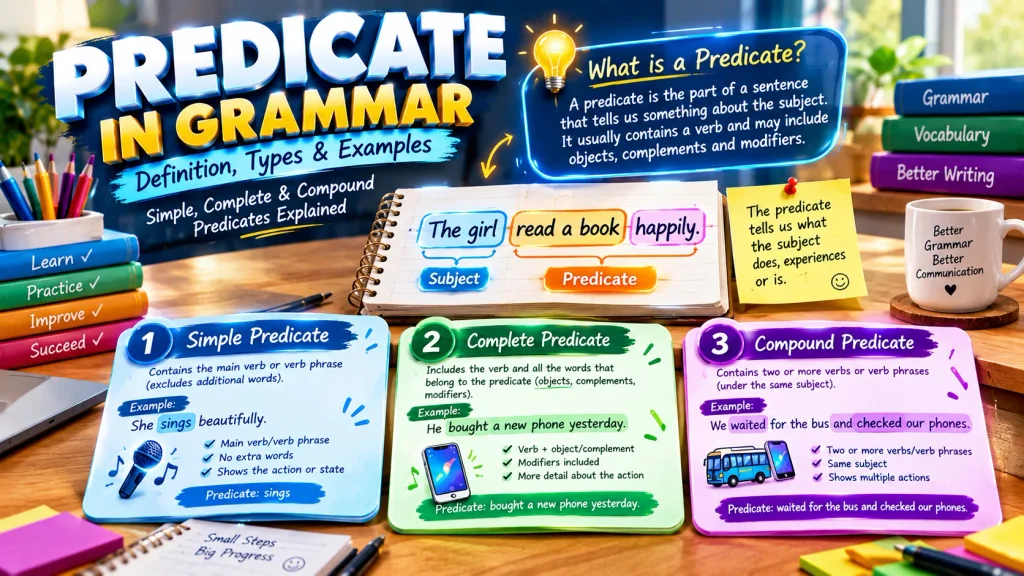
Common Mistakes When Identifying Predicates
Students often make the following mistakes when learning about predicates.
Mistake 1: Identifying Only the Verb as the Complete Predicate
Incorrect analysis: In “The dog ran across the road,” the complete predicate is “ran.”
Correct analysis: The simple predicate is “ran,” while the complete predicate is “ran across the road.”
Mistake 2: Confusing the Predicate With the Object
Example: Sarah bought a book.
- Subject: Sarah
- Predicate: bought a book
- Object: a book
The object forms part of the predicate, but it does not include the verb.
Mistake 3: Confusing a Compound Predicate With a Compound Sentence
Compound predicate: The boy laughed and shouted.
Compound sentence: The boy laughed, and his friend shouted.
The first example shares one subject. The second contains two independent clauses with separate subjects.
Mistake 4: Ignoring Auxiliary Verbs
Example: They have been working all day.
The simple predicate includes the verb phrase “have been working,” not merely “working.”
Mistake 5: Assuming Every Predicate Describes an Action
Example: She is a teacher.
The predicate “is a teacher” expresses a state or identity rather than a physical action.
Predicate in Grammar: Practice Exercises
Test your understanding by identifying the predicate in each sentence. For the first five questions, identify the complete predicate.
- The cat slept under the table.
- My brother plays cricket every weekend.
- The students are studying for their exams.
- The little girl opened the window.
- Our teacher explained the lesson clearly.
- The birds sang and flew away.
- Is your mother at home?
- Please turn off the lights.
- The weather became cold after sunset.
- Jack washed the dishes, and Emma dried them.
Answers:
- slept under the table
- plays cricket every weekend
- are studying for their exams
- opened the window
- explained the lesson clearly
- sang and flew away — compound predicate
- is — the predicate in this short question; “at home” functions as a subject-oriented complement in a fuller analysis, so the complete predicate is is your mother at home? only under a surface-word-order approach. For conventional school analysis, the subject is “your mother” and the predicate is is at home.
- turn off the lights — the subject “you” is understood.
- became cold after sunset
- washed the dishes and dried them — two predicates in a compound sentence.
People Also Ask
A predicate is the part of a sentence that tells us something about the subject. For example, in “The dog barks,” “barks” is the predicate.
The three commonly taught types are the simple predicate, complete predicate, and compound predicate.
Yes. A sentence can contain a compound predicate when one subject performs multiple actions. For example, “Liam ran and jumped.”
A complete declarative sentence normally has a predicate. Imperative sentences also have predicates, even when their subject “you” remains understood. Fragments and elliptical expressions may omit parts of a full sentence structure.
Yes. The predicate contains the verb or verb phrase. A complete predicate may also include objects, complements, and modifiers.
A verb expresses an action, occurrence, or state. A predicate contains the verb and may include additional words that tell us more about the subject.
Conclusion
A Predicate is an essential part of English sentence structure because it tells us something about the subject. It can express an action, a state, a condition, or an identity.
The three main types commonly taught in school grammar are the simple predicate, complete predicate, and compound predicate. Other important concepts include predicate nominatives, predicate adjectives, and predicates within independent and dependent clauses.
To identify a predicate, find the verb or verb phrase and determine which additional words belong to the statement about the subject.
With regular practice, you can recognize predicates more confidently and write clearer, more grammatically accurate sentences.











3 thoughts on “Predicate in Grammar: Definition, Types, Rules & Examples”