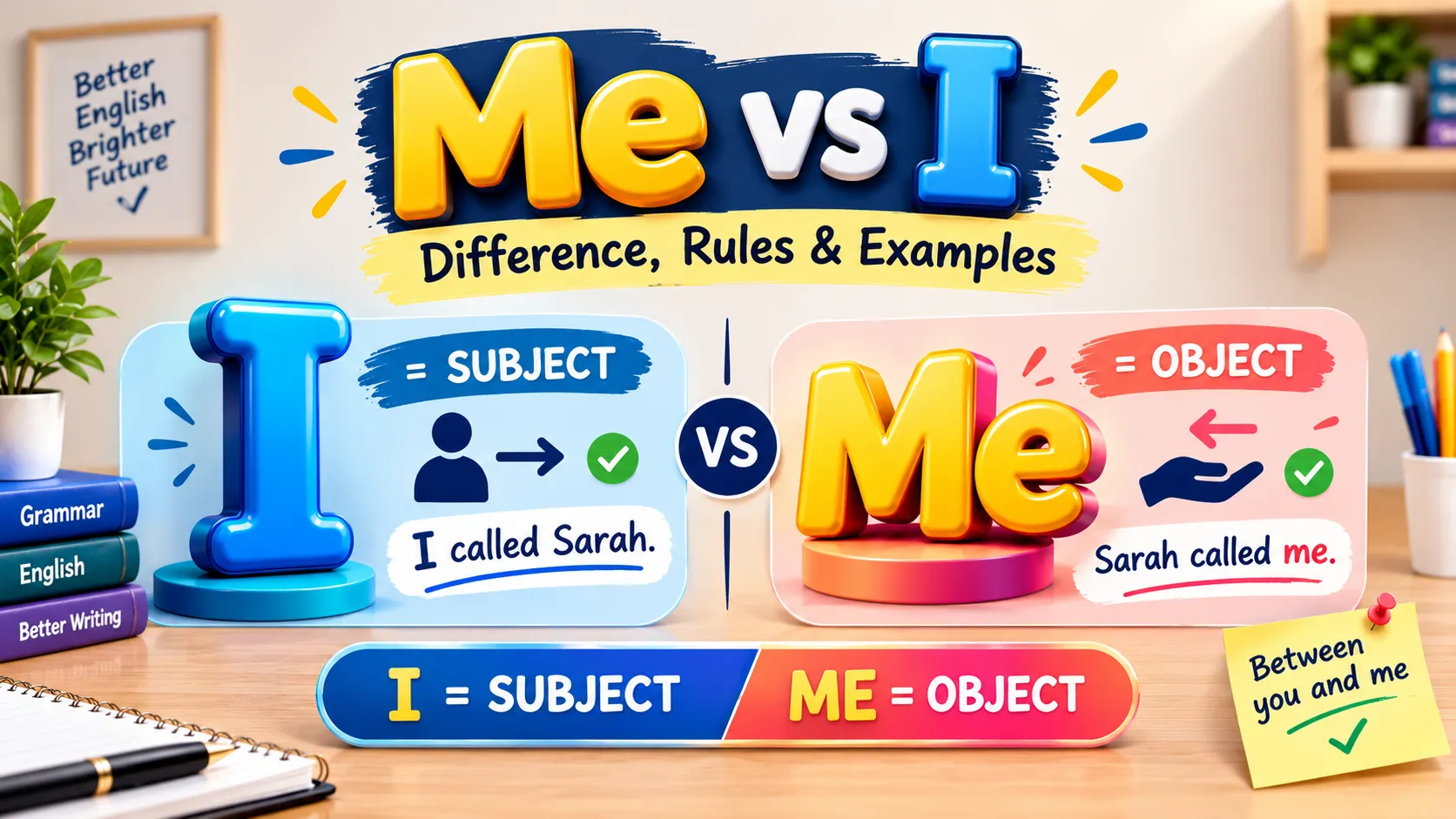
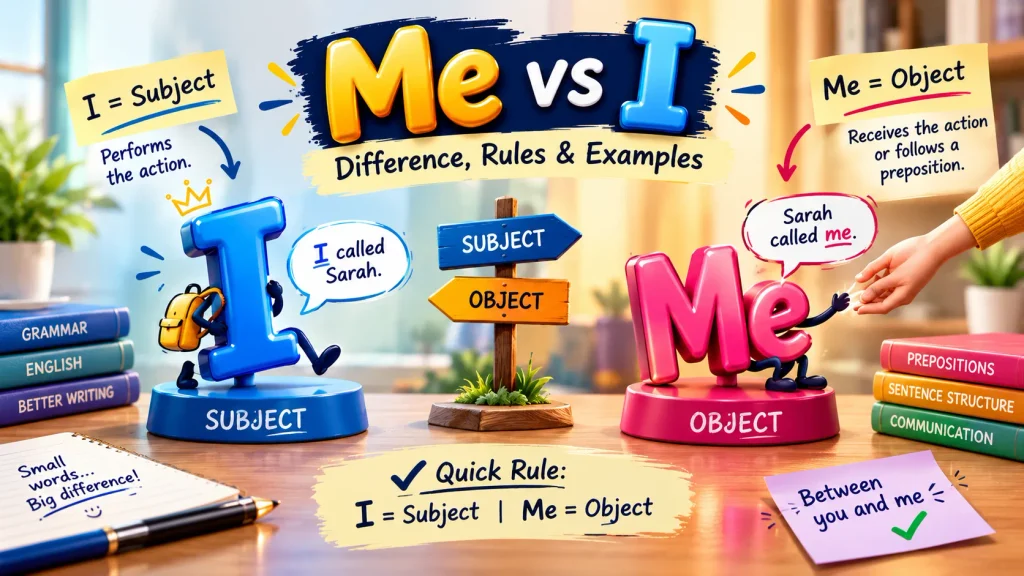
Me vs I: Both me and I refer to the person speaking, but they serve different grammatical roles. Use I as a subject when the person performs an action, and use me as an object when the person receives an action or follows a preposition.
For example, “I called Sarah” is correct because I performs the action. “Sarah called me” is correct because me receives the action.
Many English learners struggle with sentences such as “My friend and I” versus “My friend and me.” The correct choice depends on the word’s role in the sentence, not on whether another person appears beside it.
In this guide, you will learn the difference between me and I, the essential grammar rules, common mistakes, and practical examples to help you choose the correct pronoun confidently.
Me vs I: Quick Difference
| Feature | I | Me |
| Part of speech | Subject pronoun | Object pronoun |
| Grammatical role | Subject | Object |
| Main use | Performs an action | Receives an action or follows a preposition |
| Example | I wrote a letter. | She thanked me. |
| With another person | My friend and I went shopping. | She invited my friend and me. |
| Common question | Who performs the action? | Whom does the action affect? |
Me vs I: Quick rule: Use I for the subject and me for the object.
What Does “I” Mean?
I is a first-person singular subject pronoun. It refers to the person speaking or writing and functions as the subject of a clause.
Use I when you perform an action or when the sentence describes your state or condition.
Examples of “I” in Sentences
- I study English every day.
- I enjoy reading books.
- I finished my homework.
- I am learning a new language.
- My brother and I play football.
- Sarah and I visited the museum.
- I was happy with the results.
- I think this answer is correct.
In each example, I functions as the subject of a clause.
When Should You Use “I”?
Use I in these situations:
1. When you perform an action
- I opened the door.
- I cooked dinner.
- I answered the question.
2. When you describe your feelings or condition
- I am tired.
- I feel excited.
- I was nervous before the exam.
3. When you form the subject with another person
- My sister and I went to the market.
- John and I work together.
- My parents and I watched a movie.
Explore More: https://wordminto.com/look-vs-see-and-watch/
What Does “Me” Mean?
Me is a first-person singular object pronoun. It refers to the person speaking or writing and functions as the object of a verb or preposition.
Use me when someone performs an action that affects you, directs an action toward you, or when a preposition requires an object.
Examples of “Me” in Sentences
- She called me yesterday.
- He helped me with my homework.
- My teacher praised me.
- Please give me your notebook.
- They invited my brother and me.
- This gift is for me.
- She sat beside me.
- The manager spoke to me.
In these examples, me functions as an object or the object of a preposition.
When Should You Use “Me”?
Use me in these situations:
1. When you receive an action
- David helped me.
- She recognized me.
- The teacher encouraged me.
2. After a preposition
- Come with me.
- This letter is for me.
- He stood behind me.
- They talked about me.
3. When you form an object with another person
- She invited my friend and me.
- The teacher congratulated Ali and me.
- They gave my sister and me some advice.
Explore More: https://wordminto.com/grammatical-agreement/
Me vs I Grammar Rules
Me vs I
Understanding a few basic rules will help you choose the correct pronoun in most situations.
Rule 1: Use “I” as the Subject
The subject performs the action or serves as the person or thing described by the verb.
Correct examples:
- I called my friend.
- My cousin and I attended the event.
- I was late for class.
Incorrect examples:
- Me called my friend.
- My cousin and me attended the event.
- Me was late for class.
The subject pronoun I fits each sentence because it performs the subject’s grammatical role.
Rule 2: Use “Me” as the Object
A direct object receives the action of a verb. An indirect object identifies the person who receives something or benefits from an action.
Correct examples:
- She invited me.
- He gave me a present.
- They saw my friend and me.
Incorrect examples:
- She invited I.
- He gave I a present.
- They saw my friend and I.
Use me because each sentence places the pronoun in an object position.
Rule 3: Use “Me” After a Preposition
Prepositions such as to, for, with, between, beside, and about generally take object pronouns.
Correct examples:
- Come with me.
- This message is for me.
- She spoke to me.
- The secret stays between you and me.
- They sat beside me.
Incorrect examples:
- Come with I.
- This message is for I.
- She spoke to I.
- The secret stays between you and I.
Remember this useful expression: between you and me, not between you and I.
Rule 4: Choose the Pronoun When Another Person Appears
When you mention yourself alongside another person, determine whether the entire phrase functions as a subject or an object.
Use “I” when the phrase acts as the subject:
- My friend and I went swimming.
- Emma and I completed the assignment.
- My father and I traveled to Islamabad.
Use “me” when the phrase acts as an object:
- She invited my friend and me.
- The coach congratulated Emma and me.
- My father drove my brother and me to school.
The presence of another person does not change the grammatical rule.
Rule 5: Remove the Other Person to Check the Sentence
One of the easiest ways to distinguish me from I is to remove the other person from the sentence temporarily.
Example 1:
- Incorrect: My brother and me went shopping.
- Test: Me went shopping.
- Correct: My brother and I went shopping.
Example 2:
- Incorrect: She invited my brother and I.
- Test: She invited I.
- Correct: She invited my brother and me.
This test works well in many everyday sentences involving compound subjects and objects.
Rule 6: Use “I” in Compound Subjects, Even After a Name
People sometimes use me after a name because the name comes first. However, grammatical function determines the correct pronoun.
- Correct: Daniel and I are classmates.
- Incorrect: Daniel and me are classmates.
- Correct: The principal spoke to Daniel and me.
- Incorrect: The principal spoke to Daniel and I.
The pronoun does not change simply because another person appears before it.
Explore More: https://wordminto.com/grammatical-agreement/
Me vs I: Common Sentence Comparisons
Me vs I
These examples show how the same meaning changes depending on the pronoun’s grammatical role.
| Incorrect sentence | Correct sentence |
| Me went to school. | I went to school. |
| She helped I. | She helped me. |
| Him and I are friends. | He and I are friends. |
| My friend and me played chess. | My friend and I played chess. |
| They called Sarah and I. | They called Sarah and me. |
| This gift is for I. | This gift is for me. |
| Between you and I, this is difficult. | Between you and me, this is difficult. |
| Me and John are studying. | John and I are studying. |
Note: The examples involving he and him illustrate the same subject-versus-object distinction that applies to I and me.
“My Friend and I” vs “My Friend and Me”
This is one of the most common sources of confusion in English grammar.
The correct phrase depends on the phrase’s function in the sentence.
Use “My Friend and I” as the Subject
- My friend and I went to the library.
- My friend and I are learning French.
- My friend and I enjoyed the concert.
- My friend and I will attend the meeting.
In each sentence, the phrase performs the subject’s role.
Use “My Friend and Me” as the Object
- The librarian helped my friend and me.
- She invited my friend and me to dinner.
- The teacher gave my friend and me extra time.
- They took a photograph of my friend and me.
In each sentence, the phrase functions as an object.
A Simple Trick
Remove the words my friend and read the remaining sentence.
- “I went to the library” sounds correct.
- “Me went to the library” sounds incorrect.
- “The librarian helped me” sounds correct.
- “The librarian helped I” sounds incorrect.
This quick check helps you identify the correct form without memorizing every example.
“Between You and Me” vs “Between You and I”
The standard grammatical expression is “between you and me.”
The word between is a preposition, and prepositions take object pronouns in standard English. Therefore, me is the correct choice.
Correct examples:
- Between you and me, I dislike that movie.
- This information stays between you and me.
- Between you and me, the plan needs improvement.
Incorrect in standard English:
- Between you and I, I dislike that movie.
- This information stays between you and I.
Although many speakers use “between you and I” in conversation, standard grammar calls for “between you and me.”
“You and I” vs “You and Me”
Both phrases are correct, but they serve different grammatical functions.
| Phrase | Function | Example |
| You and I | Subject | You and I need to talk. |
| You and me | Object | She invited you and me. |
| You and I | Subject | You and I are good friends. |
| You and me | Object | This decision affects you and me. |
Do not choose I just because it sounds more formal. Choose the pronoun that fits the sentence structure.
“For You and Me” vs “For You and I”
The preposition for requires an object pronoun. Therefore, use “for you and me.”
Correct examples:
- This present is for you and me.
- They prepared a special meal for you and me.
- The teacher saved two seats for you and me.
Incorrect in standard English:
- This present is for you and I.
- They prepared a special meal for you and I.
The same principle applies to other prepositions, including to, with, about, and between.
Is It Ever Correct to Start a Sentence With “Me”?
Yes, but the answer depends on the sentence structure.
In standard English, me cannot normally function as the subject of a complete clause. However, it can appear at the beginning of a sentence when it serves as an object or when the sentence uses a conversational fragment.
Correct examples:
- Me? I didn’t take your pen.
- Me, I prefer tea over coffee. (Conversational emphasis)
- Me included, everyone received a certificate. (Understandable, but “including me” is more natural in many contexts.)
In everyday conversation, people sometimes say “Me and John went to the store.” However, standard written English prefers “John and I went to the store.”
Is It Ever Correct to Use “I” After “Than”?
Yes. The correct choice depends on the implied or stated sentence structure.
When than introduces a comparison, it can function as a conjunction or a preposition, depending on the construction.
Examples:
- She is taller than I am.
- She is taller than I. (Formal; the verb am is understood.)
- She likes him more than me. (This can mean she likes him more than she likes me.)
- She likes him more than I do. (This means my level of liking him is lower than hers.)
The longer versions often communicate the intended meaning more clearly. Choose the wording that expresses your comparison accurately.
Me vs I in Everyday English
Me vs I
These examples demonstrate the correct pronoun choice in common situations.
At School
- I completed my homework.
- The teacher called me.
- My classmate and I studied together.
- The teacher gave my classmate and me a certificate.
At Work
- I sent the email.
- My manager thanked me.
- Sarah and I prepared the report.
- The director invited Sarah and me to the meeting.
In Daily Conversation
- I need some help.
- Can you hear me?
- My friend and I watched a movie.
- They invited my friend and me.
In Social Media Captions
- Just me enjoying the moment.
- My best friend and I, making memories.
- A little adventure for you and me.
- I believe in myself.
These examples show that I and me can both appear naturally in everyday communication, provided you use them in the correct grammatical roles.
Common Mistakes to Avoid
Mistake 1: Using “Me” as a Subject
Incorrect: Me and my sister went shopping.
Correct: My sister and I went shopping.
Why? The phrase functions as the subject, so use I.
Mistake 2: Using “I” as an Object
Incorrect: He called my sister and I.
Correct: He called my sister and me.
Why? The verb called takes an object, so use me.
Mistake 3: Using “I” After a Preposition
Incorrect: She came with my brother and I.
Correct: She came with my brother and me.
Why? The preposition with takes an object pronoun.
Mistake 4: Choosing “I” Because It Sounds More Formal
Incorrect: The gift is for my wife and I.
Correct: The gift is for my wife and me.
Why? Formality does not change the pronoun’s grammatical function.
Mistake 5: Forgetting the Verb in a Comparison
Potentially ambiguous: He likes football more than me.
Clearer: He likes football more than I do.
Why? The second sentence makes the intended comparison explicit.
Me vs I: Practice Exercises
Choose the correct pronoun to complete each sentence.
- ___ went to the supermarket yesterday. (Me / I)
- Sarah and ___ are best friends. (me / I)
- The teacher praised John and ___. (me / I)
- This letter is for ___. (me / I)
- My parents and ___ watched a movie. (me / I)
- She invited my brother and ___. (me / I)
- The secret stays between you and ___. (me / I)
- ___ finished the assignment on time. (Me / I)
- He gave ___ a useful suggestion. (me / I)
- My friend and ___ are planning a trip. (me / I)
- The manager spoke to David and ___. (me / I)
- ___ think this book is interesting. (Me / I)
- They chose my sister and ___ for the project. (me / I)
- Please come with ___. (me / I)
- ___ and my cousin visited the museum. (Me / I)
Answers and Explanations
- I — The pronoun acts as the subject.
- I — The phrase “Sarah and I” forms the subject.
- me — The pronoun receives the action of being praised.
- me — The preposition for takes an object pronoun.
- I — The phrase “My parents and I” acts as the subject.
- me — The pronoun serves as the object of invited.
- me — The preposition between takes an object pronoun.
- I — The pronoun performs the action of finishing.
- me — The pronoun acts as the indirect object of gave.
- I — The phrase forms the subject.
- me — The preposition to takes an object pronoun.
- I — The pronoun serves as the subject of think.
- me — The pronoun acts as an object of chose.
- me — The preposition with takes an object pronoun.
- I — The complete subject is “I and my cousin”; the more natural order is “My cousin and I.”
People Also Ask
I is a subject pronoun, while me is an object pronoun. Use I when you perform an action, as in “I called her.” Use me when you receive an action, as in “She called me.”
In standard English, use “John and I” when the phrase functions as the subject.
Example: “John and I went to school.”
When the phrase functions as an object, use “John and me.”
Example: “The teacher helped John and me.”
Both phrases are correct in different contexts. Use “my friend and I” as a subject and “my friend and me” as an object.
My friend and I played tennis.
She invited my friend and me.
In standard English grammar, “between you and me” is correct because between is a preposition and takes the object pronoun me.
People often use this construction in casual conversation. However, in standard written English, use “my friend and I” when the phrase acts as the subject.
Conclusion
The difference between me and I becomes simple once you understand their grammatical roles. Use “I” as a subject and “me” as an object or after a preposition.
Say “My friend and I went shopping,” but “She invited my friend and me.” Use “between you and me,” not “between you and I,” in standard English.
With regular practice and attention to sentence structure, you can choose the correct pronoun confidently in academic writing, professional communication, and everyday conversation.











1 thought on “Me vs I: What’s the Difference? Meaning, Grammar Rules & Examples”