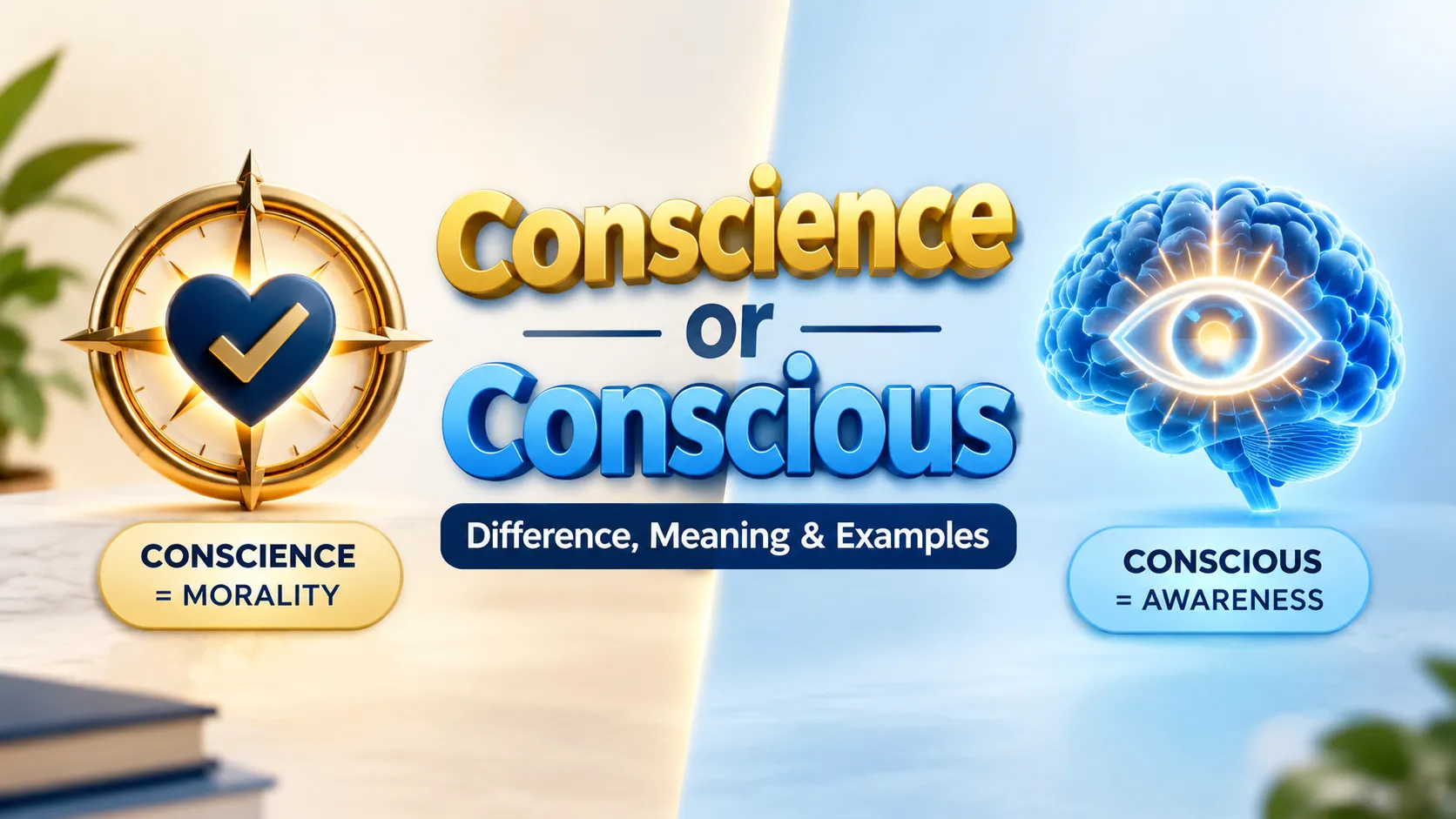
Conscience or Conscious: Conscience and Conscious look and sound similar, but they have different meanings and grammatical functions. Conscience is about your sense of right and wrong, while conscious describes being awake, aware, or aware of something.
This guide explains conscience vs. conscious with simple definitions, examples, memory tricks, common mistakes, and practical usage.
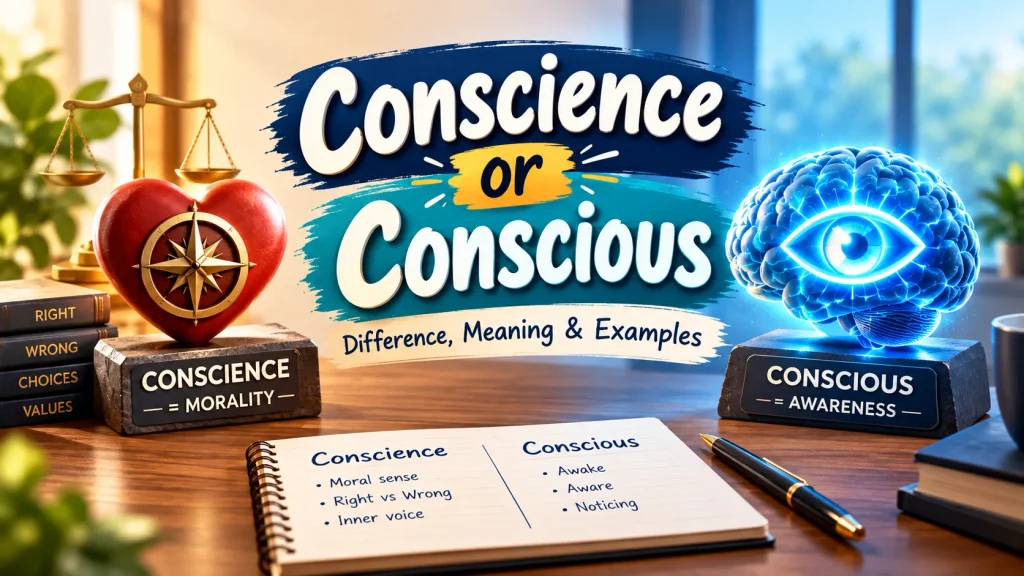
Conscience or Conscious: Quick Difference
| Word | Part of Speech | Meaning | Example |
| Conscience | Noun | Your inner sense of right and wrong | My conscience told me to apologize. |
| Conscious | Adjective | Awake, aware, or noticing something | She was conscious of the noise. |
The easiest way to remember
Conscience = morality
Conscious = awareness
If you are talking about what feels morally right or wrong, use conscience.
If you are talking about being awake, aware, or noticing something, use conscious.
What Does Conscience Mean?
Conscience is a noun that means your inner sense of what is morally right or wrong.
Your conscience can make you feel guilty when you do something wrong or encourage you to do what you believe is right.
Examples of Conscience
- My conscience would not let me lie.
- She has a clear conscience.
- His conscience bothered him after he cheated.
- I could not ignore my conscience.
- Her conscience told her to return the money.
Conscience in a Sentence
I returned the wallet because my conscience told me it was the right thing to do.
Here, conscience refers to the person’s moral judgment.
Explore More: https://wordminto.com/then-vs-than/
What Does Conscious Mean?
Conscious is an adjective that generally means awake, aware, or mentally alert.
It can describe someone’s physical state or their awareness of something.
Examples of Conscious
- I was still conscious after the accident.
- She remained conscious throughout the procedure.
- He became conscious of the noise.
- I am conscious of my responsibilities.
- She is conscious that people are watching.
Conscious in a Sentence
He became conscious of the mistake after reading the report.
Here, conscious means aware.
Conscience vs. Conscious Examples
The following examples make the difference easier to see:
Conscience
- My conscience told me not to cheat.
- She has a guilty conscience.
- He acted according to his conscience.
- I could not sleep because my conscience bothered me.
- His conscience would not allow him to deceive anyone.
Conscious
- She was conscious during the entire conversation.
- I became conscious of the cold weather.
- He is conscious of his responsibilities.
- The patient is now conscious.
- She is very conscious of her appearance.
Explore More: https://wordminto.com/affect-or-effect/
Conscience vs. Conscious Pronunciation
Although the words look similar, their pronunciation differs.
Conscience
Conscience is pronounced approximately:
KON-shuhns
It has a sound similar to science at the end.
Conscious
Conscious is pronounced approximately:
KON-shuhs
The ending sounds like -shus.
A useful distinction is:
- Conscience → ends with a sound like “sense”
- Conscious → ends with a sound like “shus”
Conscience: Meaning and Usage
Conscience usually appears when discussing morality, guilt, honesty, responsibility, or ethical decisions.
Common expressions with Conscience
A clear conscience
This means you do not feel guilty because you believe you have done nothing wrong.
I have a clear conscience because I told the truth.
A guilty conscience
This means you feel guilty about something you have done.
He had a guilty conscience after lying to his friend.
Ease your conscience
This means to do something that reduces your feelings of guilt.
She apologized to ease her conscience.
On your conscience
This means that something causes you guilt or moral responsibility.
The decision remained on his conscience for years.
Conscience-stricken
This describes someone who feels extremely guilty.
She was conscience-stricken after hurting her friend’s feelings.
Explore More: https://wordminto.com/borrow-or-lend/
Conscious: Meaning and Usage
Conscious has several related meanings.
1. Awake
The patient is finally conscious.
Here, conscious means awake rather than unconscious.
2. Aware
I was conscious of someone standing behind me.
Here, it means aware of something.
3. Deliberately Aware or Intentional
He made a conscious decision to change careers.
Here, conscious means deliberate or intentional.
4. Concerned About Something
She is very conscious of her appearance.
Here, it means particularly aware or concerned about something.
Conscious vs. Unconscious
The opposite of conscious is often unconscious.
Conscious
Means awake or aware.
The driver remained conscious after the crash.
Unconscious
Means not awake or not aware.
The driver became unconscious after the crash.
This distinction can help you remember the meaning of conscious.
Explore More: https://wordminto.com/layed-or-laid/
Conscience vs. Conscious: Common Mistakes
Because the words look almost identical, writers often confuse them.
Mistake 1: “My conscious told me…”
❌ My conscious told me not to lie.
Here, you are talking about your moral sense.
✅ My conscience told me not to lie.
Mistake 2: “I was conscience of the problem.”
❌ I was conscience of the problem.
Here, you mean that you were aware of the problem.
✅ I was conscious of the problem.
Mistake 3: “He has a clear conscious.”
❌ He has a clear conscious.
The correct expression is:
✅ He has a clear conscience.
Mistake 4: “She lost her conscience.”
This sentence can be grammatically correct, but it usually means something very different from losing consciousness.
If you mean that she became unconscious:
❌ She lost her conscience.
✅ She lost consciousness.
Losing consciousness means to become unconscious or stop being aware.
Explore More: https://wordminto.com/sometime-vs-some-time/
Conscience or Conscious: Which One Should You Use?
Ask yourself what you mean.
Are you talking about morality?
Use conscience.
My conscience would not let me steal.
Are you talking about awareness?
Use conscious.
I was conscious of the danger.
Are you talking about being awake?
Use conscious.
The patient is conscious now.
Are you talking about guilt?
Use conscience.
His conscience bothered him.
Easy Memory Trick for Conscience
Think:
Conscience = Choice between right and wrong
The word contains science, but its meaning has nothing to do with scientific knowledge.
You can remember:
Conscience = moral sense
If your inner voice asks, “Is this right or wrong?”, think conscience.
Easy Memory Trick for Consciousness
Think:
Conscious = C for “Current awareness.”
If you are awake and aware of what is happening around you, you are conscious.
You can remember:
Conscious = aware
If the sentence means awake, aware, alert, or deliberately aware, use conscious.
Conscience vs. Conscious in Questions
Which is correct: “I have a guilty conscience” or “I have a guilty conscious”?
✅ I have a guilty conscience.
Conscience is the noun that refers to your moral sense.
Which is correct: “I am conscious of the problem” or “I am conscience of the problem”?
✅ I am conscious of the problem.
Conscious is the adjective meaning aware.
Which is correct: “My conscience bothered me” or “My conscious bothered me”?
✅ My conscience bothered me.
Your conscience can cause feelings of guilt.
Which is correct: “She became conscious” or “She became conscience”?
✅ She became conscious.
Here, conscious means awake or aware.
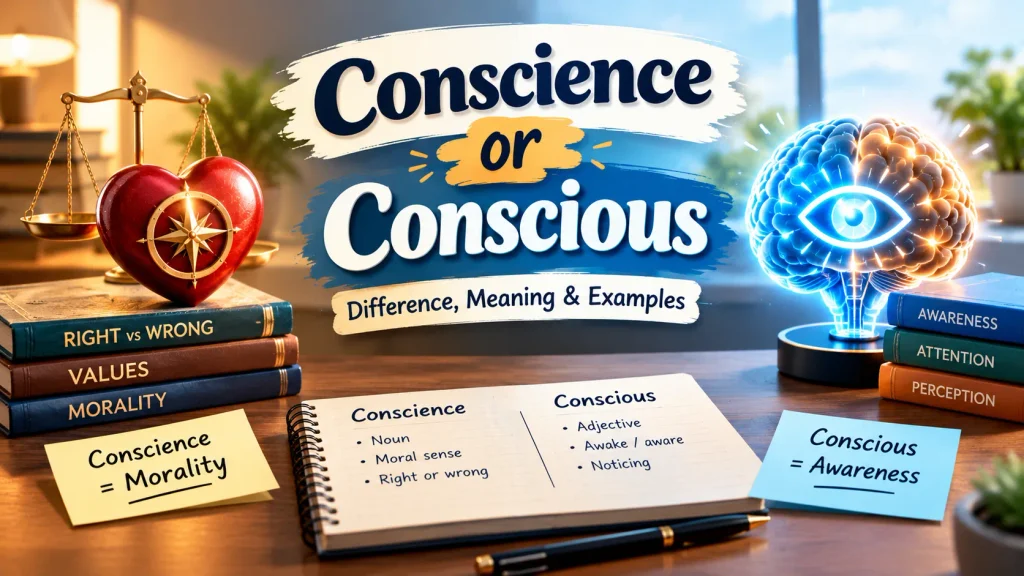
Conscience vs. Conscious vs. Consciousness
These three words connect to similar ideas but have different meanings.
Conscience
A noun meaning your moral sense of right and wrong.
His conscience prevented him from cheating.
Conscious
An adjective meaning awake or aware.
She was conscious of the problem.
Consciousness
A noun referring to the state of being awake and aware.
The patient regained consciousness.
A simple pattern is:
Conscience → morality
Conscious → aware
Consciousness → state of awareness
Conscience vs. Conscious vs. Unconscious
| Word | Meaning | Example |
| Conscience | Moral sense | My conscience told me to apologize. |
| Conscious | Awake or aware | He is conscious of the problem. |
| Unconscious | Not awake or aware | The patient was unconscious. |
| Consciousness | State of being awake and aware | She regained consciousness. |
Practice Exercise: Conscience or Conscious?
Choose the correct word in each sentence.
- My ______ would not allow me to cheat.
- She was ______ of the risks.
- He has a clear ______.
- The patient remained ______ after the operation.
- His guilty ______ kept him awake.
- I became ______ of how loud the music was.
- She made a ______ decision to leave.
- He could not ignore his ______.
Answers
- conscience
- conscious
- conscience
- conscious
- conscience
- conscious
- conscious
- conscience
People Also Ask
Both words are correct, but they have different meanings. Conscience means your inner sense of right and wrong, while conscious means awake, aware, or mentally alert.
Conscience is a noun related to morality and ethical judgment. Conscious is an adjective related to awareness or being awake.
Conscience is a noun.
Her conscience bothered her.
Conscious is primarily an adjective.
He is conscious of the problem.
My conscience told me that lying was wrong.
Final Difference: Conscience or Conscious
The simplest way to remember the difference is:
Conscience = your moral sense of right and wrong.
Conscious = awake, aware, or mentally alert.
Compare these two sentences:
My conscience told me that stealing was wrong.
I was conscious of the security camera.
The first sentence concerns morality, so it uses conscience. The second concerns awareness, so it uses conscious.
Quick memory rule:
Conscience → right vs. wrong
Conscious → aware or awake
Once you connect conscience with morality and conscious with awareness, you can easily choose the correct word.











8 thoughts on “Conscience or Conscious: What’s the Difference? Meaning, Rules & Examples”