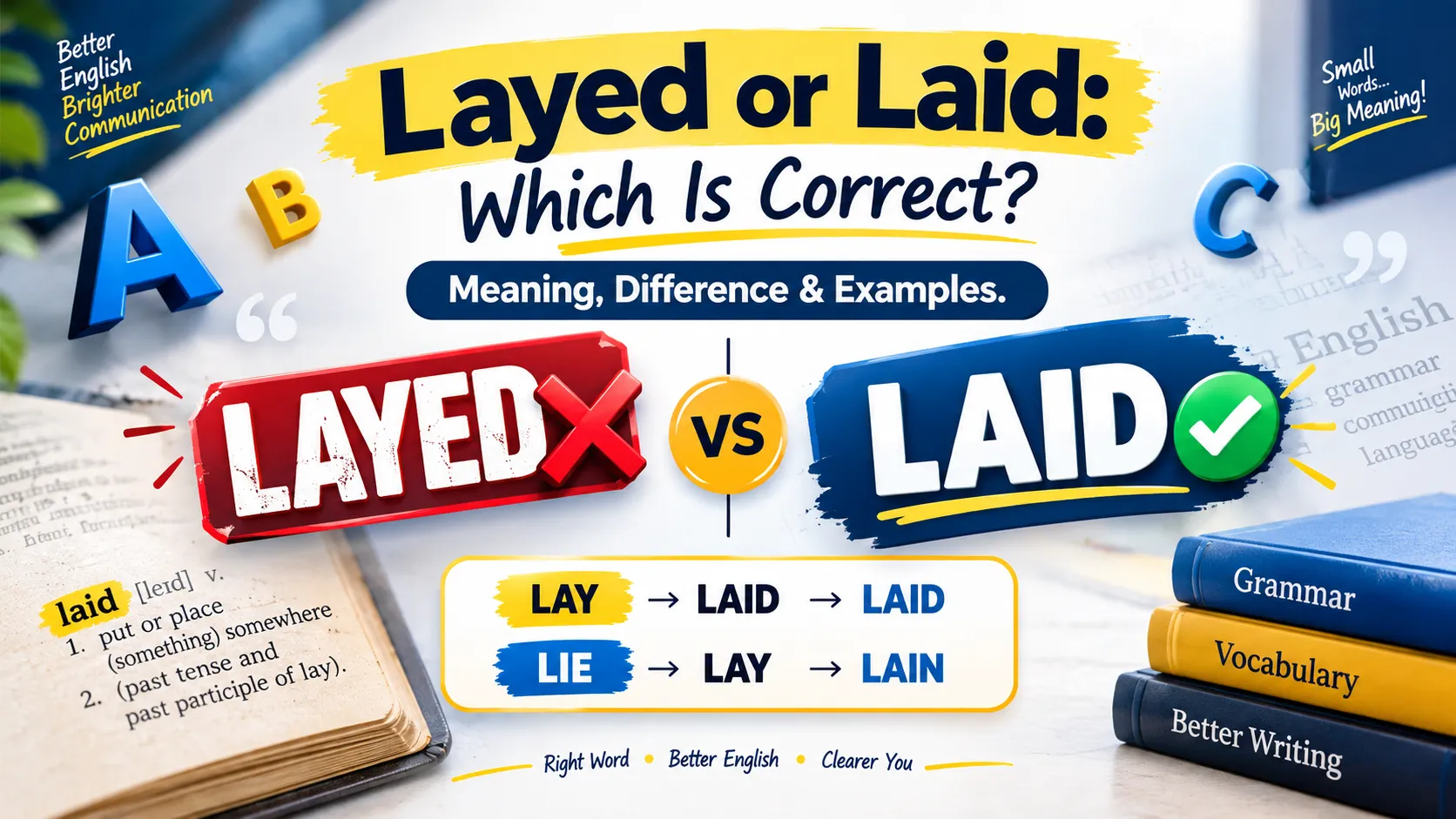
Layed or Laid: If you are unsure whether to write layed or laid, the correct choice in standard English is almost always laid. It is the past tense and past participle of lay, which means to put or place something somewhere.
However, lay and lie create a lot of confusion because their forms overlap. For example, laid is the past tense of lay, while lay is the past tense of lie.
The easiest rule is:
Lay → laid → laid
Lie → lay → lain
So, if you mean put or placed something, use laid.
She laid the book on the desk.
If you mean rested or reclined, use lay when talking about the past.
She lay on the sofa yesterday.
Layed or Laid: Quick Answer
Laid is the standard correct form when it is the past tense or past participle of lay.
- ✅ I laid the keys on the table.
- ✅ She laid the baby in the crib.
- ✅ They have laid the foundation.
- ❌ I layed the keys on the table.
- ❌ She layed the baby in the crib.
Layed is generally not used as the standard past form of lay in modern English.
What Does “Laid” Mean?
Laid is the past tense and past participle of lay.
The verb lay means to put, place, or set something somewhere. It normally takes a direct object.
Examples
- I laid my phone on the desk.
- She laid the clothes on the bed.
- He laid the documents beside the computer.
- We laid the books on the table.
- The workers laid the bricks carefully.
In each example, something gets placed somewhere.
Explore More: https://wordminto.com/sometime-vs-some-time/
Why Is “Layed” Incorrect?
The confusion comes from the fact that many English verbs form their past tense by adding -ed:
- play → played
- walk → walked
- clean → cleaned
- work → worked
It may seem logical to change lay into layed, but lay is an irregular verb.
Its forms are:
lay → laid → laid
Therefore, adding -ed does not produce the standard past form.
Incorrect
He layed the book on the table.
Correct
He laid the book on the table.
Lay vs. Lie: The Difference You Need to Know
The biggest source of confusion is the difference between lay and lie.
Although the two verbs have related meanings, they work differently in a sentence.
Lay
Lay means to put or place something somewhere.
It normally needs an object.
Please lay the book on the desk.
The object is the book.
Lie
Lie means to rest or recline.
It does not normally take an object.
I lie on the sofa when I feel tired.
You are resting yourself rather than placing an object somewhere.
Explore More: https://wordminto.com/rn-meaning/
Lay, Laid, Lie, and Lain
These four forms are easier to understand when you see them together.
| Verb | Meaning | Present | Past | Past Participle |
| lay | put or place | lay | laid | laid |
| lie | rest or recline | lie | lay | lain |
Compare these sentences:
Present:
I lay the book on the table.
Past:
I laid the book on the table yesterday.
Now compare the other verb:
Present:
I lie on the sofa.
Past:
I lay on the sofa yesterday.
This is why the words can be confusing: lay belongs to both verb patterns, but it has a different role in each one.
When to Use “Laid”
Use laid when someone placed or put something somewhere in the past.
1. Placing an object
She laid her phone beside the laptop.
2. Putting something down
He laid the newspaper on the table.
3. Putting a person or animal somewhere
She laid the baby in the crib.
4. Construction
The workers laid the bricks.
5. Preparing something
She laid the table for dinner.
In every case, something receives the action.
Explore More: https://wordminto.com/frfr-meaning/
When to Use “Lay”
Lay has two important uses.
Present tense of “lay”
When you mean put or place, use lay in the present tense.
I lay my keys on the desk every morning.
Please lay the papers here.
Past tense of “lie”
When you mean rest or recline, lay is the past tense of lie.
I lay on the bed for an hour yesterday.
She lay on the beach all afternoon.
This distinction is extremely important.
“Lay Down” vs. “Lie Down”
The phrase lay down causes frequent mistakes because its correct form depends on whether you are placing something or reclining yourself.
If you put something down:
Lay the book down.
Past tense:
Laid the book down.
If you recline yourself:
Lie down.
Past tense:
Lay down.
Compare
Please lay the baby down.
Here, you are putting the baby somewhere.
I need to lie down.
Here, you are going to rest yourself.
Yesterday:
I lay down for a few minutes.
Explore More: https://wordminto.com/everyday-vs-every-day/
Examples in Everyday English
Here are some natural examples:
Example 1
She laid her bag on the chair.
The bag was placed on the chair.
Example 2
He laid the plates on the table.
The plates were placed on the table.
Example 3
I lay on the couch after work.
Here, lay means rested or reclined. It is the past tense of lie.
Example 4
They have laid the foundation for the new building.
Here, laid is the past participle of lay.
Example 5
Please lay the documents on my desk.
This refers to placing something now or in the future.
Example 6
She lay awake all night.
She remained in a resting position. The verb comes from lie.
Common Mistakes
Mistake 1: Using “layed” instead of “laid”
❌ He layed the keys on the counter.
✅ He laid the keys on the counter.
Mistake 2: Using “laid” when you mean “lay”
❌ Yesterday, I laid on the sofa.
✅ Yesterday, I lay on the sofa.
Here, no object is being placed. The person is reclining.
Mistake 3: Saying “layed down”
❌ I layed down after dinner.
✅ I lay down after dinner.
The sentence means that you reclined.
Explore More: https://wordminto.com/sexy-vs-sexi/
Mistake 4: Confusing “lay down” with “laid down”
Both can be correct, but they have different grammatical uses.
Please lay the blanket down.
She laid the blanket down yesterday.
But:
Please lie down.
She lay down yesterday.
Laid as a Past Participle
Laid can also appear after auxiliary verbs such as has, have, and had.
Examples
- She has laid the book on the desk.
- They have laid the foundation.
- He had laid the papers aside.
- We have laid the groundwork for the project.
The pattern remains:
lay → laid → laid
Common Expressions With “Laid”
The word appears in several familiar expressions.
Laid the groundwork
This means to prepare the basis for something.
The research laid the groundwork for future studies.
Laid the foundation
This means to establish the basic structure of something.
The first experiment laid the foundation for the project.
Laid out
This can mean arranged, displayed, or explained.
She laid out all the documents on the table.
The manager laid out the plan clearly.
Laid to rest
This can refer to burial or to settling a matter.
The family laid him to rest.
The evidence finally laid the rumors to rest.
Laid-back
This adjective means relaxed or easygoing.
He has a laid-back personality.
Is “Layed” Ever Used?
You may occasionally encounter layed in historical texts, dialectal writing, or specialized contexts. However, it is not the normal modern-English past tense of “lay.”
For standard writing, including:
- school assignments
- professional writing
- websites
- academic work
- emails
- formal documents
use laid when you need the past form of lay.

A Simple Trick to Remember the Difference
Ask yourself:
Am I putting or placing something?
If yes, use lay or laid.
I lay the book down every night.
I laid the book down yesterday.
Am I resting or reclining?
If yes, use lie or lay.
I lie on the sofa after work.
I lay on the sofa yesterday.
A second useful trick is to remember the two patterns:
Lay → laid → laid = put something somewhere
Lie → lay → lain = rest or recline
Practice Quiz
Choose the correct word.
- She ___ the keys on the kitchen counter yesterday.
- I want to ___ down for a few minutes.
- He ___ on the bed all afternoon.
- They have ___ the foundation for the house.
- Please ___ the papers on the desk.
- She has ___ the baby in the crib.
- I usually ___ down when I feel tired.
- Yesterday, I ___ down after lunch.
- The workers ___ the bricks carefully.
- He had ___ the book beside his computer.
Answers
- laid
- lie
- lay
- laid
- lay
- laid
- lie
- lay
- laid
- laid
People Also Ask
Laid is the standard form when you need the past tense or past participle of lay.
She laid the book on the table.
You may find layed in some historical or specialized sources, but it is not the standard modern English past tense of lay. In ordinary writing, use laid.
The past tense of lay is laid.
Present: I lay the book down.
Past: I laid the book down.
The past tense of lie is lay.
Present: I lie on the sofa.
Past: I lay on the sofa.
It depends on what you mean.
If you mean that you reclined, the standard form is:
I lay down.
If you mean that you put something down, use an object:
I laid the book down.
Usually, no. If you mean that someone reclined, use lay down for the past tense.
She lay down after dinner.
If someone placed an object somewhere, use laid.
She laid the book down.
Remember:
Lay → laid → laid = put/place
Lie → lay → lain = rest/recline
Final Answer
When choosing between layed and laid, use laid in standard modern English when you mean the past tense of lay.
❌ She layed the book on the table.
✅ She laid the book on the table.
But don’t confuse laid with lay, which can be the past tense of lie:
✅ I lay on the sofa yesterday.
The simplest rule is:
If you put something somewhere, use “lay/laid.” If you rest or recline, use “lie/lay.”











4 thoughts on “Layed or Laid: Which Is Correct? Meaning, Difference & Examples”