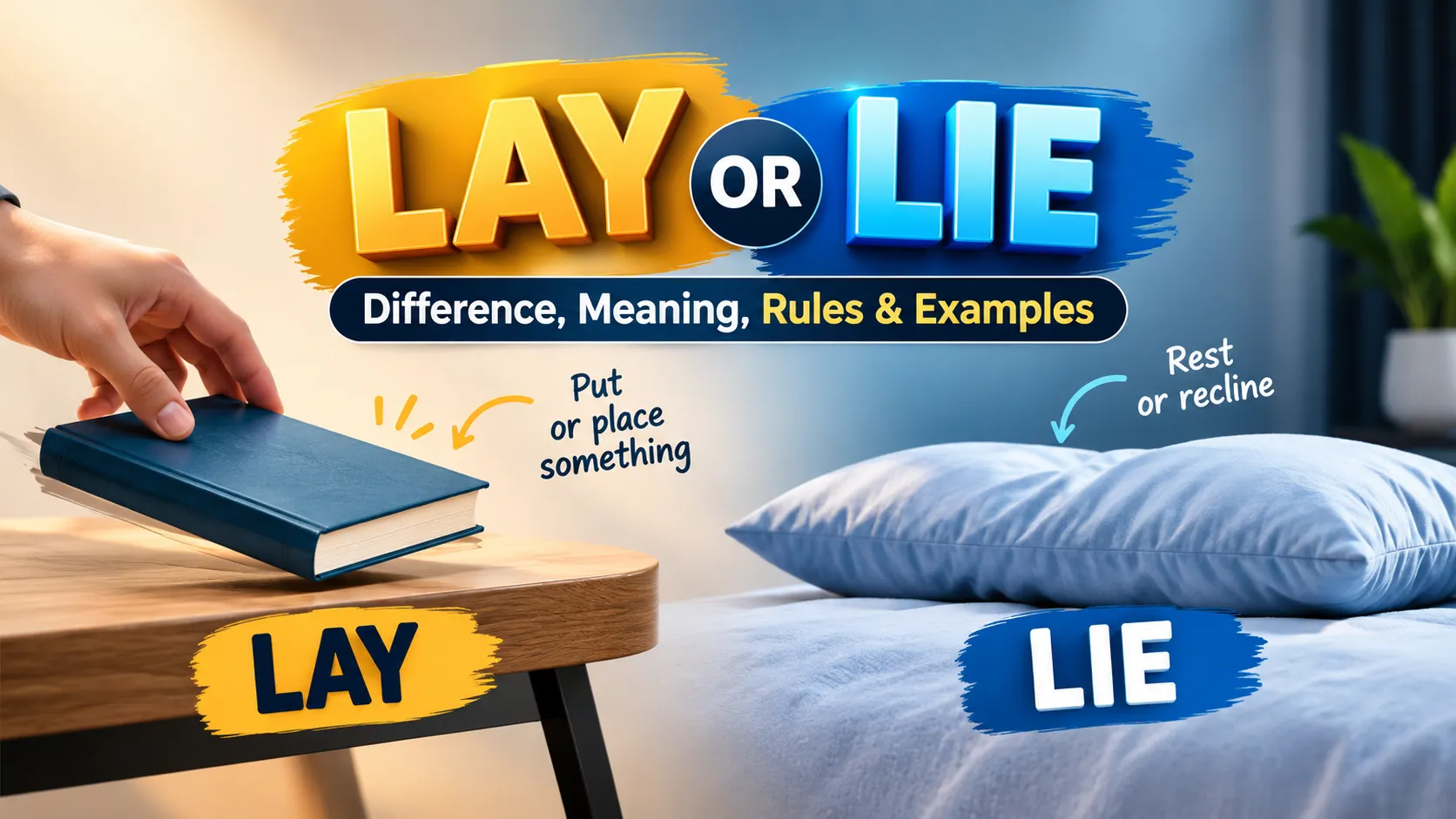
Lay or Lie: Lay and lie confuse many English learners because both words relate to putting or resting something. The main difference is simple:
- Lay means to put or place something somewhere. It needs a direct object.
- Lie means to rest or recline. It does not take a direct object.
The confusion becomes greater because lay is also the past tense of lie. Once you learn the verb forms, the difference becomes much easier.
Lay vs. Lie: Quick Difference
| Word | Meaning | Needs an object? | Example |
| lay | put or place something | Yes | Please lay the book on the desk. |
| lie | rest or recline | No | I need to lie down. |
| laid | past/past participle of lay | Yes | She laid the keys on the table. |
| lay | past tense of lie | No | He lay on the sofa yesterday. |
| lain | past participle of lie | No | He has lain there for an hour. |
The easiest rule
Ask yourself:
Are you putting something somewhere? → Use “lay.”
Are you resting yourself or something that is already there? → Use “lie.”
Lay the phone on the table.
Lie on the sofa.
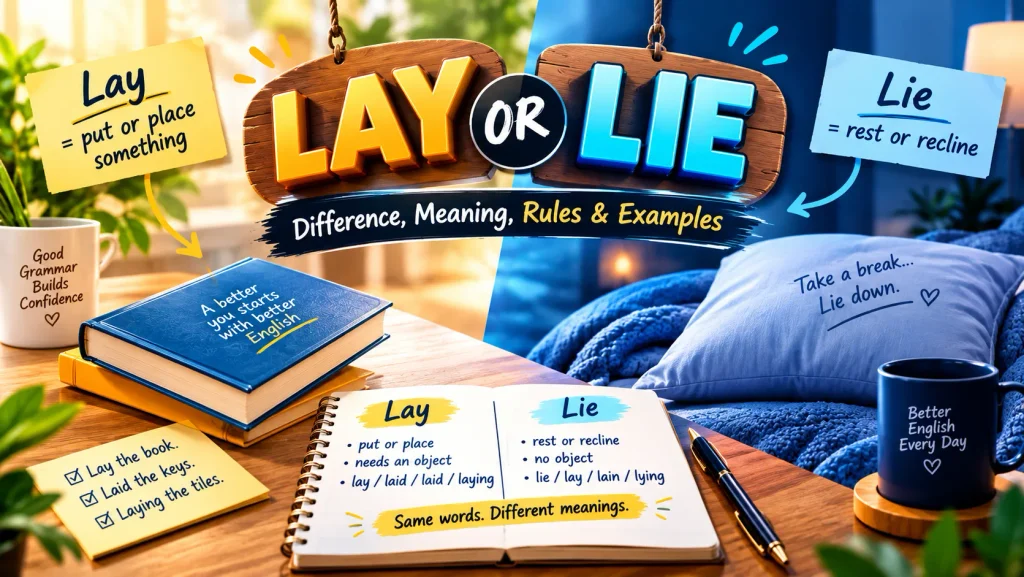
What Does “Lay” Mean?
Lay means to put, place, or set something down.
Because you place something, lay normally requires a direct object.
Examples
- Please lay the papers on my desk.
- She laid the baby in the crib.
- He lays his clothes on the chair every evening.
- We are laying the tiles in the kitchen.
- They have laid the foundation for the building.
In each sentence, something receives the action:
- lay the papers
- laid the baby
- lays his clothes
- laying the tiles
- laid the foundation
Lay in a sentence
Please lay the book on the table.
You can ask:
Lay what? → the book
That direct object tells you that lay is correct.
Explore More: https://wordminto.com/borrow-or-lend/
What Does “Lie” Mean?
Lie means to rest, recline, or be in a horizontal position.
In this sense, lie does not take a direct object.
Examples
- I want to lie down.
- She likes to lie on the beach.
- The dog is lying under the table.
- He lay on the bed all afternoon.
- They have lain there for hours.
Notice that nobody is placing an object. The subject itself rests.
Lie in a sentence
I need to lie down.
You cannot naturally ask:
Lie what?
There is no direct object. Therefore, lie is correct.
Explore More: https://wordminto.com/layed-or-laid/
Lay vs. Lie Verb Forms
This is where the confusion usually starts.
Forms of “Lay”
| Tense/Form | Verb |
| Present | lay |
| Past | laid |
| Past participle | laid |
| -ing form | laying |
Examples:
- I lay the book down every night.
- I laid the book down yesterday.
- I have laid the book on the desk.
- I am laying the book on the desk.
Forms of “Lie”
| Tense/Form | Verb |
| Present | lie |
| Past | lay |
| Past participle | lain |
| -ing form | lying |
Examples:
- I lie down every afternoon.
- I lay down yesterday.
- I have lain here for an hour.
- I am lying on the couch.
This creates the confusing pair:
Lay = present tense of “lay”
Lay = past tense of “lie”
The surrounding sentence tells you which meaning applies.
Explore More: https://wordminto.com/sometime-vs-some-time/
Why “Lay” Causes So Much Confusion
Consider these two sentences:
I lay the book on the desk every morning.
Here, lay means put. It is the present tense of lay.
Now compare:
I lay on the couch yesterday.
Here, lay means rested. It is the past tense of lie.
The same word has two different grammatical functions.
Compare
Present:
I lay the blanket on the bed.
Past:
Yesterday, I lay on the bed.
The first sentence has an object: the blanket.
The second sentence has no object. The subject simply rests.
Lay vs Lie: The Object Test
One of the fastest ways to choose between lay and lie is to look for a direct object.
Use “lay” when something receives the action.
She laid the phone on the table.
What did she lay?
The phone.
Therefore, laid is correct.
Use “lie” when the subject rests.
She lay on the sofa.
What did she lay?
Nothing.
She rested herself, so lay is the past tense of lie.
More examples
Correct:
Please lay the towels on the bed.
Correct:
Please lie on the bed.
Correct:
He laid the documents on my desk.
Correct:
He lay on my desk? ❌
If you mean that he rested on the desk, the sentence is grammatically possible but unusual. If you mean he put something on the desk, you need an object:
He laid the documents on my desk.
Explore More: https://wordminto.com/rn-meaning/
Lay or Lie Down?
This is one of the most common questions.
Correct:
Lie down.
When you tell someone to rest, use lie.
- I need to lie down.
- You should lie down and rest.
- She wants to lie down.
- Please lie down for a few minutes.
Why not “lay down”?
In standard English, lay down requires an object when lay means “put.”
Lay the book down.
Here, the book is the object.
However, “lay down” is also widely used informally to mean “lie down,” especially in everyday speech. For formal or careful writing, use lie down when the subject is resting.
Lay or Lie in the Past Tense?
This is the tricky part.
If someone rested yesterday, use lay.
I lay on the couch yesterday.
If someone placed something yesterday, use laid.
I laid the book on the couch yesterday.
Compare
She lay on the floor.
.
She rested on the floor.
.
She laid the blanket on the floor.
.
She placed the blanket on the floor.
The distinction depends on whether the verb takes an object.
Explore More: https://wordminto.com/frfr-meaning/
Lay vs Lie in Present Tense
Use lay when you put something somewhere.
I lay my keys on the table every evening.
Use lie when you rest.
I lie on the sofa every evening.
More examples
- Birds lay eggs.
- I lie in bed when I feel tired.
- She lays the clothes on the chair.
- She lies on the beach.
- We lay the cards on the table.
- We lie under the stars.
Laid vs Lain
Another common mistake involves laid and lain.
“Laid” belongs to “lay”
Use laid when the verb means put or place.
She has laid the keys on the counter.
“Lain” belongs to “lie”
Use lain when the verb means rest or recline.
She has lain in bed all morning.
Compare
Laid:
He has laid the papers on the desk.
Lain:
He has lain on the sofa all morning.
A simple memory trick:
Lay → laid → laid
Lie → lay → lain
Laying vs Lying
The -ing forms create another common spelling problem.
Laying
Use laying when someone is putting or placing something.
She is laying the books on the shelf.
The farmer is laying the eggs in a basket.
Lying
Use lying when someone or something is resting or reclining.
She is lying on the bed.
The dog is lying under the table.
Notice that lying keeps the ie before adding -ing:
lie → lying
Not:
lie → lieing ❌
Lay vs Lie Examples
Here are common examples that show the difference clearly.
Example 1
Lay the book on the table.
Correct because you are putting the book somewhere.
Example 2
Lie on the table.
Correct if you mean to rest on the table.
Example 3
I laid my phone beside the bed.
Correct because my phone is the object.
Example 4
I lay beside the bed.
Correct if you mean you rested there.
Example 5
The dog is lying on the floor.
Correct because the dog is resting.
Example 6
She is laying the blanket on the floor.
Correct because she is placing the blanket.
Lay or Lie: Common Mistakes
Mistake 1: “I am going to lay down.”
In careful standard English, when you mean rest, use:
I am going to lie down.
But if you mean that you will place something down:
I am going to lay the baby down.
Mistake 2: “I have laid down for an hour.”
If you mean that you rested for an hour, use:
I have lain down for an hour.
More naturally:
I have been lying down for an hour.
Mistake 3: “She is laying on the bed.”
If she is resting on the bed:
She is lying on the bed.
If she is placing something on the bed:
She is laying the clothes on the bed.
Mistake 4: “He laid on the sofa yesterday.”
If he rested on the sofa:
He lay on the sofa yesterday.
If he placed something on the sofa:
He laid the blanket on the sofa yesterday.
Lay or Lie for Animals and Objects
The same distinction applies to animals and things.
Resting position
The cat is lying on the chair.
Placing something
She is laying the blanket on the chair.
Eggs
With eggs, use lay because the subject produces or places the eggs.
The hen lays eggs.
Past tense:
The hen laid an egg.
Not:
The hen layed an egg. ❌
“Lay” Can Also Mean Produce Eggs
Lay has another common meaning: to produce or deposit an egg.
Examples
- Chickens lay eggs.
- The hen laid three eggs.
- The turtle laid its eggs in the sand.
- The bird is laying eggs.
Here, lay does not mean simply “put.” It still takes an object:
The hen laid an egg.
Lay or Lie: A Simple Memory Trick
Remember this:
Lay = place
Lie = recline
If you can replace the verb with put, choose lay.
Lay the keys on the table.
→ Put the keys on the table.
If you can replace the verb with rest, choose lie.
Lie on the bed.
→ Rest on the bed.
Another quick trick
Ask:
Lay what?
If you can answer the question, lay is probably correct.
Lay what? → the book
If you cannot identify an object and the subject simply rests, lie is probably correct.

Lay vs. Lie Cheat Sheet
| Meaning | Present | Past | Past Participle | -ing |
| Put/place | lay | laid | laid | laying |
| Rest/recline | lie | lay | lain | lying |
Remember
LAY → LAID → LAID → LAYING
LIE → LAY → LAIN → LYING
This four-form pattern solves most lay vs. lie problems.
Lay or Lie in Everyday Sentences
| Incorrect/Commonly Confused | Correct | Why |
| I will lay down. | I will lie down. | You are resting. |
| She is laying on the bed. | She is lying on the bed. | She is resting. |
| He laid on the couch. | He lay on the couch. | Past tense of lie. |
| Lay down on the sofa. | Lie down on the sofa. | No object. |
| Lay the baby down. | Lay the baby down. | “Baby” is the object. |
| She has laid there all day. | She has lain there all day. | Past participle of lie. |
| He is laying the book down. | He is laying the book down. | He is placing it. |
| The dog is laying on the floor. | The dog is lying on the floor. | The dog is resting. |
How to Remember Lay, Lie, Laid, and Lain
The most useful pattern is:
When you put something somewhere:
lay → laid → laid → laying
I lay the book down.
.
I laid the book down yesterday.
.
I have laid the book down.
.
I am laying the book down.
When you rest:
lie → lay → lain → lying
I lie down every afternoon.
.
I lay down yesterday.
.
I have lain down.
.
I am lying down.
The confusing part is only the past tense:
The past tense of “lie” is “lay.”
Lay vs Lie Practice Exercise
Choose the correct word in each sentence.
- Please ___ the book on the desk.
- I need to ___ down for a while.
- She ___ on the beach yesterday.
- He ___ his jacket on the chair.
- The dog is ___ under the table.
- The hen ___ an egg this morning.
- I have ___ awake all night.
- She is ___ the baby in the crib.
- We usually ___ on the grass after lunch.
- He has ___ the documents on the table.
Answers
- lay
- lie
- lay
- laid
- lying
- laid
- lain
- laying
- lie
- laid
People Also Ask
Use lie down when you mean rest or recline.
I need to lie down.
Use lay down when you mean put something down.
Lay down the book.
No. Layed is not the standard past tense of lay.
The correct form is:
lay → laid
For example:
She laid the book on the desk.
Not:
She layed the book on the desk. ❌
If you mean I rested, the standard past tense is:
I lay down.
If you mean I placed something down, use laid with an object:
I laid the book down.
If you are resting on the bed:
I am lying on the bed.
If you are putting something on the bed:
I am laying the clothes on the bed.
The past tense of lie meaning “rest” is:
lay
Example:
I lay on the couch yesterday.
Its past participle is:
lain
Example:
I have lain on this couch for hours.
The past tense of lay is:
laid
Example:
She laid the keys on the table.
Final Rule: Lay or Lie
The easiest way to remember the difference is:
Lay = put or place something.
Lie = rest or recline.
Use lay when the verb has an object:
Lay the phone on the table.
Use lie when the subject rests:
Lie on the sofa.
Then remember the forms:
Lay → laid → laid → laying
Lie → lay → lain → lying
Once you separate putting something somewhere from resting, the lay vs. lie distinction becomes much easier to master.











5 thoughts on “Lay or Lie: Difference, Meaning, Rules & Examples”