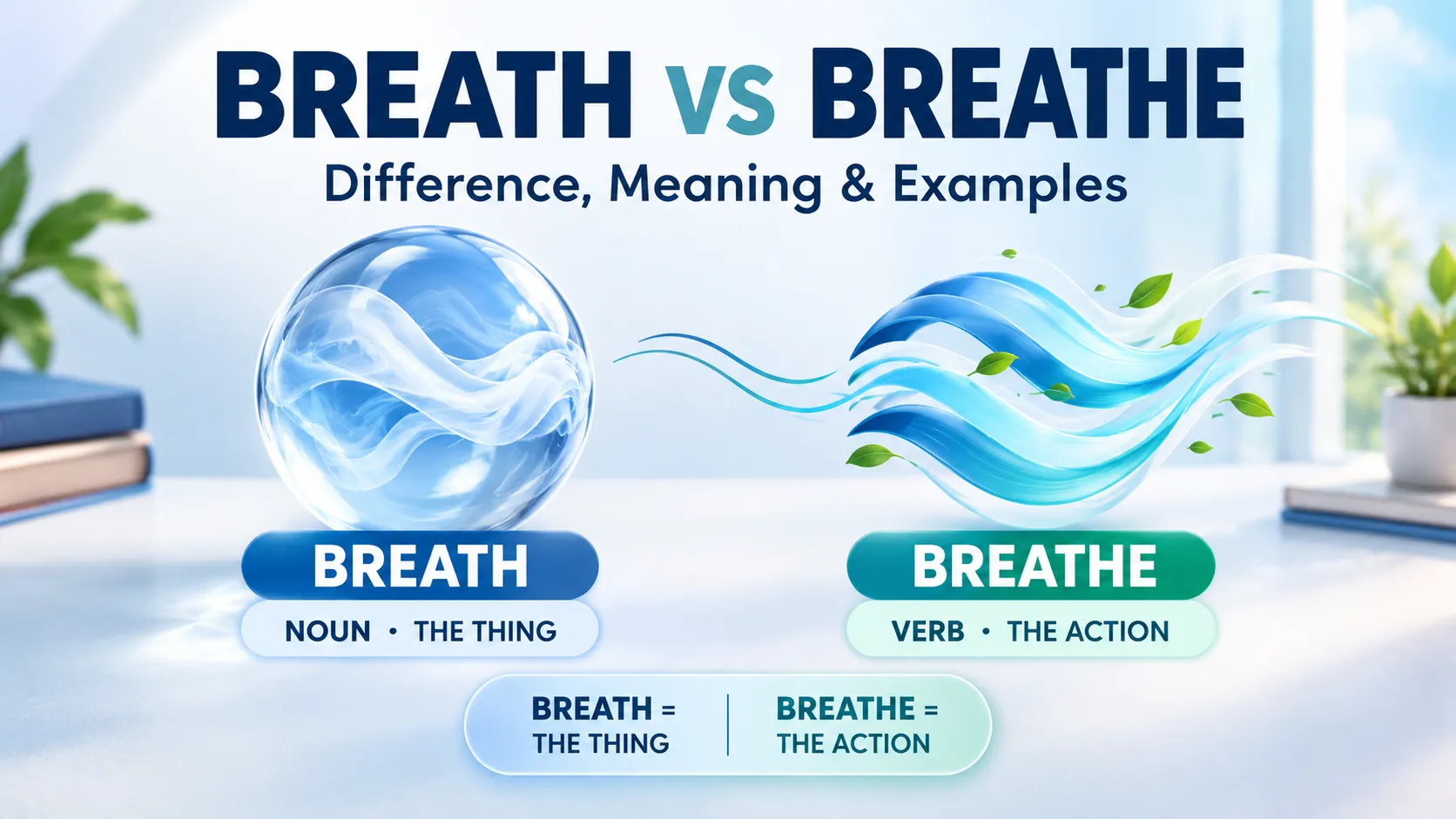
Breath vs Breathe: These two words look almost identical, but they have different meanings and grammatical roles. Breath is a noun that refers to the air you take in or release, while breathe is a verb that means to take air into your lungs and let it out.
The easiest way to remember the difference is:
Breath = the air
.
Breathe = the action
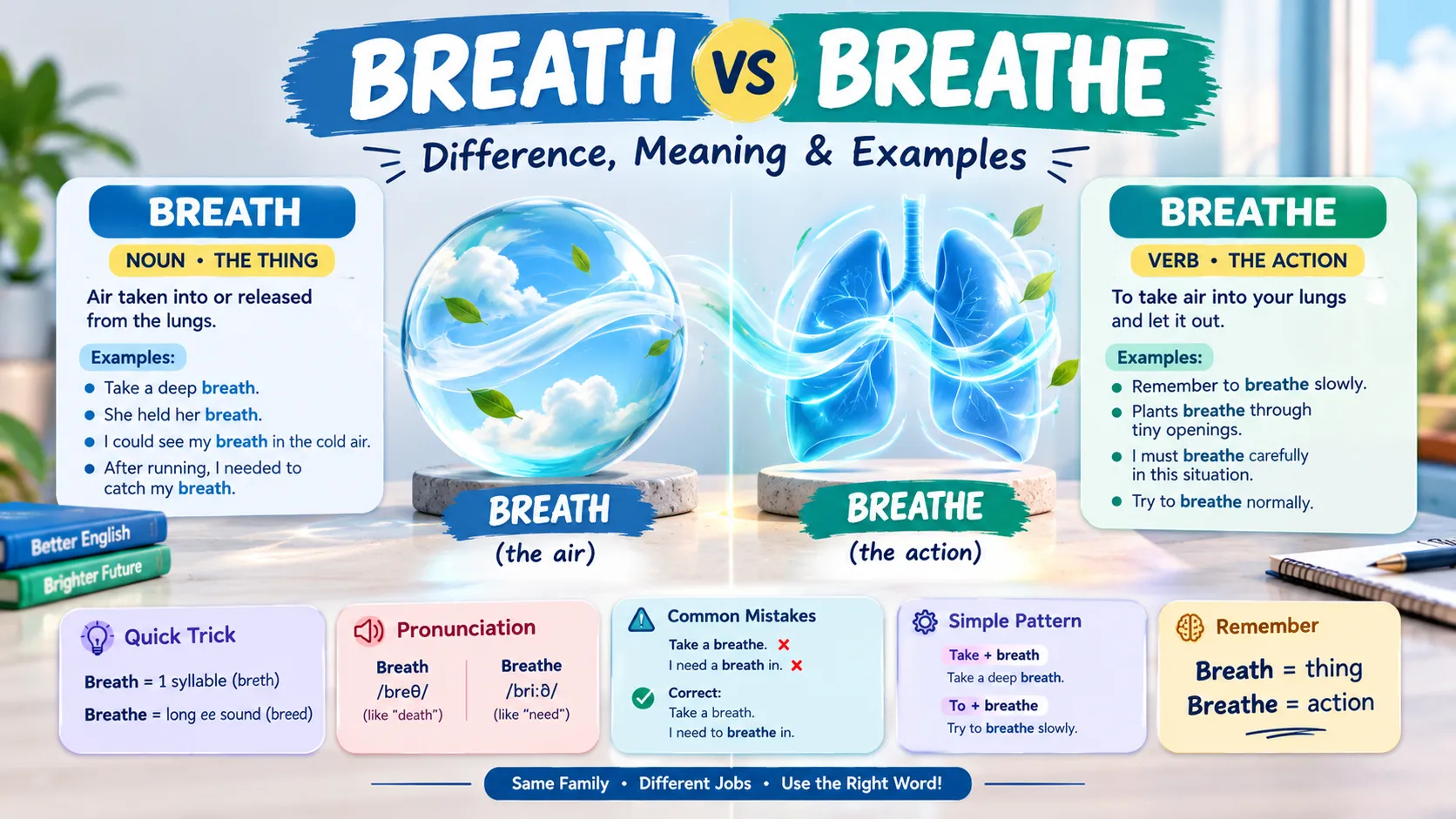
Breath vs. Breathe at a Glance
| Word | Part of Speech | Meaning | Example |
| Breath | Noun | Air taken into or released from the lungs | Take a deep breath. |
| Breathe | Verb | To take in and release air | Try to breathe slowly. |
Quick Trick
Breath has one syllable and sounds like “breth.”
Breathe has a long ee sound and sounds like “breed.”
- Take a breath.
- Breathe deeply.
What Does “Breath” Mean?
Breath is a noun. It refers to the air that enters or leaves your lungs when you breathe.
Examples of Breath
- Take a deep breath.
- She held her breath underwater.
- He took a quick breath before speaking.
- I could see my breath in the cold air.
- After running, I needed to catch my breath.
Because breath is a noun, you can often use words such as a, the, your, my, his, her, or one before it.
Common Expressions With Breath
Take a breath
Take a deep breath and relax.
Hold your breath
He held his breath while waiting for the result.
Catch your breath
We stopped for a minute to catch our breath.
Out of breath
She was out of breath after climbing the stairs.
A breath of fresh air
The new manager was a breath of fresh air.
Explore More: https://wordminto.com/conscience-or-conscious/
What Does “Breathe” Mean?
Breathe is a verb. It describes the action of taking air into your lungs and releasing it.
Examples of Breathe
- Remember to breathe slowly.
- Plants breathe through tiny openings.
- It was difficult to breathe in the smoky room.
- Close your eyes and breathe deeply.
- I could hardly breathe after running.
Because breathe is a verb, it can follow helping verbs such as can, should, will, must, and may.
- You should breathe slowly.
- Try to breathe normally.
- We must breathe carefully in this situation.
- She can breathe more easily now.
Breath or Breathe: The Main Difference
The biggest difference is their part of speech.
Breath names the air or a single act of taking air in or releasing it. Therefore, it works as a noun.
Breathe describes the physical action of taking air in and releasing it. Therefore, it works as a verb.
Compare these sentences:
Take a deep breath.
Here, breath names the air/action as a thing.
Breathe deeply.
Here, breathe describes what you should do.
Simple Pattern
Take + breath
Take a deep breath.
To + breathe
Try to breathe slowly.
This simple pattern can help you choose the correct word quickly.
Explore More: https://wordminto.com/fewer-vs-less/
Breath vs. Breathe Pronunciation
The pronunciation provides another useful clue.
Breath
Breath is pronounced approximately like:
breth
The vowel sound is short, similar to the vowel sound in “death.”
Breathe
Breathe is pronounced approximately like:
breed
The vowel sound is long, similar to the sound in “need.”
The final th also changes:
- breath → /θ/
- breathe → /ð/
The distinction is similar to the difference between the th sounds in think and this.
Why Do Breath and Breathe Look So Similar?
Both words come from the same linguistic family and relate to the act of respiration.
English often forms a verb and noun from related words, but their pronunciation and spelling can change.
In this case:
- breath = noun
- breathe = verb
The extra e in breathe helps distinguish the verb from the noun.
A useful memory association is:
Breath = thing
Breathe = action
Explore More: https://wordminto.com/then-vs-than/
How to Remember Breath vs. Breathe
Try these three memory tricks.
1. Remember “Breathe = Do”
Breathe describes something you do.
I breathe.
Breath describes something you have or take.
I take a breath.
2. Look at the Final E
Breathe ends with e.
Think:
Breathe = action
The word has an extra letter because it represents the verb.
3. Use “Take” as Your Test
If you can put take before the word, you probably need breath.
Take a breath. ✓
Not:
Take a breathe. ✗
If you can put to before the word, you probably need breathe.
to breathe ✓
Not:
to breath ✗
Explore More: https://wordminto.com/affect-or-effect/
Common Mistakes With Breath and Breathe
Mistake 1: Take a Deep Breathe
❌ Take a deep breathe.
✅ Take a deep breath.
Why?
The word follows a, so it needs to function as a noun.
Mistake 2: Remember to Breath
❌ Remember to breath.
✅ Remember to breathe.
Why?
The word follows to and describes an action, so you need the verb breathe.
Mistake 3: I Can’t Breath
❌ I can’t breath.
✅ I can’t breathe.
Why?
After can, use the base form of the verb: breathe.
Mistake 4: Hold Your Breathe
❌ Hold your breathe.
✅ Hold your breath.
Why?
The phrase requires the noun breath.
Mistake 5: She Took a Deep Breathe
❌ She took a deep breathe.
✅ She took a deep breath.
Why?
You take a breath, not a breathe.
Explore More: https://wordminto.com/borrow-or-lend/
Breath or Breathe in Common Phrases
Learning common expressions can make the difference easier to remember.
| Correct Phrase | Incorrect Phrase |
| Take a breath | Take a breathe |
| Hold your breath | Hold your breathe |
| Catch your breath | Catch your breathe |
| Out of breath | Out of breathe |
| Breathe deeply | Breath deeply |
| Breathe slowly | Breath slowly |
| Hard to breathe | Hard to breath |
| Remember to breathe | Remember to breath |
Breath or Breathe in Sentences
Here are several examples showing the difference clearly.
Breath
- Take a deep breath before you begin.
- He held his breath.
- She was out of breath after the race.
- I could see his breath in the freezing air.
- Take another breath and try again.
Breathe
- Try to breathe slowly.
- It is difficult to breathe in this room.
- She stopped running to breathe.
- Remember to breathe during the exercise.
- He could finally breathe normally.
Breath as a Noun
Breath can describe one instance of inhaling or exhaling, the air involved in respiration, or even the smell coming from someone’s mouth.
For example:
She took a deep breath.
Here, breath means one intake of air.
It can also describe someone’s exhaled air:
His breath was visible in the cold.
And it can refer to an unpleasant smell:
I noticed the smell of garlic on his breath.
Breathe as a Verb
Breathe describes the process of taking air into the lungs and releasing it.
It can appear in different verb forms:
- breathe — base form
- breathes — third-person singular
- breathed — past tense
- breathing — present participle
Examples
I breathe slowly.
She breathes deeply.
He breathed a sigh of relief.
They are breathing normally.
Notice that breathed and breathing retain the e pattern differently:
- breathe
- breathed
- breathing
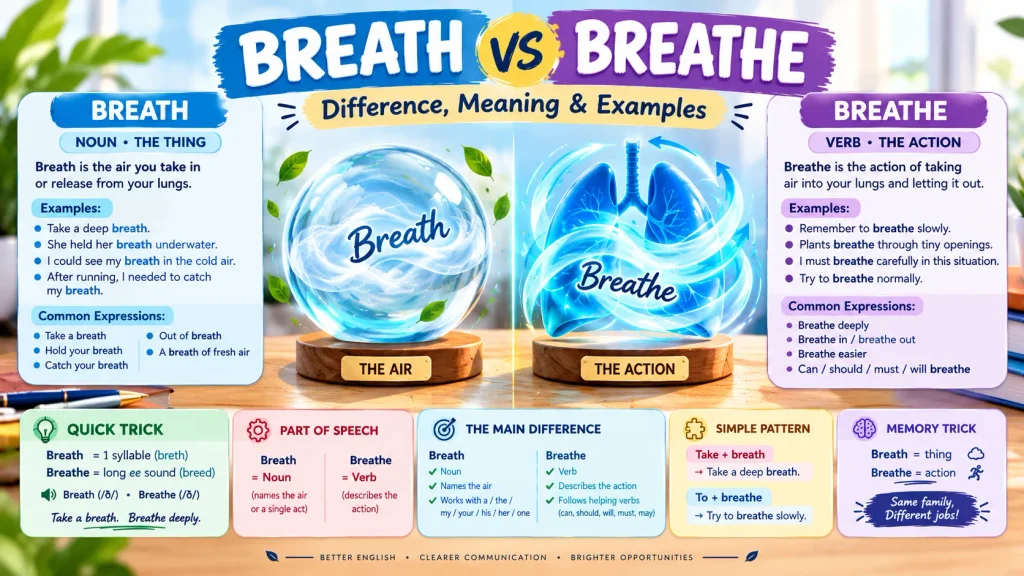
Breath, Breathe, and Breathing
These three forms can confuse learners.
Breath
Noun:
Take a breath.
Breathe
Verb:
Breathe slowly.
Breathing
Verb form or gerund:
Breathing slowly can help you relax.
A useful sequence is:
breath → breathe → breathing
Breath vs. Breathe: Easy Comparison Examples
Compare these pairs:
Take a breath.
Breathe deeply.
She held her breath.
She tried to breathe slowly.
I was out of breath.
I couldn’t breathe easily.
He took another breath.
He began to breathe normally.
The meaning remains closely connected, but the grammatical role changes.
Is “Breath” a Verb?
No. In standard modern English, breath is primarily a noun.
Use breathe when you need the verb.
❌ I need to breath.
✅ I need to breathe.
Is “Breathe” a Noun?
No. Breathe is a verb.
Use breath when you need the noun.
❌ Take a deep breathe.
✅ Take a deep breath.
Breath or Breathe: Which One Should You Use?
Use breath when you are talking about the air or a single intake/exhalation of air.
Take a breath.
Use breathe when you are talking about the action of taking air in and releasing it.
Breathe slowly.
The Fastest Rule
If it is a thing → breath.
If it is an action → breathe.
Quick Quiz: Breath or Breathe?
Choose the correct word in each sentence.
- Take a deep ___ before speaking.
- Remember to ___ slowly.
- She held her ___ underwater.
- I could barely ___ after running.
- He was out of ___.
- Try to ___ normally.
- Take another ___.
- It was difficult to ___ in the smoky room.
- She took a short ___.
- You need to ___ more slowly.
Answers
- breath
- breathe
- breath
- breathe
- breath
- breathe
- breath
- breathe
- breath
- breathe
People Also Ask
The correct phrase is “take a breath.”
Take a deep breath.
Breath functions as a noun.
The correct phrase is “breathe deeply.”
Breathe deeply and slowly.
Breathe functions as a verb.
The correct phrase is “hold your breath.”
Hold your breath for a few seconds.
The correct phrase is “hard to breathe.”
It was hard to breathe after running.
No. They have different pronunciations.
breath → sounds like breth
breathe → sounds like breed
Remember:
Breath = nounBreathe = verb
You take a breath, but you breathe.
Final Takeaway
Breath and breathe have related meanings, but they perform different grammatical jobs.
- Breath is a noun: Take a deep breath.
- Breathe is a verb: Breathe deeply.
- Breath sounds like “breth.”
- Breathe sounds like “breed.”
The simplest rule is:
You take a breath, but you breathe.
Once you remember that breath is the thing and breathe is the action, choosing the correct word becomes much easier.










