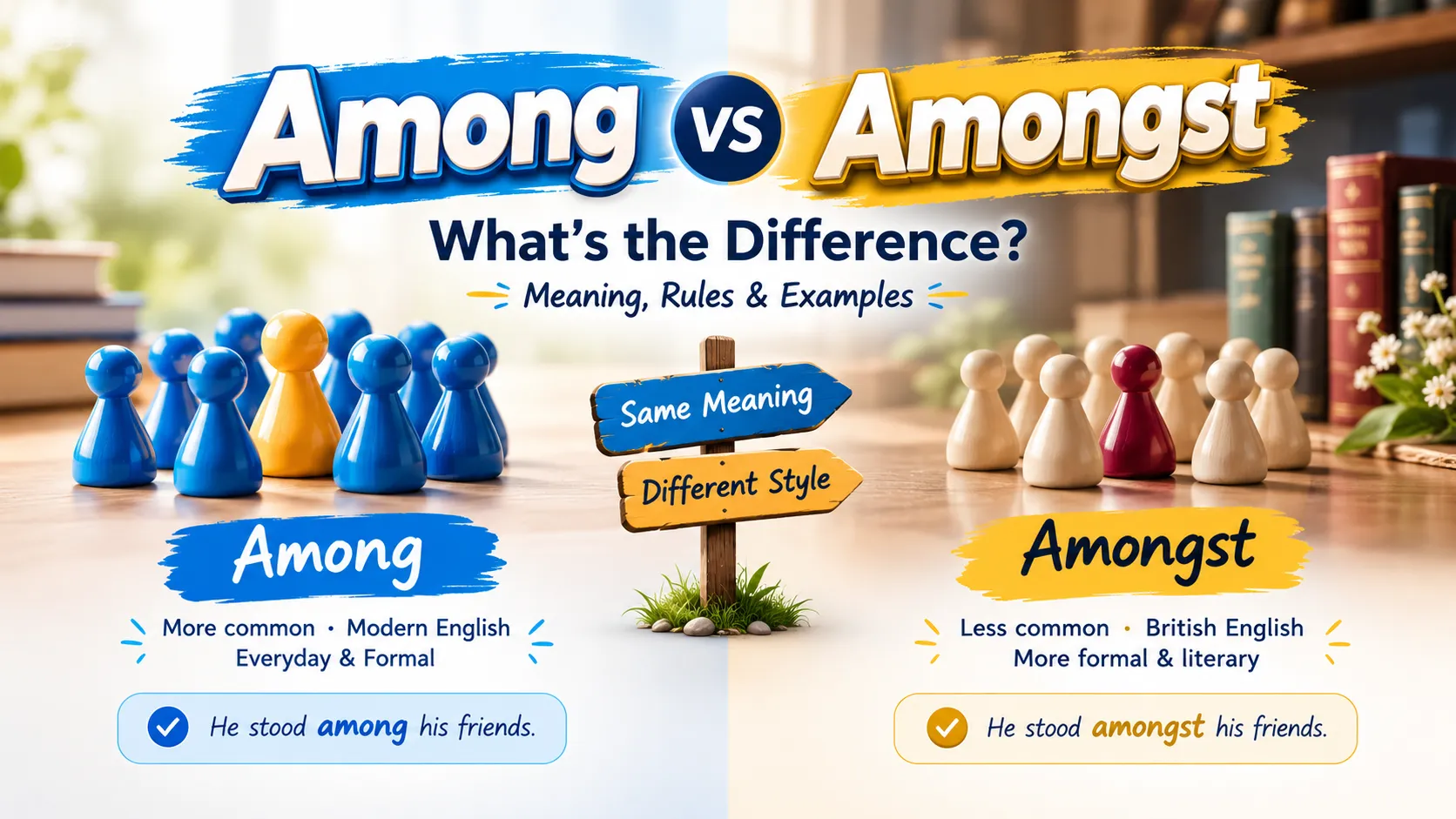
Among vs Amongst: Both words mean “in the middle of,” “surrounded by,” or “included in a group.” They help describe people, objects, or things that form part of a larger group. In most contexts, Among and Amongst have the same meaning and work in the same way.
The main difference involves usage and style. Among is more common in modern English, especially in American English. Amongst appears more often in British English and can sound slightly more formal, literary, or old-fashioned.
For example, you can say, “She stood among her friends” or “She stood amongst her friends.” Both sentences are correct.
In this guide, you will learn the difference between among and amongst, their meanings, grammatical rules, common mistakes, and examples that show when to use each word.
Quick Answer: Among vs Amongst
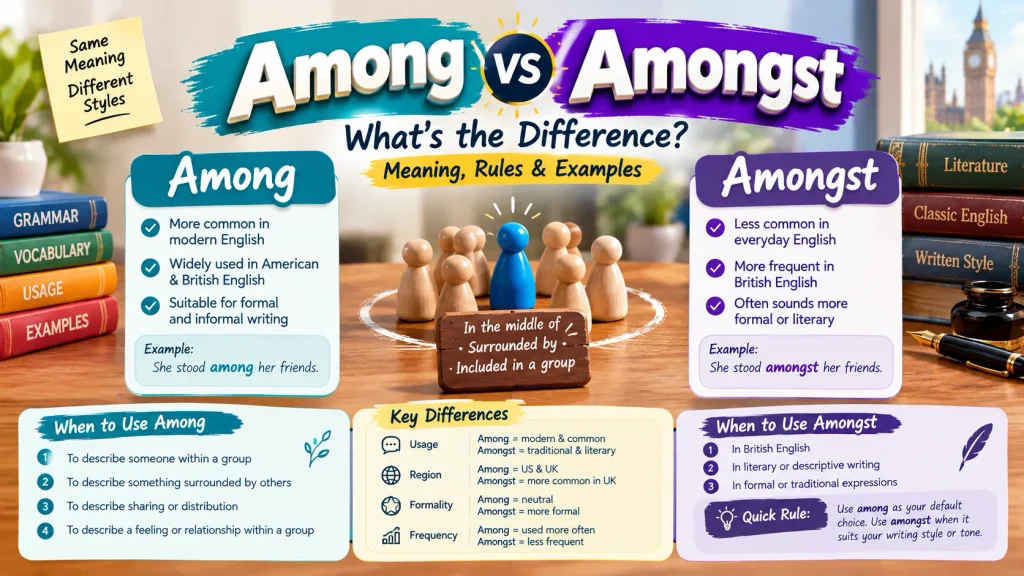
| Among | Amongst |
| More common in modern English | Less common in everyday English |
| Widely used in American and British English | More frequent in British English |
| Suitable for formal and informal writing | Often sounds more formal or literary |
| Example: He sat among his classmates. | Example: He sat amongst his classmates. |
Quick rule: Use among as your default choice. Use amongst when it suits your writing style or matches the tone of your sentence.
What Does Among Mean?
Among is a preposition meaning surrounded by, included in, or associated with a group of people or things.
Use it when someone or something forms part of a larger group rather than standing apart from it.
Examples:
- She felt comfortable among her friends.
- The teacher distributed the worksheets among the students.
- A small cottage stood among the trees.
- He is popular among his colleagues.
- The news spread quickly among the villagers.
In each sentence, among connects a person or thing with a group.
When to Use Among
Use among in these common situations:
1. To describe someone within a group
- She walked among the tourists.
- The child played among the other children.
2. To describe something surrounded by other things
- The house stood among tall trees.
- A red flower grew among the green leaves.
3. To describe sharing or distribution
- They divided the prize money among the winners.
- The manager distributed the tasks among the team members.
4. To describe a feeling or relationship within a group
- Trust is important among friends.
- The proposal received strong support among employees.
Explore More: https://wordminto.com/ms-vs-mrs-vs-miss/
What Does Amongst Mean?
Amongst is also a preposition. It has the same basic meaning as among: surrounded by, included in, or within a group.
The difference is mainly stylistic rather than grammatical. Amongst is more common in British English than American English and may give a sentence a more traditional, literary, or formal tone.
Examples:
- She wandered amongst the flowers.
- The secret remained amongst close friends.
- A narrow path ran amongst the trees.
- The news circulated amongst the villagers.
- He felt at home amongst his colleagues.
These sentences convey essentially the same meanings as their versions with among.
When to Use Amongst
Use amongst when you prefer its sound or when it fits the tone of your writing.
1. In British English
- The children played amongst the autumn leaves.
- The cottage stood amongst the hills.
2. In literary or descriptive writing
- Mist drifted amongst the ancient trees.
- A sense of peace settled amongst the crowd.
3. In formal or traditional expressions
- The matter was discussed amongst the committee members.
- The decision caused disagreement amongst the participants.
These uses are correct, but among would also work in each example.
Explore More: https://wordminto.com/conscience-or-conscious/
Among vs Amongst: Key Differences
Although these words share the same meaning, a few practical differences can help you choose between them.
1. Meaning
Both words describe a position, relationship, or situation within a group.
- Among: The dog ran among the children.
- Amongst: The dog ran amongst the children.
Both sentences describe the dog moving within a group of children.
2. British English vs American English
Both words occur in British and American English, but their frequency differs.
- American English: Among is strongly preferred in everyday communication.
- British English: Both forms are used, although among remains common and amongst is more frequent than in American English.
For example:
- American usage: The decision was popular among voters.
- British usage: The decision was popular amongst voters.
Neither version is inherently incorrect.
3. Formality and Style
Among works naturally in almost any type of writing. Amongst can sound more formal, traditional, or literary, depending on the context.
- Everyday: He felt relaxed among his friends.
- Literary: He felt at peace amongst the ancient ruins.
The distinction is one of tone, not a strict grammatical rule.
4. Frequency
Modern English uses among more frequently than amongst. You will commonly see among in news reports, academic writing, business documents, and everyday conversation.
Amongst remains a valid alternative, particularly in British English and descriptive prose.
5. Grammar
Both words function as prepositions. They can appear before nouns and noun phrases, including plural nouns and collective groups.
- Among the students
- Amongst the students
- Among the options
- Amongst the options
The grammatical structure does not change when you replace one word with the other.
Explore More: https://wordminto.com/fewer-vs-less/
Among vs Amongst Examples
The following examples show how both words work in different contexts.
| With Among | With Amongst |
| She sat among her friends. | She sat amongst her friends. |
| The cabin stood among the trees. | The cabin stood amongst the trees. |
| The teacher shared the books among the students. | The teacher shared the books amongst the students. |
| Trust grew among the team members. | Trust grew amongst the team members. |
| The rumor spread among the villagers. | The rumor spread amongst the villagers. |
| He searched among the old photographs. | He searched amongst the old photographs. |
| The issue sparked debate among experts. | The issue sparked debate amongst experts. |
| She found a letter among the papers. | She found a letter amongst the papers. |
| The bird disappeared among the branches. | The bird disappeared amongst the branches. |
| Happiness spread among the crowd. | Happiness spread amongst the crowd. |
Remember: Both columns contain grammatically acceptable sentences. Choose the version that best matches your preferred style and audience.
How to Use Among and Amongst Correctly
Follow these practical rules to use both words naturally.
Rule 1: Use Among for General Writing
When you are unsure which word to choose, use among. It is widely accepted in formal and informal English.
Examples:
- The survey measured satisfaction among customers.
- She divided the responsibilities among her siblings.
- The topic generated discussion among researchers.
Rule 2: Use Amongst When It Fits Your Style
Choose amongst when you prefer its traditional or literary tone.
Examples:
- The castle stood amongst the mist-covered hills.
- The message passed quietly amongst the guests.
Do not assume that amongst is automatically more correct or more professional.
Rule 3: Keep Your Audience in Mind
For American audiences, among is usually the most natural option. For British audiences, either form works, although among is still a safe default.
Examples:
- American business report: The findings were popular among employees.
- British descriptive writing: Wildflowers bloomed amongst the grasses.
Rule 4: Use the Correct Preposition for the Context
Both words describe relationships within a group. However, they do not automatically replace every other preposition.
For example:
- Correct: She divided the money among the three children.
- Correct: She divided the money amongst the three children.
- Incorrect for the intended meaning: She divided the money between the three children.
The final sentence is not always wrong in English, because between can refer to more than two distinct people or things. However, among is often the more natural choice when discussing a group collectively.
Explore More: https://wordminto.com/breath-vs-breathe/
Among vs Between: What Is the Difference?
Writers often confuse among with between. Both words describe relationships involving people or things, but they emphasize different kinds of relationships.
Among generally describes someone or something within a group.
Between commonly describes a relationship involving distinct individuals, objects, places, or alternatives. It can also refer to more than two clearly distinct parties.
Examples:
- The teacher stood among the students.
- The agreement was between the three companies.
- She found her keys among the clothes.
- The path between the two buildings was narrow.
Use among when you want to emphasize membership in or presence within a group. Use between when you want to emphasize separation, a connection, or a relationship between identifiable parties.
Is Amongst Correct English?
Yes. Amongst is a correct English word. It is not a spelling mistake or a grammatical error.
Although some writers consider it old-fashioned, it continues to appear in modern English, particularly in British usage and literary writing.
Examples:
- The children ran amongst the trees.
- She felt comfortable amongst her peers.
- The issue remained controversial amongst residents.
All three sentences are grammatically correct.
However, among is more common and often sounds more natural in straightforward modern writing.
Explore More: https://wordminto.com/then-vs-than/
Is Among More Formal Than Amongst?
Not necessarily. Among is appropriate for both formal and informal writing. Amongst may sound more traditional or literary, but it does not automatically make a sentence more formal or professional.
Compare these sentences:
- Formal: The findings revealed significant differences among participants.
- Formal: The findings revealed significant differences amongst participants.
Both sentences work. The first is generally the safer choice for academic and professional writing because among is more widely used.
Common Mistakes to Avoid
Avoid these common misunderstandings when using among and amongst.
Mistake 1: Thinking Amongst Is Incorrect
Incorrect belief: “Amongst is not a real English word.”
Correction: Amongst is a valid preposition with the same basic meaning as among.
Mistake 2: Thinking Amongst Is Always More Formal
Incorrect belief: “I should use amongst in every formal document.”
Correction: Among is fully appropriate in academic, professional, and official writing. Choose amongst only when it suits your style.
Mistake 3: Assuming Only British Speakers Use Amongst
Incorrect belief: “Americans never use amongst.”
Correction: American speakers can use amongst, but they generally prefer among.
Mistake 4: Treating the Words as Different in Meaning
Incorrect belief: “Among means within a group, but amongst means surrounded by a group.”
Correction: The words share the same basic meaning. Their main difference concerns usage, frequency, and tone.
Mistake 5: Using Among When Between Is More Precise
Incorrect: The road among the two houses was narrow.
Better: The road between the two houses was narrow.
Use between when you mean the space separating two houses. Use among when you mean a location within a larger group of houses.
Among vs Amongst in Academic Writing
In academic writing, among is usually the better default because it is common, clear, and widely accepted.
Examples:
- Researchers identified differences among the study participants.
- The analysis examined relationships among several variables.
- The survey revealed variations among age groups.
- The researchers observed agreement among the reviewers.
You can use amongst without making a grammatical error, but it may sound less conventional in some academic contexts. Follow your institution’s style guide or the publication’s editorial requirements when they specify a preference.
Among vs Amongst in Everyday Conversation
In everyday conversation, most speakers can use either word without changing the meaning. However, among tends to sound more natural in common expressions.
Examples:
- “I was among the first people to arrive.”
- “She is well-liked among her friends.”
- “There was a lot of excitement among the fans.”
- “He felt comfortable among his classmates.”
You can replace among with amongst in these sentences, but the result may sound more formal or literary to some speakers.
Among vs Amongst in British and American English
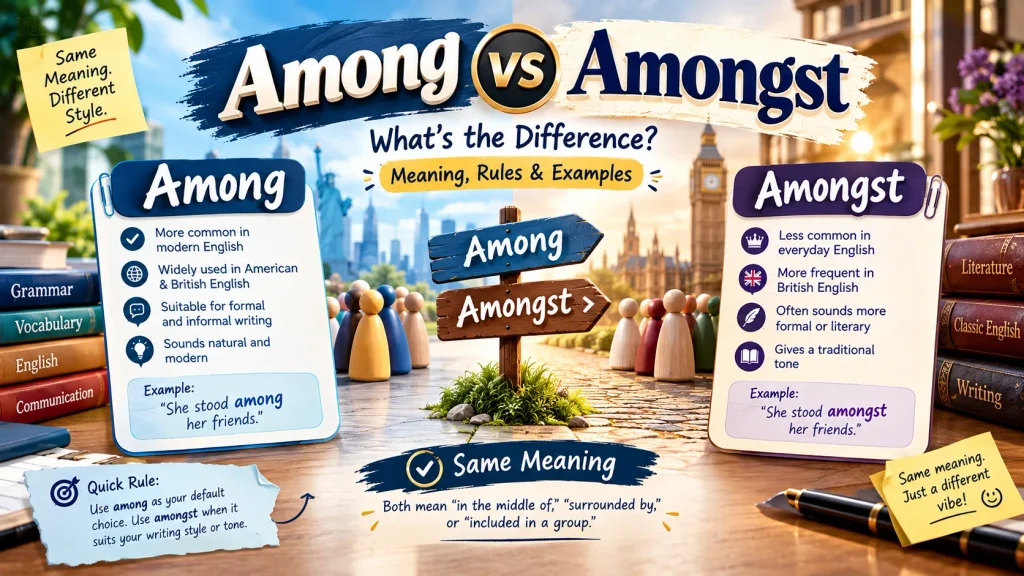
The difference between the two words becomes clearer when you consider regional preferences.
British English
Both words are accepted. Amongst appears more frequently than in American English, especially in descriptive or traditional writing.
Example: The cottage was hidden amongst the trees.
American English
Among is the more common choice in both conversation and writing.
Example: The cottage was hidden among the trees.
For international English
Use among unless you have a specific stylistic reason to choose amongst. This approach keeps your writing natural and accessible to a broad audience.
Synonyms of Among and Amongst
| Alternative | Meaning or use | Example |
| Within | Inside a group or boundary | She felt comfortable within the group. |
| Amid | In the middle of or surrounded by something | The house stood amid the trees. |
| Amidst | A variant of amid | The village lay amidst the hills. |
| In the company of | Together with other people | He relaxed in the company of friends. |
| Surrounded by | Having things or people around you | The house was surrounded by trees. |
| In the midst of | In the middle of a group or situation | She stood in the midst of the crowd. |
Depending on the context, you can replace among or amongst with another word or phrase. These alternatives do not fit every sentence. Choose one that preserves the intended meaning.
Practice Exercise: Among or Amongst?
Choose the word that best completes each sentence. In most cases, both answers are grammatically possible.
- The teacher distributed the papers ___ the students.
- A small village stood ___ the mountains.
- Trust is important ___ friends.
- The rumor spread quickly ___ the villagers.
- She found the missing key ___ the books.
- He felt relaxed ___ his colleagues.
- The bird disappeared ___ the branches.
- The survey examined differences ___ participants.
Answers
- Among
- Among
- Among
- Among
- Among
- Among
- Among
- Among
You could use amongst in all eight sentences without changing their basic meaning. The exercise uses among because it is the more common choice.
People Also Ask
Both words mean “within,” “surrounded by,” or “included in a group.” Among is more common in modern English, while amongst occurs more frequently in British English and can sound more literary or traditional.
Both are correct. Use among as your default choice in most situations, and use amongst when it suits your preferred style.
Amongst is more common in British English. American English generally favors among, although both forms are understood.
Yes. Amongst is grammatically correct in formal writing. However, among is often the more conventional choice for academic papers, business reports, and professional documents.
Yes. In ordinary usage, amongst and among have the same basic meaning. The difference mainly involves regional preference, frequency, and style.
Use among unless your style guide or the tone of your essay calls for amongst. Among is clear, natural, and suitable for academic writing.
Final Verdict: Among vs Amongst
Among and Amongst have the same basic meaning and follow the same grammatical rules. The main difference lies in their frequency, regional usage, and tone.
- Choose Among for everyday conversation, academic writing, business communication, and most other contexts.
- Choose Amongst when you prefer its traditional or literary tone, particularly in British English.
- Remember that both words are correct, and neither is inherently more grammatical than the other.
When in doubt, use among. It is the simplest and most widely accepted choice in modern English.











2 thoughts on “Among vs Amongst: What’s the Difference? Meaning, Rules & Examples”