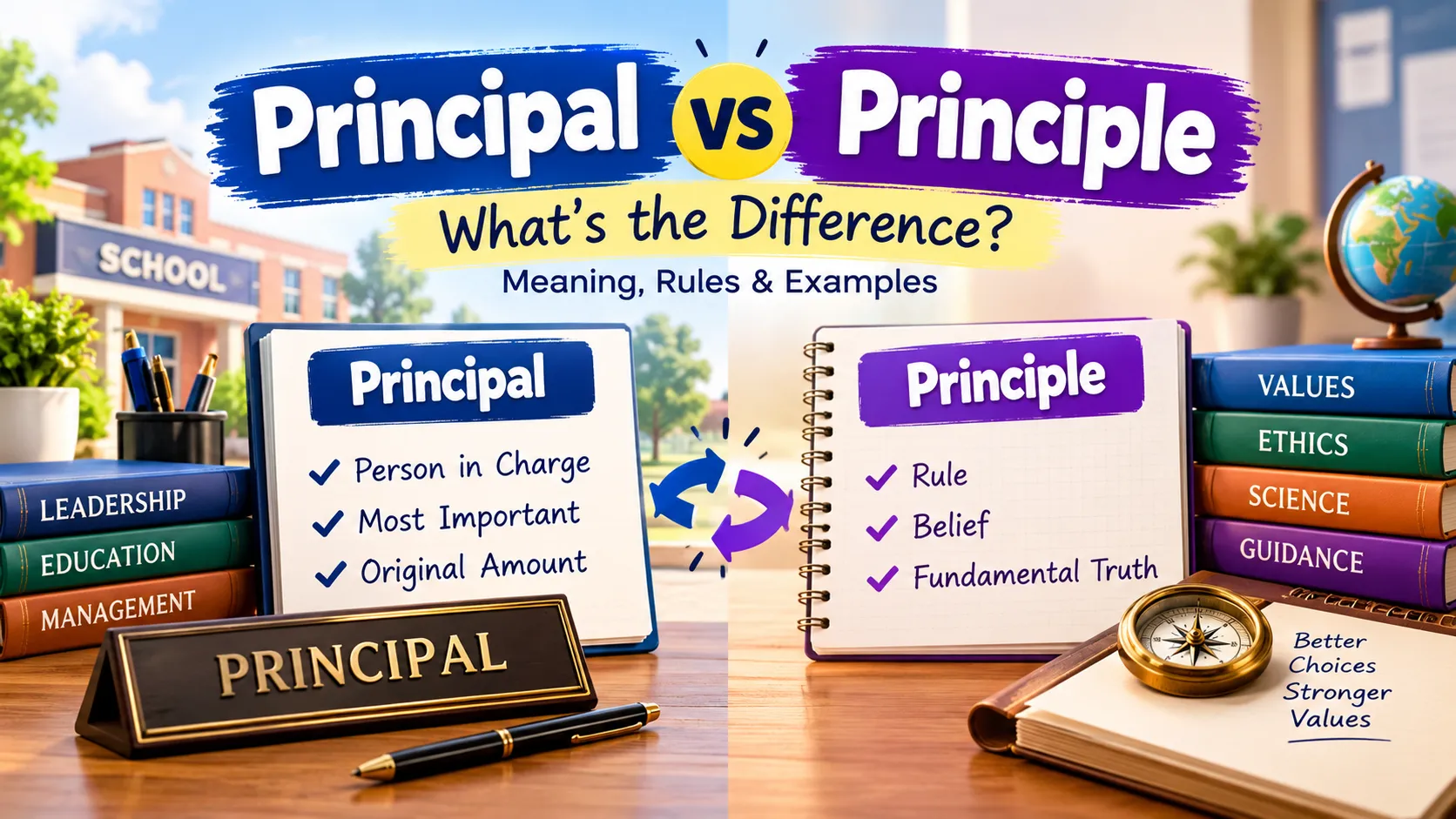
Principal vs principle: These two words sound the same, but they have different meanings and uses. Principal can refer to the head of a school, a person in charge, or something most important. Principle refers to a fundamental rule, belief, value, or truth that guides behavior and decisions.
Although both words sound identical, their spelling and grammatical functions distinguish them. Understanding the difference helps you avoid common spelling mistakes in academic writing, professional communication, and everyday English.
Principal vs Principle: Quick Difference
| Word | Meaning | Example |
| Principal | The head of a school or the most important person or thing | The principal welcomed the new students. |
| Principle | A fundamental rule, belief, or moral value | Honesty is an important principle. |
Easy trick to remember:
- Principal = Person or Primary. Think of a school principal or the principal reason for something.
- Principle = Rule or Belief. Think of moral principles, scientific principles, or guiding values.
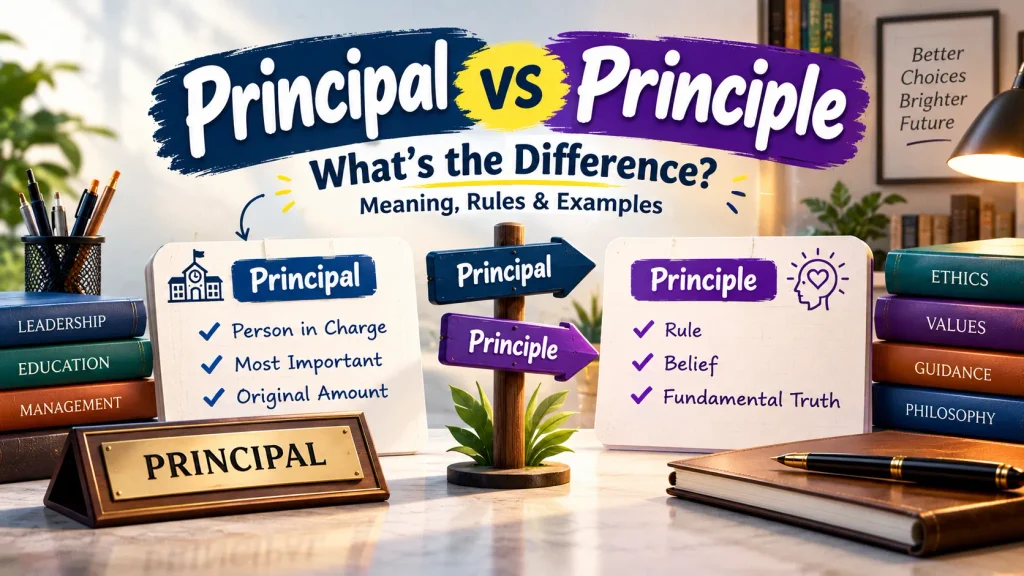
What Does Principal Mean?
Principal is a noun or adjective that refers to a person in charge, something most important, or the original amount of money in a financial arrangement.
1. Principal as a Noun
As a noun, principal commonly refers to the head of a school or the person with the highest authority in a particular situation.
Examples:
- The principal announced the school’s new schedule.
- Our school principal organized a science competition.
- The principal met with the students’ parents.
- The company principal approved the final decision.
In finance, principal also refers to the original amount of money borrowed or invested, excluding interest.
Examples:
- She paid off the principal of her loan.
- The bank calculated interest on the loan’s principal.
- He invested a principal amount of $5,000.
2. Principal as an Adjective
As an adjective, principal means main, primary, or most important.
Examples:
- Education is the principal goal of the program.
- The principal reason for the delay was bad weather.
- Our principal concern is student safety.
- The principal ingredient in this recipe is flour.
In each example, principal identifies the most important person, reason, goal, or ingredient.
Explore More: https://wordminto.com/advisor-vs-adviser/
What Does Principle Mean?
Principle is a noun that means a fundamental rule, belief, value, or general truth. Principles guide people’s behavior, explain how systems work, and establish standards for making decisions.
1. Principle as a Moral Belief
A moral principle is a value that guides how someone behaves or makes decisions.
Examples:
- Honesty is an important principle in every relationship.
- She refused to compromise her principles.
- He follows the principle of treating everyone fairly.
- Integrity is one of the principles that guide our team.
2. Principle as a Fundamental Rule
A principle can also describe a basic rule or idea that explains how something works.
Examples:
- The principle of gravity helps explain why objects fall.
- Students learned the basic principles of mathematics.
- The machine operates on a simple principle.
- The teacher explained the principles of effective communication.
3. Principle in Professional and Academic Contexts
People use principle in science, business, education, law, and other fields to describe foundational ideas or standards.
Examples:
- The company operates according to ethical principles.
- The scientist explained the principle behind the experiment.
- The lawyer discussed the legal principles relevant to the case.
- Good research follows the principles of accuracy and transparency.
Principal vs Principle: Key Differences
Although these words sound alike, their meanings and grammatical uses differ.
| Feature | Principal | Principle |
| Part of speech | Noun or adjective | Noun |
| Main meaning | Person in charge, primary, or original amount | Rule, belief, or fundamental truth |
| School context | The head of a school | A rule or value taught at school |
| Financial context | Original loan or investment amount | A fundamental financial rule |
| Common phrases | School principal, principal reason, principal amount | Moral principle, basic principle, guiding principle |
| Memory clue | Person or Primary | Rule or belief |
Explore More: https://wordminto.com/anyway-vs-anyways/
Principal vs Principle: Example Sentences
These examples show how each word works in everyday English.
Sentences With Principal
- The principal congratulated the winning students.
- Our principal objective is to improve customer service.
- The principal reason for the meeting was to discuss the budget.
- She made a payment toward the principal of her mortgage.
- The principal investigator presented the research findings.
- Safety remains our principal concern.
- The principal character appears in every chapter.
- The principal of the school introduced the guest speaker.
Sentences With Principle
- Honesty is a principle I will never abandon.
- The students studied the principles of physics.
- The company follows the principle of equal opportunity.
- She believes in the principle of fairness.
- The experiment demonstrates a basic scientific principle.
- He refused to act against his principles.
- The teacher explained the principle behind the formula.
- Respect is a guiding principle in our workplace.
Principal vs Principle in School
The school context provides one of the easiest ways to understand the difference.
Principal identifies a person, usually the head of a school.
Principle identifies a rule, belief, or value that guides behavior.
Examples:
- The principal addressed the students during assembly.
- The school teaches the principle of respect.
- The principal believes that discipline supports learning.
- The principle of fairness applies to every student.
Remember: A principal is a person; a principle is an idea or rule.
Explore More: https://wordminto.com/toward-vs-towards/
Principal vs Principle in Business and Finance
Both words appear in professional and financial writing, but they serve different purposes.
Principal in Finance
In finance, principal refers to the original amount borrowed or invested.
For example, if you borrow $10,000, the principal is $10,000 before considering repayments. Interest represents the additional cost of borrowing.
Examples:
- The borrower reduced the principal by making an extra payment.
- The investment earned interest on its principal.
- The lender calculated the remaining principal balance.
Principle in Business
In business, principle refers to a fundamental rule, ethical standard, or concept that guides decisions.
Examples:
- Transparency is a key business principle.
- The manager follows the principle of accountability.
- The company applies the principles of responsible leadership.
Quick distinction: Principal refers to an amount of money; principle refers to a guiding rule or idea.
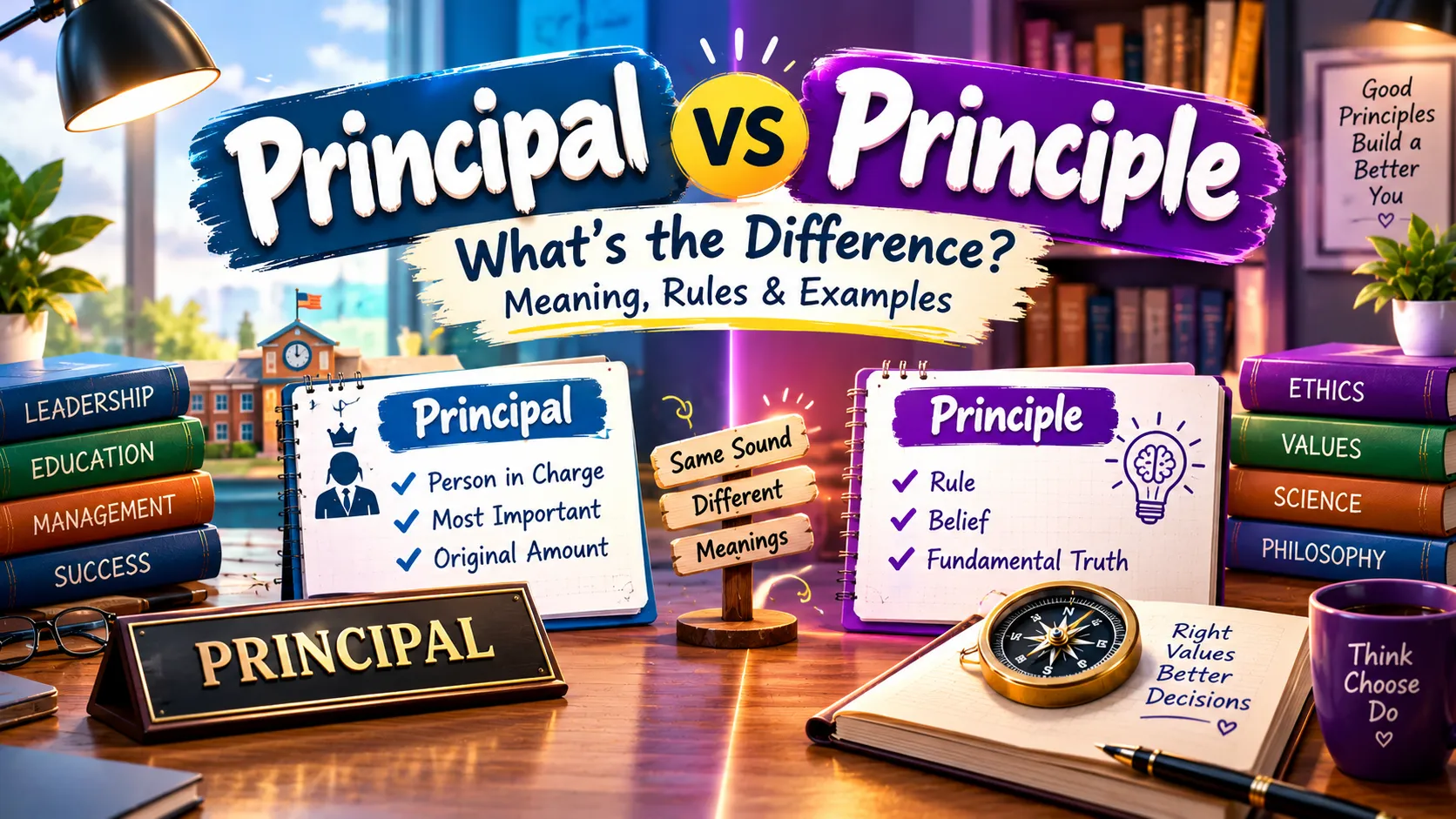
Principal vs Principle: Common Mistakes
Writers often confuse these words because they have the same pronunciation. The following examples show how to correct the most common errors.
| Incorrect sentence | Correct sentence |
| The principle called a meeting. | The principal called a meeting. |
| Honesty is an important principal. | Honesty is an important principle. |
| She paid the principle on her loan. | She paid the principal on her loan. |
| The school principal of fairness matters. | The principle of fairness matters. |
| Our main principle concern is safety. | Our principal concern is safety. |
The correct choice depends on the meaning of the sentence, not its pronunciation.
Explore More: https://wordminto.com/among-vs-amongst/
How to Remember Principal vs Principle
Use these simple memory tricks to choose the correct spelling.
1. Principal = Person
Think of a school principal. Both principal and person begin with the letter P.
Example: The principal welcomed the new teachers.
2. Principal = Primary
When principal works as an adjective, it often means primary or most important.
Example: Our principal objective is to finish the project.
3. Principle = Rule
Think of a principle as a rule, belief, or fundamental idea.
Example: Honesty is a guiding principle.
4. Principle Ends in “-ple”
Connect principle with words such as rule or example to remind yourself that it describes an idea or standard rather than a person.
Example: The principle of equality applies to everyone.
The easiest rule: If you mean a school leader, a primary matter, or an original loan amount, use principal. If you mean a rule, belief, or fundamental truth, use principle.
Principal vs Principle: Synonyms
Learning synonyms can help you recognize each word’s meaning in different contexts.
Synonyms of Principal
When principal means the head of a school or a person in charge:
- Headteacher
- School leader
- Administrator
- Director
principal means most important:
- Main
- Primary
- Chief
- Leading
- Major
When principal refers to money:
- Original amount
- Loan balance, depending on context
- Invested amount, depending on context
Synonyms of Principle
Depending on the context, synonyms include:
- Rule
- Belief
- Standard
- Value
- Doctrine
- Fundamental
- Guideline
- Truth
These words do not always replace principal or principle directly. Choose a synonym that preserves the intended meaning.
Explore More: https://wordminto.com/lay-or-lie/
Practice Quiz: Principal vs Principle
Test your understanding by choosing the correct word in each sentence.
- The school ______ welcomed the new students.
- Honesty is an important ______ in any relationship.
- The borrower made an extra payment toward the loan’s ______.
- Our ______ goal is to improve customer satisfaction.
- The scientist explained the basic ______ of the experiment.
- The ______ reason for the cancellation was bad weather.
- She refused to compromise her moral ______.
- The teacher introduced the new ______ investigator.
Answers and Explanations
- Principal — A principal leads a school.
- Principle — Honesty is a moral value.
- Principal — Principal refers to the original loan amount.
- Principal — Here, principal means main or primary.
- Principle — A principle is a fundamental rule or idea.
- Principal — Principal means the main reason.
- Principles — Moral principles are beliefs that guide behavior.
- Principal — A principal investigator leads or directs a research project.
People Also Ask
Both spellings are correct, but they have different meanings. Principal refers to a person in charge, something most important, or an original financial amount. Principle refers to a fundamental rule, belief, or truth.
The correct spelling is principal. A school principal is the person who leads or manages a school.
Example: The principal spoke to the students after assembly.
The correct word is principle because honesty is a moral value that guides behavior.
Example: Honesty is an important principle in professional life.
The correct expression is principal amount. In finance, principal means the original amount of money borrowed or invested.
Yes. As an adjective, principal means main, primary, or most important.
Example: The principal cause of the problem was poor communication.
Yes. The plural form is principles. It refers to multiple rules, beliefs, or fundamental ideas.
Example: The organization follows strict ethical principles.
Final Verdict: Principal vs Principle
The difference between principal and principle becomes simple when you focus on their meanings.
- Principal: A school leader, a primary or most important person or thing, or the original amount of a loan or investment.
- Principle: A fundamental rule, belief, moral value, or truth.
Remember “principal = person or primary” and “principle = rule or belief.” This simple distinction will help you spell both words correctly in school assignments, professional documents, financial discussions, and everyday writing.











4 thoughts on “Principal vs Principle: What’s the Difference? Meaning, Rules & Examples”