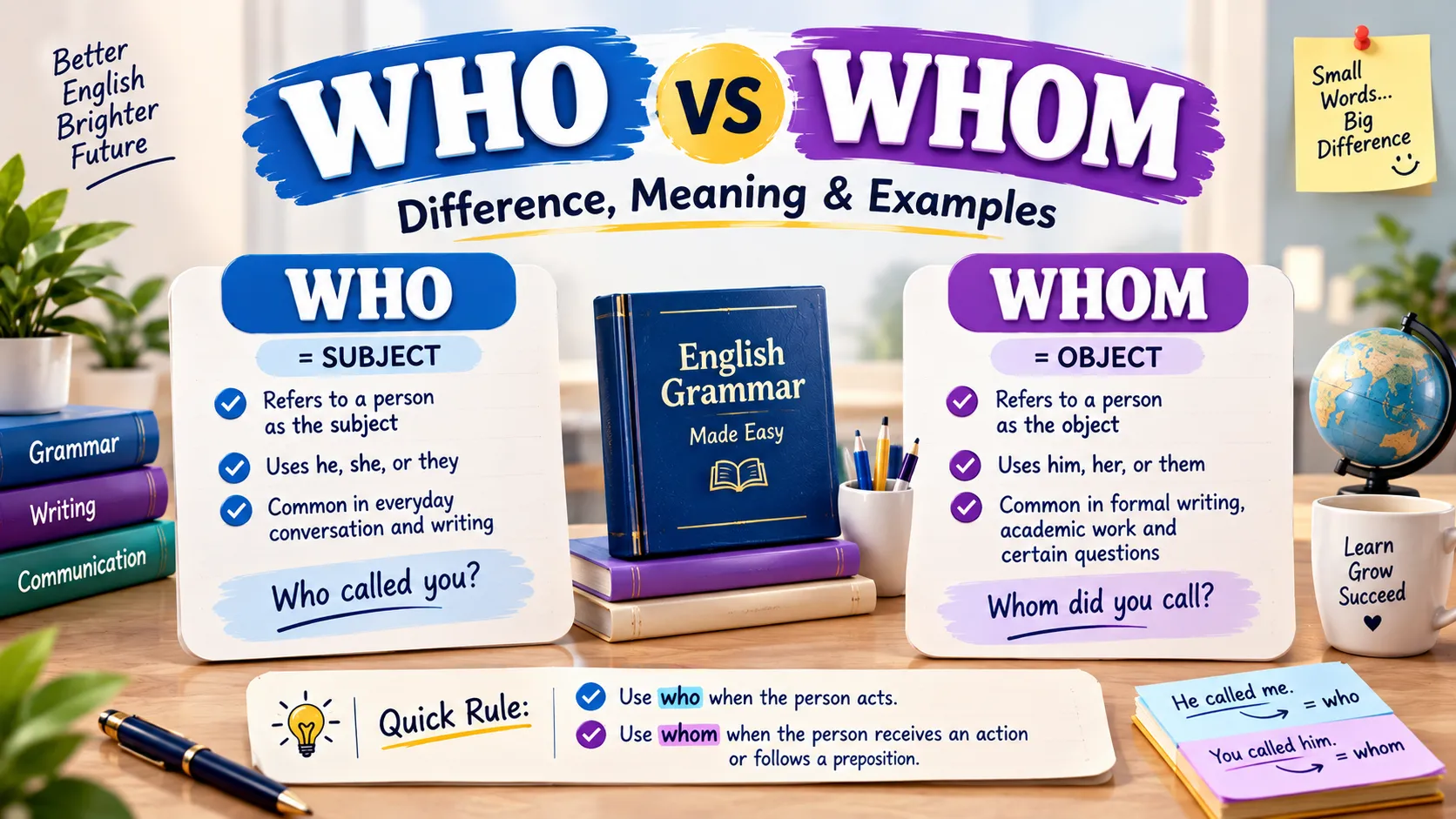
Who vs whom: Both words refer to people, but they serve different grammatical roles. Who acts as the subject of a sentence or clause, while whom acts as the object of a verb or preposition. The easiest way to choose the correct word is to check whether you can replace it with he or she or him or her.
Although who appears more frequently in everyday English, whom still plays an important role in formal writing, academic work, and professional communication. Understanding the difference helps you write clearer sentences and avoid common grammar mistakes.
Who vs Whom: Quick Difference
| Feature | Who | Whom |
| Meaning | Refers to a person as the subject | Refers to a person as the object |
| Grammatical role | Subject | Object |
| Pronoun test | He, she, or they | Him, her, or them |
| Common usage | Everyday conversation and writing | Formal writing and certain questions |
| Example | Who called you? | Whom did you call? |
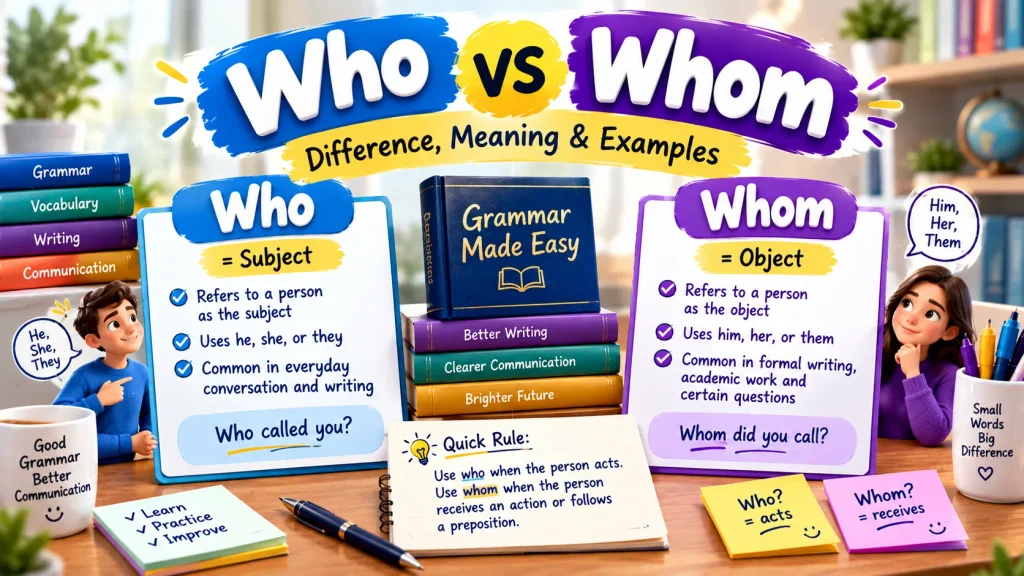
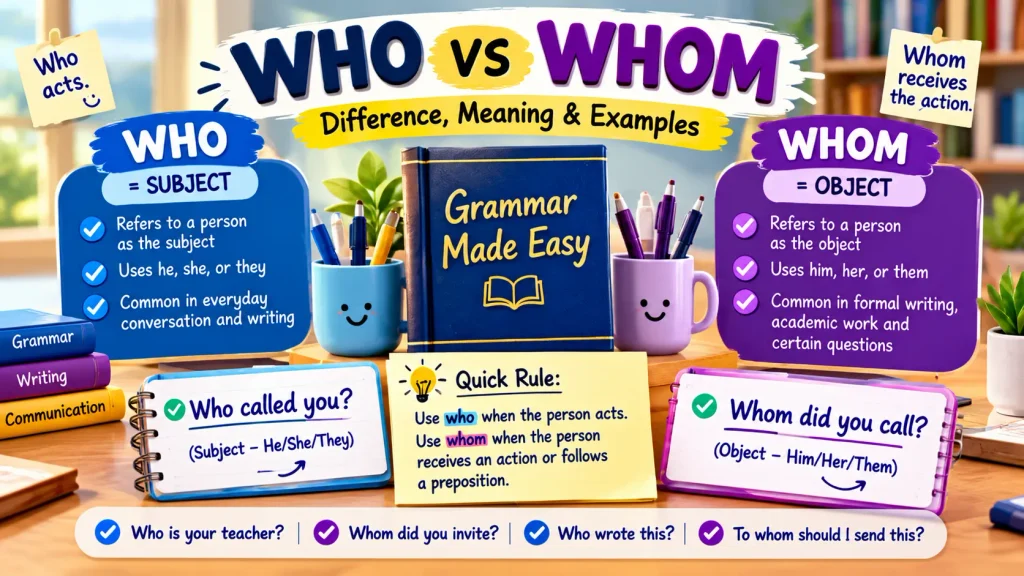
Quick rule: Use who when the person acts. Use whom when the person receives an action or follows a preposition.
What Does Who Mean?
Who is an interrogative or relative pronoun that refers to a person acting as the subject of a verb.
Use who when you want to identify the person acting or when you introduce a clause that describes someone.
Examples of Who in Sentences
- Who called me last night?
- Who is your English teacher?
- Who wrote this article?
- Who wants to join us?
- I know who won the competition.
- She is the woman who helped me.
- Who broke the window?
- Do you know who lives here?
In each example, who functions as the subject of a verb within its clause.
When Should You Use Who?
Use who in these situations:
- As the subject of a question: Who opened the door?
- As the subject of a statement: I know who opened the door.
- To identify a person: Who is standing outside?
- To introduce a relative clause: The student who answered correctly received a prize.
Remember that the position of who does not determine its grammatical role. Its function within the clause does.
Explore More: https://wordminto.com/ms-vs-mrs-vs-miss/
What Does Whom Mean?
Whom is an interrogative or relative pronoun that refers to a person functioning as the object of a verb or preposition.
Use whom when someone receives an action or when a preposition such as to, for, with, or about refers to that person.
Examples of Whom in Sentences
- Whom did you invite to the party?
- To whom should I send this email?
- Whom did the manager select?
- With whom are you traveling?
- For whom did you buy this gift?
- I know whom she recommended.
- The person whom you called is my brother.
- Whom are they waiting for?
In these sentences, whom functions as an object rather than the subject.
When Should You Use Whom?
Use whom in these situations:
- As the object of a verb: Whom did you meet?
- After a preposition: To whom did you speak?
- As the object in a relative clause: The woman whom I hired has excellent qualifications.
- In formal questions: Whom do you recommend for the position?
In everyday conversation, many English speakers use who instead of whom in questions such as “Who did you meet?” Formal writing may favor whom in that position.
Explore More: https://wordminto.com/conscience-or-conscious/
The Easiest Trick to Remember Who vs Whom
The simplest way to distinguish these words is to replace them with personal pronouns.
- If he, she, or they fits, use who.
- If him, her, or them fits, use whom.
This method works because who behaves like a subject pronoun, while whom behaves like an object pronoun.
Examples Using the Pronoun Trick
Example 1: Who called you?
Answer: He called you.
Because he fits, who is correct.
Example 2: Whom did you call?
Answer: You called him.
Because him fits, whom is correct in formal English.
Example 3: Who is coming to dinner?
Answer: She is coming to dinner.
Because she fits, who is correct.
Example 4: Whom did Sarah invite?
Answer: Sarah invited them.
Because them fits, whom is correct in formal English.
Who vs Whom in Questions
Questions often confuse English learners because both words can appear at the beginning of a sentence.
The correct choice depends on the role of the person within the question, not simply on the first word.
| Correct sentence | Explanation |
| Who called you? | Who acts. |
| Whom did you call? | Whom receives the action. |
| Who helped Sarah? | Who performs the action. |
| Whom did Sarah help? | Whom receives the action. |
| Who is speaking? | Who is the subject. |
| Whom are you speaking to? | Whom is the object of the preposition to in formal usage. |
Why Do People Say “Who Did You Call?”
In modern spoken English, people frequently use who in place of whom, even when the pronoun functions as an object.
For example, both of these sentences communicate the same question:
- Who did you call?
- Whom did you call?
The second version follows the traditional formal distinction. The first sounds more natural in most everyday conversations.
Explore More: https://wordminto.com/principal-vs-principle/
Who vs Whom After Prepositions
Traditional grammar uses whom after prepositions such as to, with, for, from, and about when the pronoun refers to a person.
Examples
- To whom did you give the keys?
- With whom did you attend the meeting?
- For whom is this package?
- About whom were they talking?
- From whom did you receive the message?
In these examples, whom serves as the object of the preposition.
Can You Use Who After a Preposition?
In informal English, speakers sometimes use who in sentences where traditional formal grammar expects whom. However, formal writing usually retains whom after a preposition.
Compare:
- Formal: To whom did you speak?
- Informal: Who did you speak to?
Both are widely understood. The first sounds more formal, while the second sounds more conversational.
Explore More: https://wordminto.com/fewer-vs-less/
Who vs Whom in Relative Clauses
Relative clauses provide additional information about a person. Both who and whom can introduce these clauses, depending on the pronoun’s grammatical role.
Use Who as the Subject
- The teacher who explained the lesson is excellent.
- I met a woman who works at the hospital.
- The student who won the award is my friend.
- He is the person who manages the department.
In each sentence, who performs the action described by the verb.
Use Whom as the Object
- The teacher whom I thanked was pleased.
- The woman whom we met works at the hospital.
- The student whom the principal praised won an award.
- He is the person whom everyone admires.
Here, the pronoun receives an action or functions as an object within its clause.
Can You Omit Whom?
Yes. English often allows speakers and writers to omit an object relative pronoun when the meaning remains clear.
For example:
- The person whom I called answered.
- The person I called answered.
Both sentences are correct. The second version sounds more natural and concise in many contexts.
Explore More: https://wordminto.com/breath-vs-breathe/
Who vs Whom in Formal and Informal English
The distinction between who and whom remains useful, but actual usage varies by context.
| Context | Preferred usage | Example |
| Casual conversation | Who | Who did you meet? |
| Text messages | Who | Who are you going with? |
| Formal correspondence | Whom where appropriate | To whom it may concern |
| Academic writing | Traditional subject-object distinction | Whom did the researchers interview? |
| Professional interviews | Either, depending on sentence structure | Who interviewed you? |
| Everyday questions | Often who | Who are you talking to? |
Formal writing often preserves whom after prepositions and as the object of a verb. Informal English tends to favor who, particularly in questions.
Do not assume that whom always sounds better. Correctness, clarity, and the expectations of your audience should guide your choice.
Common Mistakes With Who and Whom
Learning the rules becomes easier when you recognize frequent errors.
Mistake 1: Using Whom as a Subject
Incorrect: Whom called you yesterday?
Correct: Who called you yesterday?
Why? The person performs the action of calling, so the pronoun acts as the subject.
Mistake 2: Using Who as an Object in Formal Writing
Traditional formal usage: Whom did you invite?
Less formal usage: Who did you invite?
The second sentence is widely accepted in everyday English. The first follows the traditional subject-object distinction and suits formal contexts.
Mistake 3: Choosing Whom Just Because It Sounds Formal
Incorrect: Whom is responsible for this project?
Correct: Who is responsible for this project?
Why? The pronoun serves as the subject of is responsible. Formality does not change its grammatical function.
Mistake 4: Forgetting the Preposition
Traditional formal usage: With whom are you working?
Informal alternative: Who are you working with?
Both are natural in their respective contexts. Use the first when you want a more formal construction.
Mistake 5: Looking Only at the Main Sentence
Consider this sentence:
I know who completed the assignment.
Here, who acts as the subject of completed, even though the entire clause “who completed the assignment” serves as the object of know.
Why? You must examine the pronoun’s role inside its own clause, rather than its role in the sentence as a whole.
Who vs Whom: Examples in Everyday English
These examples demonstrate how each word works in common situations.
At School
- Who answered the question?
- Whom did the teacher choose as class representative?
- Who is teaching mathematics today?
- Whom did you ask for help?
At Work
- Who prepared the report?
- Whom should I contact about the meeting?
- Who manages this department?
- Whom did the company appoint as director?
In Daily Conversation
- Who is at the door?
- Whom did you see at the mall?
- Who wants some coffee?
- Whom are you waiting for?
In Writing
- Who wrote this book?
- To whom should I address the letter?
- The author who wrote this novel lives nearby.
- The author whom the publisher contacted accepted the offer.
Who vs Whom in Indirect Questions
An indirect question reports or embeds a question within another statement. The same subject-object rule applies.
Examples:
- I wonder who called you.
- Do you know who won the match?
- Tell me whom you invited.
- She asked whom the manager had selected.
- I cannot remember who sent the package.
- We need to determine whom the committee appointed.
Notice that who and whom do not always appear at the beginning of an indirect question. Their grammatical roles still determine the choice.
Who vs Whom in Relative Pronouns and Prepositional Phrases
Prepositional phrases can change how a sentence sounds, but they do not remove the subject-object distinction.
Compare these examples:
Who:
- The employee who spoke to the director received a promotion.
- The friend who lives next door is visiting us.
Whom:
- The employee to whom I spoke received a promotion.
- The friend whom I invited lives next door.
In the first pair, who performs the action within its clause. In the second pair, whom functions as the object of a verb or preposition.
Who vs Whom: Practice Exercises
Choose the correct word in each sentence. Use the subject-object test to help you decide.
- _____ is knocking at the door?
- _____ did you invite to your birthday party?
- To _____ should I send the application?
- The woman _____ helped me was very kind.
- _____ did the manager promote?
- I know _____ completed the project.
- With _____ are you traveling?
- The student _____ the teacher praised felt proud.
- _____ wants to participate in the competition?
- For _____ did you purchase this gift?
- The person _____ called earlier left a message.
- _____ are you waiting for?
Answers and Explanations
- Who — The person performs the action of knocking.
- Whom — The person receives the action of inviting in traditional formal grammar.
- Whom — The pronoun follows the preposition to.
- Who — The pronoun acts as the subject of helped.
- Whom — The person receives the action of promoting in traditional formal grammar.
- Who — The pronoun acts as the subject of completed.
- Whom — The pronoun follows the preposition with.
- Whom — The student receives the teacher’s praise in traditional formal grammar.
- Who — The pronoun acts as the subject of wants.
- Whom — The pronoun follows the preposition for.
- Who — The pronoun acts as the subject of called.
- Whom — Traditional formal grammar uses whom as the object of for. In everyday conversation, “Who are you waiting for?” is more common.
People Also Ask
Both words are correct, but they have different grammatical functions. Use who as the subject of a verb and whom as the object of a verb or preposition in traditional grammar.
Replace the word with he or she, and then try him or her. If the subject pronoun fits, choose who. If the object pronoun fits, choose whom.
For example, “Who called?” becomes “He called,” while “Whom did you call?” becomes “You called him.”
Yes. “Who did you call?” is standard, widely accepted English, especially in conversation. “Whom did you call?” follows the traditional formal distinction.
No, not in standard grammar. The correct question is “Who is this?” because the pronoun functions as the subject complement in this construction.
Use whichever construction fits the sentence and the formality of your email. For example, “Who is responsible for this task?” is correct, while “To whom should I send the report?” suits formal correspondence.
Conclusion
The difference between who and whom comes down to grammatical function. Use who for the subject—the person performing an action. Use whom for the object—the person receiving an action or following a preposition in traditional grammar.
Remember the simple test: who = he or she; whom = him or her. In everyday conversation, who often replaces whom in object questions, but knowing the traditional distinction helps you write accurately in formal, academic, and professional contexts.
Fix the Whom Preposition Examples: Clarify Modern Whom Usage











1 thought on “Who vs Whom: What’s the Difference? Meaning, Rules & Examples”