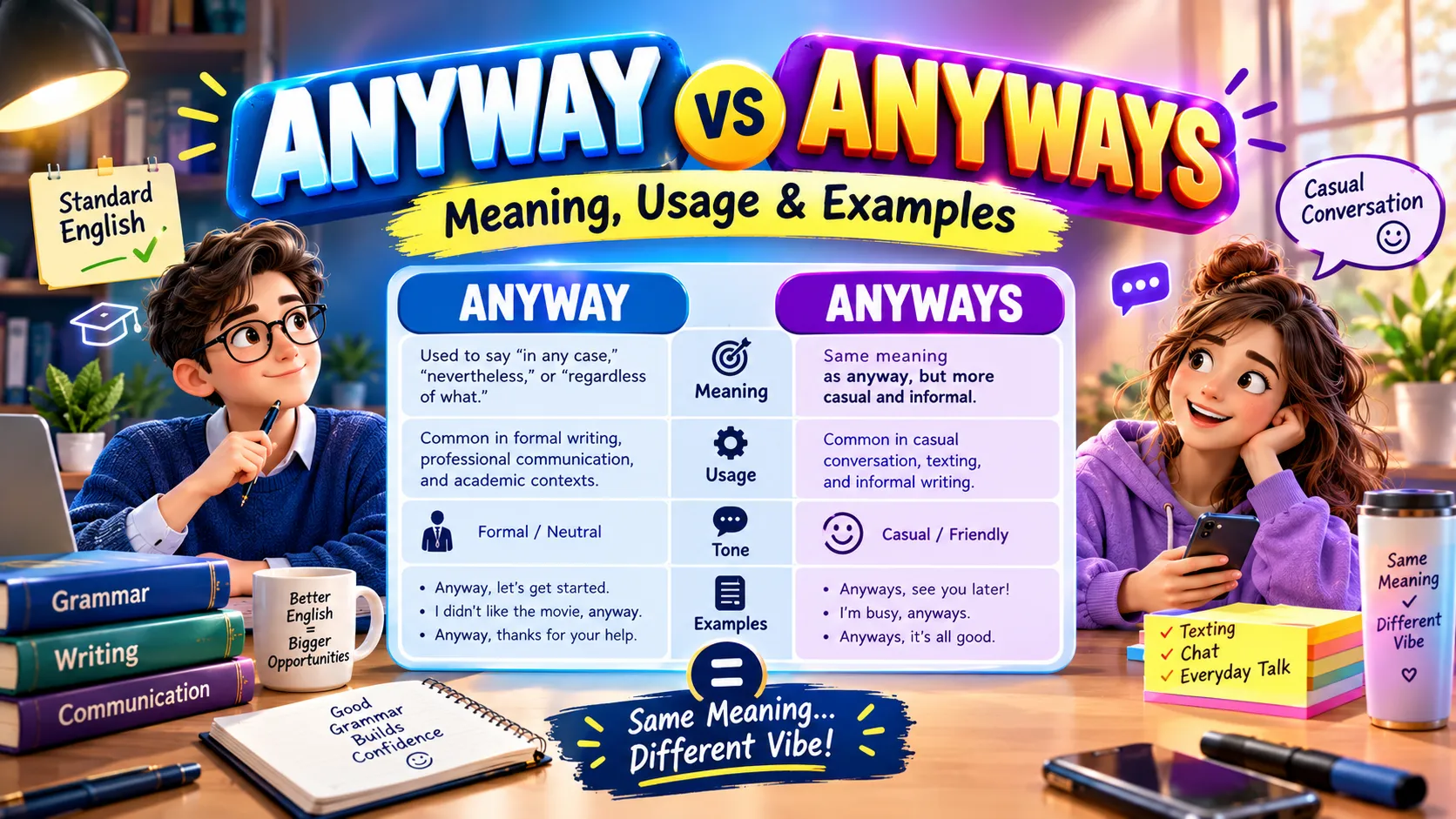
Anyway vs Anyways: Both words can mean “in any case” or help someone return to a previous topic, change the subject, or continue a conversation. However, anyway is the standard form in formal and informal English, while anyways is an informal variant that appears more often in casual speech and conversation.
Although many people use both words interchangeably, anyway works best in academic writing, professional communication, and formal contexts. Anyways often sounds conversational and may feel less appropriate in formal writing.
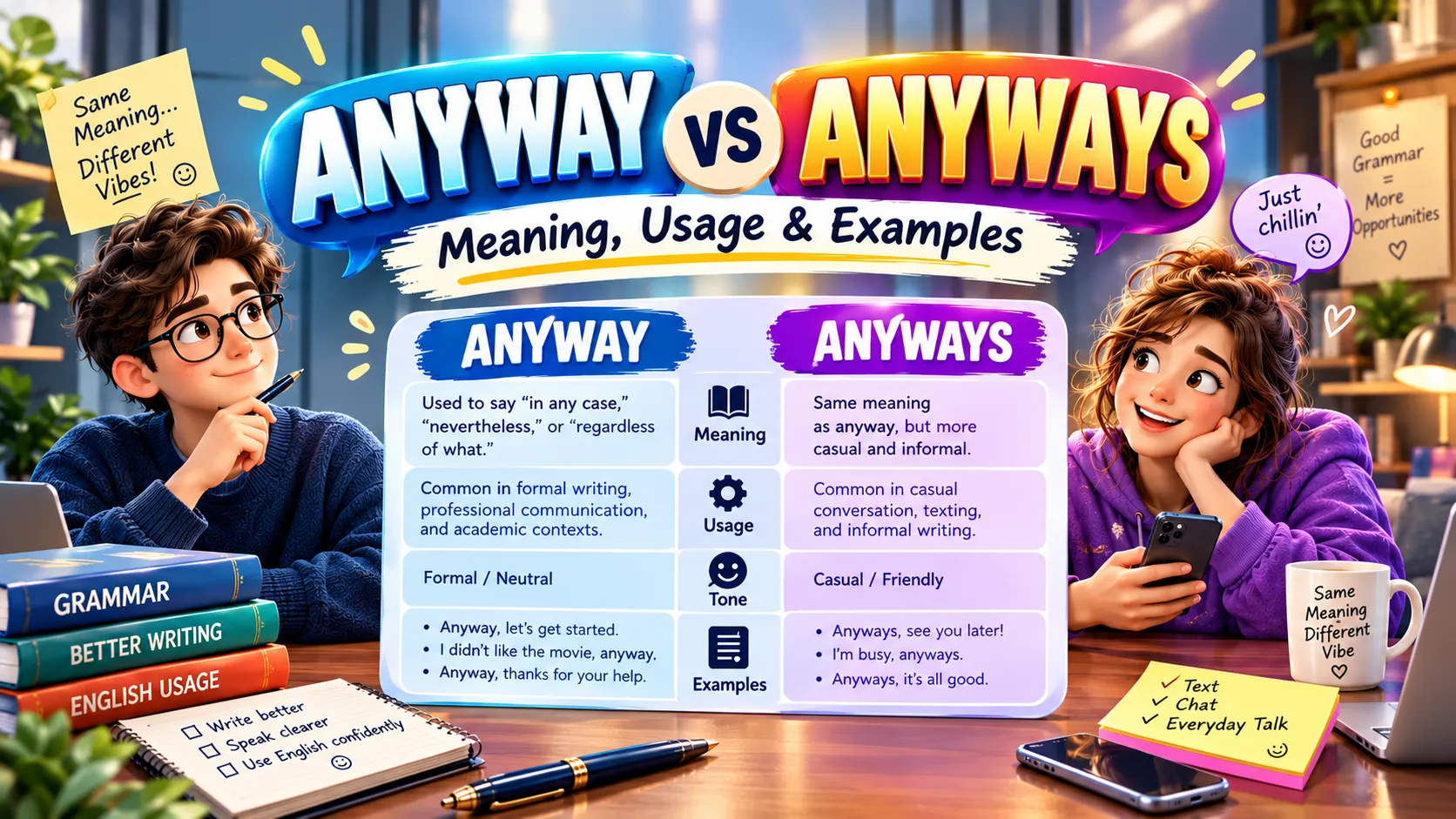
Quick Answer: Anyway vs Anyways
| Anyway | Anyways |
| Standard English adverb | Informal variant of anyway |
| Works in formal and informal English | Mainly used in casual conversation |
| Common in academic and professional writing | Common in everyday speech, texting, and informal messages |
| Example: “Anyway, let’s begin.” | Example: “Anyways, let’s begin.” |
Easy rule: Use anyway when you want a safe choice in any situation. Use anyways in casual conversation if it fits your natural speaking style.
What Does Anyway Mean?
Anyway is an adverb that means “in any case,” “regardless,” or “despite what has happened.” Speakers also use it to return to a previous topic, introduce a new subject, or conclude a discussion.
Examples of Anyway in Sentences
- Anyway, we should finish the project today.
- I was tired, but I went to the gym anyway.
- The weather looks bad, but we’re going anyway.
- Anyway, what were you saying about your trip?
- I don’t really like that restaurant. Anyway, let’s try something new.
In each sentence, anyway helps express continuation, contrast, or a shift in conversation.
Explore More: https://wordminto.com/toward-vs-towards/
What Does Anyways Mean?
Anyways is an informal variant of anyway. It usually carries the same meaning, but it often sounds more conversational. People commonly use it in casual conversations, text messages, social media posts, and relaxed discussions.
Although anyways has a long history of use, many style guides prefer anyway in standard written English.
Examples of Anyways in Sentences
- Anyways, I’ll see you tomorrow.
- I didn’t want to go, but I went anyways.
- Anyways, let’s talk about something else.
- She was busy, but she helped me anyways.
- Anyways, what happened after the meeting?
These examples reflect common informal usage. In formal writing, you can usually replace anyways with anyway without changing the meaning.
Anyway vs Anyways: Key Differences
The main difference between anyway and anyways involves formality, style, and standard usage rather than meaning.
1. Formality
Anyway fits both formal and informal situations. Anyways generally suits casual speech and relaxed writing.
- Formal: Anyway, we must consider the available evidence.
- Informal: Anyways, let’s grab some food.
2. Grammar
Both words function as adverbs in common usage. They can modify a verb or an entire statement, depending on the sentence.
- I’ll finish the assignment anyway.
- I’ll finish the assignment anyways.
Both sentences communicate the same basic idea.
3. Professional Writing
Use anyway in business emails, reports, essays, research papers, and other professional documents.
- Preferred: Anyway, we should review the final proposal.
- Less suitable: Anyways, we should review the final proposal.
The second sentence may sound too casual for a formal setting.
4. Everyday Conversation
Both forms occur in everyday conversation, but anyways often adds a relaxed, conversational tone.
- Anyway, how was your weekend?
- Anyways, how was your weekend?
Both are understandable. The first is the more widely accepted standard choice.
Explore More: https://wordminto.com/advisor-vs-adviser/
When Should You Use Anyway?
Use anyway when you want to express a thought clearly without worrying about formality. It works especially well in the following situations.
1. To Mean “Regardless”
Use anyway when something happens despite a problem, obstacle, or opposing circumstance.
Examples:
- It was raining, but we played outside anyway.
- I didn’t feel hungry, but I ate anyway.
- He knew the risks and continued anyway.
2. To Change the Subject
Use anyway to move a conversation toward another topic.
Examples:
- Anyway, what are your plans for tomorrow?
- Anyway, let’s discuss the next chapter.
- Anyway, have you spoken to Sarah recently?
3. To Return to the Main Topic
Use anyway to bring a conversation back to an earlier point after a distraction.
Examples:
- Anyway, as I was saying, we need more time.
- Anyway, let’s return to the original question.
- Anyway, where were we?
4. In Formal and Academic Writing
Use anyway when you need a standard, widely accepted form.
Examples:
- The experiment produced inconsistent results. Anyway, the research team continued its analysis.
- Anyway, we must evaluate the evidence before reaching a conclusion.
In academic writing, however, a more precise transition such as nevertheless, regardless, or in any case may improve the flow.
Explore More: https://wordminto.com/lay-or-lie/
When Should You Use Anyways?
Use anyways mainly when you want a casual, conversational tone. It is common in relaxed speech and informal online communication.
1. In Casual Conversations
Examples:
- Anyways, what are you doing tonight?
- Anyways, I’ll call you later.
- Anyways, let’s get going.
2. In Text Messages
Examples:
- Anyways, I’ll text you when I arrive.
- Anyways, did you finish the movie?
- Anyways, talk to you soon!
3. To End or Redirect a Conversation
Speakers often use anyways to wrap up a discussion or move on to something else.
Examples:
- Anyways, I should get back to work.
- Anyways, it was nice talking to you.
- Anyways, let’s not worry about it now.
Writing tip: If you are unsure whether anyways fits the situation, choose anyway. It sounds natural in both casual and formal contexts.
Explore More: https://wordminto.com/layed-or-laid/
Anyway vs Anyways Examples
Compare these sentences to see how both words work in similar contexts.
| With Anyway | With Anyways |
| I’ll go anyway. | I’ll go anyways. |
| Anyway, let’s start. | Anyways, let’s start. |
| She helped me anyway. | She helped me anyways. |
| Anyway, what happened next? | Anyways, what happened next? |
| We continued anyway. | We continued anyways. |
The meaning remains essentially the same in these examples. The main difference lies in tone and conventional usage.
Is Anyway or Anyways More Correct?
Anyway is the safer and more standard choice. Major dictionaries recognize anyways as a variant, often labeling it informal or chiefly used in certain varieties of English. That means anyways is not simply a meaningless or universally incorrect word.
However, editors and teachers often recommend anyway because it suits a wider range of contexts.
Consider these examples:
- Standard: I didn’t want to argue. Anyway, we reached an agreement.
- Informal: I didn’t want to argue. Anyways, we reached an agreement.
Both communicate the same idea, but the first suits a wider audience and a broader range of writing styles.
Explore More: https://wordminto.com/borrow-or-lend/
Is Anyways Grammatically Incorrect?
No. Anyways is an established informal variant of anyway. However, some readers consider it nonstandard, particularly in formal or edited writing.
The best choice depends on your audience and purpose:
- School assignments: Use anyway.
- Professional emails: Use anyway.
- Academic papers: Prefer anyway or a more precise transition.
- Casual texting: Either form can work.
- Informal conversation: Choose the form that sounds natural to you.
You do not need to treat anyways as a universal grammatical error. Instead, understand its informal tone and use it appropriately.
Can You Use Anyway and Anyways Interchangeably?
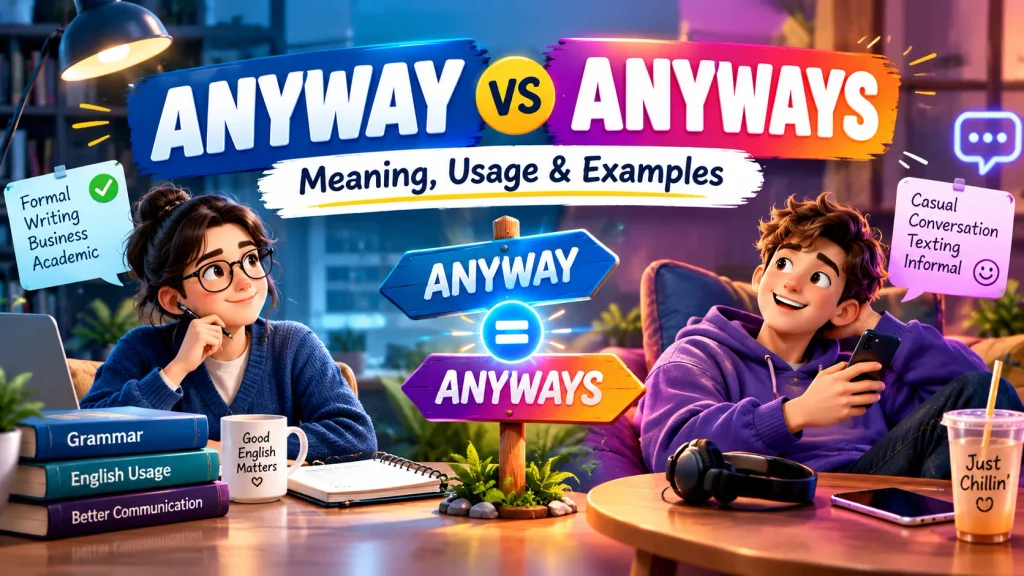
Yes, in many everyday sentences, you can replace one with the other without changing the intended meaning.
For example:
- I was late, but I came anyway.
- I was late, but I came anyways.
Both sentences mean that the speaker came despite being late.
However, interchangeability does not mean that both forms suit every context equally well. Anyway remains the better choice for formal communication and polished writing.
Common Mistakes With Anyway and Anyways
Avoid these common usage problems when writing or speaking.
Mistake 1: Using Anyways in Formal Writing
Less suitable: Anyways, the findings support our conclusion.
Better: Anyway, the findings support our conclusion.
For a more formal academic tone, consider: “The findings nevertheless support our conclusion.”
Mistake 2: Assuming Anyways Is Always Wrong
Incorrect assumption: Anyways is never a real English word.
Correct understanding: Anyways is an established informal variant, although some contexts call for anyway.
Mistake 3: Adding Unnecessary Words
Wordy: Anyways, in any case, we should leave now.
Better: Anyway, we should leave now.
Use one transition when it communicates your meaning clearly.
Mistake 4: Confusing Anyway With Any Way
These expressions look similar but have different grammatical functions.
- Anyway: An adverb meaning “regardless” or “in any case.”
- Any way: A two-word phrase meaning “by any method” or “in any manner.”
Examples:
- I’ll finish the work anyway.
- Is there any way to fix this problem?
Remember that anyway and any way are not interchangeable.
Anyway vs Any Way vs Anyways
These three forms can confuse English learners, but each has a clear role.
| Word or phrase | Meaning | Example |
| Anyway | Regardless; in any case | I’ll go anyway. |
| Anyways | Informal variant of anyway | Anyways, let’s begin. |
| Any way | Any method or manner | Is there any way to help? |
Memory trick: If you mean “regardless,” use anyway. If you mean “any method,” use any way.
Anyway vs Anyways in American and British English
Both forms appear in English-speaking communities, but their frequency and social associations vary.
- American English: Anyway is the standard choice; anyways is common in informal speech.
- British English: Anyway is also the standard choice, while anyways appears in informal conversation.
- International English: Anyway offers the clearest, most widely accepted option.
These are general usage patterns rather than strict regional rules. Individual speakers may use anyways regardless of where they live.
Anyway vs Anyways in Texting and Social Media
In text messages and social media posts, people often prioritize conversational tone over formal style.
Examples:
- “Anyway, what are we doing this weekend?”
- “Anyways, that movie was amazing.”
- “Anyway, I need to tell you something.”
- “Anyways, I’ll message you later.”
Both forms can sound natural in casual messages. If you are writing for a professional account, business page, or formal publication, anyway is generally the better choice.
Anyway vs Anyways: Practice Exercises
Choose the most appropriate word or phrase for each sentence.
- It was getting late, but we continued ______.
- ______, let’s move on to the next question.
- Is there ______ to contact the manager?
- ______, I’ll see you tomorrow! (casual message)
- For a formal report, ______ is the safer choice.
Answers and Explanations
- Anyway — The standard choice when something happens regardless of circumstances.
- Anyway — A standard transition to the next topic.
- Any way — This asks whether a method exists.
- Anyways — Acceptable in a casual message; anyway would also work.
- Anyway — It suits formal and professional writing.
People Also Ask
Both are used in English. Anyway is the standard form and works in formal and informal contexts, while anyways is generally informal.
Both usually mean “in any case” or “regardless.” The main difference is tone: anyway is standard, whereas anyways sounds more conversational.
Yes. Dictionaries recognize anyways as a variant of anyway, commonly with an informal usage label.
Use anyway in professional emails. It sounds natural, clear, and appropriate for both formal and informal business communication.
Yes. You can start an informal sentence with anyways to change the subject, return to a previous topic, or wrap up a conversation. In formal writing, prefer anyway.
Not exactly. Anyways is an informal variant of anyway, not merely internet slang. People use it in everyday speech and casual writing.
Conclusion
The difference between Anyway vs Anyways mainly comes down to standard usage and tone. Both forms appear in English and often express the same meaning, but anyway works in a broader range of situations.
Use anyway in essays, reports, professional emails, and everyday conversations. Choose anyways when you want a relaxed, informal tone. And remember that any way is a separate phrase when you mean a method or manner.
The simplest rule is this: When in doubt, use anyway.











1 thought on “Anyway vs Anyways: What’s the Difference? Meaning, Usage & Examples”