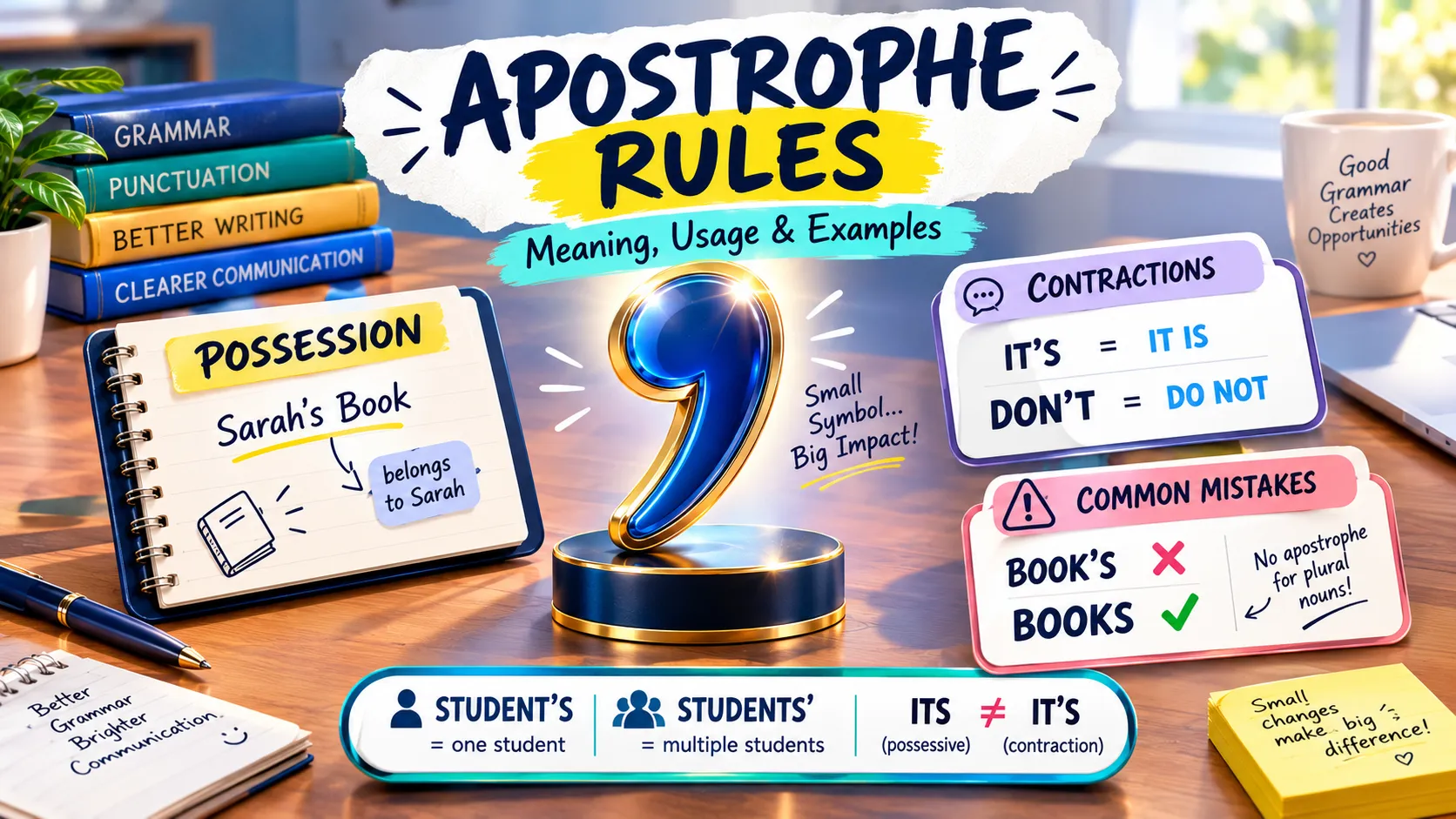
Apostrophe Rules explain how to use the apostrophe (’) to show possession, form contractions, and indicate certain omissions. Although this punctuation mark looks small, it plays an important role in clear and correct English writing. For example, the student’s book shows possession, while it’s raining uses an apostrophe to combine it and is.
Many writers confuse apostrophes in singular and plural nouns, possessive pronouns, contractions, and plural words. Understanding a few simple rules can help you avoid these mistakes in essays, emails, academic assignments, professional documents, and everyday communication.
In this guide, you’ll learn the main apostrophe rules, explore clear examples, understand common exceptions, and practice using apostrophes correctly.
What Is an Apostrophe?
An apostrophe (’) is a punctuation mark that indicates possession, represents missing letters in contractions, or marks certain omissions in writing.
Examples:
- Possession: Sarah’s notebook is on the desk.
- Contraction: I don’t understand the question.
- Omission: She was born in the summer of ’98.
The apostrophe usually appears above the line, although its exact appearance depends on the font and typing method.
Apostrophe Rules: Use an Apostrophe to Show Singular Possession
Add an apostrophe and s (‘s) to a singular noun to show that something belongs to, relates to, or is associated with that person, animal, place, or thing.
Rule: Singular noun + ‘s
Examples:
- The girl’s bicycle is new.
- My brother’s room is clean.
- The teacher’s desk is near the window.
- The dog’s collar is red.
- The company’s website looks professional.
In each example, the apostrophe shows a relationship between the noun and another thing.
More examples:
| Incorrect | Correct |
| The girls book | The girl’s book |
| My brothers car | My brother’s car |
| The dogs tail | The dog’s tail |
| The teachers office | The teacher’s office |
Remember: Even if a singular noun ends in s, many style guides recommend adding ‘s. For example, James’s phone is standard in many styles. Some style guides permit James’ phone, so follow the convention required by your school, publisher, or organization.
Explore More: https://wordminto.com/principal-vs-principle/
Use an Apostrophe to Show Plural Possession
When a plural noun already ends in s, add only an apostrophe after the final s to show possession.
Rule: Plural noun ending in s + ‘
Examples:
- The students’ classroom is upstairs.
- The teachers’ meeting starts at noon.
- The players’ uniforms are ready.
- The girls’ school organizes annual competitions.
- The dogs’ food is in the kitchen.
In these examples, the nouns refer to more than one student, teacher, player, girl, or dog.
Compare singular and plural possession:
| Singular | Plural |
| The student’s book | The students’ books |
| The teacher’s desk | The teachers’ desks |
| The girl’s shoes | The girls’ shoes |
| The player’s locker | The players’ lockers |
Key difference: The student’s book refers to one student. The students’ books refer to books belonging to multiple students.
Add ‘s to Irregular Plural Nouns
Some plural nouns do not end in s. These nouns usually take ‘s to show possession.
Rule: Irregular plural noun + ‘s
Examples:
- The children’s toys are everywhere.
- The men’s restroom is downstairs.
- The women’s team won the tournament.
- The people’s opinions differ.
- The mice’s hiding place is behind the cupboard.
Common irregular plural nouns:
| Singular | Plural | Possessive plural |
| Child | Children | Children’s |
| Man | Men | Men’s |
| Woman | Women | Women’s |
| Person | People | People’s |
| Mouse | Mice | Mice’s |
Important: Do not write childrens’ toys or mens’ room. The plural forms children and men do not end in s, so add ‘s.
Explore More: https://wordminto.com/conscience-or-conscious/
Use Apostrophes in Contractions
A contraction combines two words into a shorter form. An apostrophe replaces the letters omitted from the original words.
Examples:
| Full form | Contraction |
| Do not | Don’t |
| Does not | Doesn’t |
| Is not | Isn’t |
| Cannot | Can’t |
| Will not | Won’t |
| I am | I’m |
| You are | You’re |
| They are | They’re |
| We have | We’ve |
| She would | She’d |
| It is | It’s |
| That is | That’s |
Example sentences:
- I don’t like cold coffee.
- She’s waiting outside.
- They’re studying for the exam.
- We’ll visit you tomorrow.
- He hasn’t finished his work.
Contractions appear frequently in conversations, messages, blogs, and informal writing. In formal academic writing, check the required style guide because some assignments discourage contractions.
Explore More: https://wordminto.com/ms-vs-mrs-vs-miss/
Understand the Difference Between Its and It’s
One of the most common apostrophe mistakes involves its and it’s.
- Its is a possessive determiner that shows ownership.
- It’s is a contraction of it is or it has.
Examples with its:
- The cat licked its paws.
- The company changed its policy.
- The tree lost its leaves.
Examples with it’s:
- It’s a beautiful morning. (It is a beautiful morning.)
- It’s been a long day. (It has been a long day.)
- It’s getting colder. (It is getting colder.)
Easy test: Replace it’s with it is or it has. If the sentence still makes sense, the contraction may be correct. Otherwise, use its when you mean possession.
Incorrect: The dog wagged it’s tail.
Correct: The dog wagged its tail.
Incorrect: Its going to rain.
Correct: It’s going to rain.
Do Not Use Apostrophes in Possessive Pronouns
Possessive pronouns already show ownership. They do not need apostrophes.
Correct possessive forms include:
- Mine
- Yours
- His
- Hers
- Ours
- Theirs
- Its
Examples:
- This book is mine.
- That jacket is yours.
- The red bicycle is hers.
- The decision was theirs.
- The dog wagged its tail.
Common mistakes:
| Incorrect | Correct |
| Your’s | Yours |
| Her’s | Hers |
| Their’s | Theirs |
| Our’s | Ours |
| It’s tail | Its tail |
Remember the difference between your and you’re:
- Your phone is ringing. (Your shows possession.)
- You’re late again. (You’re means you are.)
Similarly, their, there, and they’re have different meanings. Only they’re contains an apostrophe because it contracts they are.
Explore More: https://wordminto.com/advisor-vs-adviser/
Do Not Use Apostrophes to Make Regular Plurals
Apostrophes do not normally make nouns plural.
Incorrect: I bought three apple’s.
Correct: I bought three apples.
More examples:
| Incorrect | Correct |
| Book’s | Books |
| Car’s | Cars |
| Student’s | Students |
| Banana’s | Bananas |
| Computer’s | Computers |
Use an apostrophe only when the sentence needs possession or a contraction.
Compare these sentences:
- The students finished their homework. (Plural)
- The student’s homework is complete. (One student’s homework)
- The students’ homework is complete. (Homework belonging to multiple students)
Each form has a different grammatical function.
Use Apostrophes with Joint Possession
When two or more people share ownership of the same thing, place the possessive ending on the final name.
Examples:
- Sarah and John’s house is beautiful.
- Tom and Mary’s business is successful.
- Jack and Jill’s project received an award.
In each example, the people share ownership of one house, business, or project.
Rule: For shared possession, add ‘s to the final name.
Separate possession
When each person owns a different thing, add the possessive ending to each name.
Examples:
- Sarah’s and John’s cars are parked outside.
- Tom’s and Mary’s offices are on different floors.
- Jack’s and Jill’s bicycles have different colors.
Compare:
- Sarah and John’s house: Sarah and John share one house.
- Sarah’s and John’s houses: Sarah and John own separate houses.
The surrounding context can clarify the intended meaning.
Explore More: https://wordminto.com/anyway-vs-anyways/
Use Apostrophes with Names Ending in S
Names that end in s can create confusion because style guides differ in their recommendations.
Many modern style guides add ‘s to singular names, including names that already end in s.
Examples:
- James’s laptop is new.
- Chris’s presentation was excellent.
- Charles’s office is upstairs.
- Alexis’s favorite book is missing.
Some styles use only an apostrophe after a singular name ending in s, particularly in certain classical or journalistic conventions.
Examples under that convention:
- James’ laptop
- Chris’ presentation
- Charles’ office
Both conventions appear in published English. Choose one consistent style and follow the instructions of your teacher, editor, or publication.
Apostrophe Rules: Use Apostrophes with Time and Measurement Expressions
Apostrophes can show possession or association in expressions involving time, distance, value, and measurement.
Examples:
- One day’s work
- Two weeks’ vacation
- An hour’s wait
- Three months’ rent
- A mile’s distance
These constructions treat the time or measurement expression as possessive.
Compare:
- I worked for one day. (No apostrophe)
- I completed one day’s work. (Apostrophe)
- We stayed for two weeks. (No apostrophe)
- We took two weeks’ vacation. (Apostrophe)
Not every time expression requires an apostrophe. Use one when the expression functions as a possessive modifier, rather than merely indicating duration.
Explore More: https://wordminto.com/toward-vs-towards/
Apostrophe Rules: Use Apostrophes with Letters, Numbers, and Symbols Carefully
Apostrophes sometimes appear when writers discuss individual letters, numbers, or symbols. However, modern style generally avoids apostrophes in ordinary plurals.
Examples:
- She received three A’s on her report card.
- The word committee contains two m’s.
- The temperature reached the high 90s.
- The 1990s brought major technological changes.
Some style guides prefer As instead of A’s when referring to letter grades. In other contexts, apostrophes can improve clarity, especially when lowercase letters might be misread as words.
For decades and numbers:
- Correct: The 1980s were memorable.
- Incorrect in standard modern usage: The 1980’s were memorable.
- Correct: There are two 7s in the code.
- Generally avoid: There are two 7’s in the code.
Use an apostrophe for omitted digits when appropriate, such as the class of ’98, but avoid unnecessary apostrophes in ordinary plurals.
Apostrophe Rules: Use Apostrophes with Possessive Gerunds
A gerund is an -ing form of a verb that functions as a noun. A possessive noun can appear before a gerund to identify who performs the action.
Examples:
- I appreciate Sarah’s helping me.
- We were surprised by John’s arriving early.
- They objected to the company’s changing its policy.
- Her singing impressed the audience.
In the first three examples, the possessive forms identify the person or organization associated with the action.
In everyday English, writers often use a nonpossessive noun or pronoun before an -ing form, especially when they emphasize the action itself.
For example:
- I appreciate Sarah helping me.
This construction is common and natural in contemporary English. The possessive form can sound more formal, so choose the structure that best fits the sentence and intended meaning.
Explore More: https://wordminto.com/among-vs-amongst/
Apostrophe Rules: Use Apostrophes in Informal Writing to Show Omitted Letters
Writers sometimes use apostrophes to represent omitted sounds or letters, particularly in informal dialogue, poetry, and familiar expressions.
Examples:
- Rock ‘n’ roll
- Singin’ in the rain
- ‘Tis the season
- ‘Twas a cold night.
These forms reflect particular pronunciation or historical spelling conventions.
In formal writing, use standard spellings unless the context requires a direct quotation, dialect, literary effect, or established expression.
Do Not Use Apostrophes in Ordinary Abbreviations and Acronyms
Most abbreviations and acronyms form plurals by adding s or es, without an apostrophe.
Examples:
- DVDs
- CDs
- PDFs
- URLs
- CEOs
- FAQs
Incorrect: The company hired three CEO’s.
Correct: The company hired three CEOs.
Possessive forms still require apostrophes when appropriate.
Examples:
- The CEO’s decision affected the company.
- The CEOs’ meeting lasted two hours.
The first sentence refers to one CEO’s decision. The second refers to a meeting involving multiple CEOs.
Use Apostrophes with Family Names Carefully
Family names usually take s or es to form plurals, without an apostrophe.
Examples:
- The Smiths live next door.
- The Johnsons are visiting this weekend.
- The Joneses invited us to dinner.
To show possession, add an apostrophe after the plural form.
Examples:
- The Smiths’ house has a large garden.
- The Johnsons’ car is parked outside.
- The Joneses’ invitation arrived yesterday.
Compare:
- The Smiths are here. (The family)
- The Smiths’ house is here. (A house belonging to the family)
Do not write the Smith’s when you mean the entire Smith family. That form usually suggests possession by one person named Smith.
Use Apostrophes in Plural Possessive Compound Nouns
Compound nouns consist of two or more words that function as a single noun. Their possessive forms depend on the structure and wording.
Examples:
- My sister-in-law’s apartment is spacious.
- The editor-in-chief’s office is upstairs.
- The sisters-in-law’s reunion was enjoyable.
When a compound noun has a plural form, place the possessive ending after the complete plural expression.
Examples:
- My brothers-in-law’s cars are outside.
- The editors-in-chief’s decisions were final.
These forms can look complicated. Identify the complete noun first, determine its plural form, and then add the possessive ending.
Distinguish Apostrophes from Quotation Marks
An apostrophe and a quotation mark may look similar, but they serve different grammatical functions.
An apostrophe marks possession or omitted letters. Quotation marks enclose direct speech, quotations, titles in some style systems, or words used in a special sense.
Examples:
- Apostrophe: Maria’s notebook is missing.
- Contraction: I’ve completed the assignment.
- Quotation marks: Maria said, “I’ve completed the assignment.”
Use the punctuation mark that matches the sentence’s purpose. Avoid substituting quotation marks for apostrophes or using straight quotation marks inconsistently when typographic consistency matters.
Understand the Difference Between Apostrophes and Plural Endings
The letter s appears in many English noun forms, but its role changes according to the sentence.
| Form | Example | Meaning |
| Plural | The cats are sleeping. | More than one cat |
| Singular possessive | The cat’s bed is soft. | One cat owns or uses the bed |
| Plural possessive | The cats’ beds are soft. | Multiple cats own or use the beds |
| Contraction | The cat’s sleeping. | The cat is sleeping |
The last example uses cat’s as a contraction of cat is, rather than as a possessive.
Tip: When you see an apostrophe before s, examine the sentence’s meaning. It may indicate possession or represent missing letters.
Know When to Avoid Apostrophes in Formal Writing
Apostrophes are essential in many contexts, but unnecessary apostrophes can make writing less accurate.
Avoid apostrophes in:
- Regular plural nouns: books, not book’s.
- Possessive pronouns: hers, not her’s.
- Most plural acronyms: URLs, not URL’s.
- Decades: the 1990s, not the 1990’s.
- Ordinary plural family names: the Browns, not the Brown’s.
However, do not remove apostrophes from genuine possessives or contractions simply because the writing is formal.
Examples:
- The student’s performance improved.
- The organization’s policy changed.
- It isn’t clear whether the results are final.
Follow your required style guide for contractions, names ending in s, and specialized punctuation.
Apostrophe Rules: Common Mistakes to Avoid
Here are frequent errors and their corrections.
| Incorrect | Correct | Explanation |
| The dogs bone | The dog’s bone | Singular possession |
| The students book | The student’s book | One student’s book |
| The students’ book (when referring to one student) | The student’s book | Singular vs. plural possession |
| Its raining | It’s raining | Contraction of it is |
| The cat lost it’s toy | The cat lost its toy | Possessive its |
| Your welcome | You’re welcome | You’re means you are |
| Her’s is blue | Hers is blue | Possessive pronouns do not use apostrophes |
| Three apple’s | Three apples | Regular plural |
| The 1990’s | The 1990s | Decade plural |
| The Smith’s arrived | The Smiths arrived | Family name plural |
Reviewing these distinctions regularly will help you recognize apostrophe errors in your own writing.
Apostrophe Rules: Quick Reference Chart
Use this chart to review the most important rules at a glance.
| Rule | Correct example |
| Singular possession | The girl’s bag |
| Plural possession ending in s | The girls’ bags |
| Irregular plural possession | The children’s toys |
| Contractions | Don’t, can’t, they’re |
| Possessive pronouns | Yours, hers, theirs |
| Regular plurals | Books, cars, students |
| Shared possession | Tom and Anna’s house |
| Separate possession | Tom’s and Anna’s houses |
| Names ending in s | James’s book or James’ book, depending on style |
| Time expressions | A day’s work |
| Decades | The 1990s |
| Family names | The Browns’ house |
Apostrophe Rules Practice: Test Your Knowledge
Choose the correct form in each sentence.
1. The _____ bicycle is outside.
- A. girls
- B. girl’s
- C. girls’
2. The _____ classroom is on the second floor. (More than one student shares the classroom.)
- A. students
- B. student’s
- C. students’
3. _____ going to be a busy day.
- A. Its
- B. It’s
- C. Its’
4. This blue jacket is _____.
- A. her’s
- B. hers
- C. she’s
5. I bought three _____ yesterday.
- A. book’s
- B. books
- C. books’
6. The _____ toys are scattered across the floor.
- A. childrens’
- B. children’s
- C. childrens
7. The _____ house needs a new roof. (The entire Brown family owns the house.)
- A. Brown’s
- B. Browns
- C. Browns’
8. _____ finished the assignment.
- A. Theyre
- B. Their
- C. They’re
9. The _____ meeting begins at 10 a.m. (A meeting involving multiple teachers.)
- A. teachers
- B. teacher’s
- C. teachers’
10. The _____ were an important decade for music. (Choose the correct plural form for the 1980s.)
- A. 1980’s
- B. 1980s
- C. 1980s’
Answers and Explanations
- B. girl’s — The apostrophe shows that one girl owns or uses the bicycle.
- C. students’ — The plural noun ends in s, so the apostrophe follows the final s.
- B. It’s — The contraction means it is.
- B. hers — Possessive pronouns do not need apostrophes.
- B. books — Regular plurals do not require apostrophes.
- B. children’s — Children is an irregular plural, so add ‘s.
- C. Browns’ — The plural family name Browns takes an apostrophe to show possession.
- C. They’re — The contraction means they are.
- C. teachers’ — The apostrophe shows that multiple teachers are associated with the meeting.
- B. 1980s — Standard decade plurals do not use apostrophes.
People Also Ask: Apostrophe Rules
Use apostrophes primarily to show possession and form contractions. Add ‘s to most singular nouns to show possession, add an apostrophe after the s in regular plural possessives, and use apostrophes to replace omitted letters in contractions. Do not use apostrophes to form ordinary plurals or possessive pronouns.
Use an apostrophe before s in many singular possessives and contractions.
Examples:
The teacher’s desk. (Possession)
It’s raining. (Contraction)
She’s ready. (Contraction)
Remember that the same spelling can represent different grammatical functions.
Place an apostrophe after the final s when a plural noun ending in s shows possession.
Examples:
The students’ projects.
The players’ uniforms.
The teachers’ lounge.
Some singular names ending in s also take only an apostrophe under certain style guides.
No. Regular plural nouns do not need apostrophes.
Correct: The cars are expensive.
Incorrect: The car’s are expensive.
However, plural nouns need apostrophes when they show possession, as in the cars’ tires.
Both forms appear in standard published English, depending on the style guide. Many modern guides prefer James’s, while some styles use James’. Choose one convention and apply it consistently.
Use its to show possession, and it’s as a contraction of it is or it has.
Examples:
The bird spread its wings.
It’s time to leave.
No. Possessive pronouns such as mine, yours, his, hers, ours, and theirs do not take apostrophes. The possessive determiner its also has no apostrophe.
Conclusion
Apostrophe Rules become easier to remember when you focus on three main functions: possession, contractions, and omissions. Use ‘s for most singular possessives, place an apostrophe after s for regular plural possessives, and use apostrophes to indicate omitted letters in contractions.
Most Importantly, distinguish between forms such as its and it’s, student’s and students’, and books and book’s. These small differences can change a sentence’s meaning or introduce a grammatical error.
With regular practice and careful proofreading, you can use apostrophes accurately in academic writing, professional communication, and everyday English.











1 thought on “Apostrophe Rules: How to Use Apostrophes Correctly (Rules, Examples & Common Mistakes)”