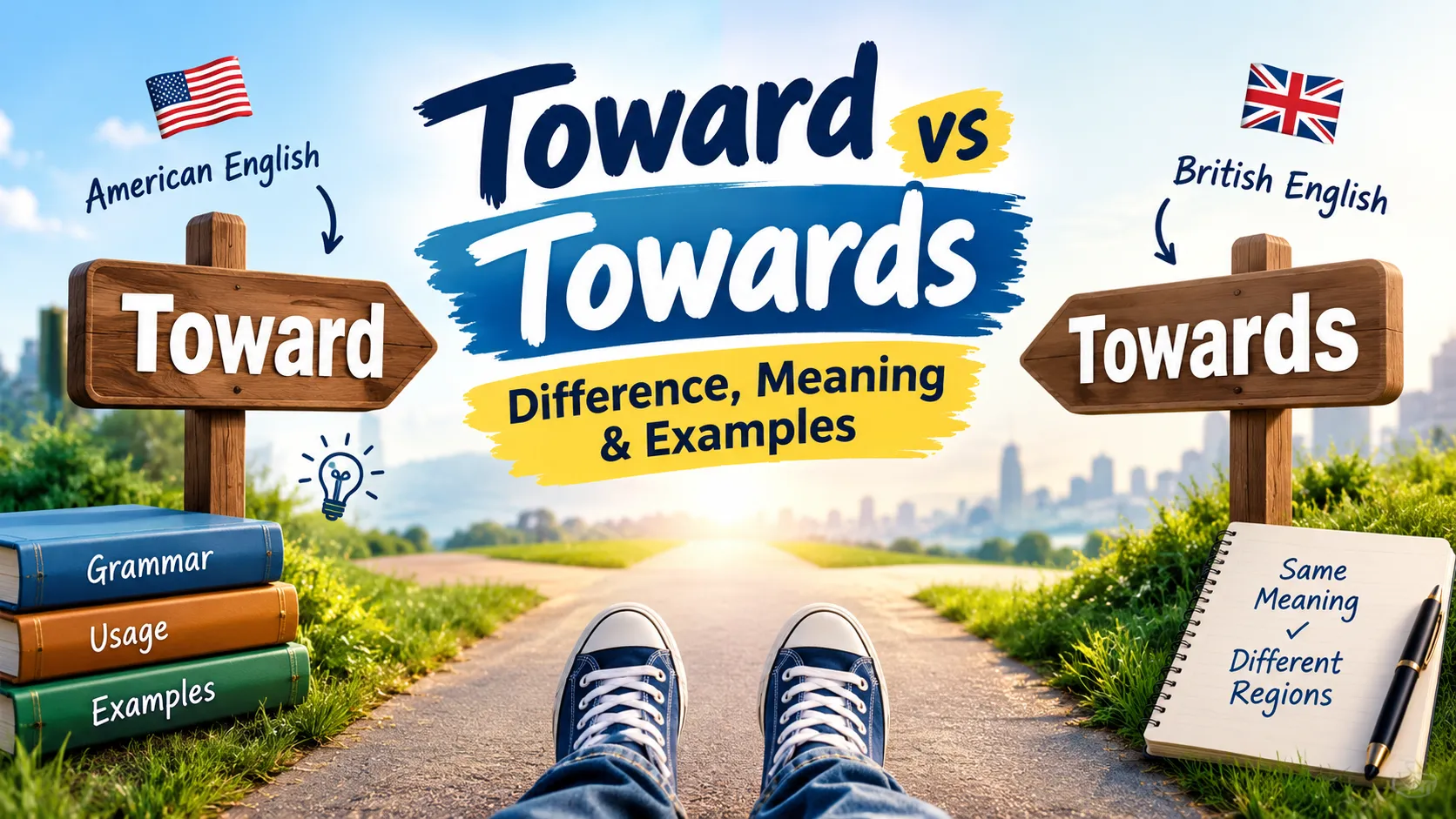
Toward vs Towards: Both words express movement, direction, or progress in the direction of something. The main difference is regional usage: Toward appears more often in American English, while Towards appears more often in British English. Both forms are correct, and their meanings are the same.
For example:
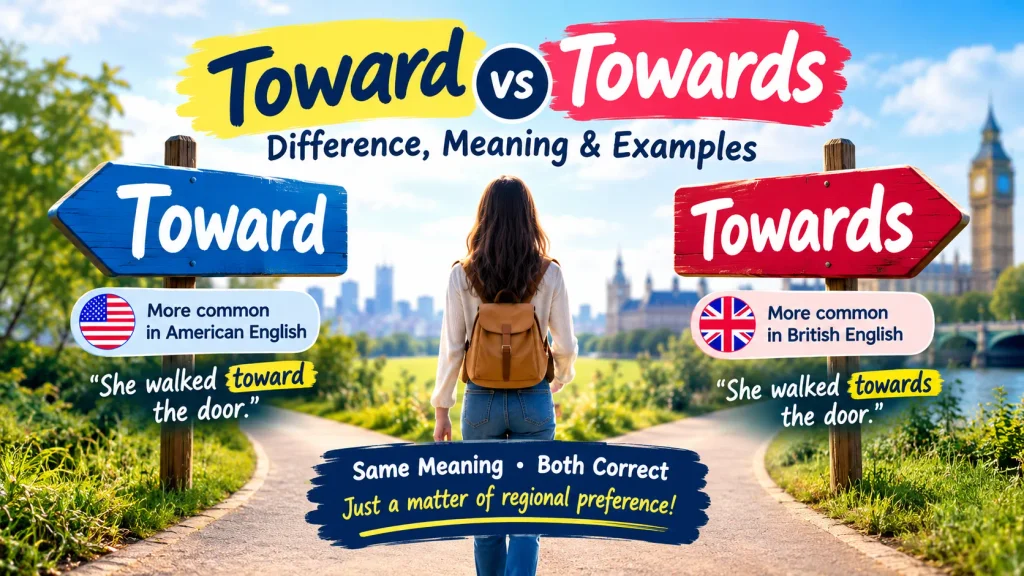
- She walked toward the door.
- She walked towards the door.
Both sentences describe the same action. Your choice usually depends on your preferred English variety, writing style, or publication guidelines.
In this guide, you will learn the meanings of toward and towards, their grammatical roles, the differences between American and British usage, common mistakes, and practical examples.
Quick Answer: Toward vs Towards
| Word | Meaning | Common Usage |
| Toward | In the direction of something; about something | More common in American English |
| Towards | In the direction of something; about something | More common in British English |
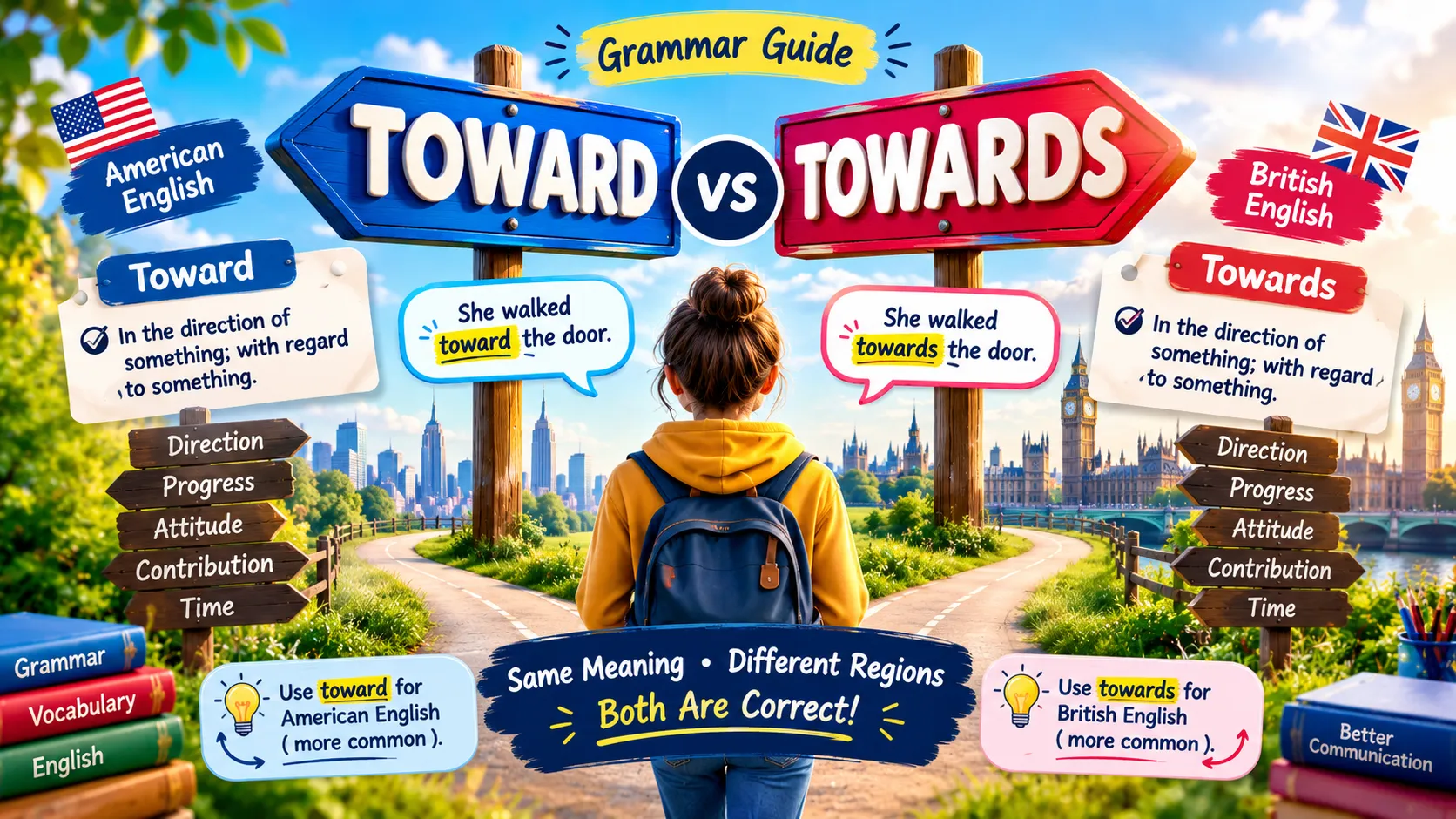
Easy rule: Use toward for American English and towards for British English. However, both forms are grammatically correct in either variety.
What Does Toward Mean?
Toward is a preposition that indicates movement in a particular direction, progress toward a goal, an attitude, or a relationship to something.
Examples of Toward in Sentences
- The children ran toward the playground.
- We are working toward a better future.
- She showed kindness toward the new student.
- He took a step toward the window.
- Every small effort brings you toward success.
American English commonly uses toward in these contexts, although British English speakers may use it as well.
When Should You Use Toward?
Use toward when you want to describe:
- Direction: The car moved toward the bridge.
- Progress: She is working toward her degree.
- Attitude: He has a positive attitude toward learning.
- Contribution: I put some money toward the trip.
- Time approaching: The weather became colder toward evening.
Explore More: https://wordminto.com/advisor-vs-adviser/
What Does Towards Mean?
Towards is also a preposition. It has the same meaning as toward and describes direction, progress, attitude, or movement toward a particular point.
Examples of Towards in Sentences
- The dog ran towards its owner.
- We are moving towards our final goal.
- She felt a growing affection towards him.
- The train was heading towards London.
- The sky darkened towards sunset.
British English commonly uses towards, especially in everyday writing and conversation. The word also appears in American English.
When Should You Use Towards?
Use towards in the same situations as toward:
- Physical direction: He walked towards the station.
- Personal goals: They are working towards financial independence.
- Feelings or attitudes: She expressed respect towards her colleagues.
- Payments or contributions: We saved money towards a new car.
- Time: The temperature dropped towards midnight.
The choice between the two words does not change the meaning of the sentence.
Toward vs Towards: Key Differences
The main difference involves regional preference rather than definition or grammar.
| Feature | Toward | Towards |
| Meaning | In the direction of | In the direction of |
| Grammatical role | Preposition | Preposition |
| American English | More common | Also correct |
| British English | Also correct | More common |
| Pronunciation | Generally the same | Generally the same |
| Formal writing | Correct | Correct |
Neither word is inherently more formal, more accurate, or more grammatically correct than the other.
Explore More: https://wordminto.com/lay-or-lie/
American English vs British English
English has several spelling and vocabulary differences across regions. Toward and towards follow a common pattern in which American English tends to favor the shorter form, while British English often favors the form ending in -s.
American English Examples
American writers commonly choose toward:
- The team is moving toward victory.
- She drove toward the city center.
- We are working toward a solution.
- He showed respect toward his teachers.
British English Examples
British writers commonly choose towards:
- The team is moving towards victory.
- She drove towards the city centre.
- We are working towards a solution.
- He showed respect towards his teachers.
Notice that the examples also reflect another regional spelling difference: center in American English and centre in British English.
Important: These are preferences, not strict rules. British writers can use toward, and American writers can use towards.
Is Toward or Towards More Correct?
Neither word is more correct than the other. Both are standard English prepositions, and both dictionaries and established writing practices recognize them.
Your best choice depends on the audience and the style you follow.
- Choose toward if you write primarily for an American audience.
- Choose towards if you write primarily for a British audience.
- Follow your organization’s style guide if it specifies one form.
- Stay consistent throughout the same article, essay, report, or website.
For example, an American publication may prefer “working toward a solution,” while a British publication may prefer “working towards a solution.” Both sentences are correct.
Explore More: https://wordminto.com/layed-or-laid/
Toward vs Towards in Formal Writing
Both forms work in academic papers, business documents, professional emails, reports, and other formal writing.
The important factor is consistency.
Academic Writing
- The study contributes toward a better understanding of the issue.
- The research moves towards a more comprehensive explanation.
Both sentences are grammatically acceptable. Follow the spelling and style conventions required by your institution or publisher.
Business Writing
- We are working toward our annual targets.
- The company is moving towards sustainable operations.
Choose the version that matches your organization’s preferred English variety.
Everyday Writing
- I am walking toward the store.
- I am walking towards the shop.
Both are natural. The regional vocabulary and context may vary, but neither preposition is incorrect.
Can You Use Toward and Towards Interchangeably?
Yes. You can generally replace toward with towards, or towards with toward, without changing the sentence’s meaning.
For example:
- She walked toward the door.
- She walked towards the door.
Both sentences describe movement in the direction of the door.
Another example:
- We are working toward a common goal.
- We are working towards a common goal.
Both express progress in the direction of achieving a goal.
However, if you are writing for a specific audience or following a style guide, choose one form and use it consistently.
Explore More: https://wordminto.com/borrow-or-lend/
Common Expressions With Toward and Towards
Both forms appear in many common English expressions.
1. Move Toward or Move Towards
Both phrases describe movement in a direction.
- The crowd moved toward the exit.
- The crowd moved towards the exit.
2. Work Toward or Work Towards
Both phrases describe efforts to achieve something.
- She is working toward a promotion.
- She is working towards a promotion.
3. Attitude Toward or Attitude Towards
Both phrases describe someone’s feelings or opinions about a person, activity, or subject.
- He has a positive attitude toward exercise.
- He has a positive attitude towards exercise.
4. Contribution Toward or Contribution Towards
Both phrases describe money, effort, or resources given to help achieve something.
- They contributed to the project.
- They contributed to the project.
5. Toward the End or Towards the End
Both expressions refer to a point near the end of a period, event, or process.
- Toward the end of the meeting, everyone agreed.
- Towards the end of the meeting, everyone agreed.
In every example, both versions are acceptable.
Explore More: https://wordminto.com/affect-or-effect/
Common Mistakes
Although the words are interchangeable in most contexts, writers sometimes misunderstand their differences.
Mistake 1: Thinking One Word Is Incorrect
Incorrect claim: “Towards” is wrong in American English.
Correct explanation: Both forms are acceptable in American English. Toward is simply more common.
Mistake 2: Thinking Toward Is Wrong in British English
Incorrect claim: British English always requires towards.
Correct explanation: British English commonly favors towards, but toward is also correct.
Mistake 3: Assuming the Words Have Different Meanings
Incorrect claim: Toward describes physical movement, while towards describes abstract progress.
Correct explanation: Both words can describe physical direction, progress, attitudes, contributions, and other relationships.
Mistake 4: Switching Forms Without a Reason
Using both forms in one article is not a grammatical error. However, switching between them unnecessarily may make your writing less consistent.
Better approach: Choose the form that matches your audience or style guide and maintain that preference.
Mistake 5: Confusing Toward With Forward
Toward and forward do not always mean the same thing.
- She walked toward the door. (She moved in the door’s direction.)
- She walked forward. (She moved ahead.)
Use toward to identify a direction or target. Use forward to describe movement ahead.
Toward vs Towards: More Example Sentences
Here are additional examples that show how both words work in everyday English.
- The hikers walked toward the mountain.
- The hikers walked towards the mountain.
- She is taking steps toward independence.
- She is taking steps towards independence.
- The children ran toward their parents.
- The children ran towards their parents.
- His feelings toward her changed over time.
- His feelings towards her changed over time.
- We are making progress toward our objectives.
- We are making progress towards our objectives.
- The ship sailed toward the coast.
- The ship sailed towards the coast.
- She contributed money toward the renovation.
- She contributed money towards the renovation.
- The discussion moved toward a practical solution.
- The discussion moved towards a practical solution.
- The temperature fell toward evening.
- The temperature fell towards evening.
- He turned toward the sound.
- He turned towards the sound.
Each pair has the same meaning. The preferred form may differ depending on the writer’s region.
Toward vs Towards in Different Contexts
| Context | Example With Toward | Example With Towards |
| Physical movement | Walk toward the door. | Walk towards the door. |
| Goals | Work toward success. | Work towards success. |
| Attitudes | Feelings toward others | Feelings towards others |
| Money | Put money toward rent. | Put money towards rent. |
| Time | Toward the end of the year | Towards the end of the year |
| Change | Move toward progress. | Move towards progress. |
These examples illustrate that the difference lies in regional preference, not meaning.
How to Remember Toward vs Towards
Use this simple memory trick:
American English = Toward
British English = Towards
Think of the final -s in towards as a form that British English often retains in this word.
Remember, this trick describes the most common preference, not an absolute spelling rule. Both versions are correct in standard English.
People Also Ask
Both are correct. American English generally favors toward, while British English generally favors towards.
They have the same meaning and grammatical function. The main difference is regional usage.
Toward is more common in American English, but British English also accepts it.
Towards is more common in British English, but American English also accepts it.
No. Neither form is inherently more formal. Both work in academic, professional, and everyday writing.
Conclusion
The difference between Toward and Towards comes down to regional preference, not meaning. Both words describe direction, progress, attitudes, and relationships, and both are grammatically correct.
Use Toward when you prefer American English and Towards when you prefer British English. If you write for an international audience, either form works. The most important rule is to follow your chosen style guide and maintain consistency throughout your writing.
Quick takeaway: Toward = commonly American. Towards = commonly British. Both are correct.











1 thought on “Toward vs Towards: What’s the Difference? Meaning, Rules & Examples”