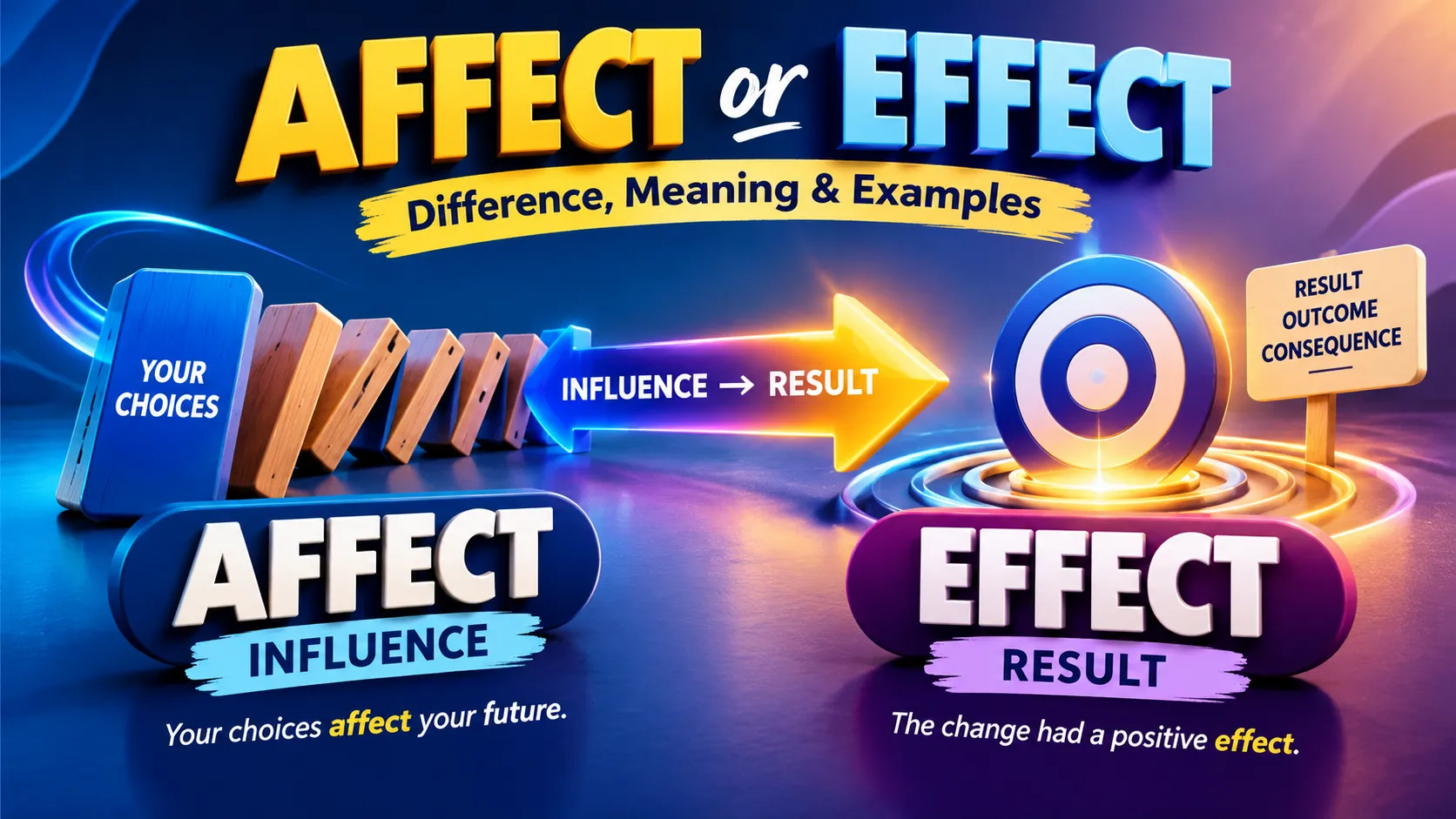
Affect or Effect: Affect and Effect are two of the most commonly confused words in English. They look and sound similar, but they usually play different grammatical roles.
The simplest rule is:
Affect is usually a verb meaning “to influence.”
Effect is usually a noun meaning “a result” or “outcome.”
For example:
- The weather affected our travel plans.
- The weather affected our travel plans.
However, English has exceptions. Effect can sometimes work as a verb, and Affect can sometimes work as a noun, especially in psychology. Understanding these less common uses will help you choose the correct word in formal writing, school assignments, exams, and everyday communication.
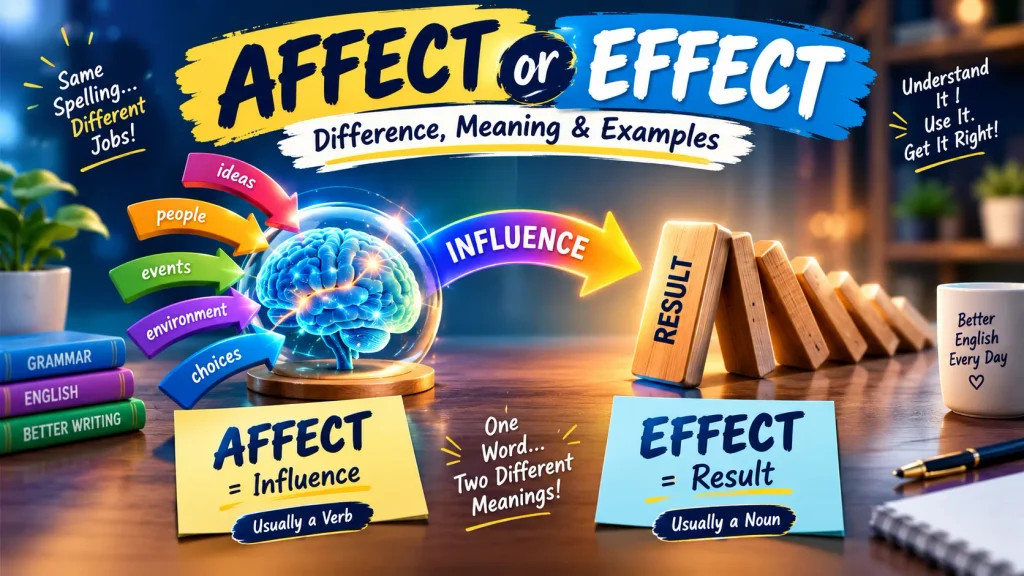
Affect or Effect: Quick Difference
| Word | Common Part of Speech | Main Meaning | Example |
| Affect | Verb | To influence or change something | Stress can affect your sleep. |
| Effect | Noun | A result or consequence | Stress can have an effect on sleep. |
Easy Memory Trick
Think:
Affect = Action
Effect = result
If something affects you, it influences you. The effect is what happens because of that influence.
What Does Affect Mean?
Affect is most commonly a verb. It means to influence, change, or have an impact on someone or something.
Examples of Affect as a Verb
- Lack of sleep can affect your concentration.
- The rain affected our plans.
- Social media can affect how people communicate.
- Exercise can affect your mood.
- The new policy will affect many employees.
In each example, affect describes something that influences another thing.
Affect in a Sentence
The loud noise affected my ability to concentrate.
The noise influenced the person’s ability to concentrate, so affected is correct.
Explore More: https://wordminto.com/lay-or-lie/
What Does Effect Mean?
Effect is most commonly a noun. It means a result, consequence, or outcome produced by an action or event.
Examples of Effect as a Noun
- The medicine had a positive effect.
- The storm had a major effect on the town.
- Exercise has many health effects.
- The new law could have a significant effect on businesses.
- His speech had a powerful effect on the audience.
Here, effect refers to what happens as a result of something.
Effect in a Sentence
The new study habits had a positive effect on her grades.
The improved grades are the result of the new study habits. Therefore, effect is correct.
Affect vs. Effect Examples
Compare these sentences:
The heat affected the crops.
Affect means the heat influenced the crops.
The heat had a damaging effect on the crops.
Effect means the damage was the result of the heat.
Another example:
Lack of sleep can affect your memory.
Lack of sleep can have a negative effect on your memory.
Both sentences communicate a similar idea, but they use different grammatical structures.
Explore More: https://wordminto.com/layed-or-laid/
Affect or Effect: Which One Should You Use?
Ask yourself what you are trying to express.
Use Affect When You Mean “Influence”
If you can replace the word with influence, affect is usually correct.
- The news affected him.
- The news influenced him.
Because “influenced” works, affected is correct.
More examples:
- Does caffeine affect your sleep?
- The decision affected everyone.
- The temperature affected the machine.
- Her words affected me deeply.
Use Effect When You Mean “Result”
If you can replace the word with result, effect is usually correct.
- The medicine had a strong effect.
- The medicine produced a strong result.
Therefore, effect is correct.
More examples:
- What was the effect of the decision?
- The policy had an unexpected effect.
- The treatment produced positive effects.
- The accident had a lasting effect on him.
Explore More: https://wordminto.com/borrow-or-lend/
Affect as a Verb
The most common use of affect is as a verb.
Its basic pattern is:
Subject + affect + object
Examples:
- Stress affects your health.
- Noise affects concentration.
- The weather affected our journey.
- The decision will affect the company.
- Your choices affect your future.
Common Forms of Affect
| Tense/Form | Example |
| Present | Stress affects sleep. |
| Past | Stress affected sleep. |
| Future | Stress will affect sleep. |
| Infinitive | Stress can affect sleep. |
| -ing form | Stress is affecting sleep. |
Effect as a Noun
The most common use of effect is as a noun.
Common patterns include:
affect on
- Exercise affects your health.
the effect of
- We studied the effect of pollution.
positive effect
- The treatment had a positive effect.
negative effect
- The change had a negative effect.
long-term effect
- The experience had a long-term effect on her career.
side effect
- The medication may cause side effects.
Explore More: https://wordminto.com/sometime-vs-some-time/
Common Expressions With Effect
Several expressions almost always use effect.
1. Have an Effect On
Exercise can have a positive effect on your health.
2. Side Effect
The medicine may cause several side effects.
3. Cause and Effect
Cause and effect describes the relationship between an action and its result.
The teacher explained the cause and effect of climate change.
4. In Effect
In effect can mean “in operation” or “essentially.”
The new rules are now in effect.
5. Take Effect
Take effect means to begin producing a result or becoming operational.
The new policy will take effect next month.
6. Come Into Effect
The law will come into effect next year.
Effect as a Verb
Although effect usually functions as a noun, it can also function as a verb.
As a verb, effect means to cause something to happen, bring about, or accomplish a change.
This use often appears in formal or professional writing.
Examples
- The organization hopes to effect meaningful change.
- The new policy could effect major improvements.
- The reforms were designed to effect change.
Notice the difference:
The new policy will affect employees.
This means the policy will influence employees.
The new policy will effect change.
This means the policy will bring about change.
That distinction matters.
Explore More: https://wordminto.com/rn-meaning/
Affect as a Noun
Affect can also function as a noun, but this use is much less common in everyday English.
In psychology and psychiatry, affect refers to the observable expression of a person’s emotional state.
For example:
The patient displayed a flat affect.
Here, affect refers to the outward expression of emotion.
This specialized use differs from the everyday verb affect.
Affect vs. Effect in Psychology
Psychology provides an important distinction between these words.
Affect refers to the observable expression of emotion.
Effect still refers to a result or consequence.
For example:
The patient’s flat affect concerned the clinician.
But:
The treatment had a positive effect on the patient’s mood.
These words have completely different meanings in these contexts.
Affect vs. Effect in Passive Constructions
You may see affected frequently in passive sentences.
Examples:
- Thousands of people were affected by the storm.
- The building was affected by the earthquake.
- Several employees were affected by the changes.
Here, affected still means “influenced” or “impacted.”
You can often rewrite the sentence:
The storm affected thousands of people.
The meaning remains the same.
Affect or Effect in Questions
These words often appear in questions where the difference can become confusing.
Correct:
How will this affect me?
Here, affect is a verb meaning “influence.”
Correct:
What effect will this have on me?
Here, effect is a noun meaning “result.”
Incorrect:
How will this effect me?
For the usual meaning of “influence,” use affect.
Affect vs. Effect: Common Mistakes
Mistake 1: Using Effect as a Verb for “Influence”
Incorrect:
The weather effected our plans.
Correct:
The weather affected our plans.
Why? Because the weather influenced the plans.
Mistake 2: Using Affect as a Noun for “Result”
Incorrect:
The medicine had a strong affect.
Correct:
The medicine had a strong effect.
Why? Because you are talking about the result of the medicine.
Mistake 3: Confusing “Have an Effect” With “Affect”
Incorrect:
The new rule will have an affect on students.
Correct:
The new rule will affect students.
Or:
The new rule will affect students.
Mistake 4: Confusing “Effect Change” With “Affect Change”
These sentences have different meanings:
The reforms will affect change.
This usually means the reforms will influence change.
The reforms will effect change.
This means the reforms will bring about or cause change.
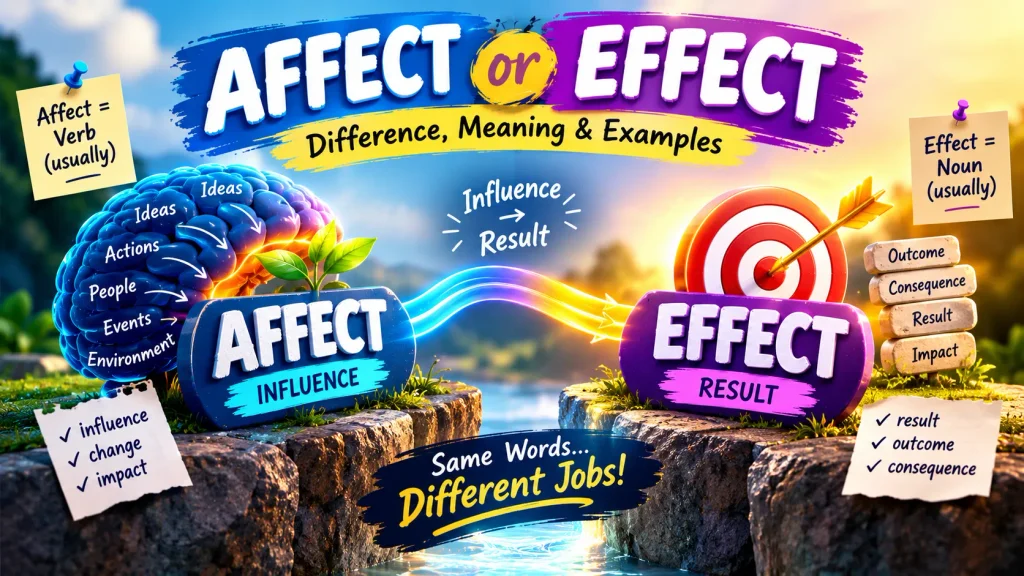
Affect or Effect: A Simple Test
Use the following three-step test.
Step 1: Can You Replace the Word With “Influence”?
If yes, use affect.
The noise affected my concentration.
→ The noise influenced my concentration.
Step 2: Can You Replace It With “Result”?
If yes, use effect.
The noise affected my concentration.
→ The noise had a result on my concentration.
The replacement does not always sound natural grammatically, but the underlying meaning helps you identify the word.
Step 3: Look at the Grammar
If you need a verb, affect is usually the answer.
If you need a noun, effect is usually the answer.
Affect vs. Effect Cheat Sheet
Remember this:
Affect = influence
The experience affected her.
Effect = result
The experience had a lasting effect.
Effect = bring about when used as a verb
The reforms effected major changes.
Affect = emotional expression when used as a specialized noun
The patient showed a flat affect.
Affect or Effect: Examples in Everyday English
Health
- Lack of sleep can affect your health.
- Lack of sleep can have a negative effect on your health.
Education
- Stress can affect students’ performance.
- Stress can have a negative effect on students’ performance.
Work
- The policy will affect employees.
- The policy will have an effect on employees.
Weather
- Heavy rain affected traffic.
- Heavy rain had a significant effect on traffic.
Technology
- Screen time can affect sleep.
- Excessive screen time can have an unwanted effect on sleep.
Business
- Inflation can affect consumer spending.
- Inflation can have a major effect on the economy.
Affect vs. Effect in Formal Writing
In academic and professional writing, choosing the correct word improves clarity.
Compare:
The intervention affected the participants’ behavior.
This emphasizes the influence of the intervention.
The intervention had a significant effect on participants’ behavior.
This emphasizes the result of the intervention.
Both can be correct, depending on the sentence structure and intended meaning.
Practice: Choose Affect or Effect
Fill in each blank with affect, effect, or the appropriate form.
- How will the decision ______ your career?
- The medicine had a positive ______.
- Stress can ______ your ability to concentrate.
- The storm had a major ______ on transportation.
- The new law may ______ thousands of workers.
- What ______ did the announcement have?
- The noise negatively ______ my sleep.
- The changes will take ______ next week.
- The organization wants to ______ meaningful change.
- The experience had a lasting ______ on her.
Answers
- affect
- effect
- affect
- effect
- affect
- effect
- affected
- effect
- effect
- effect
People Also Ask
Usually, use affect as a verb meaning “influence” and effect as a noun meaning “result.”
The decision affected me.
The decision affected me.
Remember:
Affect = Action
Effect = result
This works for most everyday situations.
Yes. As a verb, effect means to bring about or cause something to happen.
The new strategy aims to effect positive change.
Yes. In psychology, affect refers to the observable expression of emotion.
The patient displayed a restricted affect.
Yes.
Many people were affected by the storm.
Here, affected means influenced or impacted.
Final Takeaway
The difference between affect and effect becomes much easier when you focus on their usual roles:
- Affect = usually a verb meaning to influence.
- Effect = usually a noun meaning a result.
- Effect can also be a verb meaning to bring about change.
- Affect can also be a noun referring to observable emotional expression in psychology.
The most useful rule to remember is:
Affect influences. Effect results.
So write:
The weather affected our plans.
But:
The weather had a major effect on our plans.
Once you recognize whether the sentence needs an action/influence or a result, choosing between affect and effect becomes much easier.











3 thoughts on “Affect or Effect: Difference, Meaning & Examples”