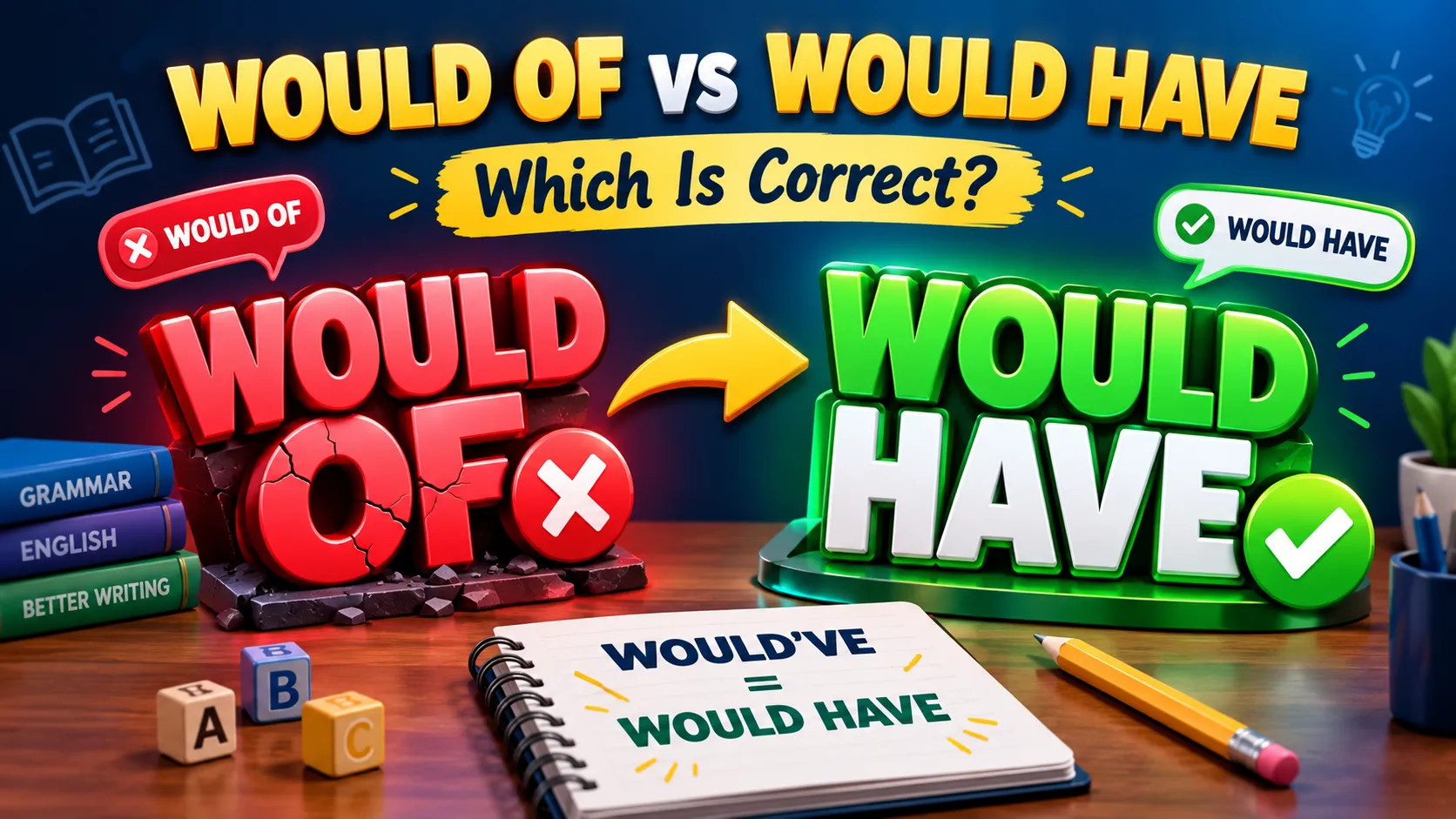
Would Of vs Would Have: Would have is the correct form in standard English. Would of is incorrect when used as a substitute for would have.
Many people confuse these expressions because would’ve, the contraction of would have, sounds very similar to “would of” in casual speech.
For example:
- ✅ I would have helped you.
- ✅ I would’ve helped you.
- ❌ I would of helped you.
If you are writing an essay, email, article, school assignment, professional message, or formal document, always use would have or would’ve, not would of.
Would Have vs Would Of: Quick Answer
| Expression | Correct? | Example |
| Would have | ✅ Yes | I would have called you. |
| Would’ve | ✅ Yes | I would’ve called you. |
| Would of | ❌ No | I would of called you. |
Would have is the full and grammatically correct form. Would’ve is its contraction.
Would of” does not function as a standard English grammatical construction in this context.
What Does “Would Have” Mean?
Would have usually describes an unreal, imagined, or conditional situation in the past.
It often expresses something that could have happened but did not happen.
Examples
- I would have gone with you if I had known.
- She would have called you, but she lost your number.
- We would have arrived earlier if the traffic had been lighter.
- He would have helped if you had asked him.
- They would have won the game if they had played better.
In each sentence, would have refers to a past possibility or hypothetical result.
Explore More: https://wordminto.com/irl-meaning/
Why Is “Would Of” Incorrect?
The confusion usually comes from pronunciation.
When people say would have quickly, they often pronounce it as would’ve.
Would have → Would’ve
For example:
I would have gone.
becomes:
I would’ve gone.
When spoken naturally, would’ve can sound similar to:
would of
However, would’ve comes from would have, not would of.
The word of does not belong in this grammatical structure.
Remember:
would’ve = would have
would of ≠ would have
Would Have vs Would’ve
Both would have and would’ve are correct.
The difference is mainly style and formality.
Would Have
The full form is appropriate in formal and informal writing.
Examples:
- I would have helped you.
- She would have accepted the offer.
- We would have stayed longer.
- He would have finished the project.
Would’ve
Would’ve is the contracted form of would have.
Examples:
- I would’ve helped you.
- She would’ve accepted the offer.
- We would’ve stayed longer.
- He would’ve finished the project.
Both versions have the same meaning.
Explore More: https://wordminto.com/ikr-meaning/
Would Of vs Would Have Examples
Here are some common examples showing the correct and incorrect forms.
Example 1
❌ I would of gone to the party.
✅ I would have gone to the party.
✅ I would’ve gone to the party.
Example 2
❌ She would of called you.
✅ She would have called you.
✅ She would’ve called you.
Example 3
❌ We would of helped them.
✅ We would have helped them.
✅ We would’ve helped them.
Example 4
❌ He would of finished the work earlier.
✅ He would have finished the work earlier.
✅ He would’ve finished the work earlier.
Example 5
❌ They would of won the match.
✅ They would have won the match.
✅ They would’ve won the match.
Explore More: https://wordminto.com/should-of-vs-should-have/
When to Use “Would Have”
Use would have + past participle to describe a hypothetical or unreal past result.
The basic structure is:
Subject + would have + past participle
Examples:
- I would have gone.
- She would have stayed.
- He would have helped.
- We would have finished.
- They would have won.
The verb after would have should appear in its past participle form.
More Examples
- I would have bought the car.
- She would have taken the job.
- He would have known the answer.
- We would have seen the movie.
- They would have arrived earlier.
Would Have in Conditional Sentences
Would have frequently appears in the third conditional, which describes an unreal past condition and its imagined result.
The basic pattern is:
If + past perfect, would have + past participle
Examples
- If I had known, I would have helped.
- If she had studied, she would have passed.
- If we had left earlier, we would have arrived on time.
- If he had listened, he would have avoided the problem.
- If they had practiced more, they would have performed better.
These sentences discuss situations that did not happen in the past.
Explore More: https://wordminto.com/imho-meaning/
Would Have for Regret
We also use would have to talk about regret or something we wish had happened differently.
Examples
- I would have apologized, but I never got the chance.
- She would have stayed, but she had to leave.
- I would have taken the opportunity.
- We would have visited you if we had known you were there.
- He would have made a different decision.
These sentences often communicate missed opportunities or imagined alternatives.
Would Have for Hypothetical Past Situations
Can describe an imagined outcome of a past situation.
For example:
If I had received your message, I would have replied.
The speaker did not receive the message, so the reply did not happen.
Another example:
If we had known about the problem, we would have fixed it.
The problem was unknown at the time, so the action did not occur.
Why Do People Write “Would Of”?
The mistake comes primarily from the spoken contraction would’ve.
Consider this sentence:
I would’ve gone.
When pronounced quickly, would’ve can sound close to would of.
Because English speakers learn many words through speech before they see them in writing, some people incorrectly interpret the sound as would of.
This creates a common writing mistake.
The same problem occurs with other contractions:
- could’ve → sometimes incorrectly written as could of
- should’ve → sometimes incorrectly written as should of
- might’ve → sometimes incorrectly written as might of
The correct forms are:
- could have
- should have
- might have
Would Of vs Would Have in Formal Writing
In formal writing, use would have rather than would of.
For example:
❌ I would of attended the meeting.
✅ I would have attended the meeting.
You can also use would’ve in less formal contexts:
✅ I would’ve attended the meeting.
For academic papers, professional reports, applications, and formal correspondence, the full form would have is usually the safest choice.
Common Mistakes With Would Have
Mistake 1: Using “Would Of”
❌ I would of gone.
✅ I would have gone.
Mistake 2: Using the Wrong Verb Form
After would have, use the past participle.
❌ I would have went.
✅ I would have gone.
❌ She would have ate dinner.
✅ She would have eaten dinner.
❌ They would have saw the problem.
✅ They would have seen the problem.
Mistake 3: Confusing “Would Have” With “Would Had”
Do not use would had.
❌ I would had helped.
✅ I would have helped.
Mistake 4: Writing “Would Of” Because It Sounds Right
Pronunciation does not always show spelling.
Would’ve may sound like “would of,” but its correct written form is would’ve or would have.
Would Have, Could Have, and Should Have
These expressions are easy to confuse because they follow similar grammatical patterns.
| Correct Form | Meaning |
| Would have | Imagined or conditional result |
| Could have | Past possibility or ability |
| Should have | Past obligation, expectation, or regret |
Examples
Would have:
I would have gone if you had invited me.
Could have:
I could have gone, but I was busy.
Should have:
I should have gone to the appointment.
Their contractions are:
- would have → would’ve
- could have → could’ve
- should have → should’ve
None of these become would of, could of, or should of.
Would Of vs Would Have in Questions
The correct form also applies to questions.
Correct
- Would you have gone with me?
- Would she have accepted the offer?
- Would they have helped us?
- Would he have known what to do?
Incorrect
- ❌ Would you of gone with me?
- ❌ Would she of accepted the offer?
- ❌ Would they of helped us?
Use would have, never would of, in these constructions.
Would Have vs Would of: Easy Memory Trick
Use this simple rule:
If you mean “would’ve,” write “would have,” not “would of.”
You can also expand the contraction.
If you see:
I would’ve gone.
Expand it:
I would have gone.
Never expand it as:
I would of gone.
So remember:
WOULD’VE = WOULD HAVE
Is “Would Of” Ever Correct?
In standard English, would of is not the correct replacement for would have.
You may encounter would of in informal online writing, text messages, social media comments, or dialogue that intentionally represents nonstandard speech. However, that does not make it the standard grammatical form.
For normal writing, choose would have or would’ve.
Would Of vs Would Have: Practice Exercise
Choose the correct option in each sentence.
- I ___ helped you if you had asked.
- A. would of
- B. would have
- She ___ gone with us.
- A. would’ve
- B. would of
- They ___ finished earlier if they had started on time.
- A. would have
- B. would of
- He ___ called you if he had your number.
- A. would of
- B. would’ve
- We ___ stayed longer if we had more time.
- A. would have
- B. would of
Answers
- B. would have
- A. would’ve
- A. would have
- B. would’ve
- A. would have
People Also Ask
No. Would of is not the standard grammatical form when you mean would have. Use would have or would’ve instead.
Yes. Would’ve is the standard contraction of would have.
In natural speech, would have contracts to would’ve, and the resulting pronunciation can sound similar to “would of.” This similarity causes the spelling mistake.
Both are correct. “ Would have” is the full form, while “would’ve” is the contraction. Use would have when you want a more formal or explicit style.
No. Avoid would of in formal, academic, professional, and standard written English.
The correct sentence is:
I would have gone.
You can also write:
I would’ve gone.
No. Would’ve is a contraction of would have. Would of is a common spelling error caused by the similar pronunciation.
Final Verdict: Would Of or Would Have?
Would have is correct. Would’ve is also correct as its contraction. Would of is incorrect when you mean would have.
Correct:
- ✅ I would have gone.
- ✅ I would’ve gone.
Incorrect:
- ❌ I would of gone.
The easiest way to remember the difference is:
Would’ve = Would have
So whenever you hear something that sounds like “would of,” check whether the speaker actually means “would have.” In standard writing, use would have or would’ve.
Quick rule: Write “would have,” never “would of.”











2 thoughts on “Would Of vs Would Have: Which Is Correct?”