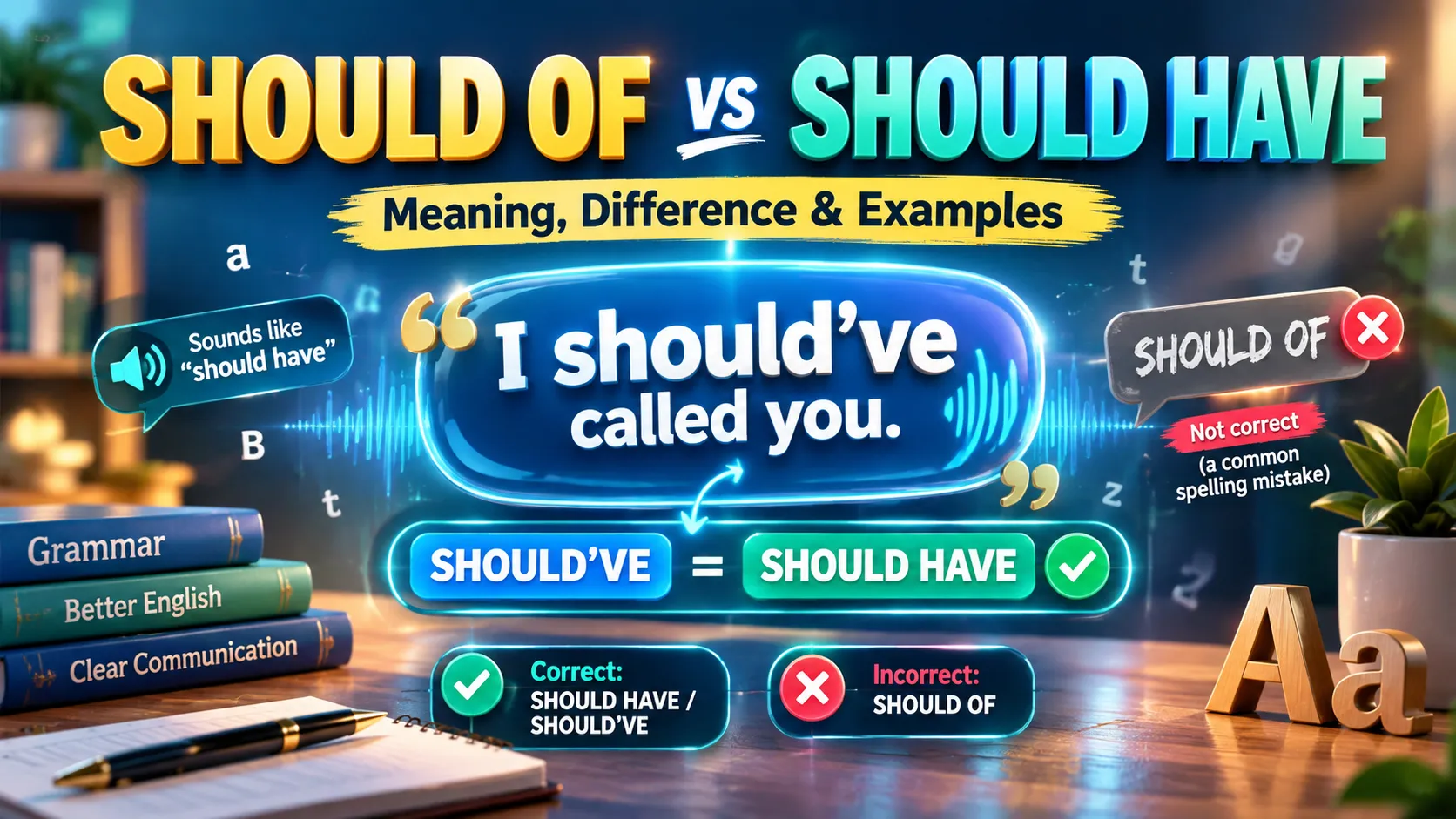
Should Of vs Should Have: “Should of” is incorrect in standard English when you mean the past form of “should.” The correct expression is “should have.”
For example:
- ❌ I should of called you.
- ✅ I should have called you.
The confusion happens because “should have” often sounds like “should’ve” in everyday speech. When people hear “should’ve,” they may mistakenly write “should of.”
In this guide, you will learn the difference between should of and should have, why the mistake happens, how to use should have correctly, and how to avoid this common grammar error.
Should Of vs Should Have: Quick Answer
| Expression | Correct? | Explanation |
| Should have | ✅ Yes | Standard English construction |
| Should’ve | ✅ Yes | Contraction of “should have” |
| Should of | ❌ No | Common writing mistake based on pronunciation |
Correct examples
- I should have studied harder.
- You should have told me earlier.
- We should have left sooner.
- She should’ve called you.
- They should’ve checked the details.
Incorrect examples
- ❌ I should of studied harder.
- ❌ You should of told me.
- ❌ We should of left earlier.
The correct form in each case is should have or should’ve.
Explore More: https://wordminto.com/imho-meaning/
What Does “Should Have” Mean?
Should have refers to something in the past that a person thinks was advisable, expected, appropriate, or necessary but did not happen.
The basic structure is:
Subject + should have + past participle
Examples:
- I should have studied.
- You should have called.
- He should have listened.
- We should have waited.
- They should have arrived earlier.
The expression often communicates regret, criticism, advice about a past situation, or an expectation that something happened.
Example
I should have taken an umbrella.
This means the speaker believes taking an umbrella would have been the better choice, but they did not take one.
Explore More: https://wordminto.com/imo-meaning/
Why Do People Say “Should Of”?
The mistake comes mainly from the pronunciation of “should have.”
In natural speech:
should have → should’ve
The contraction should’ve sounds similar to:
should of
For example:
You should’ve called me.
When spoken quickly, should’ve can sound like “should of.”
However, of does not function as the auxiliary verb in this construction.
Therefore:
- ❌ You should of called me.
- ✅ You should have called me.
- ✅ You should’ve called me.
“Should of” reflects a pronunciation-based spelling mistake, not a standard grammatical construction.
Should Have vs Should’ve
Both should have and should’ve are grammatically correct.
Should have
Use the full form when you want a more formal or emphatic style.
You should have checked the instructions.
Should’ve
Use the contraction frequently in everyday speech and informal writing.
You should’ve checked the instructions.
Both sentences have the same basic meaning.
| Full form | Contraction |
| should have | should’ve |
| could have | could’ve |
| would have | would’ve |
The important point is that “should’ve” contains “have,” not “of.”
Explore More: https://wordminto.com/further-vs-farther/
The Grammar Rule for “Should Have”
After should, use have + past participle when you talk about a past situation.
Formula
Subject + should + have + past participle
Examples:
- I should have gone.
- She should have studied.
- He should have called.
- We should have left.
- They should have finished.
Notice that the verb after have uses its past participle form.
Common examples
- should have done
- should have gone
- should have seen
- should have written
- should have taken
- should have eaten
- should have known
- should have made
Explore More: https://wordminto.com/idc-meaning/
Should Have + Past Participle
One common mistake involves using the simple past after should have.
The correct pattern is:
should have + past participle
For example:
- ❌ I should have went home.
- ✅ I should have gone home.
- ❌ She should have saw the doctor.
- ✅ She should have seen the doctor.
- ❌ He should have did his homework.
- ✅ He should have done his homework.
- ❌ We should have took the bus.
- ✅ We should have taken the bus.
The word have requires the past participle in this construction.
When to Use “Should Have”
1. To Express Regret
Use should have when you regret a past action or missed opportunity.
I should have studied for the exam.
I should have listened to your advice.
We should have booked the tickets earlier.
These sentences describe actions that did not happen but would have been better choices.
2. To Criticize a Past Action
You can use should have to say that someone did something differently from what you expected or considered appropriate.
You should have told me the truth.
He should have apologized.
They should have followed the instructions.
The expression can communicate criticism, although the tone depends on the context.
3. To Give Advice About a Past Situation
Should have can describe what would have been the better action.
You should have taken a taxi.
She should have asked for help.
We should have checked the address first.
This type of sentence advises about something that has already happened.
4. To Talk About Missed Opportunities
You can use should have when someone failed to take an opportunity.
I should have applied for that job.
We should have visited the museum.
She should have accepted the invitation.
The sentence often carries a sense of regret.
5. To Express an Expected Past Result
Should have can also describe something that was expected to happen by a particular time.
The package should have arrived by now.
He should have reached home already.
The train should have arrived ten minutes ago.
Here, the speaker expresses an expectation rather than necessarily expressing regret.
Explore More: https://wordminto.com/idk-meaning/
Should Have vs Should Of Examples
Should Of vs Should Have
The easiest way to understand the difference is to compare incorrect and correct sentences.
| Incorrect | Correct |
| I should of called you. | I should have called you. |
| You should of told me. | You should have told me. |
| She should of studied more. | She should have studied more. |
| We should of waited. | We should have waited. |
| He should of listened. | He should have listened. |
| They should of arrived earlier. | They should have arrived earlier. |
| I should of known better. | I should have known better. |
| You should of asked first. | You should have asked first. |

Should Of vs Should’ve
This is another common source of confusion.
Should’ve
Should’ve is correct.
It is a contraction of:
should + have = should’ve
Example:
I should’ve called you.
Should of
Should of is not the standard form of the construction.
Example:
❌ I should of called you.
The writer probably intended:
✅ I should’ve called you.
or:
✅ I should have called you.
Should Have vs Should
The difference between should and should have mainly involves time.
Should
Use should for present or future advice, expectations, or recommendations.
You should study tonight.
This gives advice about something happening now or in the future.
Should have
Use should have for a past situation.
You should have studied last night.
This refers to something that already happened.
Compare:
- You should call him. → Call him now or later.
- You should have called him. → You did not call him, and calling him would have been better.
Should Have vs Must Have
These expressions can look similar, but they communicate different ideas.
Should have
Should have often expresses advice, regret, or expectation.
You should have called me.
The speaker believes calling would have been the right action.
Must have
Must have can express a strong deduction about a past event.
She must have forgotten the meeting.
The speaker concludes that she probably forgot.
Compare:
You should have called me.
.
You did not call, and I think you ought to have called.
.
You must have called me.
I strongly conclude that you called me.
Negative Form: Should Not Have
The negative form is:
should not have + past participle
The contraction is:
shouldn’t have + past participle
Examples:
- You should not have said that.
- You shouldn’t have said that.
- I should not have spent so much money.
- She shouldn’t have ignored the warning.
- We shouldn’t have waited so long.
Meaning
This structure usually means that an action happened, but the speaker believes it was wrong, unnecessary, or unwise.
I shouldn’t have eaten so much.
The person ate too much and now regrets it.
Should Have in Questions
You can also use should have in questions.
Examples:
Should I have called him?
.
Should we have waited longer?
.
Should she have told her parents?
These questions ask whether a different action would have been appropriate in the past.
Example
Should I have apologized?
The speaker asks whether an apology would have been the right thing to do.
Should Have in Conditional Sentences
Should have frequently appears in sentences about hypothetical past situations.
For example:
If I had known about the problem, I should have acted sooner.
However, depending on the intended meaning, would have or could have may fit better.
Compare:
- I should have called you. → Calling would have been the right thing to do.
- I would have called you. → Calling was a hypothetical result.
- I could have called you. → Calling was possible, but I did not do it.
These modal constructions express different ideas.
Common Mistakes With Should Have
Mistake 1: Writing “Should Of”
❌ I should of studied.
✅ I should have studied.
Mistake 2: Writing “Should’ve” as “Should Of”
❌ She should of known.
✅ She should’ve known.
Mistake 3: Using the Simple Past After “Have”
❌ He should have went home.
✅ He should have gone home.
Mistake 4: Using “Should Have” for Present Advice
❌ You should have study harder.
✅ You should study harder.
If the advice concerns the present or future, use should + base verb.
Easy Trick to Remember Should Have
Remember this rule:
Should’ve = Should Have
The apostrophe contraction should’ve comes from should have, not should of.
You can remember:
should’ve → should + have
Not:
should’ve → should + of
Simple memory trick
If you can replace should’ve with should have, then have is the correct word.
I should’ve called you.
Replace the contraction:
I should have called you.
Therefore:
❌ I should of called you.
✅ I should have called you.
Should Of vs Should Have in Texting
Informal texting often reflects pronunciation.
Someone might write:
I should of told you.
This form appears in casual communication, but it remains nonstandard in edited English.
For school, academic writing, professional communication, websites, applications, and formal documents, use:
should have
or, where appropriate:
should’ve
For example:
Formal:
I should have informed you earlier.
Informal:
I should’ve told you earlier.
Avoid:
I should of told you earlier.
Should Have Examples in Everyday English
Here are more natural examples:
- I should have called you yesterday.
- You should have checked your email.
- She should have arrived by now.
- He should have listened to his parents.
- We should have left earlier.
- They should have asked for directions.
- I should have brought an umbrella.
- You should have saved the document.
- She should have studied for the test.
- We should have booked a table.
- He should have apologized.
- They should have followed the instructions.
- I should have known better.
- You should have warned me.
- We should have taken a different route.
Should Of vs Should Have: Practice Exercise
Choose the correct form.
- I should ___ called you earlier.
- She should ___ studied harder.
- You should ___ told me.
- We should ___ left before sunset.
- He should ___ known the answer.
- They should ___ checked the details.
- I should ___ listened to your advice.
- You should ___ asked for help.
Answers
- have
- have
- have
- have
- have
- have
- have
- have
The correct construction in every sentence is should have + past participle.
Should Of vs Should Have: Final Comparison
| Feature | Should Have | Should Of |
| Standard English | ✅ Yes | ❌ No |
| Correct contraction | should’ve | — |
| Used for past situations | ✅ Yes | ❌ |
| Used for regret | ✅ Yes | ❌ |
| Used for past advice | ✅ Yes | ❌ |
| Commonly heard in speech | Yes | Sounds similar |
| Appropriate in formal writing | Yes | No |
People Also Ask
No. “Should of” is not the standard English construction when expressing the past meaning of “should.” Use should have or should’ve.
Yes. Should’ve is the contraction of should have.
I should’ve called you.
People often confuse should’ve with should of because the two expressions can sound similar in rapid speech.
Both are correct. Should have works well in formal writing, while should’ve commonly appears in conversational and informal writing.
In standard English, no, not when you intend the modal construction should have. The word of has other grammatical functions, but it does not replace have in this construction.
Conclusion
The difference between should of and should have is straightforward: should have is the correct standard-English construction, while should of usually results from confusing the pronunciation of should’ve with the word of.
Use:
✅ should have
or:
✅ should’ve
Avoid:
❌ should of
Remember the key rule:
Should’ve = Should Have
Once you connect should’ve with should have, this common spelling mistake becomes much easier to avoid.