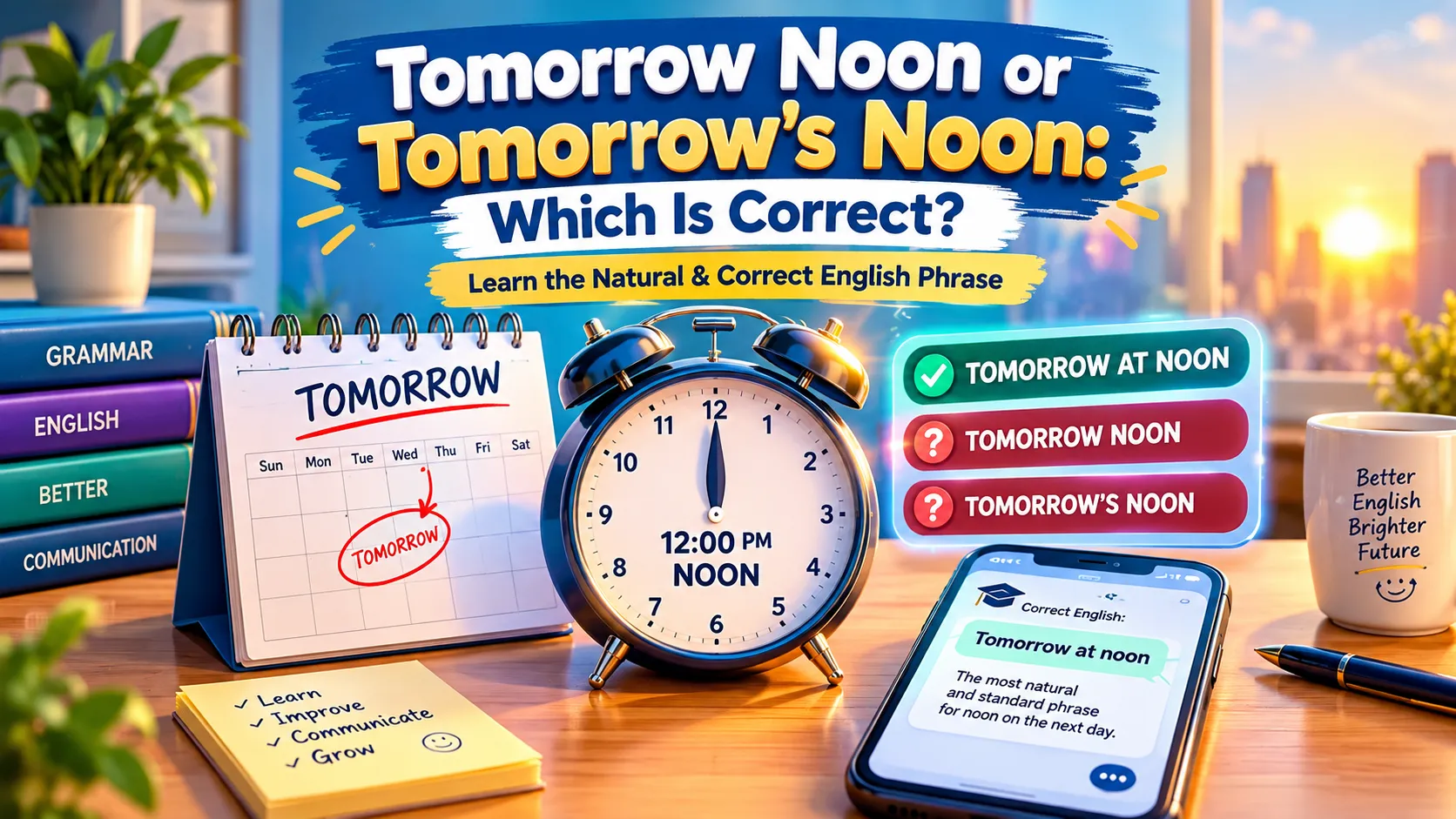
Tomorrow Noon or Tomorrow’s Noon: Tomorrow noon and tomorrow’s noon may look similar, but neither expression works equally well in standard English. If you want to talk about noon on the following day, the most natural expression is usually tomorrow at noon.
The form tomorrow’s noon can appear when tomorrow functions as a possessive noun, but it sounds less natural in everyday English. Tomorrow noon sometimes appears in informal speech, but standard English generally prefers tomorrow at noon.
Tomorrow Noon or Tomorrow’s Noon: Which Is Correct?
The most natural and standard choice is:
tomorrow at noon
For example:
- I will call you tomorrow at noon.
- We have a meeting tomorrow at noon.
- She will arrive tomorrow at noon.
What About “Tomorrow Noon”?
Tomorrow noon can occur in some varieties of English, particularly in informal speech, but it does not sound natural to many speakers of standard American or British English.
Instead of:
- ❌ I will meet you tomorrow noon.
Use:
- ✅ I will meet you tomorrow at noon.
What About “Tomorrow’s Noon”?
Tomorrow’s noon is grammatically possible because tomorrow can function as a noun and take the possessive form tomorrow’s.
For example:
- The temperature at tomorrow’s noon will be high.
However, this construction sounds formal, unusual, or awkward in ordinary conversation. Native speakers generally say:
- The temperature tomorrow at noon will be high.
Therefore, tomorrow at noon is normally the best choice.
Explore More: https://wordminto.com/tbh-meaning/
The Correct Phrase: “Tomorrow at Noon”
When you want to specify 12:00 PM on the next day, use:
tomorrow at noon
The preposition at connects the time expression noon with the day tomorrow.
Examples
- I will see you tomorrow at noon.
- The meeting starts tomorrow at noon.
- Please send the report tomorrow at noon.
- We will have lunch tomorrow at noon.
- The train arrives tomorrow at noon.
- She plans to leave tomorrow at noon.
This structure sounds natural in everyday English.
Why Do We Say “At Noon”?
English commonly uses at with specific points in time.
Examples include:
- at noon
- at midnight
- at 5 p.m.
- at 8 o’clock
- at sunrise
- at sunset
Therefore, when you combine tomorrow with noon, the natural structure becomes:
tomorrow + at + noon
So:
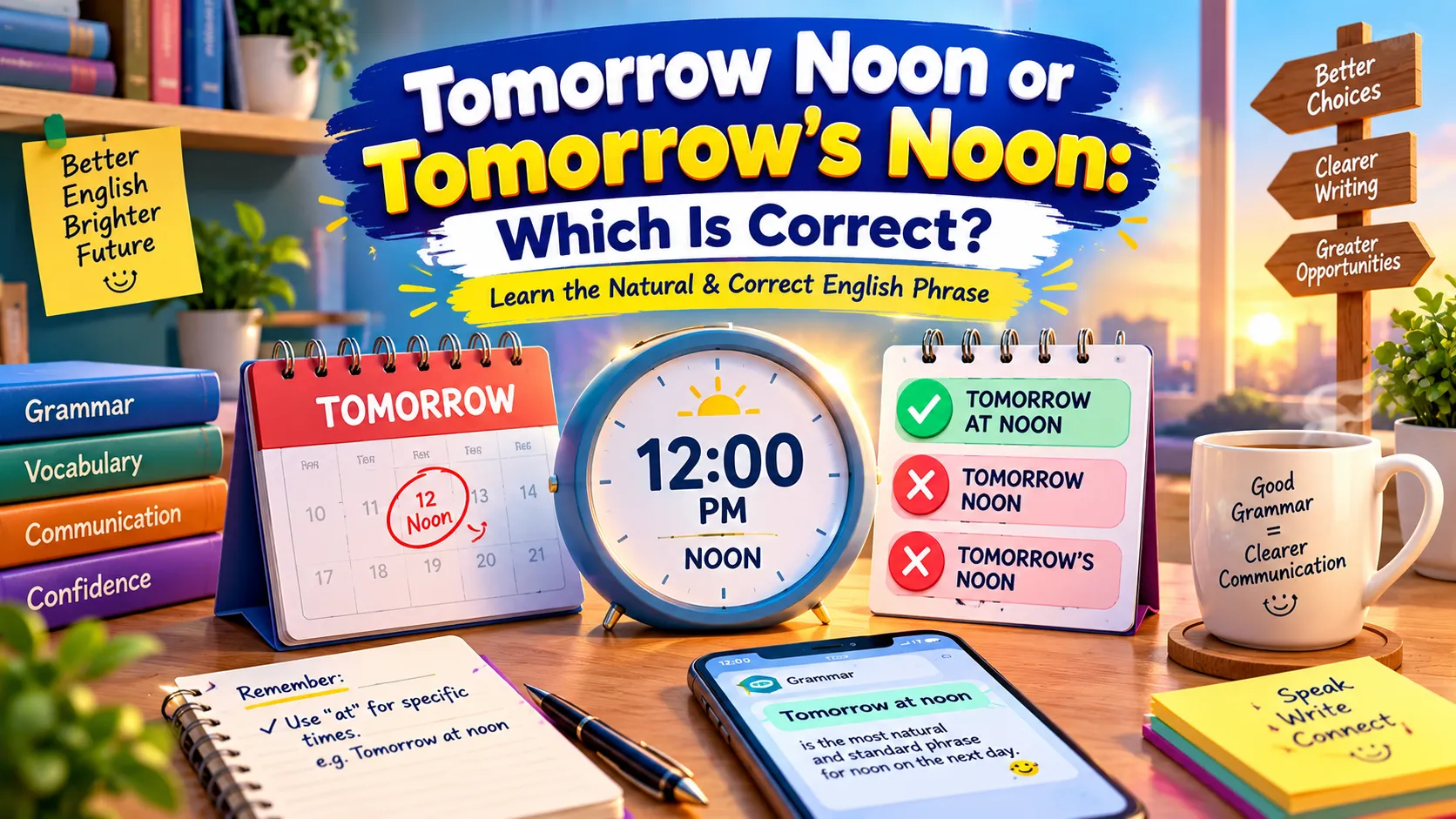
- ✅ tomorrow at noon
- ❌ tomorrow noon — less natural in standard English
- ⚠️ tomorrow’s noon — grammatically possible but usually awkward
Explore More: https://wordminto.com/fyi-meaning/
Is “Tomorrow Noon” Grammatically Correct?
Tomorrow noon can appear in informal English and in some regional varieties of English, but standard English generally favors tomorrow at noon.
For polished writing, academic writing, professional communication, and general-purpose English, choose:
tomorrow at noon
Example
Instead of:
❌ The interview is scheduled tomorrow noon.
Write:
✅ The interview is scheduled tomorrow at noon.
Is “Tomorrow’s Noon” Grammatically Correct?
Yes, it can be grammatically formed, but it rarely represents the most natural way to express the idea.
Here, tomorrow’s uses the possessive apostrophe:
tomorrow + ‘s = tomorrow’s
The phrase literally treats noon as belonging to or being associated with tomorrow.
For example:
Tomorrow’s noon will bring intense heat.
The sentence is grammatically understandable, but most speakers would naturally say:
It will be very hot tomorrow at noon.
So grammatical possibility does not always equal natural usage.
Explore More: https://wordminto.com/borrow-vs-lend/
Tomorrow vs. Tomorrow’s
Understanding the difference between tomorrow and tomorrow’s helps explain the issue.
Tomorrow
Tomorrow refers to the day after today.
Examples:
- I will call you tomorrow.
- We have an exam tomorrow.
- She will arrive tomorrow.
Tomorrow’s
Tomorrow’s can show possession or association.
Examples:
- tomorrow’s meeting
- tomorrow’s weather
- tomorrow’s schedule
- tomorrow’s deadline
- tomorrow’s newspaper
For example:
Tomorrow’s meeting starts at 10 a.m.
Here, tomorrow’s modifies meeting.
However, sounds much less natural because English normally expresses the time with tomorrow at noon.
Tomorrow’s Noon vs. Tomorrow at Noon
Compare these two constructions:
| Phrase | Meaning | Naturalness |
| tomorrow at noon | At noon on the next day | Very natural |
| tomorrow’s noon | The noon associated with tomorrow | Grammatically possible but uncommon |
| tomorrow noon | Noon on the next day | Informal/regional; less standard |
Best Example
I will meet you tomorrow at noon.
This sentence clearly communicates both the day and the time.
Why “Tomorrow’s Noon” Sounds Awkward
English often uses at to identify a specific time.
Compare:
- at noon
- at midnight
- at 3 p.m.
- at 7:30 a.m.
When you add a day:
- tomorrow at noon
- tomorrow at midnight
- tomorrow at 3 p.m.
- tomorrow at 7:30 a.m.
The construction remains straightforward.
Using the possessive tomorrow’s changes the structure:
Although understandable, it creates a construction that English speakers rarely need in everyday communication.
Examples of “Tomorrow at Noon”
Here are natural examples:
- I will call you tomorrow at noon.
- The meeting begins tomorrow at noon.
- We are leaving tomorrow at noon.
- Can you come tomorrow at noon?
- The doctor will see you tomorrow at noon.
- The store opens tomorrow at noon.
- Our lunch is scheduled for tomorrow at noon.
- The results will arrive tomorrow at noon.
- Please be here tomorrow at noon.
- The event starts tomorrow at noon.
Examples of “Tomorrow’s”
Although tomorrow’s noon sounds unusual, tomorrow’s works naturally with many other nouns.
Tomorrow’s Meeting
.
Tomorrow’s meeting starts at 9 a.m.
.
Tomorrow’s Weather
.
Tomorrow’s weather should remain warm.
.
Tomorrow’s Schedule
I will send tomorrow’s schedule tonight.
Tomorrow’s Deadline
.
Tomorrow’s deadline gives us very little time.
.
Tomorrow’s Event
.
Tomorrow’s event begins at noon.
Notice how tomorrow’s naturally modifies a noun.
Common Mistakes
Mistake 1: Using “Tomorrow Noon” in Formal Writing
❌ The meeting will take place tomorrow noon.
Better:
✅ The meeting will take place tomorrow at noon.
Mistake 2: Adding an Apostrophe Without Needing One
❌ I will call you tomorrow’s at noon.
This is incorrect.
Use:
✅ I will call you tomorrow at noon.
Tomorrow’s needs a noun or another grammatical reason to justify the possessive form.
Mistake 3: Confusing “Tomorrow’s Noon” With “Tomorrow at Noon”
⚠️ Tomorrow’s noon
This construction is understandable, but it sounds unusual in ordinary English.
Better:
✅ tomorrow at noon
Mistake 4: Writing “Tomorrows Noon”
❌ tomorrows noon
If you use the possessive construction, you need the apostrophe:
✅ tomorrow’s noon
But for normal communication, use:
✅ tomorrow at noon
Tomorrow Noon vs. Tomorrow’s Noon vs. Tomorrow at Noon
The difference becomes clearer when you compare all three.
Tomorrow Noon
Tomorrow noon means approximately noon tomorrow, but many standard-English speakers find the construction unnatural.
Better:
tomorrow at noon
Tomorrow’s noon treats noon as associated with tomorrow. It can make grammatical sense, but it sounds formal or unusual.
Better in most contexts:
tomorrow at noon
/
Tomorrow at Noon
Tomorrow at noon clearly means at noon on the following day.
It is the most natural general-purpose expression.
Is “Tomorrow at Noon” Formal or Informal?
Tomorrow at noon works in both casual and formal English.
Casual
Can you meet me tomorrow at noon?
Professional
The interview is scheduled for tomorrow at noon.
Academic
The presentation will begin tomorrow at noon.
Business
We will discuss the proposal tomorrow at noon.
The phrase fits almost any context.
Can You Say “Tomorrow at 12 PM”?
Yes.
Tomorrow at noon and tomorrow at 12 p.m. generally communicate the same time.
Examples:
The meeting starts tomorrow at noon.
The meeting starts tomorrow at 12 p.m.
However, noon often provides a cleaner and more natural way to identify 12:00 in everyday English.
Noon or 12 PM?
Noon means 12:00 p.m., the middle of the day.
You can say:
- tomorrow at noon
- tomorrow at 12 p.m.
- tomorrow at 12:00 p.m.
For ordinary writing, tomorrow at noon often sounds the most natural.
“Tomorrow at Noon” in Questions
Use the same structure when asking questions.
Examples:
- Can you meet me tomorrow at noon?
- Are you free tomorrow at noon?
- Will you be available tomorrow at noon?
- Should I call you tomorrow at noon?
- Can we have lunch tomorrow at noon?
“Tomorrow At Noon” in Negative Sentences
The structure also works naturally in negative sentences.
Examples:
- I cannot meet you tomorrow at noon.
- She will not be available tomorrow at noon.
- We do not have a meeting tomorrow at noon.
- He cannot call tomorrow at noon.
“Tomorrow at Noon” in Future Tense
Because tomorrow refers to the future, English commonly uses future constructions with it.
Examples:
I will call you tomorrow at noon.
We will meet tomorrow at noon.
She will arrive tomorrow at noon.
You can also use the present continuous for scheduled arrangements:
I am meeting him tomorrow at noon.
Both structures work naturally.
Quick Grammar Rule
Remember this simple rule:
Use “tomorrow at noon” when you mean noon on the next day.
Use tomorrow’s when you need a possessive form before a noun:
tomorrow’s meeting
tomorrow’s schedule
tomorrow’s weather
tomorrow’s deadline
Do not add an apostrophe to tomorrow simply because you are talking about a future time.
Easy Memory Trick
Think of at as the bridge between a day and a specific time:
Tomorrow + at + noon
So:
Tomorrow at noon = noon on the next day
This pattern also works with other times:
- tomorrow at 8 a.m.
- tomorrow at 10 a.m.
- tomorrow at noon
- tomorrow at 3 p.m.
- tomorrow at midnight
Practice: Choose the Correct Expression
Choose the most natural option.
1. I will call you ______.
A. tomorrow noon
B. tomorrow’s noon
C. tomorrow at noon
Answer: C. tomorrow at noon
2. The meeting starts ______.
A. tomorrow at noon
B. tomorrows noon
C. tomorrow’s at noon
Answer: A. tomorrow at noon
3. ______ meeting starts at 9 a.m.
A. Tomorrow
B. Tomorrow’s
C. Tomorrows
Answer: B. Tomorrow’s
4. Can we meet ______?
A. tomorrow at noon
B. tomorrow’s noon
C. tomorrows at noon
Answer: A. tomorrow at noon
5. I will send you the schedule for ______.
A. tomorrow
B. tomorrow’s
C. tomorrow at
Answer: A. tomorrow
People Also Ask
Tomorrow noon can occur in informal or regional English, but tomorrow at noon sounds more natural in standard English.
Tomorrow’s noon can make grammatical sense, but it sounds unusual in everyday English. Tomorrow at noon usually provides the more natural wording.
For standard, natural English, use tomorrow at noon.
If you specifically write tomorrow’s noon, the apostrophe in tomorrow’s is grammatically required. However, most everyday contexts call for tomorrow at noon instead.
Yes. Tomorrow at noon is a natural and standard way to refer to noon on the following day.
Final Answer
If you are choosing between tomorrow noon and tomorrow’s noon, the most natural standard-English expression is:
Tomorrow at noon ✅
Tomorrow noon can occur in informal or regional usage, but many speakers prefer tomorrow at noon.
Tomorrow’s noon is grammatically possible, but it sounds unusual in ordinary conversation and writing.
Remember:
- ✅ tomorrow at noon — natural and standard
- ⚠️ tomorrow noon — informal/regional; less natural for many speakers
- ⚠️ tomorrow’s noon — grammatically possible but uncommon
- ❌ tomorrows noon — incorrect possessive spelling
For clear, natural English, choose tomorrow at noon.