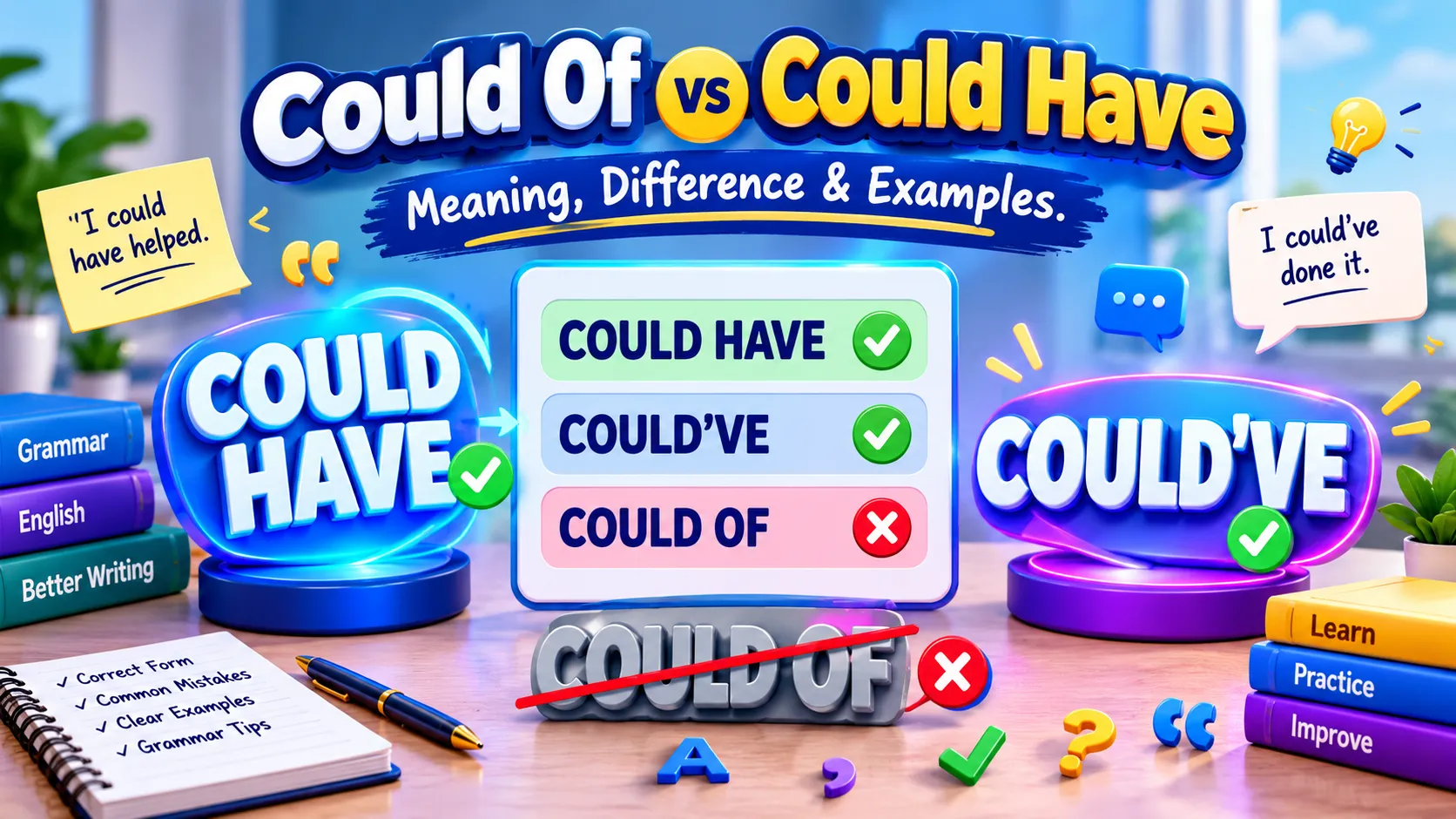
Could of vs could have is a common English grammar confusion, especially because “could’ve” sounds similar to “could of” in everyday speech.
The correct form is “could have.” The phrase “could of” is not standard English when you mean the modal construction could have.
For example:
- Correct: I could have helped you.
- Incorrect: I could of helped you.
- Contraction: I could’ve helped you.
This guide explains the difference between could of and could have, why people confuse them, how to use could have correctly, and how to avoid the mistake in writing.
Quick Answer
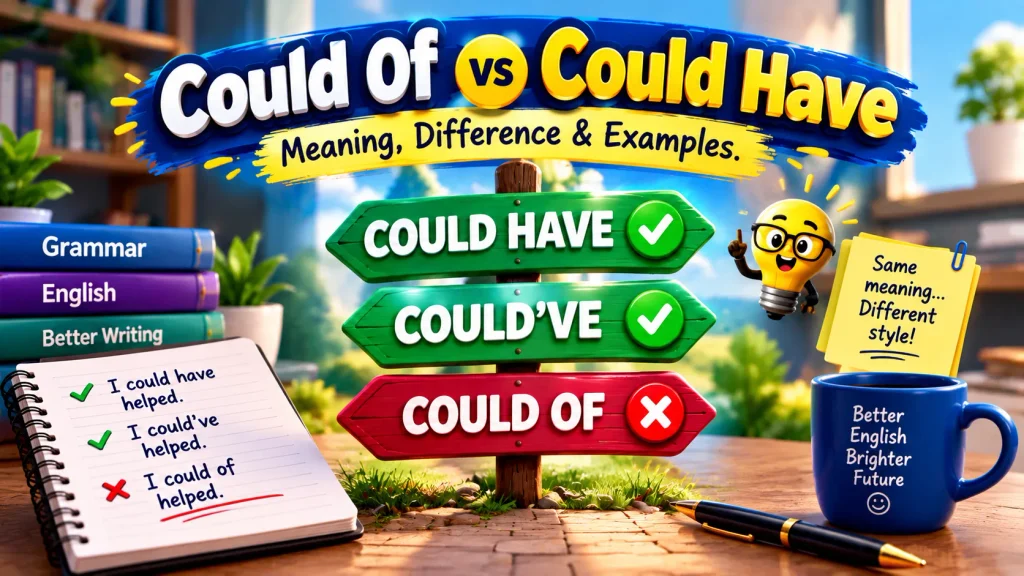
Could have is the correct grammatical form when could combines with have.
Could of is generally incorrect when someone intends to write could have.
| Form | Correct? | Example |
| could have | ✅ Yes | I could have called you. |
| could’ve | ✅ Yes | I could’ve called you. |
| could of | ❌ No | I could of called you. |
The confusion comes from the contraction could’ve, which represents could have.
What Does “Could Have” Mean?
Could have combines the modal verb could with have and usually refers to a past possibility, past ability, or an opportunity that existed in the past.
Examples:
- I could have won the race.
- She could have called earlier.
- We could have taken the train.
- You could have told me.
- They could have arrived before noon.
The basic structure is:
Subject + could have + past participle
Examples:
I could have gone.
She could have helped.
They could have finished.
Explore More: https://wordminto.com/tbh-meaning/
Why Is “Could Of” Incorrect?
Could of comes from a common misunderstanding of the spoken contraction could’ve.
When people say:
could’ve
the pronunciation can sound similar to:
could of
However, “of” does not expand the contraction.
The correct expansion is:
could’ve = could have
Not:
could’ve = could of
For example:
❌ I could of helped you.
✅ I could have helped you.
✅ I could’ve helped you.
The same pattern occurs with other modal contractions:
- would’ve = would have
- should’ve = should have
- might’ve = might have
- must’ve = must have
Could Have vs Could’ve
Could have and could’ve have the same grammatical meaning.
The difference lies mainly in style.
Could Have
Use could have in formal or careful writing.
She could have completed the project earlier.
Could’ve
Use could’ve in informal writing, dialogue, texting, and conversational contexts.
She could’ve completed the project earlier.
Both forms are grammatically correct.
Explore More: https://wordminto.com/fyi-meaning/
Could Have in Past Possibilities
We often use could have to talk about something that was possible in the past.
We could have missed the bus.
This means missing the bus was a possibility.
Another example:
He could have gotten lost.
The speaker considers getting lost a possible past event.
More Examples
- She could have forgotten the appointment.
- They could have taken a different route.
- You could have misunderstood the instructions.
- The package could have arrived yesterday.
- He could have left before we arrived.
Could Have for Missed Opportunities
Could have can also describe an opportunity or possibility that someone did not take.
I could have studied harder.
The speaker means that studying harder was possible, but they did not do it.
Other examples:
- We could have bought the tickets earlier.
- She could have applied for the job.
- He could have joined us.
- You could have asked for help.
- They could have stayed another night.
In these sentences, could have often carries the idea of an unrealized possibility.
Explore More: https://wordminto.com/borrow-vs-lend/
Could Have + Past Participle
After could have, use the past participle, not the simple past form.
Correct
- could have gone
- could have seen
- could have written
- could have eaten
- could have taken
- could have finished
Incorrect
- could have went
- could have saw
- could have wrote
- could have ate
- could have took
- could have finish
For example:
❌ I could have went home earlier.
✅ I could have gone home earlier.
The structure is:
could + have + past participle
Explore More: https://wordminto.com/btw-meaning/
Could Have vs Could
The two forms can refer to different time frames.
Could
Could can describe present or general possibility:
We could go tomorrow.
Could Have
Could have generally refers to a past possibility or past opportunity:
We could have gone yesterday.
Compare:
I could help you.
This refers to a possible action.
I could have helped you.
This refers to a possible action in the past.
Could Have vs Could of Examples
Here are some common corrections:
| Incorrect | Correct |
| I could of helped you. | I could have helped you. |
| She could of won. | She could have won. |
| We could of stayed longer. | We could have stayed longer. |
| He could of called me. | He could have called me. |
| They could of arrived earlier. | They could have arrived earlier. |
| You could of asked. | You could have asked. |
“Could Of” vs “Could Have” in Texting
You may see could of in informal online writing, comments, texts, and social-media posts.
For example:
I could of done that.
Many readers understand the intended meaning, but could of remains nonstandard when it represents could have.
For correct English, write:
I could have done that.
Or:
I could’ve done that.
Informal communication does not change the standard grammatical form.
Explore More: https://wordminto.com/asap-meaning/
Why Do People Write “Could Of”?
The mistake usually comes from pronunciation.
Consider this sentence:
I could’ve helped.
When spoken quickly, could’ve can sound close to could of.
The apostrophe in could’ve also represents omitted letters:
could have → could’ve
Because “ve” sounds like a weak “v” sound in connected speech, some writers mistakenly interpret the phrase as could of.
This creates the common error.
Could Have, Would Have, and Should Have
The same grammar rule applies to several modal constructions.
| Correct | Incorrect |
| could have | could of |
| would have | would of |
| should have | should of |
| might have | might of |
| must have | must of |
Their contractions are:
- could’ve = could have
- would’ve = would have
- should’ve = should have
- might’ve = might have
- must’ve = must have
So if you hear “could’ve,” remember that the full form contains have, not of.
Could Have vs Could’ve vs Could Of
The easiest way to remember the difference is:
Could have → correct
Could’ve → correct contraction
Could of → incorrect replacement for “could have”
For example:
I could have finished it.
.
I could’ve finished it.
.
I could of finished it. ❌
The first two sentences are correct. The third contains the common error.
Is “Could Of” Ever Correct?
Could of is not the standard grammatical form when you intend the modal expression could have.
The word of can appear naturally after could when it belongs to a separate grammatical construction.
For example:
Could some of you help me?
Here, “of” belongs to “some of you.” It does not replace have.
Therefore, don’t treat every appearance of could and of together as automatically wrong. The specific grammatical structure matters.
Could Have in Questions
You can use could have in questions about past possibilities or actions.
Examples:
- Could you have helped me earlier?
- Could she have forgotten the meeting?
- Could they have taken the wrong road?
- Could he have misunderstood the message?
- Could we have avoided the problem?
The question form remains:
Could + subject + have + past participle?
Could Have in Negative Sentences
The negative form is:
could not have
or the contraction:
couldn’t have
Examples:
- I could not have known that.
- She couldn’t have done it alone.
- They couldn’t have arrived so early.
- He couldn’t have forgotten the date.
Do not write:
❌ couldn’t of
Write:
✅ couldn’t have
or
✅ couldn’t’ve

Common Mistakes With Could Have
1. Writing “Could Of”
❌ I could of helped.
✅ I could have helped.
2. Using the Simple Past After Have
❌ She could have went home.
✅ She could have gone home.
3. Confusing Could Have With Could
❌ Yesterday, I could go to the store.
If you mean that going to the store was a past possibility that did not happen, write:
✅ Yesterday, I could have gone to the store.
4. Confusing Could’ve With Could Of
❌ Could of is the full form of could’ve.
✅ Could have is the full form of could’ve.
How to Remember “Could Have” Easily
Use this simple rule:
If you can write “could’ve,” you can write “could have.”
Never expand could’ve as could of.
Think:
could’ve → could have
not:
could’ve → could of
A useful memory trick is:
H in “have” = H in “could have.”
When you see could + ___ + past participle, choose have:
could have gone
.
could have seen
.
could have helped
..
could have finished
…
Could Of vs Could Have: Practice
Choose the correct form.
1. I ___ helped you.
A. could of
B. could have
C. could’ve
Answer: B or C
Both could have and could’ve are correct.
2. She ___ won the competition.
A. could of
B. could have
C. could’ve
Answer: B or C
3. They ___ arrived earlier.
A. could of
B. could have
C. could’ve
Answer: B or C
4. Which sentence is correct?
A. He could of called me.
B. He could have called me.
C. He could have called me.
Answer: B and C
The two correct choices are identical.
5. What does “could’ve” mean?
A. could of
B. could have
C. could had
Answer: B — could have
People Also Ask
No, not when could of represents could have. The standard form is could have, or the contraction could’ve.
Yes. Could’ve is the standard contraction of could have.
No, not as a substitute for could have. Use could have in formal writing.
The pronunciation of could’ve can sound similar to could of in rapid speech. This similarity causes the spelling mistake.
I could have gone is correct.
Final Verdict: Could Of or Could Have?
Could have is the correct standard form.
Could’ve is the correct contraction.
Could of is a common spelling error that usually results from hearing could’ve in speech.
Remember:
could have = correct
could’ve = correct
could of = incorrect when intended to mean “could have”
When in doubt, write could have. It works in both formal and informal contexts and eliminates the confusion completely.











2 thoughts on “Could Of vs Could Have: Meaning, Difference & Correct Usage”