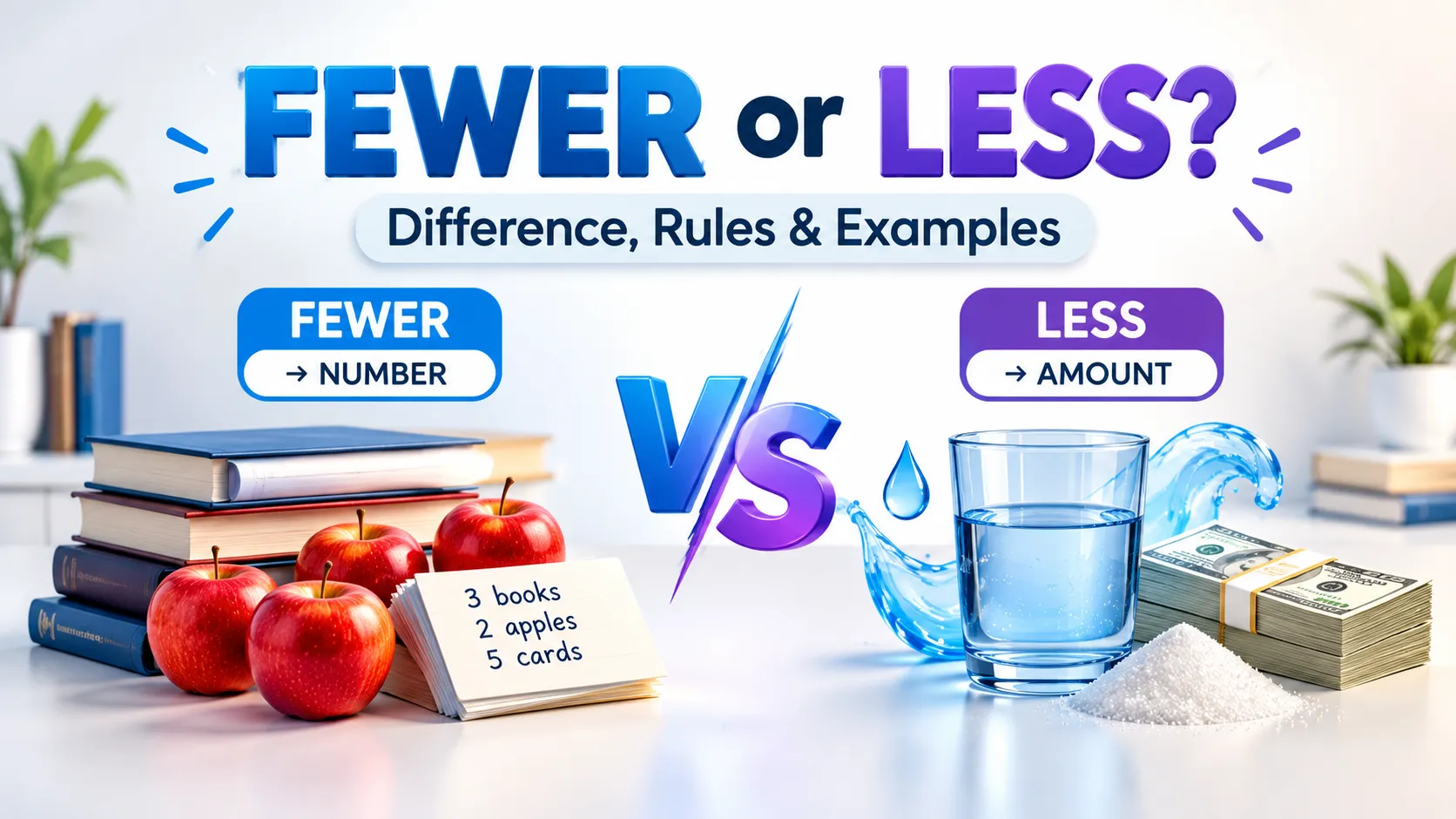
Fewer vs less? These two words both express a smaller amount, but they do not usually work with the same types of nouns. Fewer generally describes countable nouns, while less generally describes uncountable nouns.
For example:
- Fewer students attended the class.
- Less water remained in the bottle.
The easiest rule is simple: use fewer for things you can count individually and less for things you measure as a whole.
However, real-world English has a few important exceptions, especially with time, money, distance, weight, percentages, and measurements. Understanding these cases will help you choose the right word in both everyday and formal writing.
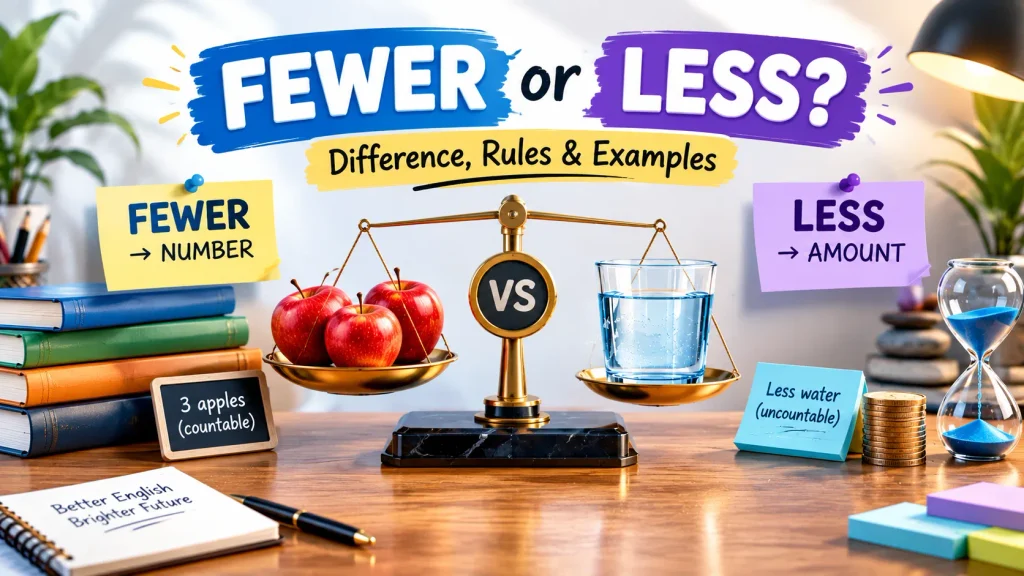
Fewer vs Less: Quick Answer
| Word | Usually Used With | Example |
| Fewer | Countable plural nouns | Fewer cars were on the road. |
| Less | Uncountable nouns | There was less traffic today. |
Simple Rule
Fewer = number
Less = amount
Compare:
- Fewer books → You can count the books.
- Less information → You cannot normally count information as individual units.
What Does “Fewer” Mean?
Fewer means a smaller number of people or things. Use it before plural countable nouns.
Examples:
- We need fewer chairs.
- Fewer employees came to work today.
- She made fewer mistakes this time.
- There are fewer cars on this road.
- I received fewer emails this week.
You can count each item separately:
- one chair, two chairs, three chairs
- one mistake, two mistakes, three mistakes
- one email, two emails, three emails
Therefore, fewer works naturally with these nouns.
Explore More: https://wordminto.com/conscience-or-conscious/
What Does “Less” Mean?
Less means a smaller amount or quantity. Use it primarily with uncountable nouns.
Examples:
- I need less sugar in my coffee.
- We have less time than yesterday.
- She drinks less water during winter.
- There is less traffic today.
- He showed less interest in the project.
These nouns usually represent substances, concepts, or quantities that English treats as a whole rather than as separate countable units.
Fewer vs Less Examples
Here are some quick comparisons:
- Fewer people attended the event.
- Less noise came from the room.
- We bought fewer apples.
- We used less fruit.
- She made fewer errors.
- She experienced less confusion.
- There are fewer students in this class.
- There is less homework this week.
- I have fewer responsibilities now.
- I have less stress now.
The noun determines which word normally fits.
Explore More: https://wordminto.com/then-vs-than/
Fewer Is Used With Countable Nouns
A countable noun refers to something you can count using individual numbers.
Examples include:
- books
- cars
- people
- students
- questions
- mistakes
- houses
- dogs
- bottles
- problems
Use fewer with these plural nouns.
Examples
- I read fewer books this month.
- There were fewer questions on the test.
- The new system caused fewer problems.
- We saw fewer tourists this year.
- The store has fewer employees now.
Incorrect in Standard Usage
- ❌ I read less books this month.
- ❌ There were less questions on the test.
- ❌ The system caused less problems.
Correct
- ✅ I read fewer books this month.
- ✅ There were fewer questions on the test.
- ✅ The system caused fewer problems.
In informal speech, less + plural countable noun appears frequently, but fewer remains the safer choice in formal and edited writing.
Less Is Used With Uncountable Nouns
An uncountable noun describes something that English normally treats as a mass, substance, concept, or general quantity.
Common examples include:
- water
- milk
- sugar
- money
- time
- information
- advice
- traffic
- patience
- furniture
- knowledge
- energy
Use less with these nouns.
Examples
- We need less water.
- I have less money this month.
- She has less patience today.
- The website contains less information than before.
- Try to spend less time on your phone.
Incorrect in Standard Usage
- ❌ I need fewer water.
- ❌ She has fewer patience.
- ❌ We have fewer information.
Correct
- ✅ I need less water.
- ✅ She has less patience.
- ✅ We have less information.
Explore More: https://wordminto.com/affect-or-effect/
Fewer vs Less With Time
Time usually takes the singular form when you mean a general amount or duration.
Examples:
- We have less time than expected.
- I need less time to finish the task now.
- She spends less time watching television.
However, when you count individual units of time, fewer can be correct.
Examples:
- We have fewer than five minutes left.
- The meeting lasted fewer than three hours.
- He worked there for fewer than ten days.
Why?
In less time, time represents a general amount.
In fewer than five minutes, minutes are individual countable units.
Fewer vs Less With Money
Money is generally uncountable, so use less when you mean a general amount.
- I have less money than I expected.
- We need to spend less money.
- She earns less money than her brother.
But specific monetary units can take fewer:
- I have fewer than ten dollars.
- The item costs fewer than five dollars.
Here, dollars are countable units.
Fewer or Less With Distance
Distance measurements can use either word depending on how you express the measurement.
Use less when referring to distance as a general amount:
- The new route requires less distance to travel.
Use fewer with countable units:
- The destination is fewer than five miles away.
- We walked fewer than three kilometers.
In everyday English, speakers often prefer a more natural construction such as:
- It is less than five miles away.
This usage has become extremely common, particularly with measurements.
Fewer or Less With Weight
The same principle applies to weight.
Use less for weight as a general amount:
- The package weighs less than the other one.
- We need less weight in the final design.
Specific units can take fewer:
- The package weighs fewer than ten kilograms.
However, less than ten kilograms is also extremely common because the phrase expresses a measurement as a total quantity rather than emphasizing individual kilograms.
“Less Than” vs. “Fewer Than”
Both phrases are correct, but they normally pair with different nouns.
Use “Fewer Than” With Countable Nouns
- Fewer than 20 students attended.
- Fewer than 10 people applied.
- Fewer than 50 houses were affected.
- Fewer than 100 tickets remained.
Use “Less Than” With Uncountable Quantities
- It costs less than $50.
- We have less than an hour.
- The bottle contains less than one liter of water.
- The project requires less than $1,000.
Important Measurement Exception
English commonly uses less than before measurements:
- less than 10 miles
- less than 20 minutes
- less than 5 kilograms
- less than 50 dollars
This does not mean the basic countable/uncountable rule has disappeared. Measurement expressions often function as a single quantity.
Fewer vs. Less With Percentages
Percentages can take either word depending on what the percentage represents.
Use fewer when the percentage refers to countable people or things:
- Fewer than 20% of students passed the test.
- Fewer than 10% of employees worked remotely.
Use less when the percentage refers to an uncountable quantity:
- Less than 20% of the water remained.
- Less than 10% of the budget was spent.
Compare:
- Fewer than 30% of voters supported the proposal.
- Less than 30% of the money was spent.
Fewer or Less With “People”
Use fewer with people because people are countable individuals.
- Fewer people attended the meeting.
- Fewer people live in the area now.
- Fewer than 100 people entered the competition.
Do not normally use less people in formal standard English.
However, less can modify a measurement or uncountable concept involving people:
- The town has less population than it once did.
Even here, fewer people usually sounds more natural when you mean individual people.
Fewer or Less With “People” vs. “Population”
Compare:
- Fewer people live here now.
- The city has less population than the neighboring city.
People refers to individuals, so fewer fits.
Population refers to a total quantity or demographic measurement, so less can fit.
Fewer or Less With “Work”
Work is generally uncountable when it means tasks or employment.
- I have less work today.
- She needs less work to complete the project.
- We have less work than yesterday.
Do not normally write:
- ❌ I have fewer work today.
But specific tasks are countable:
- I have fewer tasks today.
- She completed fewer assignments.
Fewer or Less With “Problems”
Problems are countable, so use fewer.
- The new system creates fewer problems.
- We encountered fewer problems this time.
- The update fixed fewer problems than expected.
Not:
- ❌ The system creates less problems.
Fewer or Less With “Issues”
Issues are countable, so use fewer.
- We have fewer issues now.
- The update caused fewer issues.
- The team reported fewer issues this week.
Fewer or Less With “Information”
Information is uncountable.
Use less:
- I need less information.
- The report contains less information than the original.
- We have less information available.
Do not use fewer information in standard English.
If you want a countable form, use pieces of information:
- Fewer pieces of information were available.
Fewer or Less With “Advice”
Advice is also uncountable.
Use less advice:
- I need less advice, not more.
- He gave me less advice than expected.
To make it countable, use pieces of advice:
- She gave me fewer pieces of advice.
Do not write:
- ❌ fewer advice
Fewer or Less With “Amount” and “Number”
This is one of the easiest ways to remember the rule.
Use:
A smaller number of + countable nouns
A smaller amount of + uncountable nouns
Examples:
- A smaller number of students attended.
- A smaller amount of water was available.
Therefore:
- fewer students
- less water
Easy Formula
Fewer → number
Less → amount
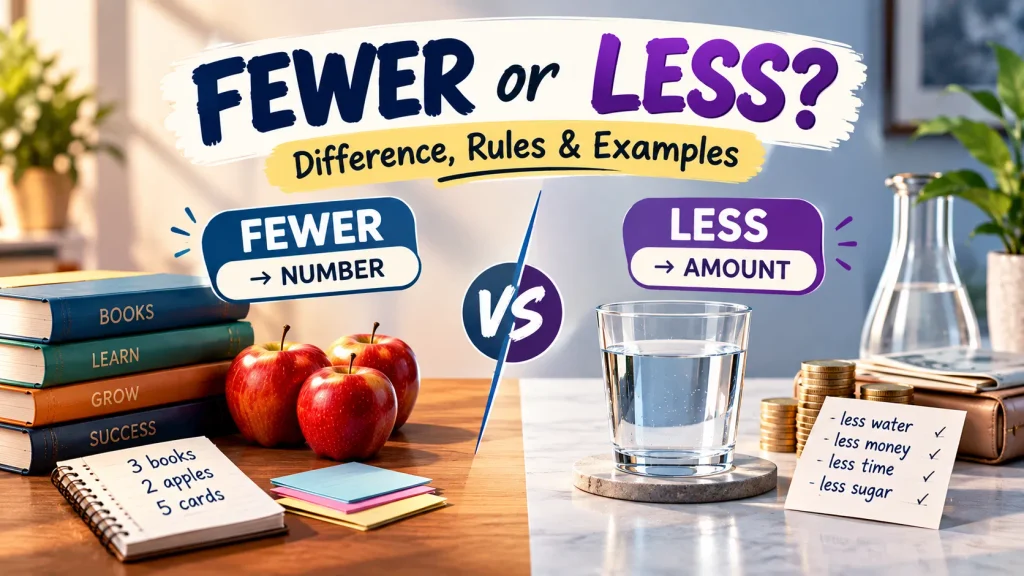
Common Mistakes With Fewer and Less
Mistake 1: Less With Plural Countable Nouns
❌ There are less cars on the road.
✅ There are fewer cars on the road.
Mistake 2: Fewer With Uncountable Nouns
❌ We need fewer information.
✅ We need less information.
Mistake 3: Fewer Money
❌ I have fewer money.
✅ I have less money.
Mistake 4: Less People in Formal Writing
❌ Less people attended the event.
✅ Fewer people attended the event.
Mistake 5: Fewer Advice
❌ She gave me fewer advice.
✅ She gave me less advice.
Or:
✅ She gave me fewer pieces of advice.
Is “Less People” Ever Used?
Yes. Less people appears frequently in casual speech, advertising, and everyday communication.
However, traditional standard grammar recommends:
fewer people
For formal writing, academic work, professional communication, and careful editing, choose fewer people.
Is “Less Books” Correct?
In standard formal English, use:
fewer books
Example:
- ❌ I bought less books this year.
- ✅ I bought fewer books this year.
Because books are countable plural nouns.
Is “Less Than” Always Correct?
No. The choice depends on what follows.
Use fewer than with countable nouns:
- fewer than 20 students
- fewer than 50 employees
- fewer than 100 cars
Use less than with uncountable quantities:
- less than 20 liters of water
- less than an hour
- less than $100
But less than commonly appears with measurements:
- less than five miles
- less than ten minutes
- less than five kilograms
A Simple Trick to Remember Fewer vs. Less
Ask yourself:
“Can I count the things one by one?”
If yes, choose fewer.
- one book → two books → three books
- fewer books
If no, choose less.
- water → not normally one water, two waters
- less water
The One-Question Test
Can I put a number directly before the noun?
If yes:
→ fewer
If no:
→ less
Examples:
Three apples → countable → fewer apples
Three waters → not normally used for the substance itself → less water
Fewer vs. Less: Comparison Table
| Example | Correct Word | Reason |
| ___ students | Fewer | Students are countable |
| ___ water | Less | Water is uncountable |
| ___ mistakes | Fewer | Mistakes are countable |
| ___ information | Less | Information is uncountable |
| ___ people | Fewer | People are countable |
| ___ money | Less | Money is generally uncountable |
| ___ time | Less | Time is generally uncountable |
| ___ questions | Fewer | Questions are countable |
| ___ traffic | Less | Traffic is uncountable |
| ___ problems | Fewer | Problems are countable |
| ___ advice | Less | Advice is uncountable |
| ___ books | Fewer | Books are countable |
Fewer vs. Less in Everyday English
In casual conversation, native speakers sometimes use less with plural countable nouns:
- less people
- less cars
- less problems
- less questions
You will hear these expressions, but that does not make them the preferred choice in formal standard English.
For polished writing, use:
- fewer people
- fewer cars
- fewer problems
- fewer questions
This distinction matters particularly in academic writing, business writing, examinations, professional documents, and edited content.
Fewer or Less: Practice Exercise
Choose fewer or less in each sentence.
- We have ___ employees this year.
- I need ___ sugar in my coffee.
- She made ___ mistakes this time.
- There is ___ traffic today.
- He has ___ money than before.
- The teacher assigned ___ questions.
- We need ___ information.
- ___ people attended the event.
- I have ___ time to finish.
- The new system causes ___ problems.
Answers
- fewer employees
- less sugar
- fewer mistakes
- less traffic
- less money
- fewer questions
- less information
- Fewer people
- less time
- fewer problems
People Also Ask
Fewer people is the standard choice because people are countable.
Usually less time.
Example: “I need less time to complete the task.”
Use less money when you mean money as a general amount.
Example: “We need less money to complete the project.”
Use fewer students because students are countable.
Use less information because information is uncountable.
Use fewer mistakes because mistakes are countable.
Final Rule: Fewer or Less?
The basic distinction is straightforward:
Use fewer with plural countable nouns and less with uncountable nouns.
Examples:
- fewer books
- fewer students
- fewer mistakes
- fewer people
- less water
- less money
- less time
- less information
Remember the shortcut:
Fewer = number
Less = amount
When you can count individual items, fewer usually fits. When you mean a general amount or quantity, less usually fits. Once you understand that distinction—and the common measurement exceptions—you can use fewer and less confidently in both everyday and formal English.











4 thoughts on “Fewer vs Less: What’s the Difference? Meaning, Rules & Examples”