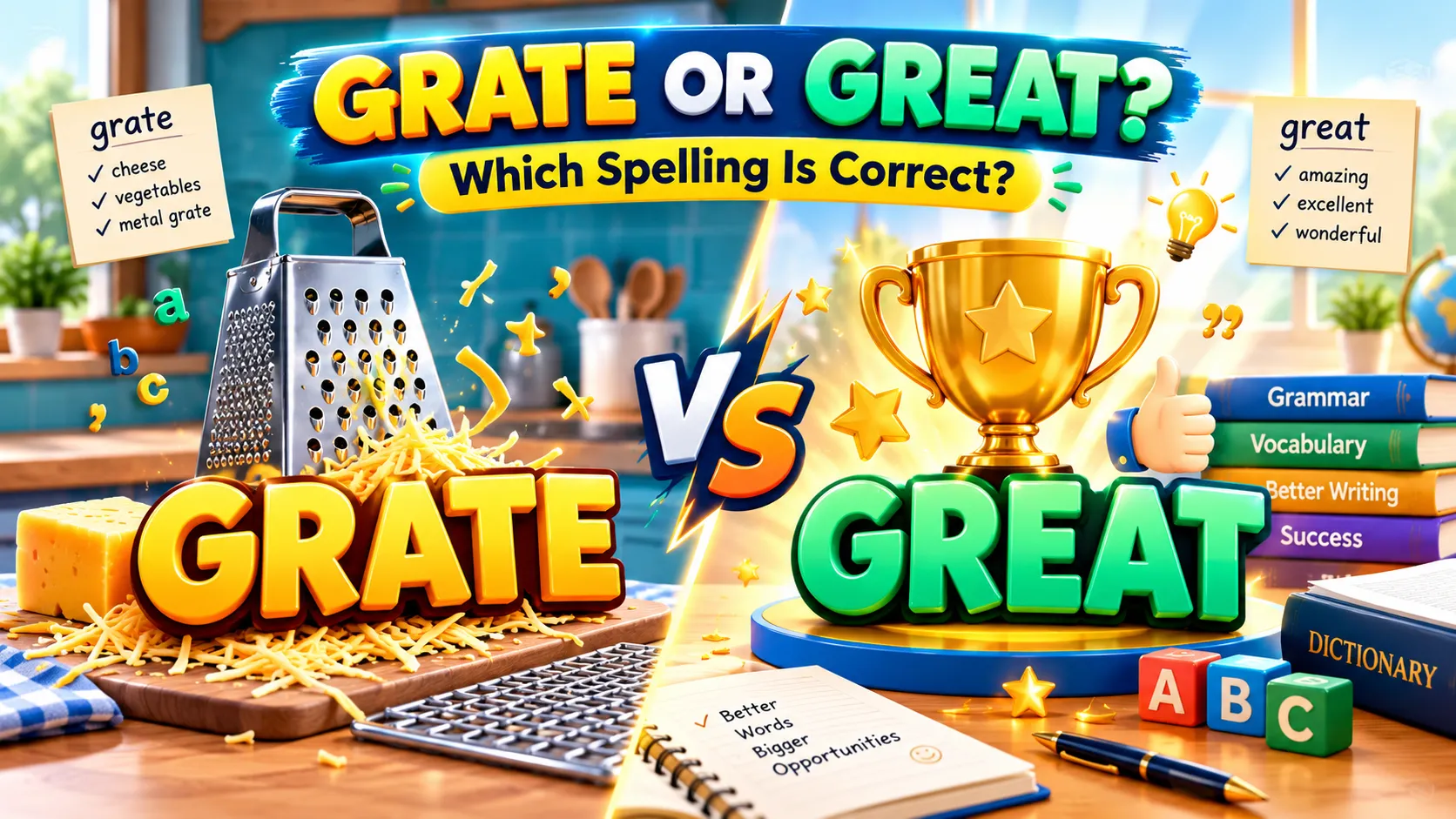
G.r.a.t.e or G.r.e.a.t: Grate or great? Both are correct English words, but they have completely different meanings and uses.
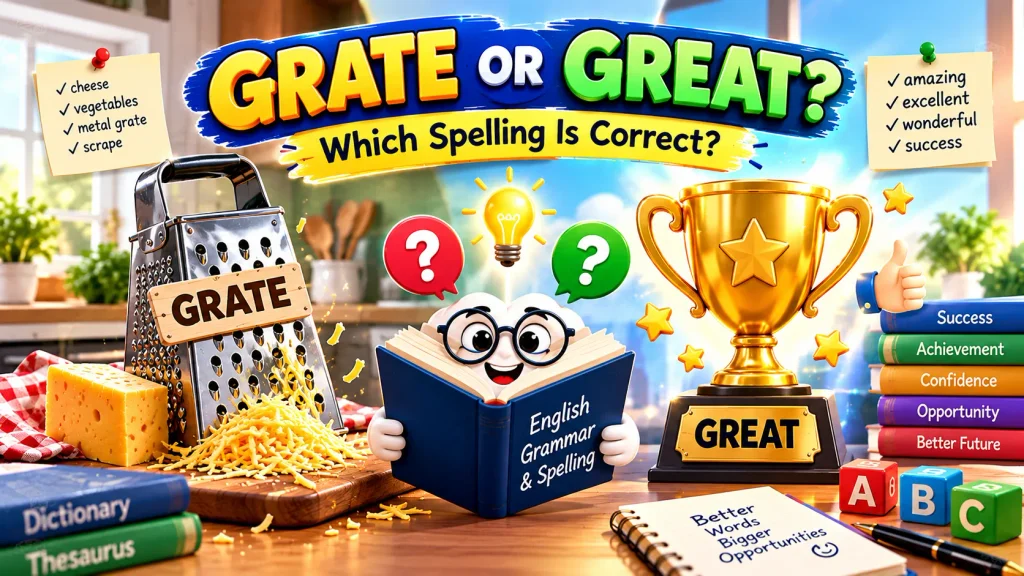
Use grate when you mean to shred food, scrape or rub something, annoy someone, or refer to a metal framework. Use great when you mean excellent, impressive, important, large, or significant.
The two words are homophones: they have the same pronunciation but different spellings and meanings. Both are pronounced /ɡreɪt/.
Quick rule:
GRATE → shred, scrape, metal, annoy
GREAT → excellent, important, large, impressive
Grate or Great: Quick Answer
| Word | Main Use | Example |
| grate | Shred food | Please grate the cheese. |
| grate | Irritate or annoy | His attitude grates on me. |
| grate | Metal framework | The fireplace grate is made of iron. |
| great | Excellent or very good | We had a great meal. |
| great | Large or significant | It required great effort. |
| great | Distinguished or famous | She is one of the greats of tennis. |
So:
- ✅ I had a great day.
- ❌ I had a grate day.
- ✅ Please grate the cheese.
- ❌ Please great the cheese.
The correct choice depends on meaning and context, not pronunciation.
Grate vs. Great: The Main Difference
G.r.a.t.e or G.r.e.a.t
The easiest way to distinguish these words is to connect each one with its common meanings.
Use grate for:
- Shredding or scraping food
- A metal framework
- A harsh rubbing or scraping sound
- Something that annoys or irritates
Use great for:
- Excellence
- Very good quality
- Large size or amount
- Importance
- Significance
- Impressive achievement or ability
Compare:
Grate the carrot before adding it to the salad.
Here, grate means shred.
That was a great performance.
Here, great means excellent.
The fireplace grate was covered with ash.
Here, grate is a noun meaning a metal framework.
Her constant interruptions grate on me.
Here, grate means annoy.
What Does Grate Mean?
Grate has several meanings. It can function as both a verb and a noun.
1. Grate Means to Shred Food
As a verb, grate means to rub food against a grater so that it is cut into small pieces.
Common foods that can be grated include:
- Cheese
- Carrots
- Ginger
- Chocolate
- Apples
- Potatoes
- Vegetables
Examples
Please grate the Parmesan over the pasta.
She grated a carrot for the salad.
I need to grate some fresh ginger.
He grated chocolate over the dessert.
Grate the apples before mixing them into the batter.
In each sentence, grate describes an action involving shredding or reducing food into smaller pieces.
2. Grate Means to Scrape or Rub
Grate can also describe two hard surfaces rubbing against each other, usually producing an unpleasant sound.
Examples:
The rusty gate grated against the wall.
The metal chair grated across the floor.
The gears grated loudly as the machine stopped.
This meaning is closely associated with a harsh scraping or grinding sound.
3. Grate Means to Annoy or Irritate
When something grates on someone, it annoys or irritates that person.
Examples:
His arrogant attitude really grates on me.
Her constant interruptions began to grate on everyone.
The repetitive noise grated on my nerves.
The expression grate on someone’s nerves is particularly useful in everyday English.
What Is a Grate?
G.r.a.t.e or G.r.e.a.t
As a noun, a grate is a framework or structure made from bars, usually metal.
You may see a grate in:
- Fireplaces
- Drains
- Vents
- Industrial structures
- Street openings
Fireplace Grate
The logs were burning on the fireplace grate.
A fireplace grate supports wood or coal while allowing air to circulate underneath.
Drain Grate
Leaves covered the drain grate.
A drain grate covers an opening while allowing water to pass through.
Metal Grate
The workers lifted the heavy metal grate.
Here, grate refers to the physical metal framework.
What Does Great Mean?
G.r.a.t.e or G.r.e.a.t
Great is most commonly an adjective. It has several meanings depending on context.
1. Great Means Excellent or Very Good
This is one of the most common meanings of great.
That was a great movie.
You did a great job.
She has a great sense of humor.
We had a great time.
That’s a great idea.
Here, great expresses positive evaluation.
2. Great Means Large
Great can describe something large in size, amount, degree, or extent.
Examples:
A great crowd gathered outside.
The project required a great amount of work.
They showed great courage.
The storm caused great damage.
In these examples, great does not necessarily mean “excellent.” It can mean large, considerable, or intense.
3. Great Means Important or Significant
Great can describe something that has considerable importance or influence.
Examples:
This is a matter of great importance.
She made a great contribution to science.
The discovery was of great significance.
He became a great leader.
4. Great Can Mean Famous or Distinguished
In some contexts, great describes someone who has achieved exceptional distinction.
Examples:
She is one of the greats of tennis.
He studied the works of the greats of literature.
Several sporting greats attended the event.
Here, the greats is an informal noun referring to highly successful or distinguished people.
Grate vs. Great: Parts of Speech
G.r.a.t.e or G.r.e.a.t
Understanding grammar makes this distinction easier.
| Word | Part of Speech | Example |
| grate | Verb | Grate the cheese. |
| grate | Noun | The fireplace grate is hot. |
| grates | Verb | His voice grates on me. |
| grated | Verb | She grated the carrot. |
| grating | Verb/adjective | The sound was grating. |
| great | Adjective | It was a great opportunity. |
| greats | Informal noun | She is one of the greats. |
| greater | Comparative adjective | This challenge is greater. |
| greatest | Superlative adjective | It was his greatest achievement. |
Important Point
Grate can commonly function as a noun or verb, while great is primarily an adjective in ordinary modern English.
Are Grate and Great Homophones?
G.r.a.t.e or G.r.e.a.t
Yes. Grate and great are homophones.
A homophone is a word that has the same pronunciation as another word but a different spelling and meaning.
Both words are pronounced:
/ɡreɪt/
They sound approximately like “grayt.”
That means you cannot always determine the spelling from speech alone.
For example, if someone says:
“We had a great time.”
You hear the sound, but the context tells you that the intended word is great, not grate.
Why This Causes Mistakes
Because grate and great sound identical, learners sometimes choose the wrong spelling when writing.
The solution is simple:
Don’t choose by sound. Choose by meaning.
How to Pronounce Grate and Great
G.r.a.t.e or G.r.e.a.t
Both words have the same pronunciation:
- grate → /ɡreɪt/
- great → /ɡreɪt/
They rhyme with words such as:
- late
- gate
- date
- eight
- wait
The spelling is different, but the pronunciation is the same in standard varieties of English.
Grate as a Verb: Its Three Main Uses
G.r.a.t.e or G.r.e.a.t
The verb grate has three especially useful meanings.
Grate = Shred
.
Grate the cheese.
.
Grate = Produce a Harsh Sound
The wheels grated against the pavement.
Grate = Annoy
His rude comments grate on me.
These meanings are different, but they share an underlying idea of rubbing, friction, or unpleasantness.
Forms of the Verb Grate
| Form | Example |
| Base form | I grate the cheese. |
| Third-person singular | She grates the cheese. |
| Past tense | She grated the cheese. |
| Past participle | The cheese was grated. |
| -ing form | He is grating the carrot. |
Great as an Adjective
G.r.a.t.e or G.r.e.a.t
Great can describe many different qualities.
It can refer to:
- Quality
- Size
- Importance
- Degree
- Achievement
- Ability
- Enjoyment
- Influence
Examples:
She is a great teacher.
That was a great opportunity.
They made a great effort.
We had a great evening.
A great number of people attended.
The exact meaning depends on the noun or context.
Grater vs. Greater: Another Common Confusion
G.r.a.t.e or G.r.e.a.t
Once you understand grate vs. great, another commonly confused pair becomes much easier:
grater vs. greater
Although they are different words, their pronunciation is the same in many varieties of English.
What Is a Grater?
A grater is a tool used to grate food.
I bought a new cheese grater.
Use a grater to shred the carrots.
Think:
grate → grater → food
What Does Greater Mean?
Greater is the comparative form of great.
It means something is larger, more important, more significant, or more considerable in comparison with something else.
This challenge is greater than the previous one.
The second building has a greater height.
She now has greater confidence.
Grate, Grater, Great, Greater
| Word | Meaning | Example |
| grate | Shred or scrape | Grate the cheese. |
| grater | Tool for shredding | Use a cheese grater. |
| great | Excellent, large, important | It was a great idea. |
| greater | Comparative form of great | This is a greater challenge. |
This four-word comparison is one of the easiest ways to organize the entire word family.
Grated vs. Greater
G.r.a.t.e or G.r.e.a.t
These two words look somewhat similar but have completely different meanings.
Grated
Grated is the past tense or past participle of grate.
She grated the cheese.
The carrots were grated finely.
Greater
Greater is the comparative form of great.
This problem is greater than the previous one.
The company now faces greater competition.
grated → grate → shredding/scraping
greater → great → comparison
Great, Greater, and Greatest
G.r.a.t.e or G.r.e.a.t
The forms of great follow a useful comparison pattern.
| Form | Function | Example |
| great | Base form | It was a great achievement. |
| greater | Comparative | This achievement is greater than the last. |
| greatest | Superlative | This was her greatest achievement. |
Do not confuse these with grated or grating.
Common Mistakes With Grate and Great
Mistake 1: “I Had a Grate Day”
❌ I had a grate day.
✅ I had a great day.
A pleasant or enjoyable day is great.
Mistake 2: “Great the Cheese”
❌ Please great the cheese.
✅ Please grate the cheese.
The verb for shredding cheese is grate.
Mistake 3: “His Voice Really Greats on Me”
❌ His voice really greats on me.
✅ His voice really grates on me.
The expression grate on someone means to annoy or irritate.
Mistake 4: “Fireplace Great”
❌ The logs are on the fireplace great.
✅ The logs are on the fireplace grate.
The metal framework in a fireplace is a grate.
Mistake 5: “A Greater for Cheese”
❌ I need a greater for the cheese.
✅ I need a grater for the cheese.
A kitchen tool used to shred food is a grater.
Mistake 6: “The Problem Is Grated”
❌ The problem is grated than before.
✅ The problem is greater than before.
Use greater when making a comparison.
Explore More: https://wordminto.com/kindergarten-or-kindergarden/
Easy Memory Tricks for Grate vs. Great
G.r.a.t.e or G.r.e.a.t
Memory Trick 1: GRATE → GRATER → FOOD
If you can use a grater, the verb is grate.
Grate the cheese with a grater.
This connection makes the spelling easier to remember.
Memory Trick 2: GREAT → EXCELLENT
Think:
GREAT = EXCELLENT
If you are praising something, great is usually the word you need.
That was a great performance.
She has a great idea.
Memory Trick 3: GRATE = Friction
Think of grate in terms of friction:
- Grate cheese.
- A grate is made of bars.
- Something can grate against another surface.
- A person’s behavior can grate on you.
Memory Trick 4: Ask One Question
Before writing the word, ask:
Am I talking about shredding, scraping, metal, or irritation?
If yes → GRATE
Am I describing something as excellent, important, large, or impressive?
If yes → GREAT
Grate or Great in Everyday Sentences
Here are practical examples:
- Please grate the Parmesan cheese.
- We had a great dinner.
- The metal grate covered the drain.
- She is a great singer.
- His attitude began to grate on me.
- The old gate grated against the pavement.
- That’s a great idea.
- He used a box grater to shred the carrots.
- The fireplace grate was made of iron.
- The new building is of great importance to the community.
Grate and Great in Conversations
These words frequently appear in everyday communication.
Conversation 1
A: How was your vacation?
B: It was great!
Here, great means very good or enjoyable.
Conversation 2
A: What should I do with this cheese?
B: Grate it over the pasta.
Here, grate means shred.
Conversation 3
A: Why did you leave the room?
B: That repetitive noise was starting to grate on my nerves.
Here, grate means irritate.
Grate and Great in Academic English
Both words can appear in formal or academic writing, but their functions are different.
Grate
The mechanical components grated against each other.
Great
The discovery was of great significance.
The experiment required great care.
In academic writing, great often appears in expressions involving importance, degree, or significance.
Grate and Great in Business English
Great is common in professional communication when describing positive results or significant matters.
The team made great progress.
This represents a great opportunity.
The project requires great attention to detail.
Grate is more likely to appear in technical or descriptive contexts:
The damaged components grated against each other.
American English vs. British English
There is no American-versus-British spelling difference between these words.
American English
- grate
- great
British English
- grate
- great
The distinction is based on meaning and grammatical function, not regional spelling.
This is different from spelling pairs such as:
- color/colour
- center/centre
- jewelry/jewellery
Word Origins: Why Do Grate and Great Have Different Spellings?
Although grate and great sound alike today, they have different historical origins.
The verb grate, meaning to scrape or rub, entered English through Middle English and Old French, with the French form grater associated with scraping.
The noun grate, referring to a framework or lattice, has a separate historical development and is connected through Middle English and Old French with Latin cratis, meaning a hurdle or lattice.
Great has a different origin. It comes from Old English grēat, meaning “big,” and is of West Germanic origin.
Therefore, their identical pronunciation today does not mean that the words originally came from the same source.
Is “Grate” a Word?
Yes. Grate is a standard English word.
It can be:
- A verb meaning to shred food
- A verb meaning to scrape or rub
- A verb meaning to annoy or irritate
- A noun meaning a metal framework
Examples:
Grate the cheese.
The wheels grated against the road.
His voice grates on me.
The fireplace grate was hot.
Is “Great” a Word?
Yes. Great is an extremely common English word.
It can mean:
- Very good
- Excellent
- Large
- Important
- Significant
- Impressive
Examples:
She did a great job.
It was a great success.
They showed great courage.
A great crowd gathered outside.
Can “Grate” Mean “Annoy”?
Yes.
When grate is used with on, it means to annoy or irritate someone.
Common structure:
something + grates on + someone
Examples:
His constant complaints grate on me.
Her sarcastic tone grates on him.
The repeated noise began to grate on everyone’s nerves.
This figurative meaning is related to the idea of unpleasant friction.
Can “Great” Be a Noun?
Yes, although this use is less common than its adjective use.
In informal English, a great or the greats can refer to a highly successful or distinguished person.
Examples:
She is one of the greats of tennis.
He studied the works of the greats.
The plural greats is especially common when discussing exceptional people in sports, music, literature, entertainment, or other fields.
Can “Great” Be an Adverb?
In informal English, great can sometimes be used adverbially.
For example:
You did great!
This usage is common in conversation, especially in American English.
In formal writing, well is generally preferred when the intended meaning is “in a good manner.”
Compare:
Informal: You did great.
More formal: You did well.
Grate or Great: A Simple Rule
Keep this quick reference in mind.
Use GRATE for:
Food + metal + scraping + irritation
- grate cheese
- grate carrots
- grate ginger
- fireplace grate
- drain grate
- grate against something
- grate on someone’s nerves
Use GREAT for:
Excellent + important + large + impressive
- great movie
- great idea
- great success
- great importance
- great achievement
- great opportunity
- great effort
Practice Quiz: Grate or Great?
Choose the correct word or form.
Fill in the Blanks
- We had a _____ time at the concert.
- Please _____ the cheese.
- His constant complaining began to _____ on me.
- The fireplace _____ was made of iron.
- She did a _____ job.
- I need to _____ the carrots.
- The issue is of _____ importance.
- The rusty hinges _____ against the door.
- He is one of the _____ athletes of his generation.
- Water flowed through the metal _____.
Answers
- great
- grate
- grate
- grate
- great
- grate
- great
- grated
- great
- grate
Multiple-Choice Questions
1. Which sentence is correct?
A. Please great the cheese.
B. Please grate the cheese.
C. Please greater the cheese.
D. Please grater the cheese.
Answer: B. Please grate the cheese.
Explanation: Grate is the verb meaning to shred food.
2. Which sentence uses “great” correctly?
A. Great the carrots.
B. The fireplace great is hot.
C. We had a great evening.
D. His voice greats on me.
Answer: C. We had a great evening.
Explanation: Great describes the evening positively.
3. Which word means a kitchen tool used for shredding food?
A. grate
B. great
C. grater
D. greater
Answer: C. grater
4. Which word is the comparative form of “great”?
A. grated
B. grating
C. grater
D. greater
Answer: D. greater
5. Which sentence means “His behavior annoys me”?
A. His behavior is great on me.
B. His behavior grates on me.
C. His behavior greater me.
D. His behavior grater me.
Answer: B. His behavior grates on me.
Sentence Correction Exercise
Correct the errors in these sentences.
- I had a grate weekend.
- Can you great the cheese?
- His constant interruptions great on me.
- The fireplace great was damaged.
- This is a grate opportunity.
- I need a greater to shred these carrots.
- The second problem is grated than the first.
- She grates the cheese with a greater.
Correct Answers
- I had a great weekend.
- Can you grate the cheese?
- His constant interruptions grate on me.
- The fireplace grate was damaged.
- This is a great opportunity.
- I need a grater to shred these carrots.
- The second problem is greater than the first.
- She grates the cheese with a grater.
Grate or Great: Final Comparison
| Question | Grate | Great |
| Can it be a verb? | Yes | Usually no |
| Can it be a noun? | Yes | Yes, informally |
| Can it be an adjective? | Not in ordinary modern use | Yes |
| Used for shredding food? | Yes | No |
| Used for a metal framework? | Yes | No |
| Can it mean “annoy”? | Yes | No |
| Can it mean “excellent”? | No | Yes |
| Can it mean “large”? | No | Yes |
| Can it mean “important”? | No | Yes |
| Pronunciation | /ɡreɪt/ | /ɡreɪt/ |
| Homophone of the other word? | Yes | Yes |
People Also Ask
Both are correct words, but they have different meanings. Grate relates to shredding, scraping, irritation, or a metal framework. Great describes something excellent, important, large, significant, or impressive.
Yes. Grate and great are homophones because they have the same pronunciation but different spellings and meanings.
Yes.
Grate the cheese before adding it to the pasta.
Yes.
That was a great performance.
Grate is the action of shredding food, while a grater is the tool used to shred it.
Grate the cheese with a cheese grater.
Great is the base adjective. Greater is its comparative form.
This is a great achievement.
This achievement is greater than the previous one.
Conclusion
Grate and great are both correct English words, but they are not interchangeable.
Use grate when you are talking about shredding food, scraping, a metal framework, harsh rubbing, or irritation.
Use great when you mean excellent, impressive, important, large, significant, or distinguished.
The best way to remember the difference is:
GRATE → shred, scrape, metal, annoy
GREAT → excellent, important, large, impressive
Because the two words are pronounced /ɡreɪt/, their sound cannot tell you which spelling to use. Context and meaning determine the correct word.










2 thoughts on “Grate or Great: Which One Is Correct?”