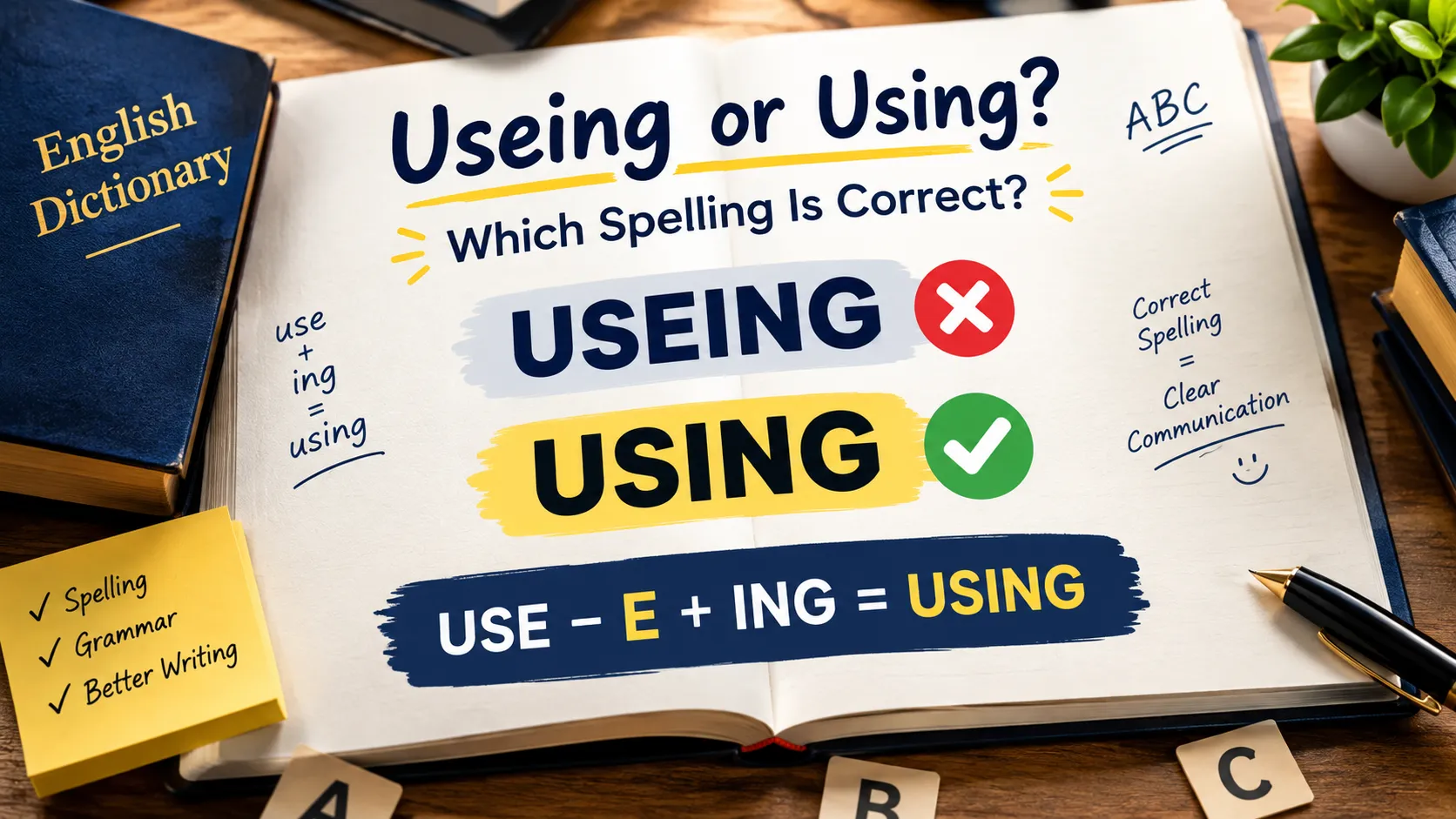
Useing or using? If you are unsure which spelling is correct, the answer is straightforward: using is correct, while useing is incorrect in standard English.
The correct form is:
use + ing → using
When -ing is added to use, the final silent e is removed before the suffix is added.
So write:
- ✅ I am using my laptop.
- ✅ She is using a new method.
- ❌ I am useing my laptop.
- ❌ She is useing a new method.
This spelling is the same in both American and British English. There is no standard English spelling variant called useing.
Useing or Using: Quick Answer
| Spelling | Correct? | Explanation |
| Using | ✅ Yes | Standard English spelling |
| Useing | ❌ No | Incorrect spelling |
The correct spelling is:
USE → USING
Not:
USE → USEING
The key spelling change is simple:
use − e + ing = using
Quick examples
- I am using my phone.
- We are using the new software.
- She is using her experience to solve the problem.
- They were using the wrong formula.
- He enjoys using simple language.
Why Is “Using” Correct?
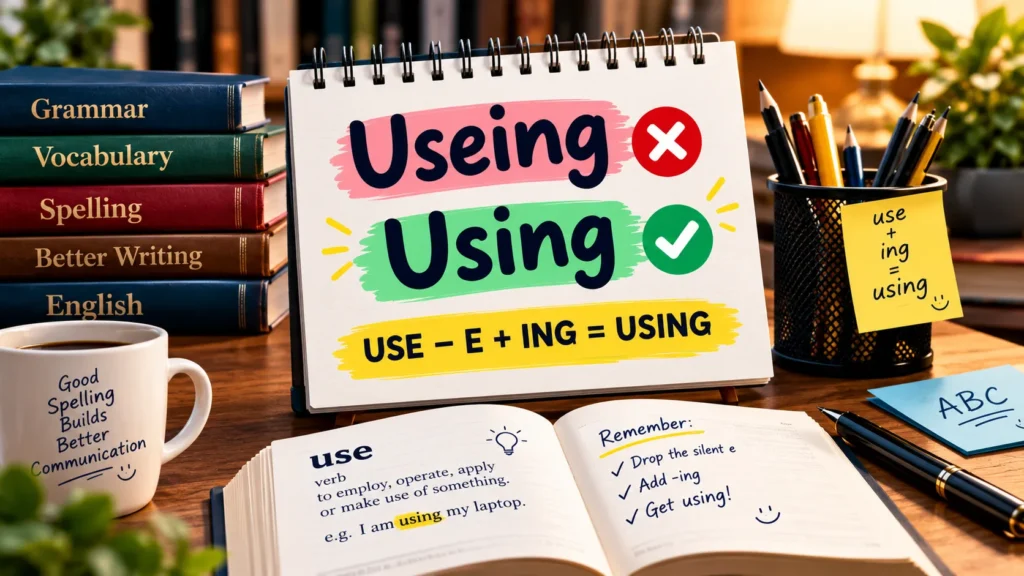
Using is the -ing form of the verb use.
The verb use ends in a final silent e. In the usual spelling pattern, that e is dropped before -ing is added.
The formation is:
use − e + ing = using
This gives:
use → using
The same spelling pattern occurs in many other verbs:
| Base Verb | + -ing | Correct Form |
| make | -ing | making |
| write | -ing | writing |
| take | -ing | taking |
| drive | -ing | driving |
| hope | -ing | hoping |
| move | -ing | moving |
| create | -ing | creating |
| use | -ing | using |
Therefore, useing incorrectly keeps the final e.
The Spelling Rule Behind Use → Using
A useful English spelling pattern is:
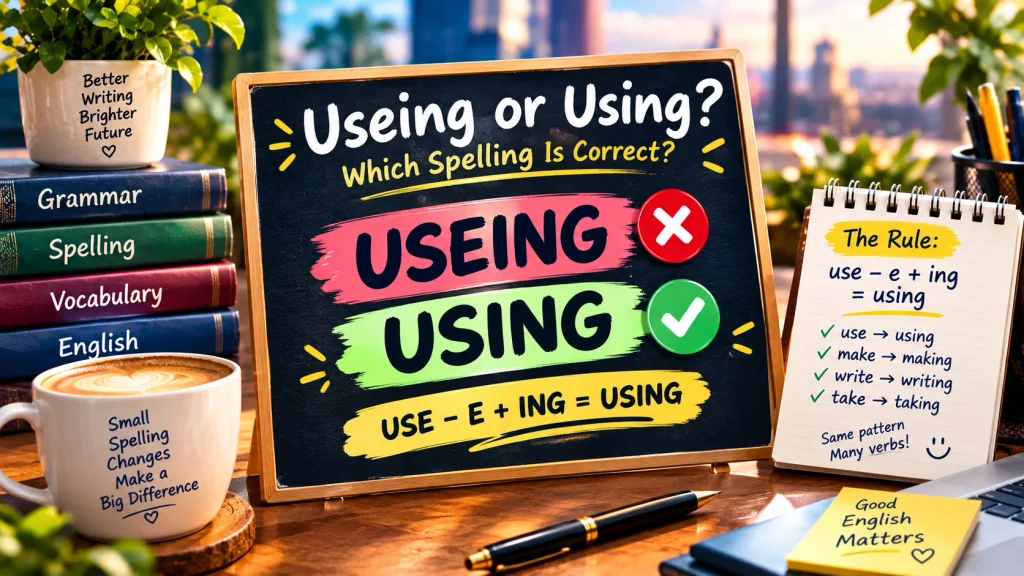
Many verbs ending in a final silent e drop the e before adding -ing.
For example:
- dance → dancing
- save → saving
- hope → hoping
- drive → driving
- write → writing
- make → making
- use → using
Why doesn’t “useing” follow the rule?
Because the spelling of the base verb changes before -ing is attached.
If you simply attach the suffix to the entire word, you might get:
use + ing = useing ❌
But standard spelling requires:
use − e + ing = using ✅
This is why using is the form you should use in essays, assignments, emails, professional writing, and everyday communication.
Important note
It is better to think of this as a general spelling pattern, not an absolute rule that every verb ending in e must follow.
English has exceptions, which we will examine later.
Why Is “Useing” Incorrect?
Useing is incorrect because it retains the final e of use when the normal spelling pattern removes that e before -ing.
Incorrect
- ❌ She is useing the computer.
- ❌ We are useing a new method.
- ❌ They are useing the latest technology.
Correct
- ✅ She is using the computer.
- ✅ We are using a new method.
- ✅ They are using the latest technology.
There is no difference in meaning between the intended forms. The issue is simply spelling.
What Does “Using” Mean?
Using comes from the verb use, which generally means to employ, operate, apply, or make use of something for a particular purpose.
For example:
I am using a calculator.
Here, using means operating or employing the calculator.
Another example:
She is using her knowledge to solve the problem.
Here, using means applying or employing her knowledge for a particular purpose.
Common meanings of “using”
The meaning depends on context.
| Meaning | Example |
| Operating something | He is using a computer. |
| Employing Something | We are using a different method. |
| Applying a skill | She is using her experience. |
| Consuming a resource | They are using less water. |
| Taking advantage of someone | He was accused of using people for personal gain. |
So using is a flexible word that appears frequently in everyday, academic, technical, and professional English.
Is “Using” a Verb, Gerund, or Present Participle?
This is one of the most useful grammar points to understand.
Using is the -ing form of the verb use. Depending on its grammatical function, it can function as a present participle or a gerund.
Using as a present participle
When using forms part of a continuous verb construction, it functions as a present participle.
She is using my computer.
Here, is using forms the present continuous.
Another example:
They were using an old system.
Here, were using forms the past continuous.
Using as a gerund
An -ing form can function like a noun. In traditional grammar, this use is called a gerund.
Using a dictionary can improve your vocabulary.
Here, Using a dictionary functions as the subject of the sentence.
Another example:
I enjoy using this application.
Here, using this application functions as the object of the verb enjoy.
Quick comparison
| Sentence | Function of “using” |
| She is using my laptop. | Present participle |
| They were using an old system. | Present participle |
| Using a dictionary is helpful. | Gerund |
| I enjoy using this application. | Gerund |
Therefore, simply calling using “a verb” does not fully explain its grammatical role. Its function depends on how it is used in the sentence.
Using in a Sentence: Examples
The word using appears in many types of English.
Everyday English
- I am using my phone.
- She is using the kitchen.
- He is using my pen.
- We are using a new computer.
- They are using public transportation.
Academic English
- The researchers are using a different method.
- Students are using online resources.
- The experiment was conducted using standard procedures.
- The study analyzes data using statistical software.
Workplace English
- We are using a new reporting system.
- The company is using advanced technology.
- I am using your template for the report.
- The team is using a more efficient process.
Technology English
- She is using artificial intelligence to analyze the data.
- He is using a password manager.
- We are using cloud-based software.
- They are using the latest version of the application.
These examples show that using is common across everyday conversations, education, business, research, and technology.
Using in Different Types of Sentences
The form using can appear in affirmative statements, negative statements, questions, continuous tenses, and introductory phrases.
Affirmative
She is using the new software.
Negative
She is not using the new software.
Question
Are you using my laptop?
Past continuous
He was using the computer when I arrived.
Present perfect continuous
They have been using this system for years.
At the beginning of a sentence
- Using can also begin a sentence.
- Using a dictionary can help you learn new words.
- Using the correct formula makes the calculation easier.
There is nothing grammatically wrong with starting a sentence with using. However, an introductory -ing phrase should be logically connected to the subject that follows.
Using vs. Use: What Is the Difference?
Use and using come from the same verb, but they have different grammatical forms.
| Word | Grammatical role | Example |
| use | Base form | I use this tool every day. |
| uses | Third-person singular | She uses this tool every day. |
| used | Past/past participle | He used the tool yesterday. |
| using | -ing form | They are using the tool now. |
Compare these sentences:
I use this computer every day.
I am using this computer right now.
The first sentence describes a habitual action. The second describes an action happening around the present time.
Using vs. Used vs. Uses
Understanding the different forms of use can help prevent common mistakes.
Use
I use this dictionary regularly.
Use is the base form.
Uses
She uses this dictionary regularly.
Uses is the third-person singular present form.
Used
He used the dictionary yesterday.
Used is the past and past participle form.
Using
They are using the dictionary now.
Using is the -ing form.
These forms are related, but they cannot simply be substituted for one another.
How to Pronounce “Using”
The standard pronunciation of using is approximately:
/ˈjuːzɪŋ/
It has two syllables:
U-sing
The first syllable contains the long u sound, while the second contains the -ing sound.
The spelling is therefore:
U-S-I-N-G
not:
U-S-E-I-N-G
Correct spelling and pronunciation should be learned together because pronunciation can help reinforce the word form.
Is “Using” the Same in American and British English?
Yes.
Unlike spelling differences such as:
- American color / British colour
- American center / British centre
- American realize / British realise
there is no American-versus-British spelling difference between using and useing.
The standard form is:
using
in both American English and British English.
The same standard spelling is also used in varieties such as Canadian and Australian English.
Quick answer
| Variety of English | Correct spelling |
| American English | using |
| British English | using |
| Canadian English | using |
| Australian English | using |
So you should never use useing as a supposed British alternative.
When Does the Silent-E Rule Not Apply?
This is an important exception to understand.
A common rule says:
Drop the final silent e before adding -ing.
That works for many verbs:
- use → using
- make → making
- write → writing
- hope → hoping
- drive → driving
However, English spelling has exceptions and different spelling patterns.
Consider:
- see → seeing
- agree → agreeing
- free → freeing
- flee → fleeing
- be → being
These forms retain the written e.
Why is this important?
It would be inaccurate to memorize the rule as:
“Every verb ending in e loses e before -ing.”
A better rule is:
Many verbs ending in a final silent e drop the e before -ing, but not every verb ending in e follows exactly the same spelling pattern.
Compare:
use → using
with:
see → seeing
The spelling patterns are different.
Why Do People Write “Useing”?
The mistake useing is understandable.
A writer may think that the -ing suffix is simply added to the complete base word:
use + ing = useing
From that perspective, preserving every letter of use may seem logical.
There is also a visual reason for the mistake. The base word use is familiar, so writers may instinctively want to preserve its entire spelling.
But English spelling frequently changes when suffixes are added.
For use, remember:
use → using
not:
use → useing
The problem is not meaning. It is the spelling formation of the -ing form.
Common Mistakes With “Using”
Mistake 1: Keeping the final e
❌ She is useing the computer.
✅ She is using the computer.
Mistake 2: Adding an unnecessary e
❌ We are useing a new method.
✅ We are using a new method.
Mistake 3: Confusing “using” with “used”
❌ I am used the computer.
✅ I am using the computer.
Mistake 4: Confusing “using” with “use”
❌ I am use the computer.
✅ I am using the computer.
Mistake 5: Assuming “useing” is British English
❌ Useing is the British spelling.
✅ Using is standard in both British and American English.
These mistakes often happen when learners confuse spelling, verb forms, or tense structures.
Explore More: https://wordminto.com/offense-or-offence/
Useing or Using: Comparison Table
| Feature | Useing | Using |
| Standard spelling | ❌ No | ✅ Yes |
| Correct -ing form of use | ❌ No | ✅ Yes |
| Present participle | ❌ No | ✅ Yes |
| Can function as a gerund | ❌ No | ✅ Yes |
| Standard formal English | ❌ No | ✅ Yes |
| American English | ❌ No | ✅ Yes |
| British English | ❌ No | ✅ Yes |
| Derived correctly from use | ❌ No | ✅ Yes |
The choice is therefore clear: using is the standard form.
Easy Memory Trick for “Using”
The easiest formula is:
USE − E + ING = USING
Think:
USE
↓ Remove E
US
↓ Add ING
USING
You can also remember:
Drop the final e, then add -ing.
Examples
- use → using
- make → making
- write → writing
- drive → driving
- hope → hoping
A simple memory sentence is:
Use loses its e when it starts using.
This connects the spelling change directly to the word itself.
Is “Useing” Ever Correct?
In standard modern English writing, no.
If you are writing an:
- essay
- assignment
- examination answer
- report
- professional document
- article
- social media post
use:
using
not:
useing
An accidental appearance of useing does not create a second accepted spelling. It is normally treated as a misspelling of using.
Can “Using” Start a Sentence?
Yes.
There is nothing grammatically wrong with beginning a sentence with using.
For example:
- Using reliable sources makes your research stronger.
- Using the correct spelling improves clarity.
- Using a dictionary can help you learn unfamiliar words.
The important point is that an introductory using phrase should logically relate to the subject of the main clause.
For example:
Using a dictionary, Maria checked the spelling.
Here, Maria is the person who is using the dictionary, so the relationship is clear.
This makes the sentence natural and grammatically sound.
What Is the Difference Between “Use” and “Using”?
The simplest distinction is:
Use = base form of the verb
Using = -ing form of the verb
Use
I use this application every day.
This describes a regular or habitual action.
Using
I am using this application right now.
This describes an action in progress.
The -ing form is especially common in progressive constructions:
- am using
- is using
- are using
- was using
- were using
- has been using
- have been using
It can also function as a gerund:
Using technology effectively requires practice.
Exam and Writing Tip
If you see a sentence containing useing, treat it as a spelling error.
For example:
The students are useing online resources.
The corrected version is:
The students are using online resources.
Quick correction rule
When you see:
use + ing
write:
using
not:
useing
This is particularly useful in spelling tests, sentence-correction questions, error-detection exercises, essays, and academic writing.
Practice Exercises
Test yourself before checking the answers.
Exercise 1: Fill in the blanks
Choose using or useing.
- I am ________ my new laptop.
- She is ________ a different technique.
- They are ________ the latest software.
- We were ________ an old system.
- He enjoys ________ simple language.
Exercise 2: Correct the sentences
Find and correct the spelling error.
- I am useing my phone.
- She is useing a calculator.
- They are useing a new method.
- We were useing the wrong formula.
- He enjoys useing this application.
Exercise 3: Multiple Choice
1. Which spelling is correct?
A. Useing
B. Using
C. Ussing
D. Useingg
Answer: B. Using
2. What happens to the final e in “use” before -ing?
A. It is doubled.
B. It changes to a.
C. It is removed.
D. It remains unchanged.
Answer: C. It is removed.
3. Which sentence is correct?
A. I am useing the computer.
B. I am using the computer.
C. I am uses the computer.
D. I am used the computer.
Answer: B. I am using the computer.
4. Which form is the -ing form of “use”?
A. Used
B. Uses
C. Using
D. Useing
Answer: C. Using
5. Which spelling is standard in both American and British English?
A. Useing
B. Using
C. Useingg
D. Uzing
Answer: B. Using
Practice Answers Explained
1. I am using my new laptop.
Using is correct because the sentence uses the present continuous structure:
am + using
2. She is using a calculator.
Again, using is the present participle in the present continuous construction:
is + using
3. They are using the latest software.
The correct spelling is using, formed by removing the final e from use before adding -ing.
4. We were using the wrong formula.
Were using forms the past continuous.
5. He enjoys using this application.
Here, using this application functions as the object of enjoy.
Quick Revision Box
Remember:
Useing ❌
Using ✅
USE − E + ING = USING
Use = base form
Uses = third-person singular
Used = past/past participle
Using = -ing form
American English: using ✅
British English: using ✅
People Also Ask
Using is correct. Useing is an incorrect spelling.
The correct formation is:
use → using
Because the final e in use is removed before the -ing ending is added.
use − e + ing = using
Yes. Using is the -ing form of use. It functions as a present participle in continuous constructions and can also function as a gerund depending on its role in a sentence.
Not as the standard -ing form of use. In standard English, useing is normally a misspelling of using.
The correct spelling is:
U-S-I-N-G
Final Answer: Useing or Using?
If you are choosing between useing and using, always choose:
Using ✅
Useing ❌ is an incorrect spelling.
The correct formation is:
use − e + ing = using
The final e is removed before -ing is added. Using is the standard form in both American and British English, and its grammatical function depends on how it is used in the sentence.
So write:
I am using my computer. ✅
Not:
I am useing my computer. ❌
The easiest way to remember it is:
USE → USING
Once you remember that use loses its final e before -ing, the spelling becomes much easier to recognize.










1 thought on “Useing or Using: Which Spelling Is Correct?”