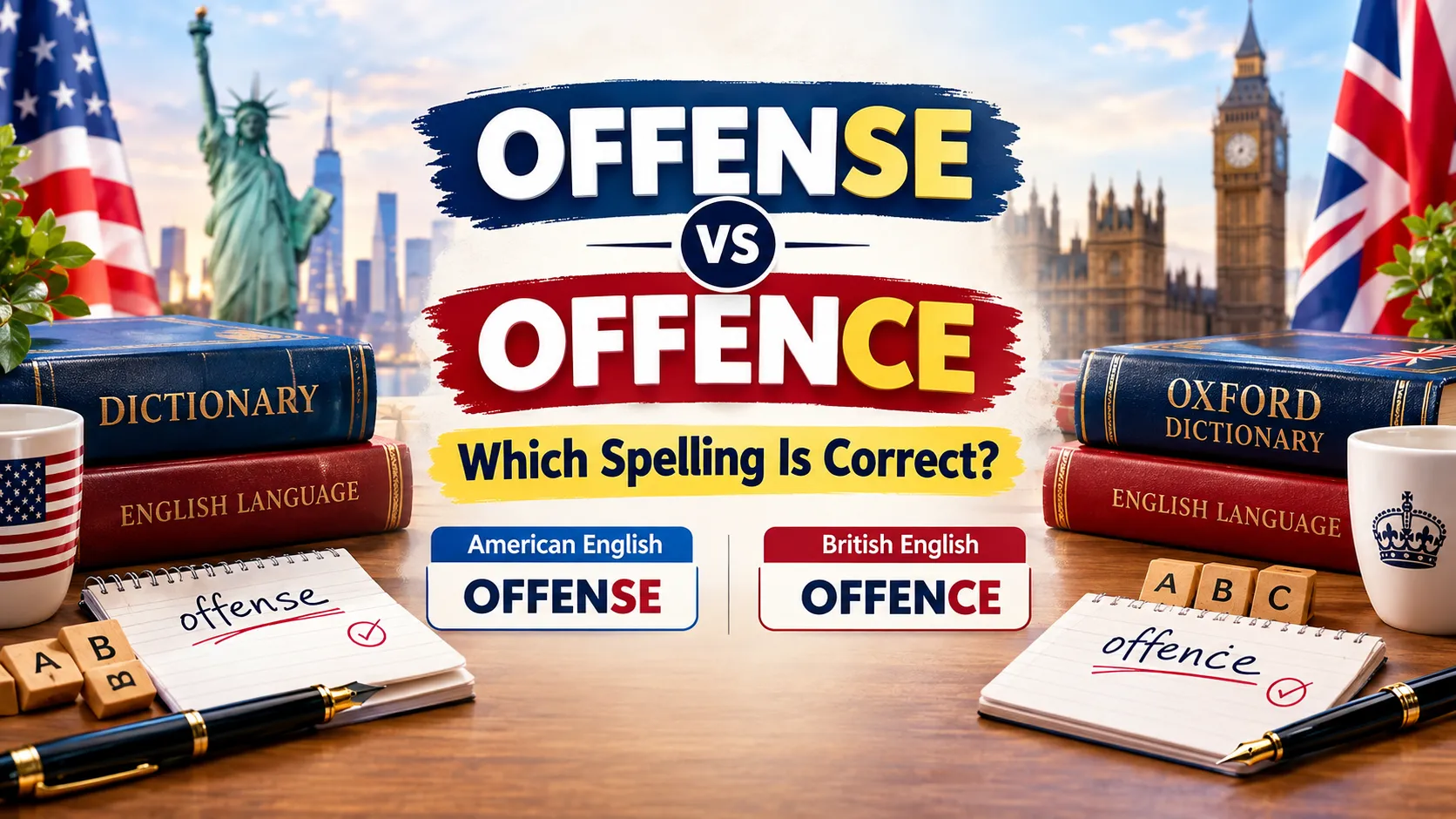
Offense and offence are both correct spellings of the same noun. The main difference is regional English: offense is the standard spelling in American English, while offence is the standard spelling in British English.
So:
American English → offense
British English → offence
Neither spelling is inherently more correct. The important rule is to choose the spelling that matches your English variety and use it consistently. Both forms can refer to a crime or violation, hurt or insulted feelings, or attacking play in sports.
Offense or Offence: Quick Answer
| Spelling | Main English variety | Example |
| offense | American English | It was a serious offense. |
| offence | British English | It was a serious offence. |
Easy rule to remember
US → offense
UK → offence
If you are writing for an American audience, use offense. If you are following British English, use offence.
The spelling difference does not normally change the meaning.
What Is the Difference Between Offense and Offence?
The primary difference between offense and offence is spelling, not meaning.
American English generally uses:
offense
British English generally uses:
offence
This is part of a wider pattern of spelling differences between American and British English:
| American English | British English |
| color | colour |
| center | centre |
| defense | defence |
| offense | offence |
| behavior | behaviour |
| organize | organise* |
*Usage of -ize/-ise can vary among British style guides, so this example should not be treated as an absolute rule.
The key point is that offense and offence are regional spelling variants of the same noun.
What Does “Offense” Mean?
Offense is the standard American English spelling.
As a noun, it has several meanings depending on context.
1. An Illegal Act or Violation
An offense can mean an act that breaks a law or rule.
Example:
Speeding can be a traffic offense.
Here, offense refers to an action that violates the law.
Other examples include:
- a criminal offense
- a traffic offense
- a serious offense
- a minor offense
- a first offense
2. Hurt or Insulted Feelings
Offense can also refer to the feeling caused when someone is insulted, disrespected, or upset.
Example:
I hope my comment caused no offense.
In this sentence, offense does not mean a crime. It refers to emotional upset or insult.
3. Attacking Play in Sports
In American English, particularly in sports such as basketball and football, offense can refer to the attacking team or its play.
Example:
The team’s offense scored 30 points in the first half.
Here, offense means the players or strategy responsible for trying to score.
These three major senses—lawbreaking, emotional offense, and sports—are important because many spelling guides focus only on the first meaning.
What Does “Offence” Mean?
Offence is the standard British English spelling of the same noun.
It can refer to:
- A Crime
- An illegal act
- A violation of a rule
- An insult
- Hurt or angry feelings
- Attacking play in sports
For example:
Driving without a licence is an offence.
Or:
I meant no offence by my comment.
In American English, these would normally be written:
Driving without a license is an offense.
I meant no offense by my comment.
The underlying meaning remains the same; the spelling changes according to the English variety.
Offense vs Offence in American and British English
The simplest way to understand the difference is to look at the regional conventions.
American English: Offense
Use offense when following American English spelling.
Examples:
- criminal offense
- first offense
- no offense
- take offense
- cause offense
- the team’s offense
British English: Offence
Use offence when following British English spelling.
Examples:
- criminal offence
- first offence
- no offence
- take offence
- cause offence
- the team’s offence
The same distinction applies to the plural forms:
offense → offenses
offence → offences
The important thing is not to switch between the two forms without a reason.
Do Offense and Offence Have Different Meanings?
No. In general, offense and offence have the same meanings.
They are different regional spellings of the same noun.
Compare:
American English:
He committed a serious offense.
British English:
He committed a serious offence.
Both sentences mean that he committed a serious violation.
Another example:
I didn’t mean any offense.
British English:
I didn’t mean any offence.
Again, the meaning is essentially identical.
The three important meanings
| Context | American | British |
| Crime | offense | offence |
| Insult/upset feelings | offense | offence |
| Sports attack | offense | offence |
So the question is usually not “Which word has the correct meaning?” but rather “Which spelling matches my English variety?”
Offense and Offence in Different Contexts
As a Crime
In legal and everyday language, the word can describe an illegal act.
American:
Theft is a serious offense.
British:
Theft is a serious offence.
As Hurt Feelings
The word can describe the emotional reaction to something rude, insulting, or disrespectful.
American:
She took offense at his comment.
British:
She took offence at his comment.
In Sports
The word can refer to attacking play or the players attempting to score.
American:
The team’s offense was excellent.
British:
The team’s offence was excellent.
The exact terminology used in individual sports can vary by country, but the spelling distinction remains a useful American-versus-British English difference.
Offense or Offence in Common Expressions
Many learners encounter this spelling difference in fixed phrases.
No Offense or No Offence
Both forms are correct.
American English:
No offense, but I disagree.
British English:
No offence, but I disagree.
The expression usually means that the speaker does not intend to insult or upset the other person.
Take Offense or Take Offence
American:
Don’t take offense at my question.
British:
Don’t take offence at my question.
Take offense/offence means to become upset, insulted, or annoyed by something.
Cause Offense or Cause Offence
American:
The advertisement may cause offense.
British:
The advertisement may cause offence.
Here, the expression means to cause someone to feel insulted or upset.
First Offense or First Offence
American:
This is his first offense.
British:
This is his first offence.
The phrase is common in legal and everyday contexts.
Criminal Offense or Criminal Offence
American:
He was charged with a criminal offense.
British:
He was charged with a criminal offence.
The spelling should follow the English variety used by the surrounding document.
Offense vs Offence Pronunciation
In ordinary use, offense and offence are generally pronounced the same way.
A common pronunciation is approximately:
uh-FENS
The spelling difference does not normally create a separate pronunciation for learners to memorize.
However, pronunciation can vary by accent and by meaning, particularly in sports terminology. For practical writing purposes, the important distinction is spelling rather than pronunciation.
Pronunciation tip
Don’t try to pronounce the final -ce in offence differently simply because the spelling is British.
Think:
offense = offence in pronunciation for ordinary noun usage.
Offense vs Offence Plural Forms
The plural forms follow the same spelling pattern.
American English
offense → offenses
Example:
The defendant was charged with several offenses.
British English
offence → offences
Example:
The defendant was charged with several offences.
Quick memory table
| Singular | Plural |
| offense | offenses |
| offence | offences |
Avoid unnecessarily mixing the systems.
For example, if your document uses offence, it is better to write offences rather than switching to the American plural offenses.
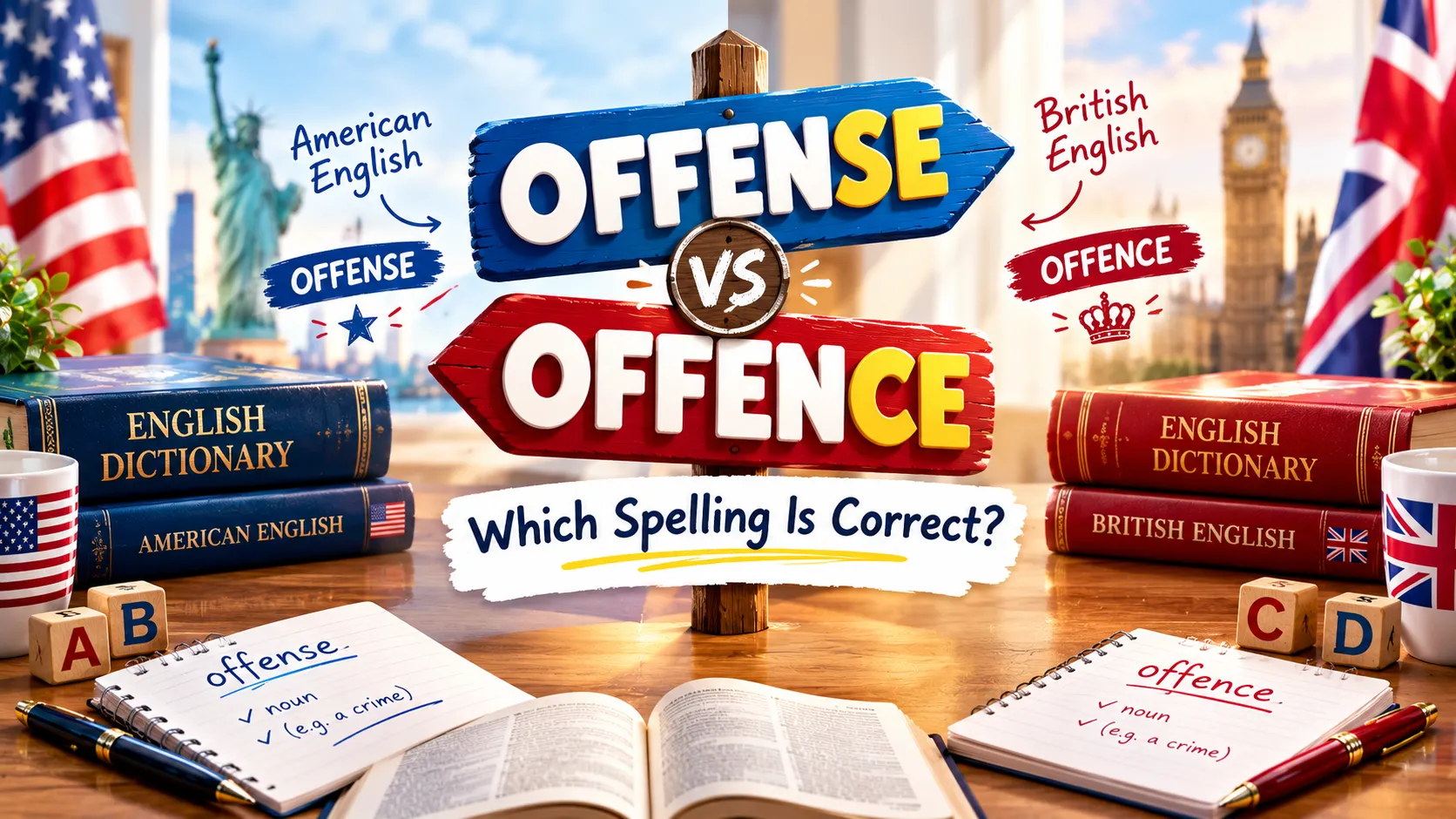
Offend, Offense, Offensive, and Offender
These words belong to the same word family, but they have different grammatical functions.
| Word | Part of speech | Meaning | Example |
| offend | Verb | To insult or upset someone | I didn’t mean to offend you. |
| offense/offence | Noun | An act, insult, or feeling of being insulted | His comment caused offense. |
| offensive | Adjective | Insulting or unpleasant | That remark was offensive. |
| offender | Noun | A person who commits an offense | The offender was arrested. |
Offend
Offend is a verb.
I didn’t mean to offend anyone.
Offense/Offence
These are nouns.
His comment caused offense.
His comment caused offence.
Offensive
Offensive is generally an adjective.
That remark was offensive.
Offender
Offender is a noun referring to someone who commits an offense or offence.
The offender was arrested.
An important point is that offend and offensive do not change to offence or offense according to American or British spelling in the same way. The major spelling variation here is the noun offense/offence.
Why Are Offense and Offence Spelled Differently?
The difference has a long linguistic history.
The word developed through forms of Middle English and Anglo-French and ultimately traces back to Latin offensa, related to offendere. English spelling was not always standardized, so different spelling conventions developed over time.
This is why modern English contains familiar spelling pairs such as:
- color/colour
- center/centre
- defense/defence
The difference between offense and offence is therefore not a recent spelling mistake. It is part of the broader development of regional English varieties.
Which Spelling Should You Use?
The correct choice depends on your audience, location, institution, and style guide.
Use “offense” when:
- You are writing American English.
- Your audience is primarily American.
- Your organization follows US spelling.
- Your school or university requires American English.
- Your publication uses American style.
Use “offence” when:
- You are writing British English.
- Your audience is primarily British.
- Your organization follows British spelling.
- Your institution requires British English.
- Your publication uses British/Commonwealth conventions.
What About International English?
If your audience is international, the most important principle is consistency.
Choose a recognized spelling system and use it throughout the document.
For example, avoid a document that randomly contains:
offense → offence → offense → offence
Instead, select one convention and maintain it.
A consistent style looks more professional and prevents readers from wondering whether the spelling changes have a particular meaning.
Explore More: https://wordminto.com/brake-or-break/
In Academic Writing
In academic writing, neither spelling is inherently more formal or more correct.
The appropriate form depends on the required English variety.
For example, an American academic paper might say:
The study examined whether the behavior constituted an offense.
A British-English paper might say:
The study examined whether the behaviour constituted an offence.
Notice that the spelling choice can extend beyond offense/offence to other words such as behavior/behaviour.
Best academic-writing rule
Follow the requirements of:
- Your university
- Your instructor
- Your journal
- Your Publisher
- Your selected style guide
Most importantly, be consistent throughout the paper.
If a journal requires British English, use offence. If it requires American English, use offense.
Offense or Offence in Legal Writing
Legal writing frequently uses this word in expressions such as:
- criminal
- serious
- minor
- first
- traffic
- statutory
The appropriate spelling depends on the jurisdiction and the relevant legal style.
Important legal-writing rule
If you are reproducing the official title of a law, legal category, court document, or quotation, preserve the spelling used by the authoritative source.
For original legal writing, follow the spelling convention required by the jurisdiction, court, institution, or organization.
What About Canada, Australia, India, and Pakistan?
The simple US vs UK rule is useful, but international English deserves a little more nuance.
| Region/context | Common formal preference |
| United States | offense |
| United Kingdom | offence |
| Australia | offence |
| New Zealand | offence |
| Canada | offence is common |
| India | offence is common in formal British-influenced usage |
| Pakistan | offence is common in British-influenced formal usage |
However, regional usage is not an absolute rule for every writer, organization, website, publisher, or institution.
For international writing, follow the style guide or institutional convention that governs your document.
This is particularly important in academic, legal, government, and professional writing.
Common Mistakes With Offense and Offence
Mistake 1: Thinking One Spelling Is Wrong
Incorrect assumption:
“Offence is wrong because offense is the correct spelling.”
That is not correct.
Both spellings are standard. The difference is primarily regional.
Correct understanding:
American English → offense
British English → offence
Mistake 2: Assuming They Have Different Meanings
Some learners think offense means one thing and offence means another.
Usually, this is not true.
They are spelling variants of the same noun.
Mistake 3: Mixing American and British Spelling
For example:
The defendant committed a serious offence, and this was his second offense.
This is not necessarily grammatically impossible, but it creates an inconsistent spelling style unless there is a specific reason for the difference.
A consistent British version is:
The defendant committed a serious offence, and this was his second offence.
A consistent American version is:
The defendant committed a serious offense, and this was his second offense.
Mistake 4: Using “Offence” as the Verb
Incorrect:
I didn’t mean to offence her.
Correct:
I didn’t mean to offend her.
Offend is the verb.
Mistake 5: Changing the Meaning Just Because the Spelling Changes
Compare:
He committed a serious offense.
and:
He committed a serious offence.
The spelling changes, but the underlying meaning does not.
Easy Trick to Remember Offense vs Offence
Use this simple memory aid:
US → offense
Think:
United States → offense
For British English:
UK → offence
You can also remember:
US = offense
UK = offence
Important note
This is only a memory trick. It is not the historical reason why the spellings developed.
Offense or Offence Examples in Sentences
American English Examples
- He committed a serious offense.
The word refers to an illegal act. - This is his first offense.
The word refers to a previous violation. - I hope you don’t take offense.
Here, it refers to feeling insulted. - No offense was intended.
The speaker says that no insult was meant. - The comment caused offense.
The comment upset or insulted someone. - The team’s offense was strong.
Here, the word refers to attacking play in sports. - The law defines the offense clearly.
The word refers to a legal violation. - She was charged with a criminal offense.
The word describes a crime.
British English Examples
- He committed a serious offence.
- This is his first offence.
- I hope you don’t take offence.
- No offence was intended.
- The comment caused offence.
- The team’s offence was strong.
- The law defines the offence clearly.
- She was charged with a criminal offence.
The grammatical structure and meaning remain essentially the same. Only the regional spelling changes.
Offense vs Offence Comparison Table
| Feature | Offense | Offence |
| Main variety | American English | British English |
| Part of speech | Noun | Noun |
| Crime meaning | Yes | Yes |
| Violation meaning | Yes | Yes |
| Insult/upset meaning | Yes | Yes |
| Sports meaning | Yes | Yes |
| Singular | offense | offence |
| Plural | offenses | offences |
| Verb | offend | offend |
| Adjective | offensive | offensive |
| No ___ | no offense | no offence |
| Take ___ | take offense | take offence |
| First ___ | first offense | first offence |
| Criminal ___ | criminal offense | criminal offence |
Practice Exercise: Offense or Offence?
Choose the spelling that best fits the English variety specified.
Fill in the Blanks
- American English: It was a serious ________.
- British English: It was a serious ________.
- American English: This is his first ________.
- British English: This is his first ________.
- American English: Please don’t take ________.
- British English: Please don’t take ________.
- American English: The defendant committed several ________.
- British English: The defendant committed several ________.
Answers
- offense
- offence
- offense
- offence
- offense
- offence
- offenses
- offences
Multiple-Choice Questions
1. Which spelling is standard in American English?
A. offence
B. offense
C. offance
D. offenсe
Answer: B. offense
2. Which spelling is standard in British English?
A. offense
B. offince
C. offence
D. offens
Answer: C. offence
3. What is the British plural of “offence”?
A. offenses
B. offences
C. offencess
D. offence
Answer: B. offences
4. What is the verb related to offense/offence?
A. offensive
B. offender
C. offend
D. offenced
Answer: C. offend
5. Are offense and offence generally different words?
A. Yes, they always have different meanings.
B. Yes, one is a verb.
C. No, they are regional spelling variants.
D. No, one is always incorrect.
Answer: C. No, they are regional spelling variants.
Sentence Correction
Correct the spelling according to the specified variety of English.
1. American English
He was charged with a criminal offence.
Correct:
He was charged with a criminal offense.
2. British English
He committed his first offense.
Correct:
He committed his first offence.
3. American English
I didn’t mean to offend you.
Correct:
I didn’t mean to offend you.
There is no change because offend is spelled the same in both varieties.
4. British English
The advertisement caused offense.
Correct:
The advertisement caused offence.
Quick Revision Box
Offense = American English
Offence = British English
offense → offenses
offence → offences
Both can mean:
- a crime
- a violation
- an insult or emotional upset
- attacking play in sports
Verb: offend
Adjective: offensive
Person: offender
One-line memory trick
US → offense | UK → offence
People Also Ask
Both are correct. Offense is the standard American English spelling, while offence is the standard British English spelling.
Offense is the standard spelling in American English.
Offence is the standard spelling in British English.
Yes. They are regional spelling variants of the same noun. Depending on context, they can refer to a crime, violation, insult or emotional upset, or attacking play in sports.
Both are correct.
American English: first offense
British English: first offence
Final Verdict: Offense or Offence?
Offense and offence are both correct.
The choice depends mainly on the variety of English you are using:
🇺🇸 American English → offense
🇬🇧 British English → offence
They can have the same meanings, including a crime or violation, hurt or insulted feelings, and attacking play in sports.
The best rule is simple:
Choose the spelling that matches your audience, institution, jurisdiction, or style guide—and stay consistent.
If you write American English, use offense. If you write British English, use offence.
Neither spelling is inherently “more correct.” They are established regional forms of the same English word.










2 thoughts on “Offense or Offence: Which Spelling Is Correct?”