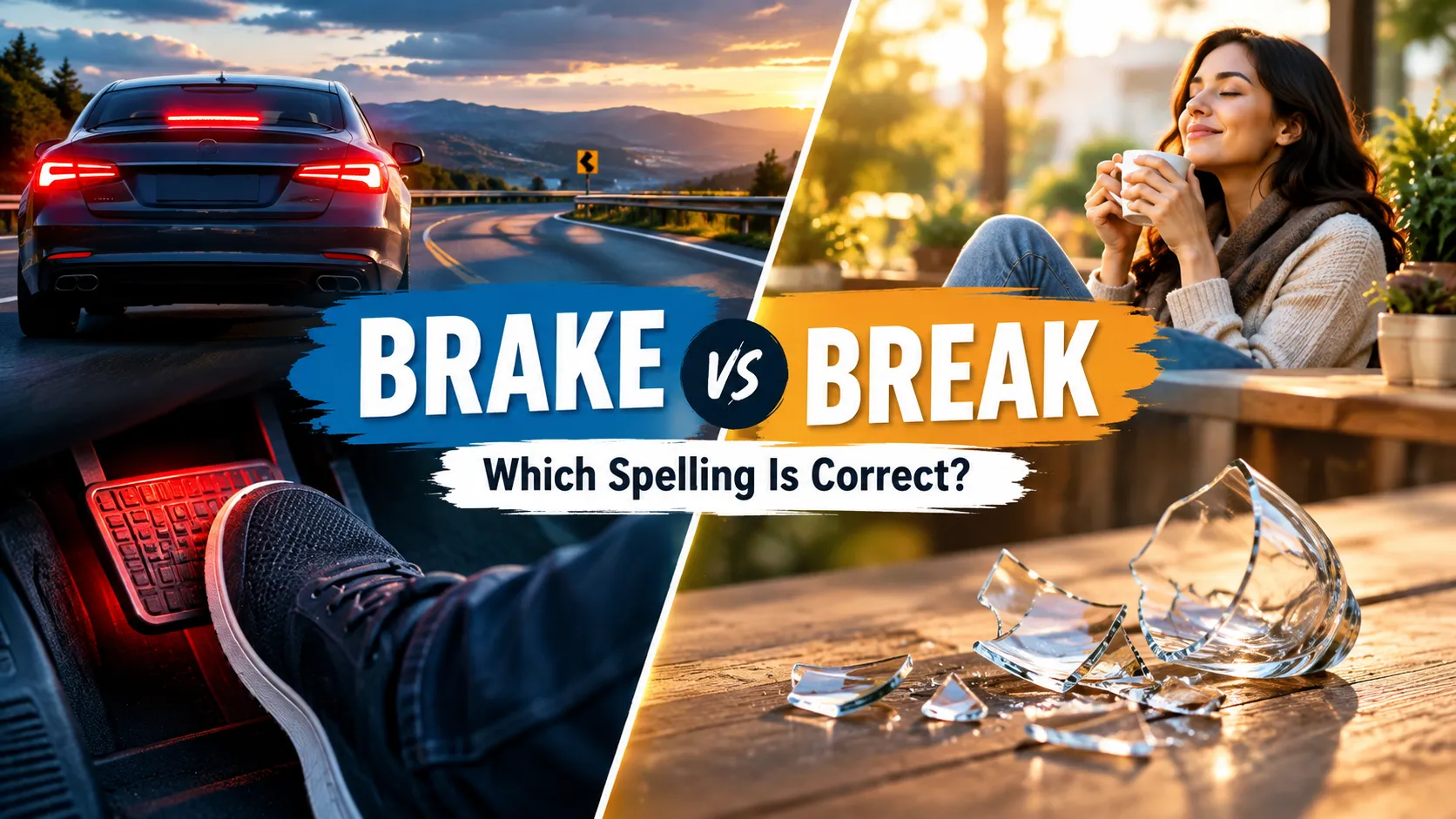
Brake or break? If you have ever wondered which spelling to use, you are not alone. These two words are homophones: they sound exactly alike but have different spellings and meanings.
The good news is that the difference is simple once you connect each word with its meaning.
Brake usually refers to something that slows or stops movement, especially a vehicle.
Break has many meanings, including damage, separate, interrupt, pause, violate, or stop working.
Compare these sentences:
- Please brake before the corner.
- Please don’t break the glass.
- Let’s take a break.
- The car braked suddenly.
So, if you are asking “Is it brake or break?”, the answer depends entirely on what you mean.
Quick rule:
Brake = slow or stop.
Break = damage, separate, interrupt, pause, or fail.
Brake vs. Break: Quick Difference
| Word | Main Meaning | Example |
| Brake | To slow or stop movement | The driver pressed the brake. |
| Brake | A device used to slow or stop a vehicle | The car needs new brakes. |
| Break | To damage or separate something | Don’t break the glass. |
| Break | To pause or rest | Let’s take a break. |
| Break | To stop functioning | My computer broke. |
| Break | To violate something | He broke the law. |
The easiest distinction
Think about the action:
Is something being slowed or stopped? → Brake
Is something being damaged, separated, interrupted, paused, or violated? → Break
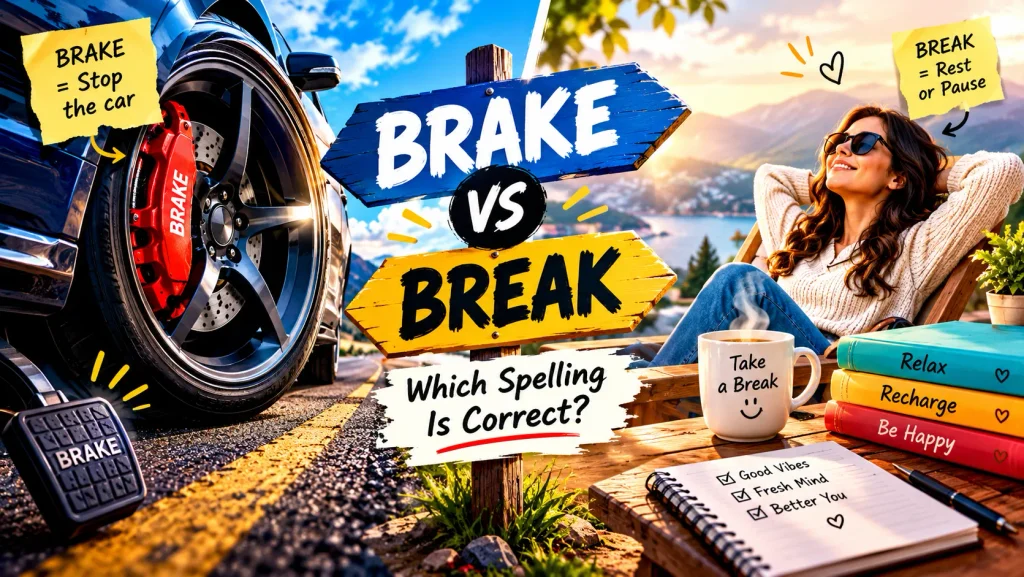
What Does “Brake” Mean?
Brake is both a noun and a verb.
Its central meaning is connected with slowing down or stopping movement.
Brake as a noun
As a noun, a brake is a device or mechanism used to slow down or stop a moving vehicle or machine.
Examples:
- The car’s brakes need repair.
- Press the brake gently.
- My bicycle has new brakes.
- The mechanic inspected the brake system.
- The driver pressed the brake pedal.
The plural form is brakes.
Brake as a verb
As a verb, brake means to slow down or stop a moving vehicle or object by using a brake.
Examples:
- Brake before the sharp turn.
- The driver braked suddenly.
- She braked to avoid the cyclist.
- The train began braking near the station.
- You should brake gradually on a wet road.
Forms of “brake”
| Form | Word |
| Base form | brake |
| Third-person singular | brakes |
| Past tense | braked |
| Past participle | braked |
| -ing form | braking |
Remember:
Brake → braked → braking
What Does “Break” Mean?
Break is also both a noun and a verb, but it has a much wider range of meanings than brake.
Depending on the context, break can mean:
- damage something
- separate something
- interrupt something
- Stop Functioning
- violate a rule
- fail to keep a promise
- pause or rest
- end a relationship
- create an opening or gap
- escape from something
- change or interrupt a pattern
For example:
- Don’t break the glass.
- He broke his phone.
- Let’s take a break.
- She broke her promise.
- My laptop broke yesterday.
- They decided to break the agreement.
Break as a Verb
When break is used as a verb, its meaning depends on the context.
1. Break means “damage”
Be careful not to break the vase.
Here, break means to damage or cause something to separate.
2. Break means “separate”
Break the chocolate into small pieces.
The object is being divided into smaller pieces.
3. Break means “stop working”
My washing machine broke yesterday.
Here, broke means the machine stopped functioning properly.
4. Break means “violate”
He broke the law.
Here, break means to violate or fail to obey a rule.
5. Break means “interrupt”
A loud noise broke the silence.
The noise interrupted the silence.
6. Break means “fail to keep a promise”
She never breaks her promises.
Here, break means to fail to do what was promised.
7. Break means “end”
They decided to break their partnership.
Here, break refers to ending a relationship or arrangement.
Break as a Noun
As a noun, break can refer to a pause, interruption, gap, fracture, or change.
Examples:
- I need a short break.
- Let’s take a coffee break.
- There was a break in the conversation.
- We noticed a break in the wall.
- The students had a ten-minute break.
- There was a break in the clouds.
One of the most common noun uses is a short period of rest:
Let’s take a break.
That is why take a brake is incorrect when you mean “take a rest.”
Brake or Break: Examples
The best way to understand brake vs. break is to see them in real sentences.
| Correct Word | Example | Meaning |
| Brake | Please brake before the turn. | Slow the vehicle. |
| Break | Don’t break the cup. | Damage The Cup. |
| Brake | She braked suddenly. | She slowed the vehicle. |
| Break | We need a break. | We need a rest. |
| Brake | The mechanic replaced the brakes. | Vehicle stopping equipment. |
| Break | He broke the window. | He damaged it. |
| Braking | The car was braking hard. | The car was slowing down. |
| Breaking | She is breaking the stick. | She is damaging/separating it. |
| Brake | Hit the brakes! | Stop or slow the vehicle. |
| Break | The computer broke down. | It stopped functioning. |
Take a Brake or Take a Break?
The correct expression is:
Take a break. ✅
Not:
Take a brake. ❌
When you mean rest, pause, or stop working temporarily, use break.
Examples
- Let’s take a break.
- I need to take a break from studying.
- We took a short break after the meeting.
- She went outside during her lunch break.
- The teacher gave the students a five-minute break.
Why is “brake” wrong here?
A brake is associated with slowing or stopping movement. A break can mean a period of rest or interruption.
So:
Take a break = rest for a while.
Brake Pedal or Break Pedal?
The correct phrase is:
Brake pedal ✅
Not:
Break pedal ❌
A brake pedal is the pedal used to activate the braking system of a vehicle.
Examples:
- Press the brake pedal slowly.
- The brake pedal felt unusually soft.
- Keep your foot near the brake pedal.
- The mechanic checked the brake pedal.
Easy memory trick
Think:
Brake → car → brake pedal
Break → damage/rest/separate
Brake Down or Break Down?
In most common situations, the correct expression is:
Break down ✅
Not:
Brake down ❌
Break down is a phrasal verb with several meanings.
When a machine stops working
My car broke down on the highway.
When a person becomes emotionally overwhelmed
She broke down in tears.
When something is divided into parts
Let’s break down the problem.
When information is explained in smaller parts
The teacher broke down the difficult concept.
The word brake can certainly appear in technical expressions related to braking systems, but break down is the standard phrasal verb for these common meanings.
Breaking or Braking?
This is one of the most important differences to remember.
Breaking
Breaking comes from the verb break.
It can mean damaging, separating, interrupting, or violating something.
Examples:
- He is breaking the glass.
- She is breaking the chocolate into pieces.
- They are breaking the rules.
- The machine is breaking down.
- The news is breaking now.
Braking
Braking comes from the verb brake.
It refers to slowing or stopping movement.
Examples:
- The driver is braking.
- The car was braking suddenly.
- The train began braking near the station.
- The cyclist was braking before the corner.
Compare them
Driver was braking.
The driver was slowing the vehicle.
The driver was breaking the rule.
Driver was violating the rule.
The extra i in braking is an important spelling clue.
Braked, Broke, or Broken?
These forms can be confusing because brake and break develop into different past forms.
Brake → braked
The past tense of brake is braked.
The driver braked suddenly.
She braked before the traffic light.
Break → broke
The simple past tense of break is broke.
He broke the window.
She broke her phone.
Break → broken
Broken is the past participle of break.
He has broken the window.
My phone is broken.
Quick comparison
| Verb | Past | Past Participle |
| Brake | braked | braked |
| Break | broke | broken |
Memory rule
Brake → braked
Break → broke → broken
Is “Break the Car” or “Brake the Car” Correct?
Both expressions can exist, but they mean very different things.
Brake the car
This means to slow or stop the car by using its brakes.
The driver braked the car before the intersection.
A more natural everyday expression is often:
The driver braked before the intersection.
Break the car
This means to damage the car or cause part of it to become damaged.
Accident broke the car’s side mirror.
So:
Brake the car = slow or stop it.
Break the car = damage it.
Hit the Brake or Hit the Brakes?
The most common expression is:
Hit the brakes! ✅
This means to apply the brakes quickly or strongly.
Examples:
- Hit the brakes! There’s a car ahead.
- He hit the brakes when the dog crossed the road.
- She had to hit the brakes suddenly.
You may also encounter hit the brake when referring to a particular brake or in a specific technical context, but hit the brakes is the standard idiomatic expression when telling a driver to stop or slow down quickly.
Brake Time or Break Time?
When you mean a period when people stop working, studying, or participating in an activity, the correct phrase is:
Break time ✅
Examples:
- It’s break time.
- The children are excited for break time.
- We usually have break time at noon.
- I’ll call you during my break time.
Brake time would relate to the operation or timing of a braking system rather than a rest period.
Put the Brakes on Something
Put the brakes on is an idiomatic expression meaning to slow down, restrict, delay, or stop something.
Examples:
The company put the brakes on its expansion plans.
Rising costs could put the brakes on the project.
This expression demonstrates that brake can be used figuratively as well as literally.
A useful broader definition is therefore:
Brake = something that slows or stops movement, progress, or activity.
Common Expressions With “Break”
Because break has many meanings, it appears in numerous everyday expressions.
Take a break
Meaning: rest or pause.
I need to take a break.
Break down
Meaning: stop functioning, fail, or analyze something.
The car broke down.
Break up
Meaning: separate or end a relationship.
They decided to break up.
Break in
Meaning: enter by force or become accustomed to something.
Someone tried to break in.
Break out
Meaning: escape or suddenly begin.
A fire broke out.
Break the law
Meaning: violate the law.
He broke the law.
Break a promise
Meaning: fail to keep a promise.
Don’t break your promise.
Break the ice
Meaning: make people feel more comfortable in a social situation.
She told a joke to break the ice.
Break a record
Meaning: achieve a better performance than the previous record.
The athlete broke the record.
Common Expressions With “Brake”
Although brake has fewer idiomatic uses, several expressions are common.
Hit the brakes
Hit the brakes before you reach the wall.
Put the brakes on
The new regulations put the brakes on Development.
Brake pedal
Press the brake pedal.
Brake pads
The mechanic replaced the brake pads.
Brake fluid
The technician checked the brake fluid.
These expressions all retain the basic idea of slowing, stopping, or controlling movement.
Why Are Brake and Break Confused?
There are two major reasons.
1. They sound identical
Both brake and break are pronounced /breɪk/.
If someone says:
“I need a break.”
and:
“I need to brake.”
you cannot determine the spelling from pronunciation alone.
You need the context and meaning.
2. Their spellings are very similar
The two words contain almost the same letters:
brake
break
The different vowel arrangement makes them easy to confuse when writing quickly.
This is why learners, students, and even fluent English speakers sometimes type the wrong word.
How to Remember Brake vs. Break
Here are several practical memory tricks.
Trick 1: Brake has “A” for automobile
Think:
Brake → A → Automobile
A car has brakes.
This is a simple and useful memory device.
Trick 2: Break has many meanings
If the word refers to:
- damage
- rest
- separation
- interruption
- rules
- promises
- records
- failure
you probably need break.
Trick 3: Ask what is happening
Ask yourself:
Am I slowing or stopping something?
If yes, choose brake.
If not, check whether you mean damage, rest, separation, interruption, failure, or another meaning of break.
Brake vs. Break: Decision Test
When you are unsure, use this three-step method.
Step 1: Identify the meaning
Ask what the word is supposed to mean.
Step 2: Think about movement
If the meaning involves slowing or stopping movement, use brake.
Step 3: Check for another meaning
If the meaning involves damage, rest, separation, interruption, violation, failure, or another common meaning, use break.
Example
Please ___ before the red light.
What does the blank mean?
It means to slow or stop the vehicle.
Therefore:
Please brake before the red light. ✅
Now:
Let’s take a ___.
It means rest.
Therefore:
Let’s take a break. ✅
Explore More: https://wordminto.com/jewelry-or-jewellery/
Brake vs. Break in Real-Life English
Understanding context makes the difference much easier.
Driving
Brake before the intersection.
The driver braked suddenly.
The brakes need inspection.
School
We have a ten-minute break.
Let’s take a study break.
Don’t break the classroom rules.
Workplace
I’ll call you after my break.
The company decided to put the brakes on the project.
The old printer broke down.
Home
Don’t break the plate.
The washing machine broke down.
Take a break and relax.
Brake vs. Break in Academic English
Both words appear in formal and academic writing, but their meanings remain distinct.
Brake in formal writing
High costs may act as a brake on economic growth.
Here, brake is being used metaphorically to describe something that limits progress.
Break in formal writing
The researchers observed a significant break in the pattern.
Here, break refers to an interruption or change.
Another example:
The study examines how traditional assumptions can break down under different conditions.
The correct spelling is break down, not brake down.
Common Mistakes With Brake and Break
Mistake 1: Take a brake
❌ Let’s take a brake.
✅ Let’s take a break.
Why? A rest is a break.
Mistake 2: Break pedal
❌ Press the break pedal.
✅ Press the brake pedal.
Why? A vehicle uses a brake to slow or stop.
Mistake 3: Braking the glass
❌ She is braking the glass.
✅ She is breaking the glass.
Why? The glass is being damaged, not slowed down.
Mistake 4: Breaking before the turn
If you mean slowing a vehicle:
❌ The driver was breaking before the turn.
✅ The driver was braking before the turn.
Why? The driver is using the vehicle’s brakes.
Mistake 5: Brake down
❌ My car braked down.
✅ My car broke down.
Why? Break down means to stop functioning.
Mistake 6: Break the car when you mean stop it
❌ He broke the car at the traffic light.
✅ He braked the car at the traffic light.
Why? He slowed or stopped the vehicle.
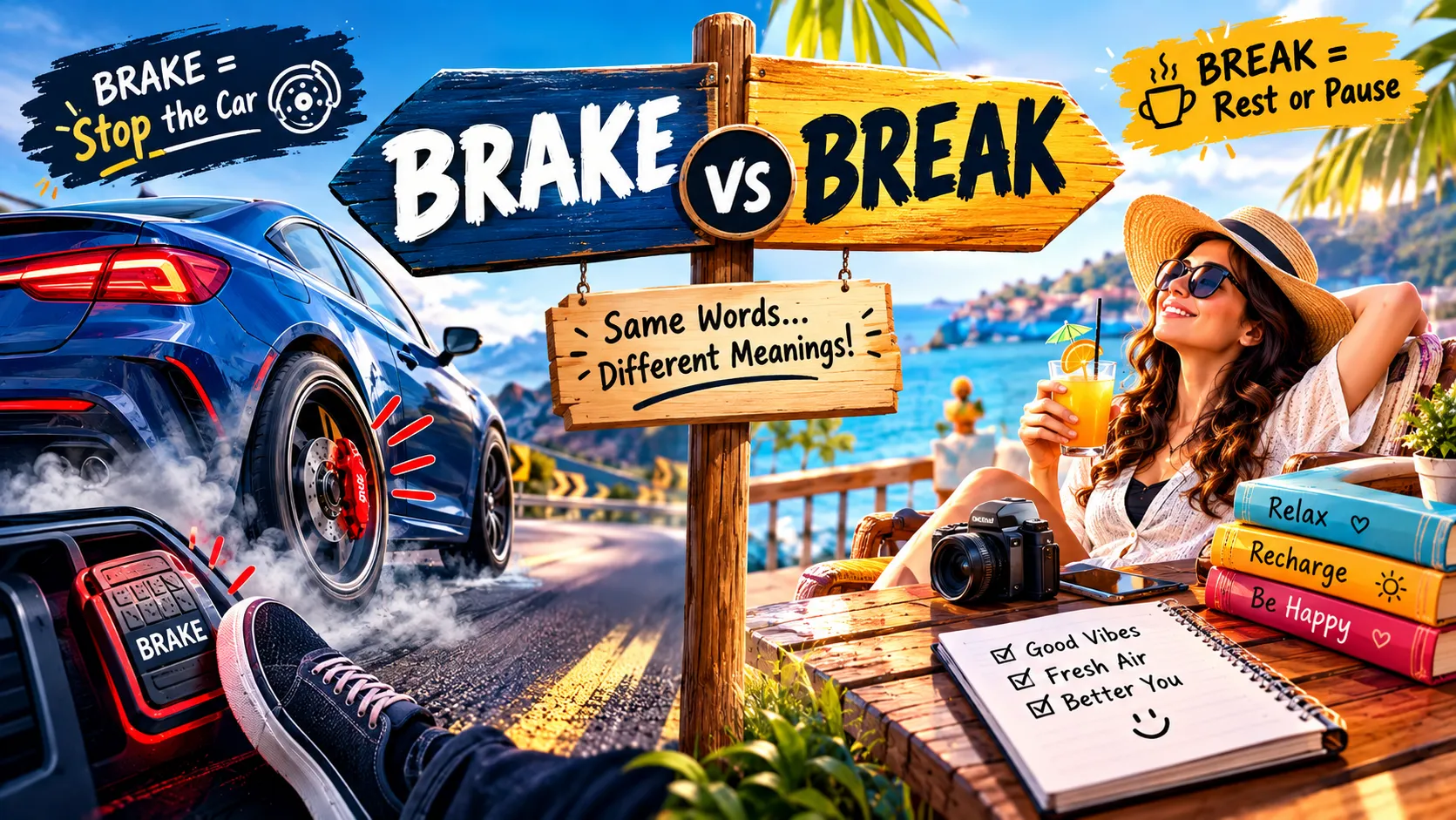
Comparison Table: Brake vs. Break
| Feature | Brake | Break |
| Pronunciation | /breɪk/ | /breɪk/ |
| Homophone | Yes | Yes |
| Noun | Yes | Yes |
| Verb | Yes | Yes |
| Core meaning | Slow or stop | Damage, separate, interrupt, pause, etc. |
| Vehicle-related | Very common | Usually not in this sense |
| Past tense | braked | broke |
| Past participle | braked | broken |
| -ing form | braking | breaking |
| Common phrase | hit the brakes | take a break |
| Phrasal verb | — | break down |
| Figurative use | put the brakes on | break the law |
Brake or Break: Easy Examples for Students
Very easy
- Press the brake.
- Don’t break the glass.
- I need a break.
- The driver braked suddenly.
- He broke the cup.
Intermediate
- The car’s brakes were not working properly.
- We decided to take a break after two hours.
- She accidentally broke the vase.
- The driver began braking near the crossing.
- My computer broke down yesterday.
Advanced
- Rising costs could put the brakes on economic growth.
- The researcher identified a significant break in the established pattern.
- The driver braked sharply to avoid the collision.
- The new evidence caused the traditional theory to break down.
- The organization decided to put the brakes on further expansion.
Practice Exercise: Brake or Break?
Choose the correct word.
Fill in the blanks
- Please ___ before the intersection.
- Don’t ___ the glass.
- Let’s take a ___.
- The driver ___ suddenly.
- My car ___ down on the highway.
- The mechanic inspected the ___.
- She is ___ the chocolate into pieces.
- The train was ___ as it approached the station.
- Don’t ___ your promise.
- Press the ___ pedal.
Answers
- brake
- break
- break
- braked
- broke
- brakes
- breaking
- braking
- break
- brake
Multiple-Choice Questions
1. Which sentence is correct?
A. Let’s take a brake.
B. Let’s take a break.
C. Let’s take braking.
D. Let’s take broke.
Answer: B. Let’s take a break.
A break can mean a period of rest.
2. Which word means to slow or stop a vehicle?
A. Break
B. Broke
C. Brake
D. Broken
Answer: C. Brake
3. Which sentence is correct?
A. The driver was breaking before the corner.
B. The driver was braking before the corner.
C. The driver was brake before the corner.
D. The driver was broke before the corner.
Answer: B. The driver was braking before the corner.
Braking is the -ing form of brake.
4. Which sentence uses “break” correctly?
A. Press the break pedal.
B. She broke the window.
C. He braked the promise.
D. The driver was breaking the car to stop.
Answer: B. She broke the window.
Here, broke means damaged.
5. Which is the correct past tense of “break”?
A. Braked
B. Breaking
C. Broke
D. Brake
Answer: C. Broke
The forms are:
break → broke → broken
Sentence Correction Practice
Correct the errors.
1. Let’s take a brake.
Correct: Let’s take a break.
2. Press the break pedal.
Correct: Press the brake pedal.
3. The driver was breaking suddenly.
Correct: The driver was braking suddenly.
4. My car braked down yesterday.
Correct: My car broke down yesterday.
5. He braked the window.
Correct: He broke the window.
Exam Tip: Brake vs. Break
Questions involving brake and break are common in spelling, vocabulary, sentence-correction, and error-detection exercises.
When solving an exam question, do not choose based on pronunciation.
Instead, examine the context.
If the sentence involves:
car + slowing + stopping + braking system
→ brake
If it involves:
damage + rest + interruption + separation + violation + failure
→ break
Exam shortcut
Brake = slow/stop.
Break = almost everything else.
This is a practical shortcut rather than a complete dictionary definition, because brake also has figurative uses.
Quick Revision Box
BRAKE
Meaning: Slow or stop movement
Noun: The device that slows a vehicle
Verb: To slow or stop
Past: Braked
-ing: Braking
Example: The driver braked suddenly.
BREAK
Meaning: Damage, separate, interrupt, pause, violate, or fail
Noun: A rest, interruption, gap, or fracture
Verb: To damage, separate, interrupt, etc.
Past: Broke
Past participle: Broken
-ing: Breaking
Example: He broke the window.
People Also Ask
Both words are correct, but they have different meanings. Brake usually means to slow or stop movement, while break can mean to damage, separate, interrupt, rest, violate, or stop functioning.
Brake is associated with slowing or stopping movement. Break has a much broader range of meanings, including damaging something, taking a rest, separating something, violating a rule, or stopping something from functioning.
The correct phrase is take a break when you mean to rest or pause.
The correct term is brake pedal because a vehicle’s brake pedal operates the braking system.
The common phrasal verb is break down. It can mean that a machine stops working or that something is divided into smaller parts for analysis.
Breaking comes from break, while braking comes from brake.
The glass is breaking.
The car is braking.
Final Answer: Brake or Break?
So, which spelling is correct—Brake or Break?
Both are correct, but they are used in different situations.
Use brake when you mean slow, stop, or restrain movement:
The driver pressed the brake.
Use break when you mean damage, separate, interrupt, pause, violate, or stop functioning:
Don’t break the glass.
Let’s take a break.
My car broke down.
The simplest memory rule is:
Brake = slow or stop.
Break = damage, separate, interrupt, pause, or fail.
Because Brake and Break sound identical, always use the meaning and context to decide which spelling belongs in your sentence.








2 thoughts on “Brake or Break: Which Spelling Is Correct?”