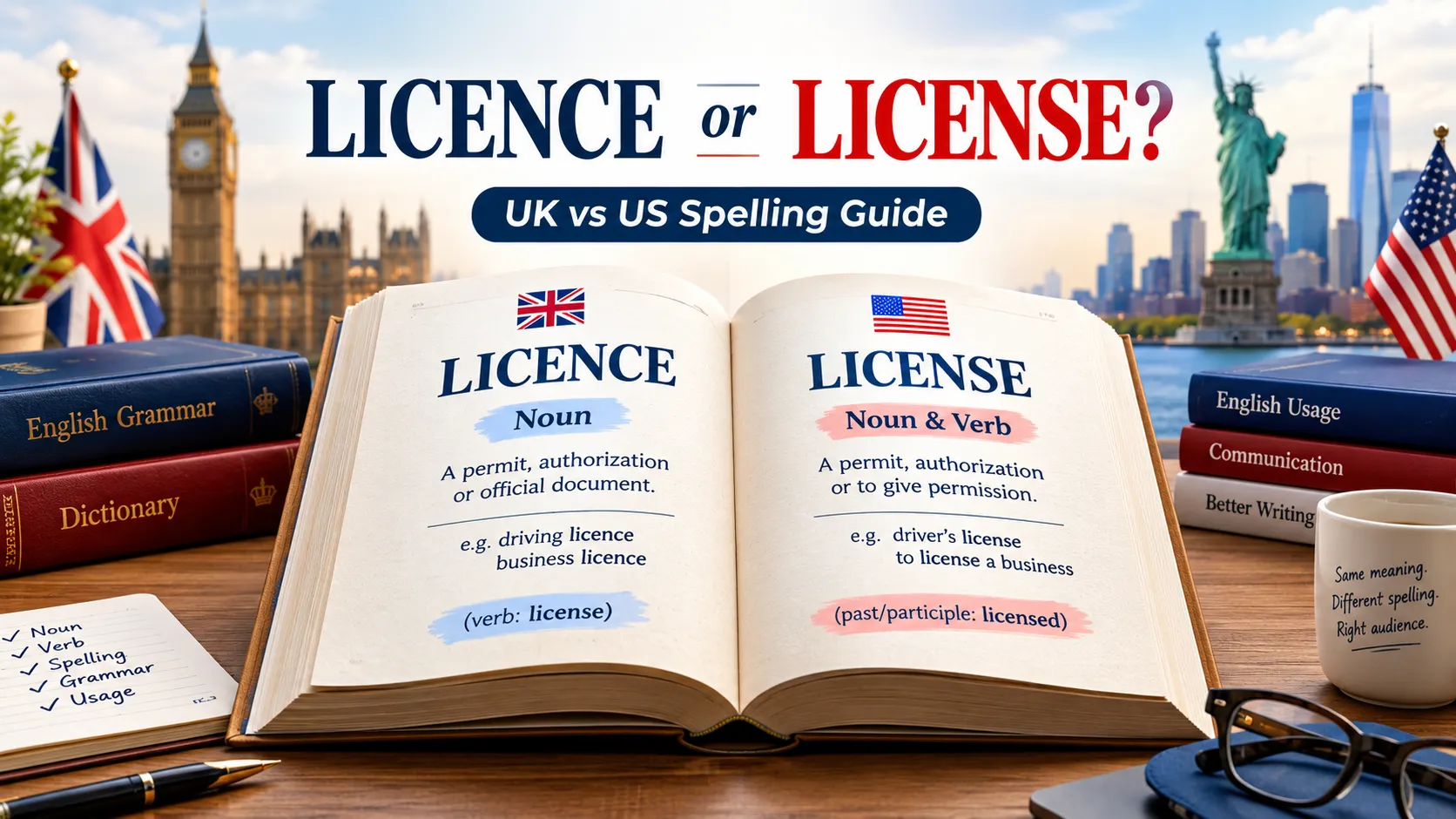
Licence or license? Both spellings are correct. The correct choice depends mainly on the variety of English you are using.
In British English, licence is normally the noun and license is the verb. In American English, license is used for both the noun and the verb. Canadian and Australian official style guidance also uses licence for the noun and license for the verb.
So:
| English variety | Noun | Verb |
| British English | licence | license |
| American English | license | license |
| Canadian English | licence | license |
| Australian English | licence | license |
For example:
- UK: I renewed my driving licence.
- US: I renewed my driver’s license.
- UK: The authority will license the business.
- US: The authority will license the business.
The important point is that license is not simply an American spelling. In British English, it is also the correct verb.
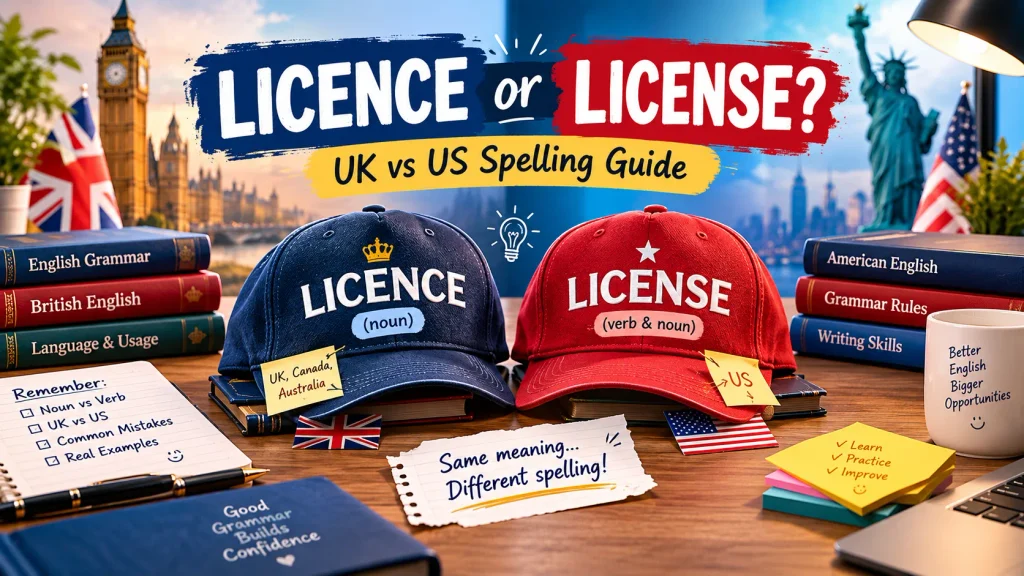
Licence or License: The Quick Answer
If you only need the answer, remember this:
British English: licence = noun, license = verb.
American English: license = noun and verb.
Quick examples
British English:
- She has a driving licence.
- The council will license the restaurant.
American English:
- She has a driver’s license.
- The state will license the restaurant.
The easiest formula
UK/Canadian/Australian style:
C = noun → licence
S = verb → license
American English:
S = noun + verb → license
This distinction is also reflected in official language guidance. The UK’s Office for National Statistics defines licence as the noun and license as the verb, while Canada’s Language Portal and Australia’s Style Manual give the same basic distinction.
What Is the Difference Between Licence and License?
The main difference is grammatical function and regional spelling convention.
Both words are connected to the idea of permission, authorization, or legal approval.
- licence is a noun.
- license is a verb.
In American English:
- license is a noun.
- license is a verb.
Compare these sentences:
The company received a licence.
Here, licence names the permission or authorization, so it is a noun.
The government will license the company.
Here, license describes the action of granting permission, so it is a verb.
American English uses the same spelling in both sentences:
The company received a license.
The government will license the company.
The meaning has not fundamentally changed. The spelling convention has.
What Does Licence Mean?
In British English and other varieties that follow the same convention, licence is a noun.
It can refer to:
- An official permit
- Legal permission
- Authorization
- A document showing permission
- Permission to carry out a regulated activity
Examples of licence
- driving licence
- fishing licence
- business licence
- television licence
- professional licence
- premises licence
- software licence
- trade licence
Examples in sentences
She renewed her driving licence yesterday.
Here, licence is the name of the authorization.
The restaurant applied for an alcohol licence.
The licence is the permission the restaurant needs.
The company obtained a professional licence.
Again, the word functions as a noun.
A licence does not have to be a physical document
A licence can refer to the permission itself, not just a card, certificate, or piece of paper.
For example:
The agreement gives the publisher a licence to reproduce the photographs.
The word refers to permission granted under an agreement.
What Does License Mean?
License can be a noun or a verb, depending on the variety of English.
As a verb, license means:
- to authorize
- to permit
- to grant permission
- to give official approval
Examples:
The government will license new operators.
The authority licenses local businesses.
The company licensed its technology to another organization.
The restaurant is licensed to sell alcohol.
In American English, license is also the noun:
I renewed my driver’s license.
The business needs a new license.
Licence vs License in British English
British English makes the distinction especially important because the two spellings perform different grammatical jobs.
Licence = Noun
Use licence when you are referring to the permission, permit, authorization, or document.
Examples:
- I have a valid driving licence.
- The company applied for a business licence.
- His fishing licence expires next month.
- The restaurant needs an alcohol licence.
License = Verb
Use license when you mean to give permission or authorize.
Examples:
- The council will license the restaurant.
- The authority licenses taxi operators.
- The government licensed the company.
- The venue is licensed to sell alcohol.
The UK’s Office for National Statistics uses the same noun/verb distinction in its style guidance.
One sentence that shows the entire rule
The company needs a licence before the regulator can license it.
The first word is a noun.
The second is a verb.
Licence vs License in American English
American English is simpler.
License is used as both a noun and a verb.
License as a noun
- driver’s license
- business license
- fishing license
- professional license
- software license
- operating license
Examples:
I renewed my driver’s license.
The company received its business license.
License as a verb
The state will license the new operator.
The agency licenses qualified professionals.
The company licensed the software.
Therefore, American writers normally do not need to choose between licence and license.
They use license.
Licence or License Around the World
The distinction is not simply “British versus American.”
Several wide English varieties use licence as the noun and license as the verb.
| English variety | Noun | Verb |
| United Kingdom | licence | license |
| United States | license | license |
| Canada | licence | license |
| Australia | licence | license |
| British-style English | licence | license |
Canada’s official Language Portal explicitly states that the Canadian noun ends in -ce (licence) while the verb ends in -se (license).
Australia’s official Style Manual likewise identifies licence as the noun and license as the verb.
Licence or License in the UK
For standard British English, use:
Nouns
- driving licence
- business licence
- television licence
- fishing licence
- software licence
- premises licence
Verbs
- license a business
- license an operator
- license a venue
- licensed premises
- licensing authority
For example:
I need to renew my driving licence.
But:
The authority will license the operator.
The official UK government website also consistently uses driving licence in its public-facing terminology.
License or Licence in the US
American English normally uses license in every ordinary context.
Correct examples include:
- driver’s license
- business license
- fishing license
- professional license
- software license
- operating license
- license agreement
Examples:
My driver’s license expires next year.
The company obtained a business license.
The state will license the new facility.
The software is properly licensed.
For an American audience, licence will generally look like a British spelling.
Licence or License in Canada
Canadian English generally follows the noun/verb distinction:
- licence = noun
- license = verb
For example:
Jenny got her driver’s licence yesterday.
Is your establishment licensed to sell alcohol?
This distinction is confirmed by Canada’s official Language Portal.
American influence means that Canadian readers may frequently encounter license, especially online. However, formal Canadian usage can still distinguish the noun licence from the verb license.
Licence or License in Australia
Australian English also generally follows:
- licence = noun
- license = verb
Examples:
She renewed her driver’s licence.
The authority will license the business.
The business is fully licensed.
Australia’s official Style Manual specifically lists licence as the noun and license as the verb.
What About India and Pakistan?
English usage in India and Pakistan has historically been influenced strongly by British English.
As a result, forms such as:
- driving licence
- business licence
- professional licence
are common in formal writing.
However, American English is also widespread in international business, technology, education, and online publishing.
The safest approach is to follow the style required by your:
- employer
- university
- publication
- government organization
- client
- target audience
Most Importantly, remain consistent.
If your article is written in British English, do not randomly switch to American spelling halfway through the page.
How to Tell Whether Licence or License Is a Noun or Verb
If you are writing British, Canadian, or Australian English, identify the grammatical function.
Ask yourself:
Are you talking about permission or a permit?
If yes, use licence.
She has a driving licence.
Are you talking about the action of granting permission?
If yes, use license.
The authority will license her business.
The Permit Test
One useful memory technique is to replace the word with permit.
If you are talking about a permit as a thing:
She has a permit.
Therefore:
She has a licence.
If you are talking about the action of giving permission:
The authority will authorize the company.
Therefore:
The authority will license the company.
This is particularly useful for British English learners.
Driving Licence or Driver’s License?
Both are correct, but they belong to different English conventions.
British English
The standard expression is:
driving licence
Example:
My driving licence expires next year.
The UK’s official terminology uses driving licence.
American English
The standard expression is:
driver’s license
Example:
My driver’s license expires next year.
Quick comparison
| UK | US |
| driving licence | driver’s license |
| licence | license |
| renew your licence | renew your license |
Do not assume that the difference is only the letter C/S. The phrase itself can also vary.
Business Licence or Business License?
The correct spelling depends on your variety of English.
British English
business licence
The company applied for a new business licence.
American English
business license
The company applied for a new business license.
The verb
In both varieties:
The authority will license the business.
So:
British: business licence → license the business
American: business license → license the business
Software Licence or Software License?
Both forms are correct in the appropriate regional context.
British English
The company purchased a software licence.
We signed a software licence agreement.
American English
The company purchased a software license.
We signed a software license agreement.
As a verb, use license:
The developer licenses the software to commercial customers.
The software is licensed for use on three devices.
Technology companies sometimes use American English as their house style even when their customers are international. That does not make a software licence incorrect in British English.
Licence Agreement or License Agreement?
Both can be correct.
British English
licence agreement
American English
license agreement
For example:
The two companies signed a licence agreement.
British English
The two companies signed a license agreement.
American English
The difference comes from the noun spelling.
Other examples include:
- copyright licence/copyright license
- software licence/software license
- commercial licence / commercial license
- trademark licence/trademark license
Licensed or Licenced: Which Is Correct?
The correct standard spelling is:
licensed
Not:
licenced
This is one of the most important related spelling points.
The verb is license, so its derived forms retain the s:
- license
- licensed
- licensing
Correct
He is a licensed driver.
The company is licensed to operate.
We use licensed software.
The premises are licensed for alcohol sales.
Incorrect
licenced driver
licenced software
licenced-professional
Even in British English, where the noun is licence, the verb is license, so the correct form is licensed. Official British style guidance follows this distinction.
Licensing or Licencing: Which Is Correct?
The standard spelling is:
licensing
Not:
licencing
Because the verb is license, the s remains in the -ing form.
Correct
- licensing agreement
- licensing authority
- software licensing
- professional licensing
- licensing requirements
Incorrect
- licencing agreement
- licencing authority
- software licencing
A simple way to remember the family is:
licence = British noun
license = verb
licensed = past/participial form
licensing = -ing form
Licensee and Licensor
Two related words frequently appear in legal, commercial, software, and intellectual-property writing.
Licensee
A licensee is the person or organization receiving permission under a licence or license.
Example:
The licensee may use the software according to the agreement.
Licensor
A licensor is the person or organization granting the permission.
Example:
The licensor retains ownership of the intellectual property.
Both words use S.
Simple distinction
Licensor → grants permission
Licensee → receives permission
These terms are especially common in:
- software agreements
- copyright agreements
- trademark agreements
- franchising
- intellectual property
- commercial contracts
Common Misspellings of Licence and License
The pronunciation can make the spelling confusing.
Here are common incorrect forms:
| Incorrect | Correct form |
| lisense | license |
| lisence | licence/license, depending on context |
| liscense | license |
| liscence | licence |
| licens | licence/license |
| licenced | licensed |
| licencing | licensing |
Why do these mistakes happen?
The spelling is not completely obvious from pronunciation.
The word is generally pronounced approximately:
/ˈlaɪ.səns/
The c in licence/license produces an /s/ sound, which can encourage learners to write the word phonetically.
The solution is to learn the spelling pattern rather than rely entirely on sound.
How to Remember Licence vs License
Here are three easy memory tricks.
Trick 1: C = noun
For British-style English:
licenCe = noun
licenSe = verb
Think:
C = Certificate
A certificate is a thing, just as a licence is a thing.
Trick 2: Compare Advice and Advise
The pair follows a familiar pattern:
- advice = noun
- advise = verb
Likewise:
- licence = noun
- license = verb
Compare:
I need some advice.
I need a licence.
But:
They advise customers.
They license operators.
Trick 3: Think “thing vs action”
Ask:
Is it a thing?
→ licence
Is it an action?
→ license
This trick is mainly useful for British, Canadian, and Australian English.
Licence vs License Examples
British English
I have a driving licence.
The council will license the business.
American English
I have a driver’s license.
The state will license the business.
Everyday English
British:
She renewed her fishing licence.
American:
She renewed her fishing license.
British:
The restaurant needs an alcohol licence.
American:
The restaurant needs a liquor license.
Business English
British:
The company applied for an operating licence.
American:
The company applied for an operating license.
Both:
The regulator will license the company.
Academic English
British:
Researchers must obtain the appropriate licence before conducting the activity.
American:
Researchers must obtain the appropriate license before conducting the activity.
The grammatical function remains the same; only the regional noun spelling changes.
Professional English
British:
The doctor must hold a valid professional licence.
American:
The doctor must hold a valid professional license.
Both:
The organization licenses qualified professionals.
Common Mistakes to Avoid
Mistake 1: Thinking Licence Is Always British, and License Is Always American
This explanation is incomplete.
British English uses both:
- licence = noun
- license = verb
American English uses:
- license = noun
- license = verb
So this sentence is perfectly correct in British English:
The government will license the company.
Mistake 2: Writing “Licenced”
Incorrect:
She is a licenced professional.
Correct:
She is a licensed professional.
The correct form keeps the s.
Mistake 3: Writing “Licencing”
Incorrect:
The Company handles professional licencing.
Correct:
The company handles professional licensing.
Mistake 4: Using “Licence” as a British Verb
Incorrect:
The government will licence the company.
Standard British English:
The government will license the company.
The British noun is licence, but the verb is license. Official British style guidance makes this distinction clear.
Mistake 5: Mixing UK and US English
Consider:
I renewed my driving licence and entered my ZIP code.
This sentence mixes British and American conventions.
Driving licence is strongly associated with British English, while ZIP code is American terminology.
Mixing varieties is not automatically grammatically wrong, but consistency is usually better in professional writing.
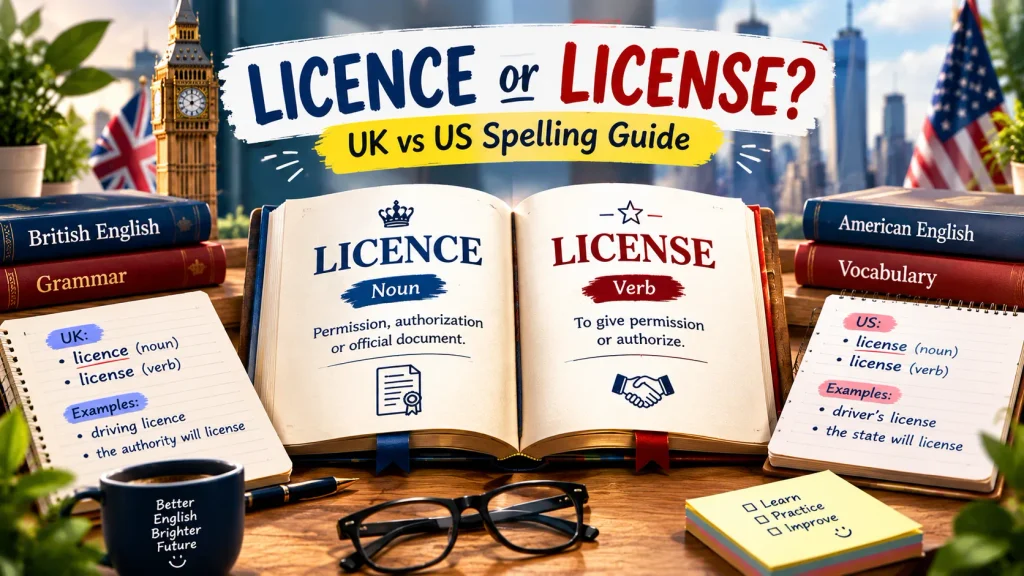
Licence vs License Comparison Table
| Feature | Licence | License |
| British noun | Yes | No |
| British verb | No | Yes |
| American noun | No | Yes |
| American verb | No | Yes |
| Means permission | Yes, as a noun | Yes |
| Means to authorize | No | Yes |
| Related form | — | licensed |
| -ing form | — | licensing |
The one-line rule
British English: licence = noun, license = verb. American English: license = noun and verb.
Quick Revision Box
Remember these four forms:
Licence → British noun
License → verb
Licensed → correct past/participle form
Licensing → correct -ing form
Regional shortcut
UK: licence/license
US: license/license
Canada: licence/license
Australia: licence/license
Explore More: https://wordminto.com/color-or-colour/
Practice: Licence or License?
Test yourself before looking at the answers.
Fill in the Blanks
- She renewed her driving ________.
- The state will ________ new businesses.
- His professional ________ expires next year.
- The authority will ________ qualified operators.
- The company purchased a software ________.
- The restaurant is fully ________.
- The government is reviewing its ________ requirements.
- The council issued several new ________.
- The company handles software ________.
- The regulator ________ the business last year.
Answers
- licence — British English / license — American English
- license
- licence — British English / license — American English
- license
- licence — British English / license — American English
- licensed
- licensing
- licences — British English / licenses — American English
- licensing
- licensed
Multiple-Choice Questions
1. Which is correct in British English?
A. I renewed my driving license.
B. I renewed my driving licence.
C. I renewed my driving licencing.
D. I renewed my driving licenced.
Answer: B
In standard British English, licence is the noun.
2. Which spelling is the verb?
A. licence
B. license
C. licencing
D. licens
Answer: B — license
The verb is license.
3. Which is standard American English?
A. driving licence
B. driver’s license
C. driver’s licence
D. driving licencing
Answer: B
American English uses driver’s license.
4. Which spelling is correct?
A. licenced
B. licenced
C. licensed
D. lisensed
Answer: C — licensed
5. Which spelling is correct?
A. licencing
B. licensing
C. lisensing
D. liscensing
Answer: B — licensing
Sentence Correction
Correct the following sentences according to the specified variety of English.
1. British English
I renewed my driving license.
Correct:
I renewed my driving licence.
2. British English
The council will licence the restaurant.
Correct:
The council will license the restaurant.
3. American English
I renewed my driving licence.
A more standard American form is:
I renewed my driver’s license.
4. Both varieties
The company hired a licenced professional.
Correct:
The company hired a licensed professional.
5. Both varieties
The authority handles licencing applications.
Correct:
The authority handles licensing applications.
People Also Ask
Both are correct. In British English, licence is normally the noun and license is the verb. In American English, license is used for both.
Licence is primarily the British-style noun spelling. American English normally uses license instead.
Both.
American English uses license as both a noun and a verb.
British English uses license as the verb.
Yes.
In British English, license is the standard verb.
For example:
The authority will license the company.
For the noun, standard British English normally uses:
Licence
The standard UK expression is:
Driving Licence
The UK government’s official terminology uses driving licence.
American English uses:
Driver’s License
Final Answer: Licence or License?
The answer becomes easy once you separate English varieties from grammatical function.
In British English
Licence = noun
I have a driving licence.
License = verb
The authority will license the company.
In American English
License = noun
I have a driver’s license.
License = verb
The state will license the company.
In Canadian and Australian English
The standard distinction is also generally:
Licence = noun
License = verb
Official Canadian and Australian guidance confirms this pattern.
And remember the related forms:
Licensed ✅
Licensing ✅
Not:
Licenced ❌
Licencing ❌
The easiest rule to remember
British English: licence = thing, license = action.
American English: license = both.
So, if you are writing for a British audience, write driving licence but licensed driver.
If you are writing for an American audience, write driver’s license and licensed driver.
The spelling difference is small, but choosing the form that matches your audience makes your writing more accurate, consistent, and professional.