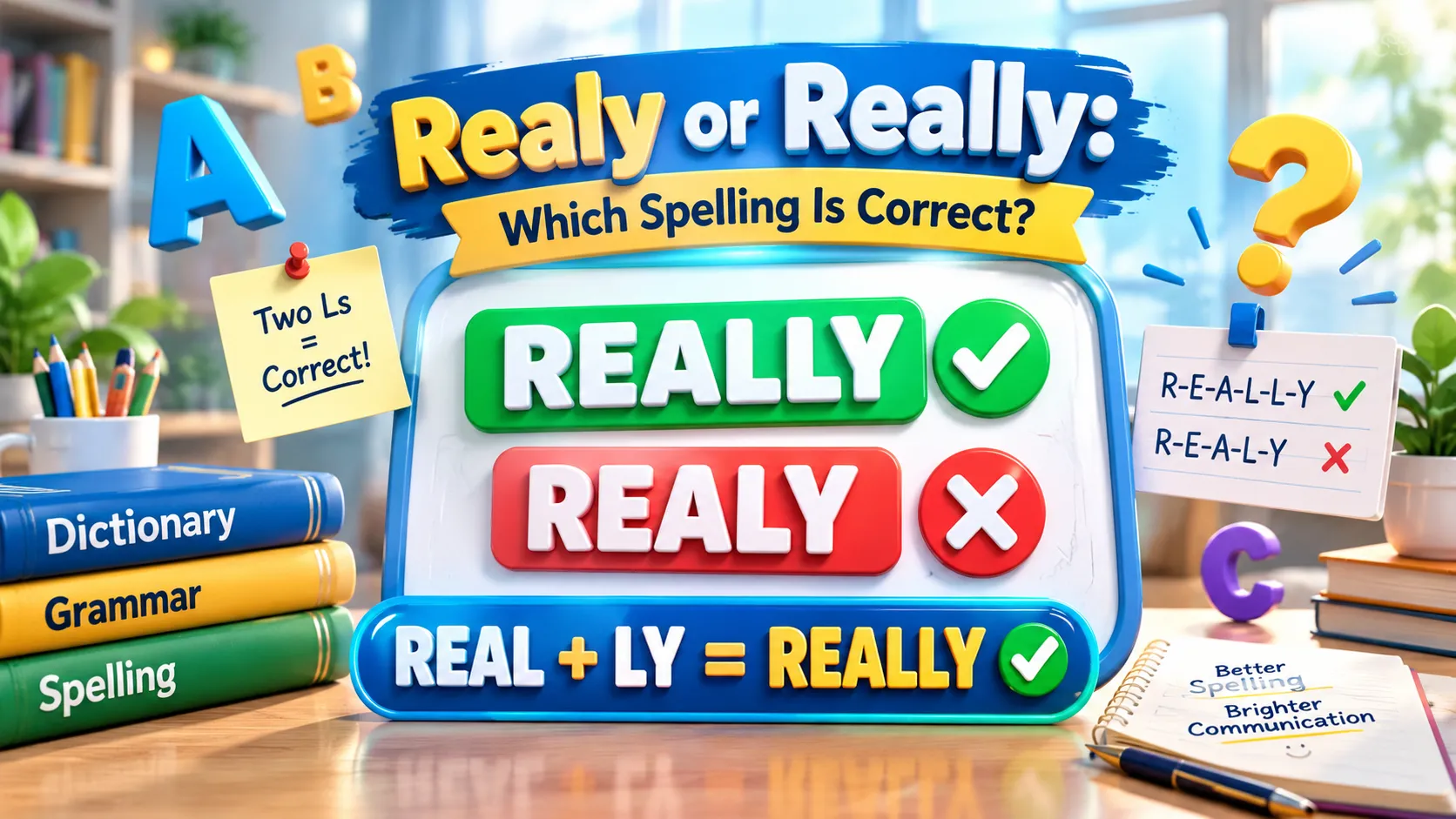
Realy or Really: If you are wondering whether the correct spelling is realy or really, the answer is straightforward:
Really is the correct spelling.
Realy is a misspelling.
The standard English spelling is R-E-A-L-L-Y, with two Ls. The word really is an adverb commonly used to express truth, emphasis, degree, certainty, or surprise.
For example:
- ✅ I really enjoyed the movie.
- ❌ I realy enjoyed the movie.
A simple way to remember the spelling is:
REAL + LY = REALLY
But spelling is only part of the story. Understanding what really means, where it belongs in a sentence, and how it differs from words such as very, truly, and actually can help you use it correctly and naturally.
Realy or Really: Quick Answer
| Spelling | Correct? | Explanation |
| Really | ✅ Yes | The standard English spelling |
| Realy | ❌ No | A common spelling mistake |
Correct
She is really talented.
Incorrect
She is realy talented.
There is no standard British or American English spelling in which realy is an accepted alternative to really.
Quick rule: Whenever you mean the adverb really, spell it with two Ls.
Why Is “Really” the Correct Spelling?
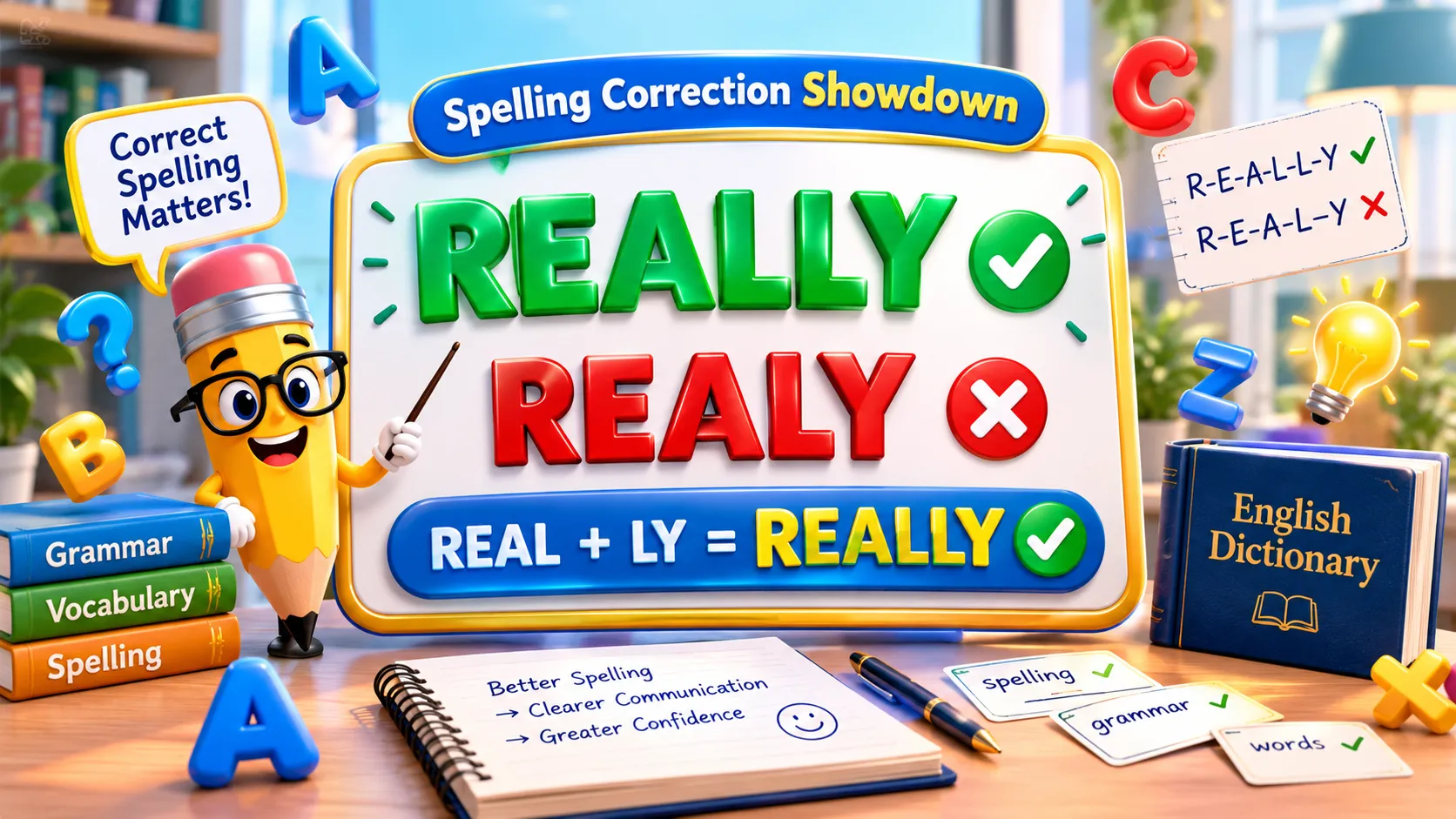
The correct spelling is really because the word is conventionally formed from real plus the adverb-forming suffix -ly:
real + ly → really
The base word real ends in l, while -ly begins with another l. The resulting spelling therefore contains two consecutive Ls:
r-e-a-l-l-y
The common misspelling realy occurs when one of those Ls is accidentally omitted.
Compare:
- ❌ I realy like this book.
- ✅ I really like this book.
- ❌ She is realy talented.
- ✅ She is really talented.
- ❌ We realy appreciate your help.
- ✅ We really appreciate your help.
The important point is that realy is not an alternative spelling of really in standard English.
Why Does “Really” Have Two Ls?
The easiest way to understand the spelling is to break the word into its parts:
REAL + LY = REALLY
The word real has one L:
R-E-A-L
The suffix -ly starts with L:
L-Y
Put them together:
R-E-A-L + L-Y
R-E-A-L-L-Y
So:
REAL → REALLY
Not:
REAL → REALY
Easy Spelling Formula
REAL + LY = REALLY ✅
REAL + Y = REALY ❌
This is a useful memory aid because the two Ls become visually obvious when you think about the base word and suffix separately.
What Does “Really” Mean?
Really is an adverb with several related meanings. Its exact meaning depends on the context.
It can communicate:
- truth or actuality
- Emphasis
- degree or intensity
- sincerity
- certainty
- surprise or interest
It is therefore inaccurate to define really simply as “very.”
1. Really Can Mean “In Fact” or “Truly”
Sometimes really emphasizes that something is true or genuine.
I really don’t know what happened.
Here, really emphasizes the truth of the speaker’s statement.
Another example:
She really wanted to attend the meeting.
This emphasizes that her desire was genuine.
2. Really Can Mean “Very” or “Very Much”
Really can also strengthen an adjective or adverb.
The movie was really interesting.
Here, really increases the degree of interesting.
Another example:
He runs really quickly.
Here, really intensifies the adverb quickly.
3. Really Can Express Surprise
Really can also stand alone as an expression.
“I won the competition.”
“Really?”
In this context, really? can express surprise, interest, disbelief, or curiosity depending on tone and context.
Is “Realy” a Word?
No. In standard English, realy is not the correct spelling of the word really.
If you write:
❌ I realy like your idea.
the intended word is almost certainly really.
The standard sentence is:
✅ I really like your idea.
This applies to both British and American English.
If you are writing an essay, email, article, school assignment, professional document, or social media post, use really, not realy.
How Do You Use “Really” in a Sentence?
One reason really is so common is that it can perform several functions in a sentence.
It can modify adjectives, adverbs, verbs, and sometimes an entire statement or clause.
Really Before an Adjective
Use really before an adjective when you want to strengthen the adjective.
Examples:
- The test was really difficult.
- She is really kind.
- This book is really useful.
- It was a really beautiful morning.
- The weather is really pleasant.
In each example, really increases the degree of the adjective.
adjective + really
For example:
difficult + really
useful + really
beautiful + really
Really Before an Adverb
Really can also modify another adverb.
Examples:
- She sings really well.
- He works really quickly.
- They arrived really early.
- The car moved really slowly.
- She answered the question really carefully.
Here, really tells us that the quality expressed by the other adverb is strong or pronounced.
really + adverb
With a Verb: Really
Really can occur with verbs to emphasize an action, feeling, preference, or attitude.
Examples:
- I really appreciate your help.
- She really likes that restaurant.
- We really enjoyed the trip.
- I really want to learn English.
- They really need more time.
In these sentences, really adds emphasis to the action or feeling.
Really in Questions
Really is especially useful in questions when the speaker wants to question whether something is true.
Examples:
- Do you really believe that?
- Are you really leaving tomorrow?
- Did she really say that?
- Is this really necessary?
- Do you really know him?
Compare:
Did she say that?
with:
Did she really say that?
The second question places greater emphasis on whether the statement is actually true.
Really as a Short Response
Really? can function as a complete conversational response.
For example:
“We’re moving to Canada.”
“Really?”
Or:
“I got the job.”
“Really? That’s fantastic!”
Depending on the situation and the speaker’s tone, really? can express:
- surprise
- interest
- Disbelief
- curiosity
- annoyance
Where Should “Really” Go in a Sentence?
The position of really can affect what receives emphasis.
Consider:
I really don’t like coffee.
This strongly emphasizes the speaker’s dislike.
Now compare:
I don’t really like coffee.
This often sounds softer and can mean something closer to “I don’t particularly like coffee.”
Another comparison:
She really sings well.
This can emphasize the fact or manner of her singing.
She sings really well.
This more directly emphasizes the degree to which she sings well.
The exact effect depends on the sentence and context, but really is flexible and can modify different parts of a clause.
Realy vs. Really: Examples
Seeing the incorrect and correct forms together makes the spelling easier to remember.
| Incorrect ❌ | Correct ✅ |
| I realy like it. | I really like it. |
| She is realy happy. | She is really happy. |
| We realy need help. | We really need help. |
| He realy enjoyed the movie. | He really enjoyed the movie. |
| Are you realy serious? | Are you really serious? |
| They realy tried their best. | They really tried their best. |
| This is realy important. | This is really important. |
| I realy appreciate it. | I really appreciate it. |
More Correct Examples
- I really enjoyed the concert.
- She is really good at mathematics.
- Do you really want to leave?
- That was really helpful.
- We really appreciate your support.
- He works really hard.
- I really hope you succeed.
- Are you really sure?
- This book is really interesting.
- She really wants to improve her English.
Really vs. Very: What Is the Difference?
Really and very can both express degree or emphasis, but they are not interchangeable in every situation.
Very
Very commonly increases the degree of an adjective or adverb.
The water is very cold.
She is very happy.
Really
Really can also intensify an adjective or adverb.
The water is really cold.
She is really happy.
In these examples, the two words have similar meanings.
However, really has additional uses connected with truth and actuality.
Did he really say that?
You cannot replace really with very here:
❌ Did he very say that?
Therefore:
| Really | Very |
| Can express degree | Commonly expresses degree |
| Can emphasize truth | Does not normally express truth in the same way |
| Can express surprise | Cannot replace really? in this use |
| Can modify verbs | Usually does not modify verbs in the same way |
| Common in everyday speech | Common for intensifying adjectives/adverbs |
Simple Rule
Use very mainly to express degree.
Use really when you want to express degree or emphasis, truth, certainty, sincerity, or surprise.
Really vs. Truly: What Is the Difference?
Really and truly can overlap in meaning, especially when expressing sincerity or truth.
Compare:
I really appreciate your help.
I truly appreciate your help.
Both sentences communicate genuine appreciation.
However, truly can sound more deliberate, sincere, or emphatic, while really is extremely common in everyday conversation.
More examples:
- I really enjoyed the show.
- I truly enjoyed the experience.
- She really cares about her students.
- She truly cares about her students.
Neither word is automatically better. The best choice depends on context, tone, and the exact meaning you want to communicate.
Actually vs. Really: What Is the Difference?
Really and actually can sometimes overlap, but they often perform different functions.
Actually
Actually often introduces a correction, clarification, or fact that differs from an assumption.
Really
Really commonly emphasizes truth, intensity, sincerity, or feeling.
I really like this restaurant.
I thought he lived in London. Actually, he lives in Manchester.
Compare:
Do you really know her?
This asks whether the claim is genuinely true.
Now:
Actually, I know her quite well.
Here, actually clarifies or corrects information.
So although the two words can have similar meanings in certain contexts, really and actually are not interchangeable everywhere.
Is “Really” Spelled the Same in British and American English?
Yes.
The spelling is the same in both major varieties of English:
| Variety | Correct Spelling |
| British English | really ✅ |
| American English | really ✅ |
There is no standard British spelling realy and no standard American spelling realy.
So whether you are writing:
- a school assignment
- an academic paper
- a business email
- a blog post
- a website
- a social media caption
- an everyday message
the correct spelling remains:
really
How Do You Pronounce “Really”?
The pronunciation of really can vary somewhat between British and American English.
Common dictionary pronunciations include:
- US: /ˈriː.ə.li/
- UK: /ˈrɪə.li/
In everyday speech, it may sound approximately like:
REE-uh-lee
or, particularly in faster speech:
REE-lee
This can make the spelling confusing because the two Ls may not be obvious when the word is spoken quickly.
However, pronunciation does not change the standard spelling.
really ✅
not:
realy ❌
Explore More: https://wordminto.com/wierd-or-weird/
Common Misspellings of “Really”
The most common spelling mistake is dropping one of the Ls:
realy ❌ → really ✅
Other incorrect forms may include:
- relly ❌
- realley ❌
- reallly ❌
- realy ❌
The standard form is:
really
Proofreading Tip
Pay special attention to the middle of the word:
rea + lly
If you see realy, check whether the second L is missing.
Why Do People Spell “Really” as “Realy”?
There are several practical reasons someone might type realy accidentally.
1. Fast Typing
When people type quickly, they may accidentally omit a repeated letter.
2. Pronunciation
In ordinary speech, the two Ls may not sound clearly distinct.
3. Spelling by Sound
English spelling is not completely phonetic. People sometimes spell words according to how they think they sound.
4. Mobile Typing
Fast typing on phones and other small keyboards can lead to accidental letter omissions.
5. Lack of Proofreading
A one-letter spelling mistake can easily go unnoticed in a message, essay, or online post.
The solution is simple:
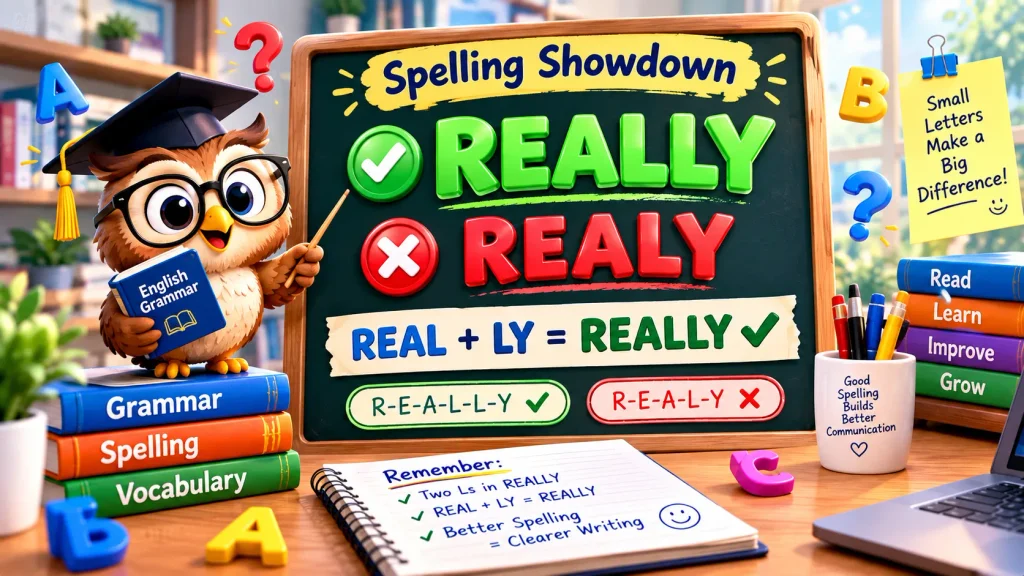
real + ly = really
Easy Trick to Remember How to Spell Really
The easiest memory trick is:
Think REAL + LY
Remember:
REAL has one L.
LY begins with another L.
Therefore:
REAL + LY = REALLY
Memory Sentence
You can also remember:
“If it is real, it is really true.”
Or simply:
REAL → REALLY
Whenever you type realy, stop and ask yourself:
“Where is the second L from -ly?”
That quick mental check can help you catch the mistake before submitting or publishing your writing.
Is “Really” Appropriate in Formal Writing?
Yes. Really is a standard English word and is grammatically acceptable in formal writing.
However, formal and academic writing often benefits from precision. If really is being used repeatedly as a general intensifier, a more specific word may communicate the intended meaning more accurately.
For example:
General
The results are really important.
More precise
The results are highly significant.
Another example:
General
The difference is really large.
More precise
The difference is substantial.
This does not mean that really is grammatically incorrect in academic or professional writing. It simply means that precise vocabulary can sometimes make formal writing stronger.
Common Mistakes to Avoid
Here are some mistakes learners frequently make with really.
Mistake 1: Dropping an L
❌ I realy like it.
✅ I really like it.
Mistake 2: Adding Too Many Ls
❌ I reallly like it.
✅ I really like it.
Mistake 3: Confusing Really With Very
❌ Did you very say that?
✅ Did you really say that?
Mistake 4: Assuming British English Uses “Realy”
❌ British: realy
✅ British: really
Mistake 5: Thinking Really Only Means Very
Really can express more than degree.
Did you really do that?
Here, it questions whether something actually happened.
Really or Realy: Quick Comparison
| Feature | Really | Realy |
| Correct spelling | ✅ Yes | ❌ No |
| Standard English word | ✅ Yes | ❌ No |
| Part of speech | Adverb | — |
| Meaning | Truth, emphasis, degree, etc. | No standard meaning |
| British English | ✅ Yes | ❌ No |
| American English | ✅ Yes | ❌ No |
| Formal writing | ✅ Yes | ❌ No |
| Academic writing | ✅ Yes | ❌ No |
| Common typing error | No | Yes |
Practice: Choose “Really” or “Realy”
Test your spelling knowledge.
1. I _____ enjoyed the movie.
A. realy
B. really
Answer: B. really
I really enjoyed the movie.
2. She is _____ talented.
A. really
B. realy
Answer: A. really
She is really talented.
3. Do you _____ believe him?
A. realy
B. really
Answer: B. really
Do you really believe him?
4. We _____ appreciate your help.
A. really
B. realy
Answer: A. really
We really appreciate your help.
5. This is _____ important.
A. realy
B. really
Answer: B. really
This is really important.
More Practice: Correct the Spelling
Correct the misspelled word in each sentence.
1.
I realy want to learn English.
Answer:
I really want to learn English.
2.
She is realy good at mathematics.
Answer:
She is really good at mathematics.
3.
Are you realy sure?
Answer:
Are you really sure?
4.
We realy enjoyed our vacation.
Answer:
We really enjoyed our vacation.
5.
He realy appreciates your support.
Answer:
He really appreciates your support.
Quick Revision
Whenever you have to choose between the two forms, remember:
REALLY = R-E-A-L-L-Y ✅
REALY = R-E-A-L-Y ❌
People Also Ask
No. Realy is a misspelling. The correct spelling is really.
Spell it:
R-E-A-L-L-Y
It contains two Ls.
Yes. Really is a standard English adverb. It can also function independently in expressions such as “Really?”
Depending on context, really can mean in fact, truly, actually, very, or very much. It can also express surprise, interest, or disbelief.
No. Standard British English uses really, not realy.
No. Standard American English also uses really.
Final Answer: Realy or Really?
If you are choosing between realy and really, always choose:
Really ✅
Realy ❌ is a misspelling.
The correct spelling is:
R-E-A-L-L-Y
Remember:
REAL + LY = REALLY
And use it confidently:
I really mean it. ✅
Not:
I realy mean it. ❌
Whether you are writing an email, essay, school assignment, professional document, blog post, or social media caption, really is the standard form.










3 thoughts on “Realy or Really: Which Spelling Is Correct?”