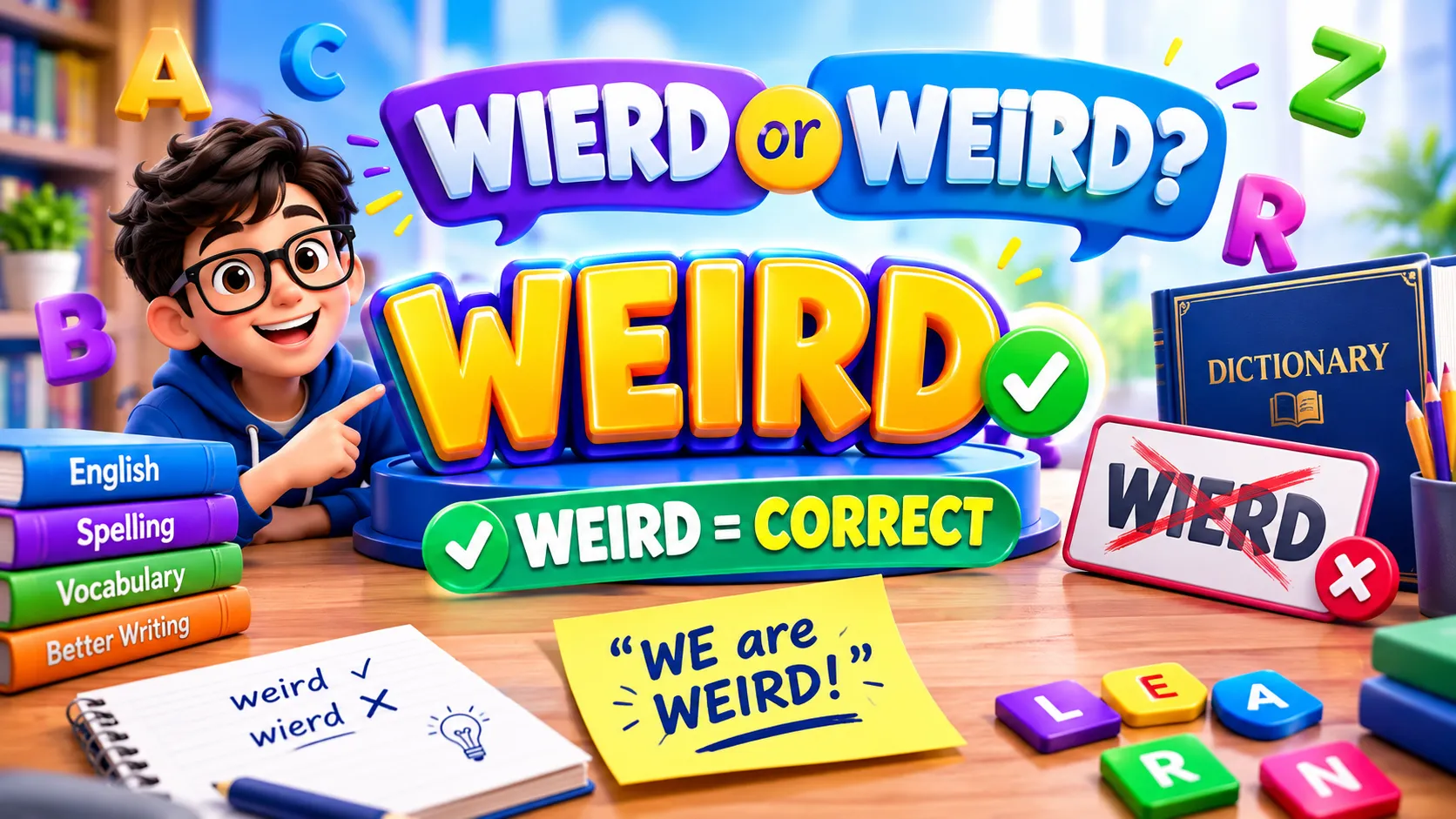
Wierd or weird? If you have ever paused while typing this word and wondered whether the I comes before the E, you are not alone. The correct spelling is weird, while wierd is a common misspelling.
The confusion is understandable because English learners often remember the spelling rhyme “I before E except after C.” However, that phrase is only a rule of thumb, not an absolute rule. Weird is one of the familiar words that uses ei rather than ie.
Wierd or Weird: Which One Is Correct?
Weird is the correct spelling.
Wierd is an incorrect spelling in standard modern English.
| Spelling | Correct? | Meaning |
| weird | ✅ Yes | Strange, unusual, unexpected, or difficult to explain |
| wierd | ❌ No | Common misspelling of weird |
For example:
- ✅ That was a weird dream.
- ❌ That was a wierd dream.
If you are writing an essay, email, article, school assignment, business document, or social media post, use weird. The standard spelling does not change between American and British English.
Quick answer: WEIRD is correct. WIERD is incorrect.
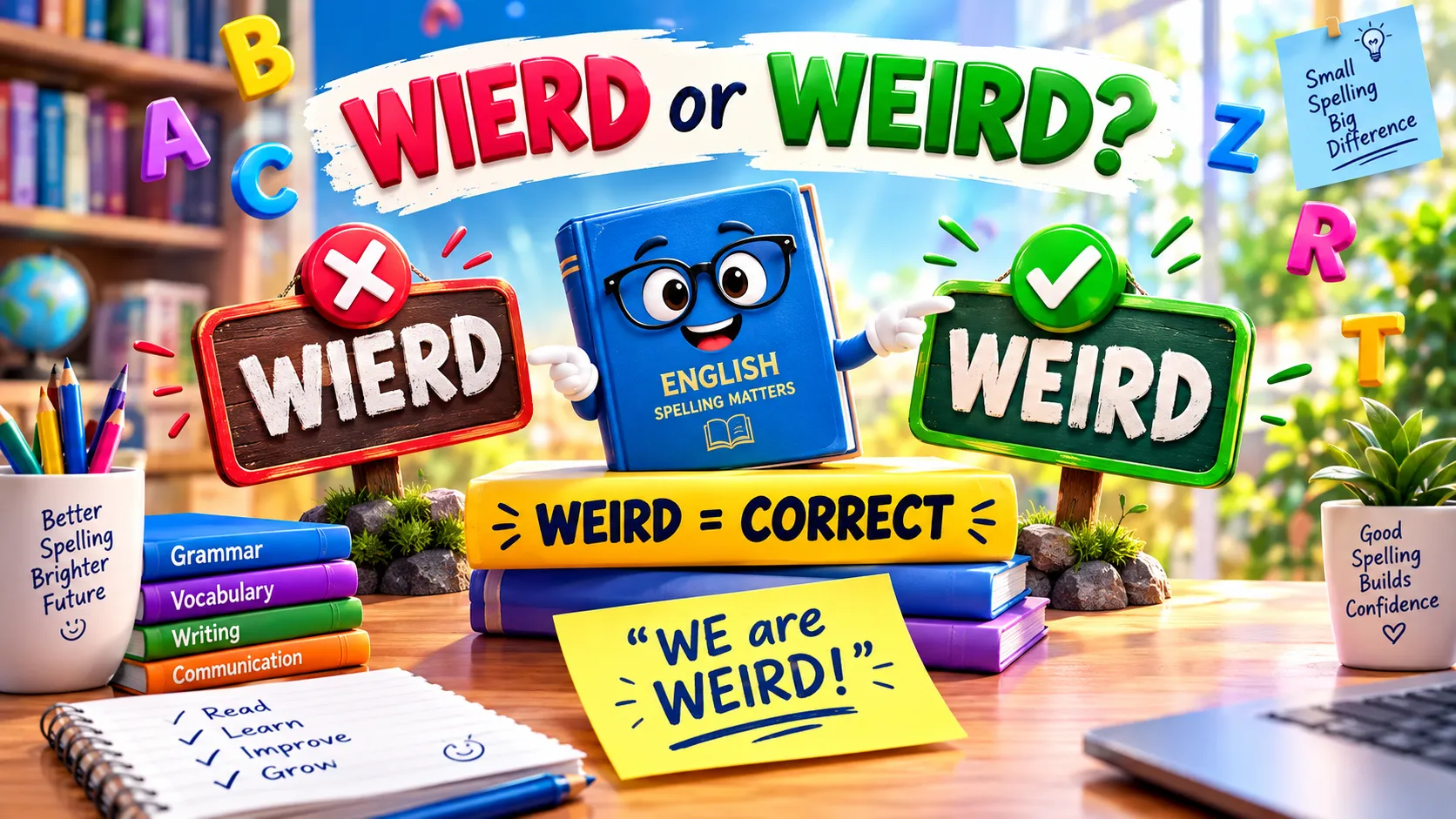
Why Is “Wierd” Incorrect?
The mistake comes from reversing the position of E and I.
The correct spelling is:
W-E-I-R-D
The common misspelling is:
W-I-E-R-D
Notice the difference:
WEIRD → EI
WIERD → IE
Many people write wierd because they remember the familiar “I before E” pattern. But English has many spelling irregularities, so a single mnemonic cannot predict every word correctly.
The easiest solution is to memorize the complete spelling:
WEIRD
rather than trying to reconstruct it from a spelling rule.
How Do You Spell Weird?
The correct spelling is:
W-E-I-R-D
A useful way to remember it is:
WE + IRD = WEIRD
You can also use the mnemonic:
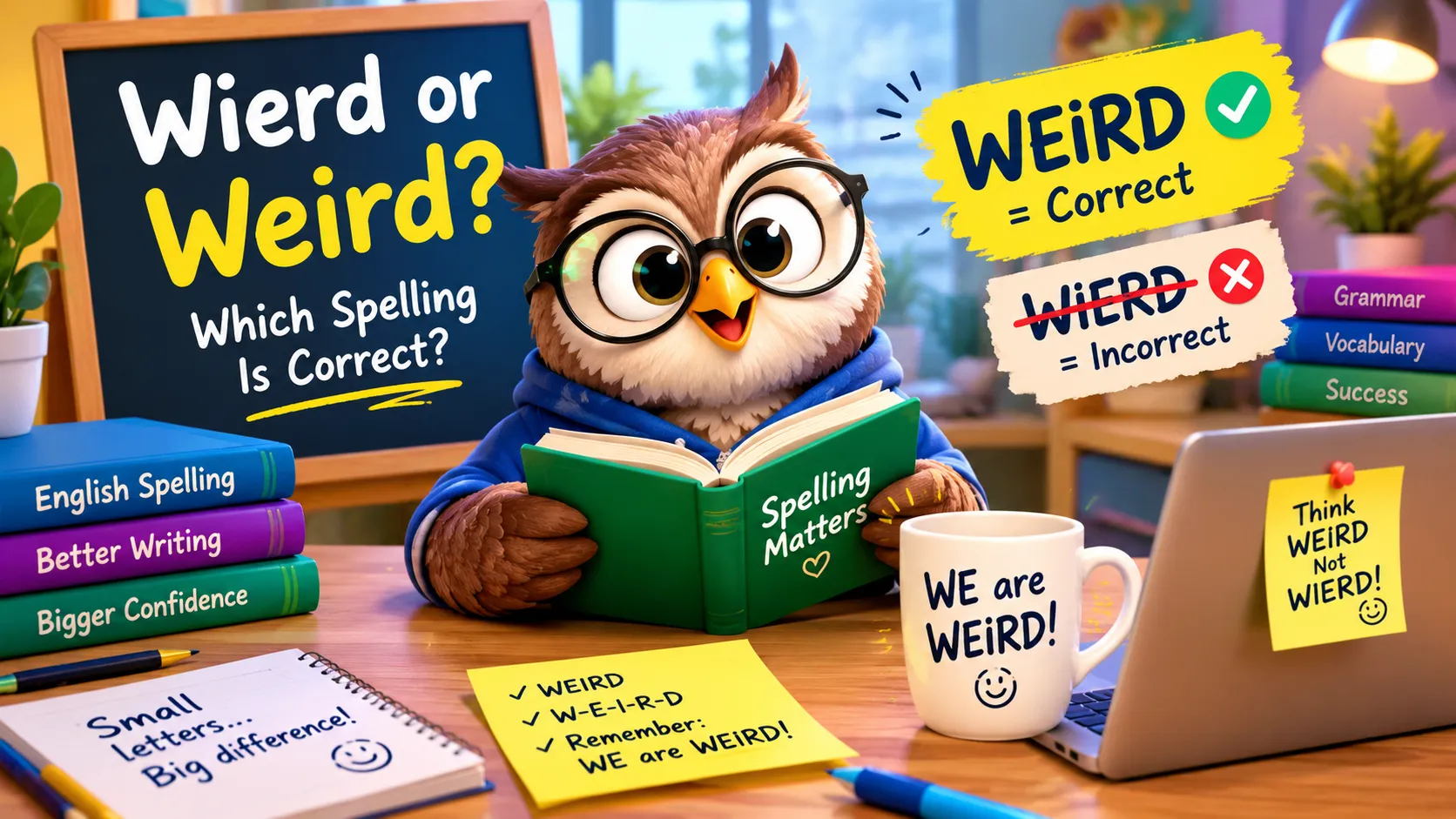
“We are weird.”
The word begins with WE, not WI.
WE + IRD → WEIRD
This simple association helps prevent the most common spelling error.
What Does Weird Mean?
Weird is an adjective used to describe something that is strange, unusual, unexpected, unnatural, mysterious, or difficult to explain.
Its meaning depends on context. Something can be weird because it is unfamiliar, surprising, humorous, unsettling, or simply different from what is normally expected.
Examples of Weird
- That was a weird dream.
- She has a weird sense of humor.
- I heard a weird noise outside.
- The movie had a weird ending.
- It felt weird to return to my old school.
- He came up with a weird idea.
The word does not always have a strongly negative meaning. Depending on the situation, weird can sound humorous, neutral, mildly critical, or even complimentary.
Weird vs. Wierd: What Is the Difference?
There is no vocabulary difference between weird and wierd because wierd is not the standard spelling of the word.
The distinction is simple:
Weird = correct English spelling
Wierd = misspelling
| Feature | Weird | Wierd |
| Standard spelling | ✅ Yes | ❌ No |
| Means strange or unusual | ✅ Yes | ❌ No |
| Standard adjective | ✅ Yes | ❌ No |
| American English | ✅ Yes | ❌ No |
| British English | ✅ Yes | ❌ No |
| Academic writing | ✅ Yes | ❌ No |
| Formal writing | ✅ Yes | ❌ No |
| Common spelling mistake | ❌ No | ✅ Yes |
Does “I Before E Except After C” Apply to Weird?
Not in its simple form.
The familiar spelling mnemonic is:
I before E except after C.
It works as a useful pattern for some English words, but it has numerous exceptions. Weird is one of the commonly cited examples where EI appears without being immediately preceded by C.
This is an important lesson for English learners:
Spelling mnemonics are helpful patterns, not universal laws.
So don’t change weird into wierd just because you remember “I before E.”
A Better Memory Trick
Instead, remember:
WE are WEIRD.
This puts E before I in the correct position.
WE → EI → WEIRD
Why Do People Spell Weird as Wierd?
Several factors can cause this mistake.
1. The “I Before E” Mnemonic
Someone may remember I before E and automatically write:
W-I-E-R-D
But the correct spelling is:
W-E-I-R-D
The mnemonic can therefore contribute to the very mistake people are trying to avoid.
2. Pronunciation Does Not Clearly Reveal the Spelling
When you hear weird, the pronunciation does not tell you whether the middle letters should be ie or ei.
That means you cannot always rely on sound to reconstruct its spelling.
3. Typing Errors
The two spellings look extremely similar:
weird
wierd
When typing quickly, it is easy to reverse the two vowels accidentally.
4. English Has Irregular Spelling Patterns
English spelling contains many historical patterns, exceptions, and words whose modern spellings cannot be predicted from one simple rule.
Weird is a good example of why memorizing frequently confused words can be more effective than relying exclusively on spelling formulas.
How Do You Pronounce Weird?
The pronunciation varies somewhat between wide varieties of English.
- British English: approximately /wɪəd/
- American English: approximately /wɪrd/
Despite this pronunciation difference, the spelling remains weird.
So:
Pronunciation can vary. Spelling does not.
Is Weird Spelled Differently in British and American English?
No.
Unlike words such as colour/color, favourite/favorite, and jewellery/jewelry, weird has the same standard spelling in British and American English.
| Variety of English | Correct spelling |
| American English | weird |
| British English | weird |
| Canadian English | weird |
| Australian English | weird |
Whether you are writing a British English assignment or an American English article, the correct form is:
weird
Weird as an Adjective
In modern English, weird is primarily used as an adjective.
An adjective describes or modifies a person, thing, situation, experience, or behavior.
For example:
- a weird sound
- a weird person
- a weird idea
- a weird dream
- a weird experience
- a weird situation
Weird for a Person
He is a little weird, but he is very friendly.
Here, weird describes the person’s behavior or personality.
Weird for an Object
There was a weird object sitting on the desk.
Here, weird describes the object as unusual or unfamiliar.
Weird for a Situation
It was weird to see everyone leave so suddenly.
Here, weird describes the unusual nature of the situation.
Weird for a Sound
We heard a weird noise coming from the basement.
Here, weird describes the sound as strange or unexpected.
Weird for a Feeling
I had a weird feeling that something was wrong.
Here, weird describes an unusual or difficult-to-explain feeling.
Comparative and Superlative Forms of Weird
Because weird is an adjective, it can be used in comparative and superlative forms.
Weird
The basic form describes something as strange.
That movie is weird.
Weirder
The comparative form compares two things.
This movie is weirder than the first one.
Weirdest
The superlative form identifies the greatest degree of weirdness among three or more things.
That was the weirdest dream I have ever had.
The standard comparative and superlative forms are weirder and weirdest.
Other Word Forms of Weird
Several related forms are commonly used in English.
| Word | Part of Speech | Example |
| weird | Adjective | That is weird. |
| weirder | Comparative adjective | This is weirder. |
| weirdest | Superlative adjective | That was the weirdest one. |
| weirdly | Adverb | He smiled weirdly. |
| weirdness | Noun | The weirdness surprised everyone. |
All of these forms retain the spelling weird.
Weird in a Sentence: 20 Examples
Here are practical examples showing how weird is used in everyday, academic, and conversational English.
- That is a weird question.
- The weather has been weird today.
- I had a weird dream last night.
- She has a weird but funny sense of humor.
- The house looked weird in the fog.
- It would be weird to leave without saying goodbye.
- The experiment produced a weird result.
- He heard a weird sound outside.
- The ending of the movie was weird.
- There was something weird about the message.
- Why are you acting so weird?
- I noticed a weird pattern in the data.
- The machine made a weird noise during the test.
- It felt weird to work in an empty office.
- We saw a weird shape in the distance.
- That is the weirdest thing I have ever seen.
- Today’s situation is weirder than yesterday’s.
- He explained the situation weirdly.
- The weirdness of the story made everyone curious.
- It would be weird if nobody noticed.
The important point in every sentence is the same: weird begins with we, not wi.
Explore More: https://wordminto.com/wholistic-vs-holistic/
Common Misspellings of Weird
The most common misspelling is:
❌ wierd
However, other incorrect forms can appear, especially when people add grammatical endings.
| Incorrect | Correct |
| ❌ wierd | ✅ weird |
| ❌ wird | ✅ weird |
| ❌ weired | ✅ weird |
| ❌ wierdly | ✅ weirdly |
| ❌ wierdest | ✅ weirdest |
When adding an ending, keep the base spelling weird intact.
Common Mistake
❌ She had the wierdest dream.
Correct
✅ She had the weirdest dream.
The ei sequence remains part of the word.
Weird Synonyms
The best synonym for weird depends on the context.
| Synonym | Typical Meaning |
| strange | Different from what is normal or expected |
| odd | Unusual or out of the ordinary |
| unusual | Not common |
| peculiar | Noticeably different or distinctive |
| bizarre | Extremely strange |
| eerie | Strange in a mysterious or frightening way |
| uncanny | Mysteriously strange or unsettling |
Strange
That was a strange experience.
Odd
There is something odd about this room.
Unusual
She has an unusual hobby.
Peculiar
He has a peculiar way of speaking.
Bizarre
The story had a bizarre ending.
Eerie
The empty building had an eerie atmosphere.
Uncanny
The resemblance between them was uncanny.
Although these words overlap with weird, they are not always interchangeable. The context and emotional tone determine which synonym works best.
The Origin and History of Weird
The history of weird is more interesting than its modern spelling might suggest.
The word can be traced to Old English wyrd, which referred to fate or destiny. Over time, its meaning developed through associations with supernatural and mysterious forces before reaching the modern sense of something strange or unusual.
A simplified semantic journey is:
fate → supernatural → uncanny → strange/unusual
This history helps explain why weird has long been associated with mysterious, supernatural, or difficult-to-explain things.
Weird and Shakespeare’s “Weird Sisters”
One famous historical association is Shakespeare’s Weird Sisters in Macbeth.
The expression refers to supernatural figures associated with fate. The historical meaning of weird therefore connects the word with ideas of destiny and supernatural forces, rather than simply today’s everyday meaning of “strange.”
This is one reason the word weird has retained associations with things that seem mysterious, uncanny, or supernatural.
Is “Wierd” Ever Correct?
For standard modern English spelling, no.
If you want to describe something as strange or unusual, write:
weird
not:
wierd
You may occasionally encounter wierd in historical material, names, usernames, quotations, or deliberately altered spellings. Such occurrences do not make wierd the standard modern spelling of the adjective.
For ordinary English writing, choose weird.
Easy Tricks to Remember Weird
If you frequently confuse weird and wierd, these memory tricks can help.
Trick 1: “We Are Weird”
Remember:
WE are WEIRD.
The word starts with WE.
WE + IRD = WEIRD
Trick 2: Think “WE + IRD”
Break the spelling into two visual parts:
WE + IRD
Therefore:
WEIRD
This is particularly useful if you tend to reverse E and I.
Trick 3: Don’t Automatically Trust “I Before E”
The mnemonic can be useful, but it is not an absolute spelling law.
When you see this word, simply remember:
WEIRD = correct
Trick 4: Practice It in Sentences
Write the word several times in meaningful sentences:
That is weird.
This feels weird.
What a weird idea!
Repeated exposure makes the correct letter order easier to recognize.
Wierd or Weird: Quick Comparison
| Question | Answer |
| Which spelling is correct? | Weird |
| Is wierd correct? | No |
| How do you spell it? | W-E-I-R-D |
| What does weird mean? | Strange, unusual, unexpected, or difficult to explain |
| Is weird an adjective? | Yes, primarily |
| What is the comparative? | Weirder |
| What is the superlative? | Weirdest |
| What is the adverb? | Weirdly |
| What is the noun form? | Weirdness |
| Is British spelling different? | No |
| Is American spelling different? | No |
| Why is it confusing? | The ei spelling conflicts with the simple “I before E” mnemonic |
| What is the easiest memory trick? | WE are WEIRD |
Practice: Choose Weird or Wierd
Test yourself before looking at the answers.
1. That was a very ______ experience.
A. wierd
B. weird
2. Why is your computer making that ______ noise?
A. weird
B. wierd
3. She had a ______ dream last night.
A. wierd
B. weird
4. That is the ______ movie I have ever seen.
A. wierdest
B. weirdest
5. He smiled ______ at me.
A. wierdly
B. weirdly
6. There was something ______ about the room.
A. wierd
B. weird
7. This situation is ______ than I expected.
A. wierder
B. weirder
8. The ______ of the story made everyone uncomfortable.
A. wierdness
B. weirdness
Answers
- B — weird
- A — weird
- B — weird
- B — weirdest
- B — weirdly
- B — weird
- B — weirder
- B — weirdness
The recurring pattern is easy to remember: the correct base spelling is always WEIRD.
Quick Revision Box
Remember these five points:
- ✅ WEIRD is the correct spelling.
- ❌ WIERD is a common misspelling.
- WEIRD means strange, unusual, unexpected, or difficult to explain.
- The word is spelled W-E-I-R-D.
- Remember: “WE are WEIRD.”
People Also Ask
No. Wierd is a common misspelling. The standard spelling is weird.
Spell it:
W-E-I-R-D
Weird is correct. Wierd is incorrect in standard modern English.
The mistake is often associated with the familiar “I before E” spelling mnemonic. However, weird is one of the words that does not follow the simple version of that pattern.
No. Both British and American English use weird.
Weird generally means strange, unusual, unexpected, unnatural, mysterious, or difficult to explain.
Final Answer: Wierd or Weird?
If you are wondering whether to write wierd or weird, the answer is straightforward:
✅ WEIRD is correct.
❌ WIERD is incorrect.
Remember the spelling:
W-E-I-R-D
Or use this simple mnemonic:
“We are weird.”
The familiar “I before E except after C” phrase can be useful for some words, but it is not an absolute rule. Weird is a well-known example that uses EI despite not following the simplest version of that pattern.
So whether you are writing an email, essay, school assignment, professional document, website, or social media post, choose:
WEIRD
Weird is the correct spelling.








2 thoughts on “Wierd or Weird: Which Spelling Is Correct? Meaning, Examples & Easy Trick”