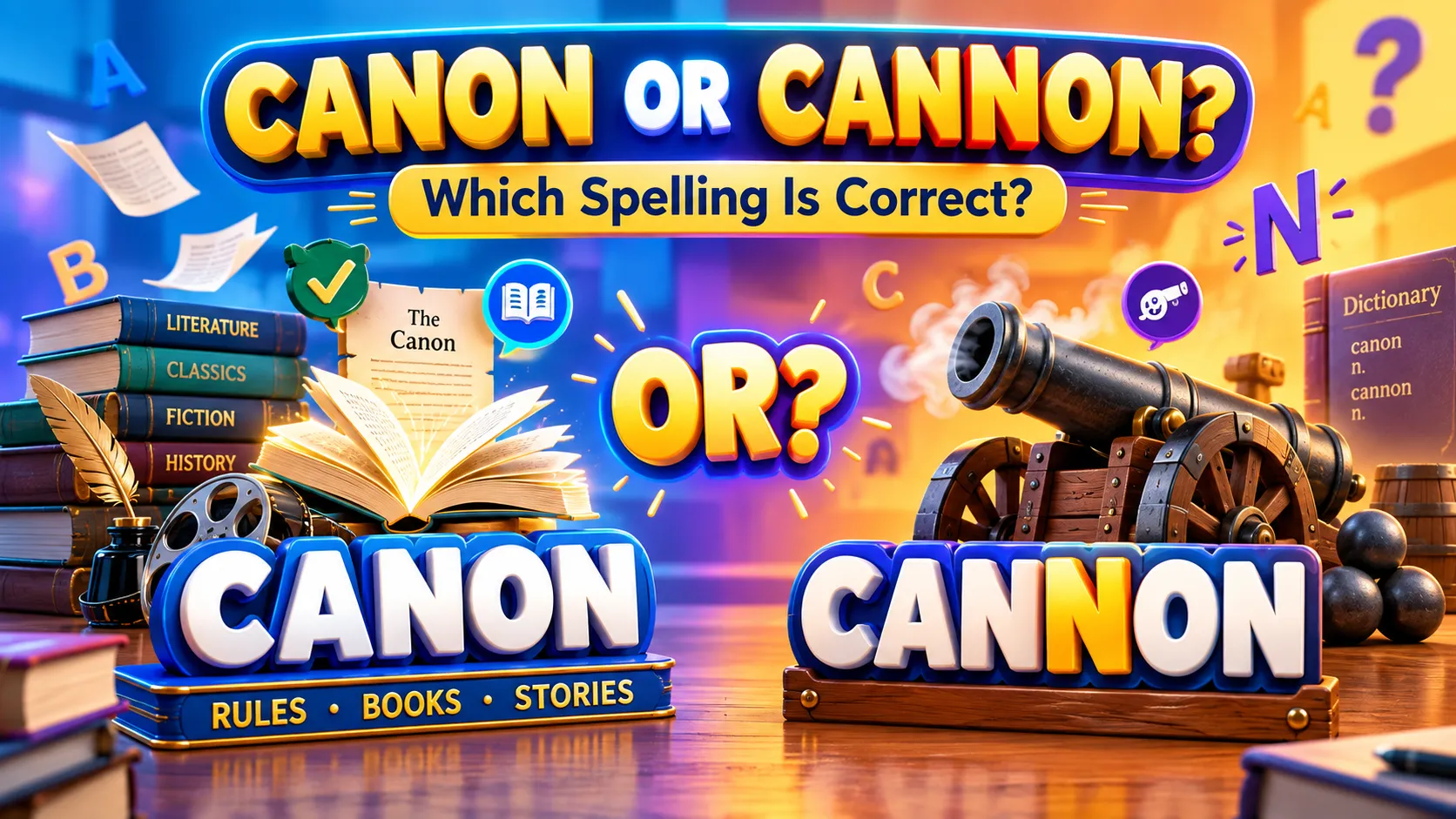
Canon or Cannon: Canon and cannon are both correct English words, but they have different meanings. Canon usually refers to an accepted rule, standard, principle, or recognized body of works. Cannon refers primarily to a large gun or artillery weapon.
They are pronounced the same in standard English, so they are homophones. This is why the two words are easy to confuse in writing.
Quick answer
- Canon = an accepted rule, standard, or recognized body of works.
- Cannon = a large gun or artillery weapon.
Examples:
The novel is part of the literary canon.
The museum displays an old cannon.
The simplest memory trick is:
CANON = content, rules, and accepted works
CANNON = combat and weapons
Canon vs. Cannon: Quick Difference
| Word | Main meaning | Common contexts | Example |
| Canon | Rule, standard, or recognized body of works | Literature, religion, music, film, television, games | The character is part of the official canon. |
| Cannon | Large gun or artillery weapon | Warfare, military history, ships, aircraft | The fort contains an old cannon. |
Oxford defines canon as an accepted rule or standard, a recognized list of important or genuine works, a musical form, and a cathedral priest.
Oxford defines cannon as an old type of large, heavy gun and also uses the word for guns mounted on aircraft or tanks.
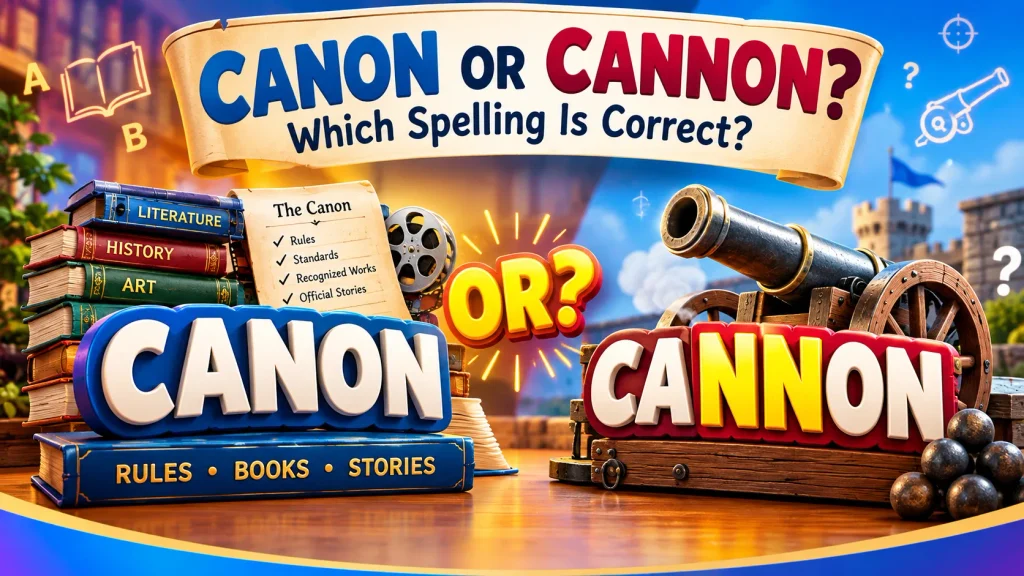
What Does Canon Mean?
Canon is primarily a noun with several related meanings. Its exact meaning depends on the context.
It can refer to:
- an accepted rule or principle
- a body of religious writings
- a recognized collection of literary works
- officially accepted material in a fictional universe
- a musical composition
- a Christian priest with special cathedral duties
Cambridge lists meanings involving religious rules or principles, important works, music, and a Christian priest.
Canon as a Rule or Principle
In formal English, canon can mean a generally accepted rule, standard, or principle.
For example:
Honesty is an important canon of professional conduct.
Here, canon means an accepted guiding principle.
Oxford gives examples such as the canons of good taste and principles of professional or medical ethics.
Canon in Religion
Canon has an important religious meaning.
It can refer to an established rule or body of authoritative religious writings.
For example:
Scholars have studied the development of the biblical canon.
Another common expression is canon law, meaning the law of the Christian Church.
Canon in Literature
In literature, a canon is a collection of works generally regarded as important, influential, or worthy of study.
For example:
Shakespeare’s plays are an important part of the English literary canon.
You may also see expressions such as:
- literary canon
- English canon
- American literary canon
- Shakespeare canon
- classical canon
Oxford specifically defines canon as a list of books or other works accepted as genuine works of a writer or as important works.
Canon in Movies and TV Shows
In modern entertainment, canon commonly means material that is officially accepted as part of a fictional universe or storyline.
For example:
The director confirmed that the character’s backstory is canon.
This means the backstory belongs to the officially established story.
You may see:
- movie canon
- TV canon
- official canon
- canon storyline
- canon character
- canon event
- canon relationship
- non-canon
This modern usage is particularly common in discussions of fictional universes and fan communities.
What Does Non-Canon Mean?
Non-canon means something is not considered officially part of an established fictional continuity.
For example:
The alternate ending is interesting, but it is non-canon.
The distinction is:
Canon → officially accepted as part of the story.
Non-canon → not officially part of the established story.
Canon in Books and Fiction
The word canon can be used in two closely related ways in books.
It can mean a recognized body of important literature:
The novel became part of the literary canon.
It can also refer to official continuity within a fictional series:
The author confirmed that the character is canon.
The first concerns recognized literature; the second concerns official fictional continuity.
Canon in Video Games
Video-game communities frequently use canon to distinguish official story material from fan theories, alternate versions, or material that is not part of the established storyline.
For example:
The developers confirmed that the character is canon.
Another example:
That ending is not considered canon.
Canon in Music
In music, a canon is a composition in which one voice or instrument repeats or imitates a melody introduced by another.
For example:
The students performed a simple musical canon.
Oxford lists this as one of the established meanings of canon.
Canon as a Clergy Title
In mainly British usage, canon can refer to a Christian priest with special duties in a cathedral.
For example:
The cathedral canon addressed the congregation.
Cambridge and Oxford both record this meaning.
What Does Cannon Mean?
Cannon is primarily a noun referring to a large, powerful gun or artillery weapon.
For example:
The soldiers positioned the cannon near the fort.
Cambridge defines cannon as a large, powerful gun and also records its use for a gun mounted on an aircraft.
Cannon in Military History
Historically, cannons were large weapons used to fire heavy projectiles.
For example:
The museum preserves a cannon from the eighteenth century.
Oxford describes a traditional cannon as a large, heavy gun, usually on wheels, that fired solid metal or stone balls.
Cannon on Ships
Cannons have historically been mounted on ships.
For example:
The warship carried several cannons.
You may also encounter the expression:
cannon fire
Cannon on Aircraft and Tanks
The word is not limited to historical wheeled artillery.
Modern dictionaries also use cannon for guns mounted on aircraft, and Oxford includes aircraft or tank guns in its definition.
For example:
The aircraft was equipped with a cannon.
Cannon as a Verb
Cannon can also function as a verb.
As a verb, it can mean to hit or collide with something forcefully, or, in British usage, to bounce off something at an angle.
For example:
The ball cannoned off the post.
The car cannoned into the barrier.
Cambridge records these verb uses, while Oxford gives cannon as an intransitive verb meaning to hit someone or something with considerable force while moving.
Canon vs. Cannon: The Key Spelling Difference
The visual difference is just one extra n:
Canon
C-A-N-O-N
Cannon
C-A-N-N-O-N
That extra n changes the meaning completely.
Canon = accepted rules, standards, or works
Cannon = a large gun or weapon
Compare:
The character is part of the official canon.
The fort contains an old cannon.
Are Canon and Cannon Homophones?
Yes. Canon and cannon are homophones because they have the same pronunciation but different spellings and meanings.
Cambridge gives both words the pronunciation /ˈkæn.ən/.
This explains why the confusion usually occurs when writing.
When someone says:
“That isn’t canon.”
The sound alone cannot tell you whether the speaker means canon or cannon. You need the context.
How to Pronounce Canon and Cannon
Canon
Pronunciation: KAN-uhn
IPA: /ˈkæn.ən/
Cannon
Pronunciation: KAN-uhn
IPA: /ˈkæn.ən/
Both words have the same basic pronunciation in standard English.
Canon vs. Cannon in Different Contexts
The context usually makes the correct spelling clear.
| Context | Correct Word |
| Accepted rule | canon |
| Standard or principle | canon |
| Religious texts | canon |
| Canon law | canon |
| Literary works | canon |
| Important artistic works | canon |
| Official movie storyline | canon |
| TV continuity | canon |
| Video-game storyline | canon |
| Fictional character officially recognized | canon |
| Musical composition | canon |
| Large gun | cannon |
| Artillery | cannon |
| Historical weapon | cannon |
| Naval gun | cannon |
| Aircraft gun | cannon |
| Tank gun | cannon |
| Cannonball | cannon |
| Cannon fire | cannon |
The fastest decision rule
Ask yourself:
Am I talking about rules, accepted works, or official story material?
→ Use canon.
Am I talking about a gun or artillery weapon?
→ Use cannon.
Canon in Movies, TV Shows, Books, and Games
The entertainment meaning of canon is especially important because it appears frequently in online discussions.
What Does Canon Mean in Movies?
A movie event is canon when it is officially part of the accepted fictional continuity.
The director confirmed that the scene is canon.
What Does Canon Mean in TV Shows?
A television event, character, relationship, or fact may be called canon if it is officially established within the show’s story.
The new episode made their relationship canon.
What Does Canon Mean in Books?
In literary studies, the canon is a recognized collection of important works.
The novel is widely discussed as part of the literary canon.
Within a fictional series, however, canon can simply mean officially established story material.
What Does Canon Mean in Video Games?
In gaming, canon usually identifies official story information.
The developers confirmed that the character is canon.
What Is a Canon Event?
A canon event is an event considered officially established within a fictional storyline.
For example:
The character’s disappearance is a canon event.
The phrase is especially common in online fandom discussions.
What Is a Headcanon?
A headcanon is a fan’s personal interpretation or belief about a fictional universe.
For example:
My headcanon is that the character learned the skill from her grandfather.
A headcanon may be meaningful to a fan without being officially established in the source material.
Canon vs. Cannon Examples in Sentences
Examples With Canon
- The novel is part of the literary canon.
- The director confirmed that the scene is canon.
- The character is officially canon in the new series.
- Scholars continue to study the biblical canon.
- Shakespeare is central to the English literary canon.
- The church developed a formal canon of religious law.
- The composer wrote the piece as a musical canon.
- The author confirmed that the event is canon.
- The new comic is not part of the official canon.
- The university course examines works from the literary canon.
Examples With Cannon
- The soldiers positioned the cannon near the fort.
- The museum displays an old cannon.
- The ship carried several cannons.
- The crew loaded the cannon before the battle.
- The aircraft was equipped with a cannon.
- The museum contains an iron cannonball.
- The fort once used a large cannon for defense.
- The ship fired its cannon.
- The museum restored the damaged cannon.
- The artillery crew prepared the cannon.
Common Mistakes With Canon and Cannon
Because the words sound alike, writers sometimes choose the wrong spelling.
Mistake 1: Using Cannon for Fiction
Incorrect:
The new episode isn’t cannon.
Correct:
The new episode isn’t canon.
The sentence concerns official fictional continuity, not a weapon.
Mistake 2: Using Canon for a Weapon
Incorrect:
The museum displayed an old canon.
Correct:
The museum displayed an old cannon.
The sentence refers to a gun.
Mistake 3: Literary Cannon
Incorrect:
Shakespeare belongs to the literary cannon.
Correct:
Shakespeare belongs to the literary canon.
The established expression is literary canon.
Mistake 4: Canonball
Incorrect:
The ship fired a canonball.
Correct:
The ship fired a cannonball.
Because the word comes from cannon, the compound is spelled cannonball.
Mistake 5: Canon Fire
Incorrect:
The soldiers heard canon fire.
Correct:
The soldiers heard cannon fire.
The weapon is a cannon.
Explore More: https://wordminto.com/g-r-a-t-e-or-g-r-e-a-t/
Canon vs. Cannon Memory Tricks
Trick 1: Canon = Content
Think:
CANON → CONTENT
If you’re discussing stories, books, rules, or accepted works, think canon.
Trick 2: Cannon = Combat
Think:
CANNON → COMBAT
If you’re discussing weapons, artillery, or warfare, think cannon.
Trick 3: The Bigger Word = Bigger Weapon
CANNON has an extra n and is the longer word.
You can associate the longer spelling with the large weapon.
CANON → one N → accepted works and rules
CANNON → two Ns → large weapon
This is a useful memory aid, but context is the most reliable way to choose the word.
The Origin of Canon
The word canon has a long history connected with the idea of a rule or standard.
Oxford traces senses relating to rules, standards, works, and music through Latin from Greek kanōn, meaning “rule.”
That basic historical idea helps explain the word’s modern range of meanings.
A canon can therefore refer to:
- a rule
- a standard
- a recognized body of works
- authoritative religious writings
- an established musical form
- officially accepted fictional material
The meanings developed in different contexts, but the underlying idea of an accepted standard or established body remains useful for understanding the word.
The Origin of Cannon
Cannon developed through a completely different historical path.
Oxford traces it through French canon and Italian cannone, meaning “large tube,” related to canna, meaning “cane” or “reed,” with further roots through Latin and Greek.
This history is associated with the tubular form of the weapon.
So although canon and cannon now sound alike, their histories and meanings developed differently.
Is Canon a Noun or an Adjective?
Canon is primarily a noun.
Examples:
The novel is part of the literary canon.
The church established a new canon.
The character is part of the official canon.
The related adjective is canonical.
Canonical
Canonical means relating to a canon or accepted as authoritative, established, or belonging to a recognized group of works.
For example:
The author is considered a canonical figure in English literature.
The event is canonical within the fictional universe.
Oxford lists canonical in religious, literary, general, and specialized contexts.
Other related forms include:
- canonically
- canonize/canonise
- canonization/canonisation
Is Cannon a Noun or a Verb?
Cannon is most commonly a noun:
The soldiers fired the cannon.
But cannon can also be a verb.
For example:
The ball cannoned off the post.
The car cannoned into the barrier.
Cambridge and Oxford both document these verb uses.
What Is the Plural of Canon?
The plural of canon is:
canons
For example:
The ethical canons of the profession were widely discussed.
Do not confuse canons with cannons.
- canons = plural of canon
- cannons = plural of cannon
What Is the Plural of Cannon?
The plural of cannon can be:
- cannon
- cannons
Oxford explicitly lists both plural forms, and Cambridge does the same.
For example:
Three cannon opened fire.
or:
Three cannons opened fire.
In everyday modern writing, cannons is often the more familiar form.
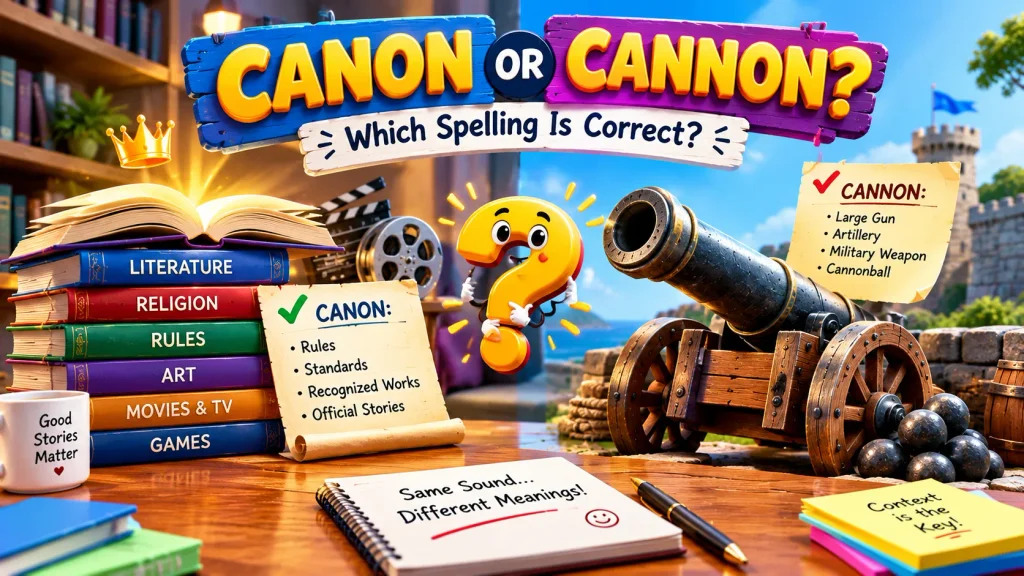
Canon vs. Cannon: Grammar Comparison
| Feature | Canon | Cannon |
| Main part of speech | Noun | Noun; also verb |
| Pronunciation | /ˈkæn.ən/ | /ˈkæn.ən/ |
| Spelling | One n in the middle | Two n’s in the middle |
| Main meaning | Rule, standard, or accepted works | Large gun |
| Literature | Yes | No |
| Religion | Yes | No |
| Fiction | Yes | No |
| Music | Yes | No |
| Warfare | No | Yes |
| Artillery | No | Yes |
| Aircraft gun | No | Yes |
| Verb use | Not in this basic sense | Yes |
Canon vs. Cannon in Academic English
The distinction matters in essays, assignments, research, and formal writing.
Consider:
The novel is part of the literary canon.
This is correct because the sentence discusses recognized literature.
But:
The museum houses a nineteenth-century cannon.
This is correct because the sentence discusses a weapon.
A spelling error can therefore change the meaning of an otherwise correct sentence.
Academic writing tip
If you are discussing literature, religion, art, or established works, check whether canon is the intended word.
If you are describing artillery or a large gun, use cannon.
Canon vs. Cannon in Professional Writing
Professional writing also requires the distinction.
Correct
The report discusses the established canon of ethical principles.
Correct
The historical museum acquired an antique cannon.
The words may sound identical when spoken, but they should never be treated as interchangeable in writing.
Canon or Cannon: Which One Should You Use?
Use canon when you mean:
- an accepted rule
- a standard
- a principle
- religious writings
- canon law
- literary works
- recognized artistic works
- official fictional continuity
- an established movie storyline
- an official TV storyline
- an official video-game storyline
- a musical canon
Use cannon when you mean:
- a large gun
- artillery
- a historical weapon
- a naval gun
- an aircraft gun
- a tank gun
- cannon fire
- a cannonball
One-question test
Ask:
Is this about accepted information or a weapon?
Accepted information, rules, or works → CANON
Weapon or artillery → CANNON
Quick Revision Box
CANON
One n in the middle.
Means a rule, standard, recognized body of works, or official fictional material.
Example: The character is part of the official canon.
CANNON
Two n’s in the middle.
Means a large gun or artillery weapon.
Example: The soldiers fired the cannon.
Practice Exercise: Canon or Cannon?
Choose canon or cannon.
- The character is part of the official ______.
- The museum displays an old ______.
- Shakespeare is part of the English literary ______.
- The ship fired its ______.
- The director confirmed that the scene is ______.
- The soldiers loaded the ______.
- The book became part of the literary ______.
- The aircraft carried a ______.
- The alternate ending is considered non-______.
- The museum preserved a nineteenth-century ______.
Answers
- canon
- cannon
- canon
- cannon
- canon
- cannon
- canon
- cannon
- canon
- cannon
Multiple-Choice Questions
1. Which sentence is correct?
A. The character is part of the official cannon.
B. The character is part of the official canon.
Answer: B
The sentence refers to official fictional continuity, so canon is correct.
2. Which sentence is correct?
A. The museum contains an old canon.
B. The museum contains an old cannon.
Answer: B
The sentence refers to a weapon, so cannon is correct.
3. Which phrase is correct?
A. literary cannon
B. literary canon
Answer: B
The standard phrase is literary canon.
4. Which word refers to a large gun?
A. canon
B. cannon
Answer: B
A large gun is a cannon.
5. Which word is used for official fictional continuity?
A. canon
B. cannon
Answer: A
The correct word is canon.
People Also Ask
Both are correct, but they have different meanings. Canon refers to rules, standards, recognized works, or official fictional material. Cannon refers primarily to a large gun or artillery weapon.
Canon has one n in the middle and relates to accepted rules, standards, or works. Cannon has two n’s and refers primarily to a large gun.
Yes. They are generally pronounced /ˈkæn.ən/, so they are homophones.
It is canon when you mean that a movie, character, event, or detail is officially part of a fictional universe.
The correct expression is literary canon.
No. Cannon is the word for a weapon.
Final Answer: Canon or Cannon?
Canon and cannon are both correctly spelled words, but they are not interchangeable.
Canon means an accepted rule, standard, recognized body of works, religious collection, musical form, or officially established fictional material.
Cannon means a large gun or artillery weapon and can also function as a verb in certain contexts.
Remember this simple distinction:
CANON = rules, literature, religion, music, and official stories
CANNON = guns, artillery, and weapons
So write:
The character is part of the official canon.
But write:
The museum contains an old cannon.
Although canon and cannon sound the same, their meanings are completely different. When you focus on the context—and remember the extra n in cannon—choosing the correct spelling becomes much easier.










1 thought on “Canon or Cannon: Which Spelling Is Correct? Meaning, Difference & Examples”