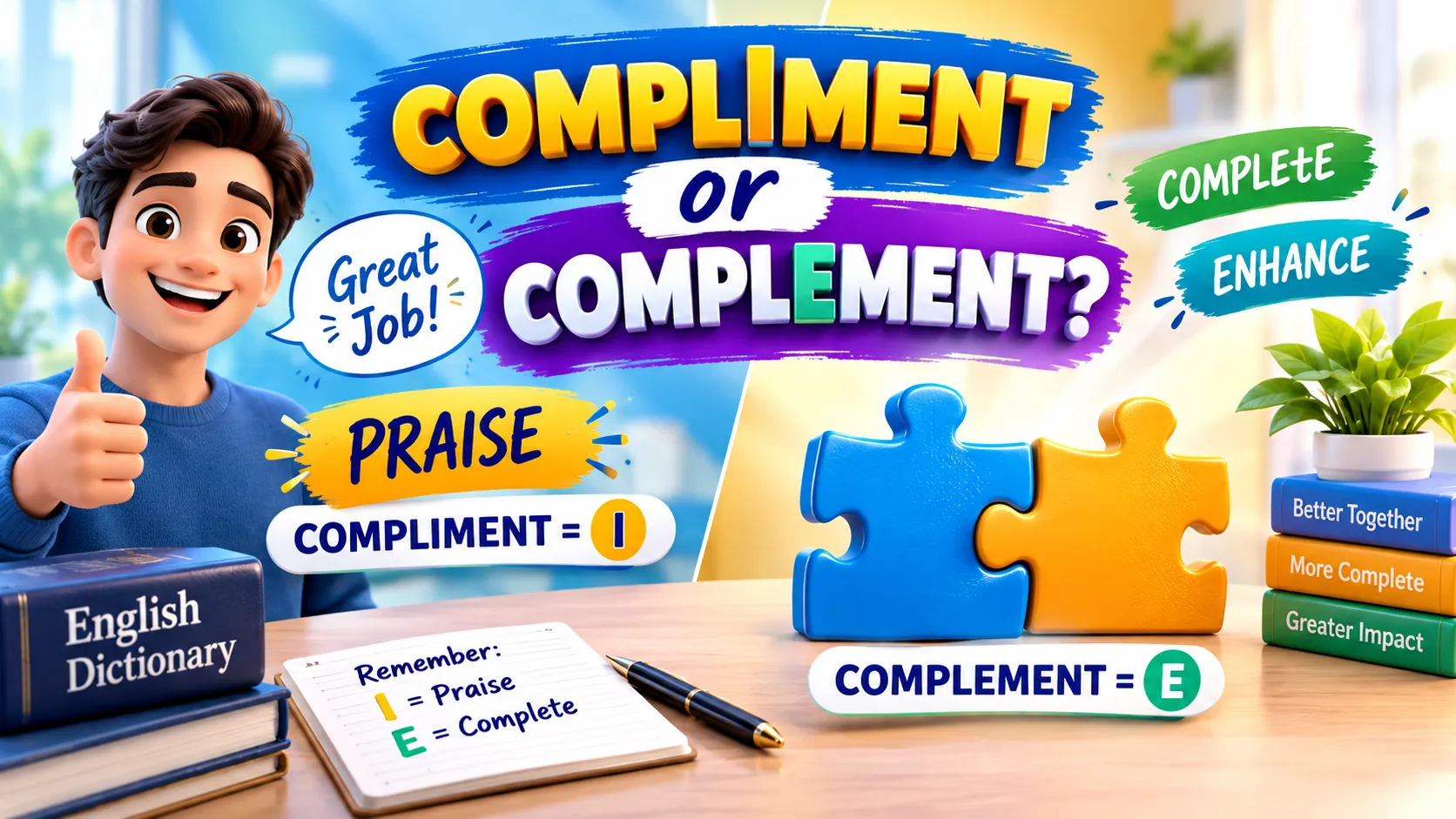
Compliment or Complement: Compliment and complement are two of the most commonly confused words in English. They look nearly identical, sound the same in many varieties of English, and can both appear in positive contexts. Yet their meanings are different.
The simplest rule is:
Compliment = praise or admiration
Complement = complete, enhance, or go well with something
For example:
- She complimented me on my presentation. → She praised me.
- The illustrations complement the article. → The illustrations enhance the article.
The related words complimentary and complementary create another layer of confusion. One can mean free or praising, while the other describes things that work well together. The pair also appears in expressions such as “compliments of” and “full complement,” while complement has a specific meaning in English grammar.
So, which spelling should you use? The answer depends entirely on what you mean.
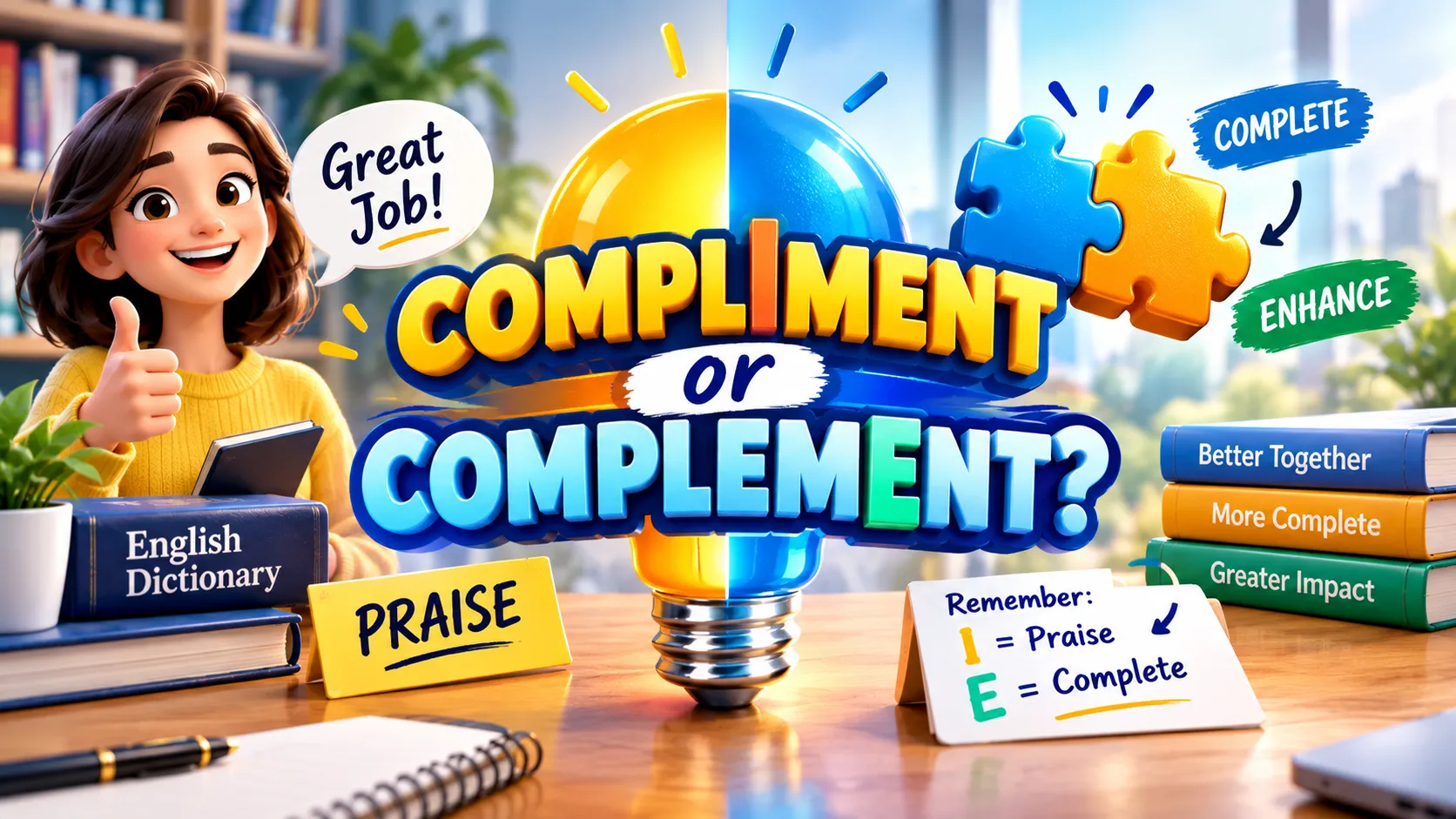
Compliment or Complement: Which One Is Correct?
Both compliment and complement are correct English words. Neither spelling is universally correct; you choose one according to the meaning of the sentence.
| Word | Main meaning | Example |
| Compliment | Praise or admiration | She gave me a compliment. |
| Complement | Something that completes or enhances | The sauce is a perfect complement to the dish. |
Use compliment when someone expresses praise, approval, admiration, or respect.
Use complement when one thing completes, enhances, balances, or works well with another.
Compare these two sentences
He complimented her on her new hairstyle.
He praised her hairstyle.
Her new hairstyle complements her face.
The hairstyle enhances or suits her face.
The meaning—not the sound—determines the spelling.
What Does “Compliment” Mean?
Compliment is a noun and a verb associated with praise, approval, admiration, or respect.
Compliment as a noun
A compliment is a positive remark or expression of praise.
Examples:
- She gave me a lovely compliment.
- His teacher paid him a compliment on his essay.
- I received several compliments about my presentation.
- That was one of the nicest compliments I have ever received.
- She took the comment as a compliment.
A common expression is:
pay someone a compliment
For example:
I paid my colleague a compliment on her excellent presentation.
Here, compliment refers to praise.
Compliment as a verb
As a verb, to compliment means to praise someone or something.
Examples:
- I complimented her on her new dress.
- The manager complimented the team on its performance.
- He complimented me on my pronunciation.
- She complimented the chef on the meal.
- They complimented him on his excellent work.
A useful sentence pattern is:
compliment + someone + on + something
Example:
She complimented David on his presentation.
The important point is that compliment involves praise.
What Does “Complement” Mean?
Complement is also both a noun and a verb. Its central idea is completion, enhancement, balance, or a good combination.
Complement as a noun
As a noun, a complement can be something that completes or enhances another thing.
Examples:
- The sauce was a perfect complement to the meal.
- The painting is a beautiful complement to the room.
- Her shoes were the perfect complement to her outfit.
- Fresh herbs make an excellent complement to the dish.
In these examples, complement does not mean praise. It refers to something that adds to another thing in a way that makes the combination more effective or pleasing.
Complement can also mean a complete number
Complement has another important meaning: the full number or quantity required or available.
For example:
The hospital now has a full complement of nurses.
This means the hospital has the complete or required number of nurses.
Similarly:
The school has a full complement of teachers.
Here, complement refers to the complete staffing level.
Complement as a verb
As a verb, to complement means to enhance, complete, balance, or work well with something else.
Examples:
- The blue shirt complements his gray trousers.
- The new furniture complements the room.
- These flavors complement each other.
- Her technical skills complement his creative abilities.
- The photographs complement the article.
A particularly useful expression is:
complement each other
For example:
Their different skills complement each other.
This means their different abilities combine effectively.
Compliment vs. Complement: Key Differences
| Feature | Compliment | Complement |
| Core meaning | Praise | Complete or enhance |
| Main association | Admiration | Combination or completion |
| Noun | An expression of praise | Something that completes or enhances |
| Verb | To praise | To enhance or complete |
| Example | She gave me a compliment. | The sauce complements the meal. |
| Memory letter | I | E |
| Common phrase | Pay a compliment | Complement each other |
The simplest rule
Compliment = praise.
Complement = complete or enhance.
If someone says something nice about you, they compliment you.
If two things work particularly well together, they complement each other.
Compliment vs. Complement in Common Situations
The easiest way to understand the distinction is to see how the words behave in real-life situations.
1. People
She complimented me on my new haircut.
2. Clothing
The shoes complement the dress.
The shoes look good with the dress.
But:
She complimented me on my dress.
Here, she praised the dress or the way you looked.
3. Food
Compare:
The waiter complimented the chef on the excellent meal.
The waiter praised the chef.
And:
The herbs complement the soup.
The herbs enhance the flavor of the soup.
4. Colors
The blue and gold colors complement each other beautifully.
The colors work well together.
5. Workplace skills
Her organizational skills complement his creativity.
Their different abilities work effectively together.
6. Writing
The photographs complement the article.
The photographs enhance the article.
7. Presentations
The manager complimented the team on its presentation.
The manager praised the team.
But:
The charts complement the presentation.
The charts enhance the presentation.
Compliment vs. Complement: A Quick Comparison
Think about these pairs:
| If you mean… | Use… | Example |
| Praise | compliment | She complimented my work. |
| Admiration | compliment | He gave me a compliment. |
| Enhance | complement | The colors complement each other. |
| Complete | complement | The final piece complements the design. |
| Match well | complement | Her shoes complement her outfit. |
| Work effectively together | complement | Their skills complement each other. |
A useful question is:
Is somebody praising something, or are two things working well together?
- Praise → compliment
- Working together → complement
Complimentary vs. Complementary
The adjective forms are another major source of confusion.
What Does “Complimentary” Mean?
Complimentary is related to compliment.
It has two especially common meanings:
- Expressing praise or approval
- Provided free as a courtesy
For example:
She was very complimentary about my work.
Here, complimentary means praising.
But:
The hotel offers complimentary breakfast.
Here, complimentary means free.
This second meaning is especially important because complimentary does not always mean “praising.”
What Does “Complementary” Mean?
Complementary is related to complement.
It describes things that combine well, complete one another, or enhance one another.
Examples:
The two colors are complementary.
Their skills are complementary.
The flavors have complementary qualities.
Complimentary vs. Complementary Table
| Word | Meaning | Example |
| Complimentary | Praising | The review was complimentary. |
| Complimentary | Free | The hotel provides complimentary breakfast. |
| Complementary | Working well together | Their skills are complementary. |
| Complementary | Completing or enhancing | The colors are complementary. |
Easy memory rule
Complimentary → praise or free
Complementary → completing, matching, or enhancing
She made a complimentary remark about my work.
She praised the work.
The two skills are complementary.
The skills work well together.
What Does “Compliments Of” Mean?
You may have seen the expression:
Compliments of the restaurant
Here, compliments of is a conventional expression meaning that something is provided by someone, often free of charge or as a courtesy.
For example:
The drinks were compliments of the restaurant.
This means the restaurant provided the drinks.
Another example:
A gift, compliments of the company.
The company provided the gift.
Do not confuse this expression with complementary. The expression compliments of uses the spelling associated with compliment.
What Does “Full Complement” Mean?
The expression full complement has nothing to do with praise.
A full complement means the complete number or quantity required or available.
For example:
The ship left the harbor with its full complement of crew.
The phrase refers to the complete number of crew members.
Another example:
The school now has a full complement of teachers.
The school has the complete number of teachers it requires.
This meaning is easy to miss if you learn only the basic rule “compliment = praise, complement = enhance.”
What Is a Complement in English Grammar?
Complement is also an established grammatical term.
In English grammar, a complement is a word or phrase that completes or adds important information about another part of a sentence.
For example:
Sarah is a doctor.
A doctor is a subject complement because it identifies or describes the subject, Sarah.
Another example is:
They elected Maria president.
President functions as an object complement because it provides information about the object, Maria.
The grammatical meaning is completely separate from the everyday meaning of “something that matches.”
Subject complement
A subject complement follows a linking verb and describes or identifies the subject.
Examples:
James is a teacher.
The soup smells delicious.
Her idea became a success.
Object complement
An object complement provides information about or describes the direct object.
Example:
They painted the door red.
The committee elected Sarah chairperson.
So, complement is not limited to colors, food, clothing, and design. It is also an important grammatical concept.
Explore More: https://wordminto.com/couch-or-coach/
Why Are Compliment and Complement Confused?
There are several reasons these words cause problems.
1. They look almost identical
The main spelling difference is one vowel:
- compliment
- complement
That small difference is easy to overlook when writing quickly.
2. They sound the same in wide varieties of English
In many varieties of English, compliment and complement are pronounced alike.
That makes the distinction particularly difficult in listening and conversation because the spelling cannot be heard.
3. Both words can be nouns and verbs
Compare:
She gave me a compliment.
She complimented me.
And:
The sauce is a complement to the meal.
The sauce complements the meal.
Their similar grammatical flexibility adds to the confusion.
4. Both can occur in positive contexts
A compliment is positive because it expresses praise.
A complement can also be positive because something can enhance another thing.
For example:
He gave me a compliment.
versus:
His skills complement mine.
Both sentences describe something positive, but the underlying meanings are different.
Common Compliment vs. Complement Mistakes
Mistake 1: “Your shoes compliment your outfit.”
If you mean the shoes look good with the outfit, use:
Your shoes complement your outfit.
The shoes are not praising the outfit. They enhance or work well with it.
Mistake 2: “She complemented me on my work.”
If you mean she praised you, use:
She complimented me on my work.
Mistake 3: “He gave me a complement.”
If you mean he said something nice about you, use:
He gave me a compliment.
Mistake 4: “The colors compliment each other.”
If you mean the colors work well together, use:
The colors complement each other.
Mistake 5: Confusing complimentary and complementary
Incorrect for “free breakfast”:
The hotel provides complementary breakfast.
Correct:
The hotel provides complimentary breakfast.
Incorrect for “skills that work well together”:
Their skills are complimentary.
Correct:
Their skills are complementary.
Easy Memory Tricks for Compliment and Complement
Memory Trick 1: Compliment has “I”
Look at the spelling:
complIment
Think:
I like you → compliment
The I can remind you of a personal expression of praise.
Memory Trick 2: Complement contains “complete”
Look at:
complement
and:
complete
They share the comple- pattern.
So remember:
Complement → complete
If something completes or enhances something else, choose complement.
Memory Trick 3: Praise has “I”
Another quick association is:
Compliment = praise = I
Complement = complete = E
The one-line memory rule
I compliment people; things complement each other.
This is only a memory aid, not an absolute grammar rule. Objects, work, performances, and other things can also receive compliments.

Compliment or Complement: How to Decide Quickly
When you are unsure, use this four-step test.
Step 1: Is someone praising someone or something?
Use compliment.
She complimented my presentation.
Step 2: Is one thing enhancing, completing, balancing, or matching another?
Use complement.
The presentation slides complement the speaker’s explanation.
Step 3: Does the adjective mean “free”?
Use complimentary.
The hotel provides complimentary Wi-Fi.
Step 4: Does it mean two things work well together?
Use complementary.
The two approaches are complementary.
Quick decision chart
Praise? → Compliment
Complete or enhance? → Complement
Free? → Complimentary
Work well together? → Complementary
Compliment vs. Complement vs. Supplement
Complement and supplement are sometimes confused because both can involve adding something to something else. Their meanings are not identical.
Complement
A complement completes, enhances, balances, or works well with something.
The herbs complement the soup.
The herbs improve the overall combination.
Supplement
A supplement is something added to provide additional material, information, support, or content.
The teacher provided a supplementary worksheet.
The worksheet adds additional material.
Three-word distinction
Compliment = praise
Complement = complete or enhance
Supplement = add something extra
For example:
She complimented the author.
She praised the author.
The illustrations complement the book.
They enhance the book.
The appendix supplements the book.
It provides additional information.
Compliment and Complement Synonyms
Synonyms for Compliment
Depending on context, related words include:
- praise
- admiration
- approval
- commendation
- flattery
- tribute
- accolade
- commend
Example:
She complimented his work.
Similar meaning:
She praised his work.
However, these words are not interchangeable in every grammatical construction.
Synonyms for Complement
Depending on context, related words can include:
- complete
- enhance
- improve
- balance
- match
- accompany
- harmonize with
For example:
The colors complement each other.
Similar idea:
The colors harmonize with each other.
The exact replacement depends on the intended meaning and sentence structure.
Compliment vs. Complement Example Sentences
Compliment examples
- She complimented me on my new jacket.
- He gave his teacher a sincere compliment.
- I received a compliment about my presentation.
- The manager complimented the employees on their hard work.
- She complimented him on his cooking.
- Everyone complimented the artist on the painting.
- He took the comment as a compliment.
- She paid me a thoughtful compliment.
- The customer complimented the staff on their service.
- His kind words were a wonderful compliment.
Complement examples
- The blue curtains complement the walls.
- The sauce complements the fish perfectly.
- Her shoes complement her dress.
- Their skills complement each other.
- The photographs complement the article.
- The furniture complements the design of the room.
- These ingredients complement one another.
- His experience complements her technical knowledge.
- The lighting complements the atmosphere.
- The side dish is a perfect complement to the main course.
Business English Examples
Both words are useful in professional communication.
Compliment
The director complimented the team on its excellent performance.
Meaning: The director praised the team.
Several clients complimented us on our customer service.
Meaning: Several clients expressed approval.
Complement
Her analytical skills complement his leadership experience.
Meaning: Their different skills work effectively together.
The new software complements our existing workflow.
Meaning: The software works well with and enhances the existing workflow.
Complimentary
All conference attendees receive complimentary Wi-Fi.
Meaning: The Wi-Fi is provided free of charge.
Complementary
The two departments have complementary responsibilities.
Meaning: Their responsibilities work together to form a more complete system.
Quick Revision Box
| Word | Remember | Example |
| Compliment | Praise | She complimented my work. |
| Complement | Complete/enhance | The colors complement each other. |
| Complimentary | Praising or free | The hotel offers complimentary breakfast. |
| Complementary | Working well together | Their skills are complementary. |
The ultimate memory trick
Compliment = I praise.
ComplEment = complEte.
If you can remember those two letters, you can usually choose the correct word.
Practice Quiz: Compliment or Complement?
Test yourself before looking at the answers.
1. She gave me a nice ______ on my presentation.
A. complement
B. compliment
2. The blue curtains ______ the gray walls.
A. compliment
B. complement
3. He ______ her on her excellent work.
A. complimented
B. complemented
4. The restaurant offers ______ drinks to guests.
A. complimentary
B. complementary
5. The two colors are ______.
A. complimentary
B. complementary
6. The sauce is an excellent ______ to the dish.
A. compliment
B. complement
7. The school has a full ______ of teachers.
A. compliment
B. complement
8. Her manager ______ her on the quality of her report.
A. complimented
B. complemented
9. These two design elements ______ each other.
A. compliment
B. complement
10. The hotel provides ______ breakfast.
A. complimentary
B. complementary
Practice Quiz Answers
- B — compliment
A nice remark about a presentation is praise. - B — complement
The curtains enhance or work well with the walls. - A — complimented
He praised her work. - A — complimentary
Here, the drinks are provided free of charge. - B — complementary
The colors work well together. - B — complement
The sauce enhances the dish. - B — complement
A full complement means the complete required number. - A — complimented
The manager praised her report. - B — complement
The elements work well together. - A — complimentary
The breakfast is provided free of charge.
Academic English Examples
The distinction also matters in essays and formal writing.
Compliment
The professor complimented the student on the clarity of her argument.
Complement
The table complements the findings presented in the main text.
Complement as a grammar term
In this sentence, the noun phrase functions as a subject complement.
Using the correct spelling is especially important in academic writing because compliment and complement can produce completely different meanings.
People Also Ask
Both are correct words, but they have different meanings.
Compliment means praise or admiration.
Complement means something that completes, enhances, balances, or works well with something else.
Remember:
Compliment = praise
Complement = complete
The i in compliment can remind you of a personal expression of praise, while the e in complement connects with complete.
If you praise a person, you compliment them.
I complimented her on her excellent presentation.
If you mean that two people’s qualities work well together, they complement each other.
Their different skills complement each other.
Colors that work well together complement each other.
The blue and gold colors complement each other.
When clothing items look good together, they complement each other.
Her shoes complement her dress.
But if someone praises your clothing, they compliment you.
She complimented me on my dress.
One meaning of complimentary is free, especially when something is provided as a courtesy.
The hotel offers complimentary breakfast.
But complimentary can also mean expressing praise.
The review was highly complimentary.
Conclusion
The difference between compliment and complement becomes much easier once you focus on meaning rather than spelling alone.
If you are talking about praise, use compliment:
She complimented my outfit.
She praised it.
If you are talking about something that enhances, completes, or works well with something else, use complement:
The shoes complemented my outfit.
The shoes worked well with it.
For the adjective forms, remember:
Complimentary = praising or free.
Complementary = combining well or completing each other.
The most useful memory rule is simple:
Compliment = praise.
Complement = complete.
Once you connect the I in compliment with praise and the E in complement with complete, this commonly confused word pair becomes much easier to master.










1 thought on “Compliment or Complement: What’s the Difference?”