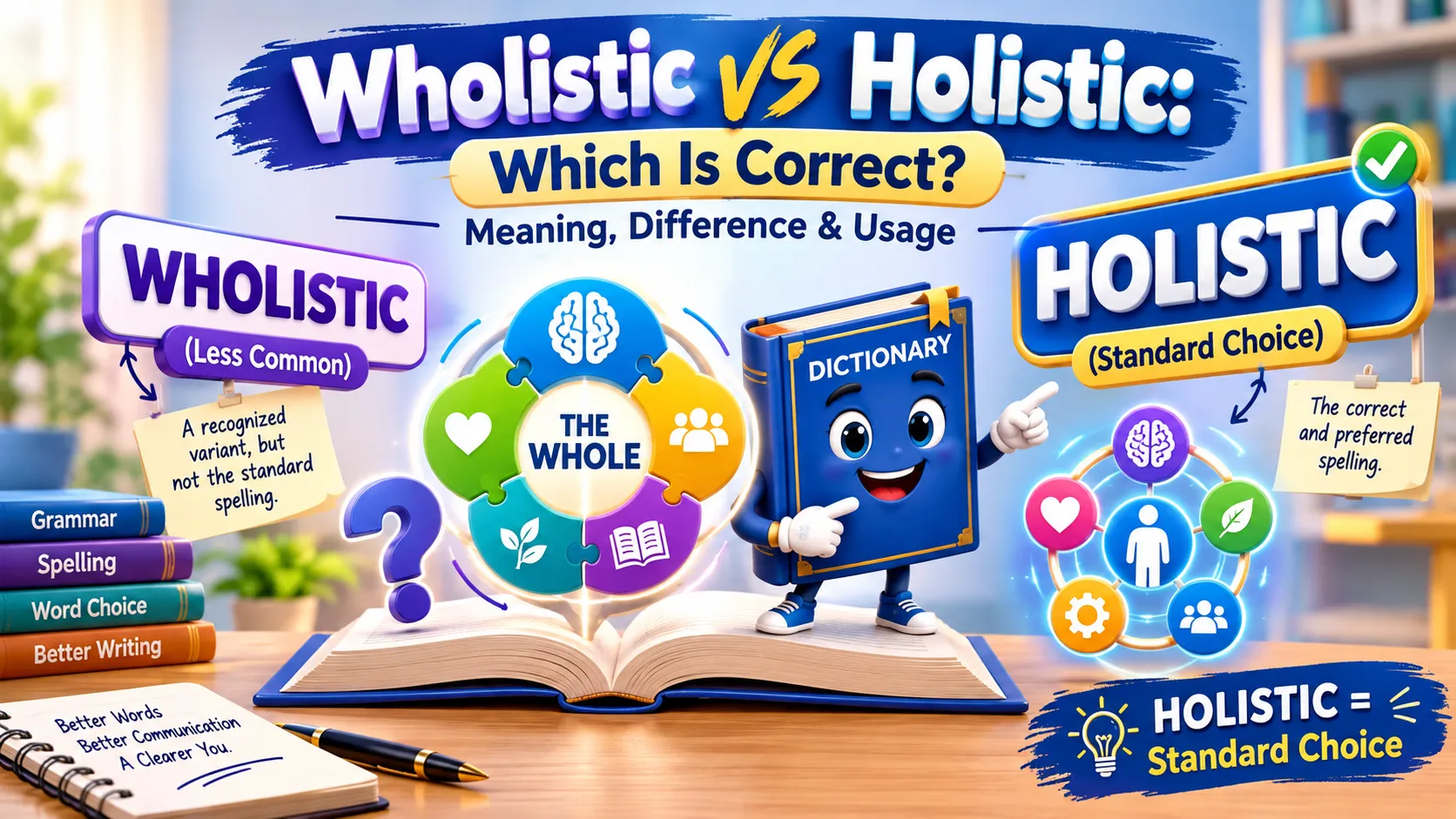
Wholistic vs Holistic is a common English spelling question because both words are closely Associated with the idea of considering something as a complete whole. If you are wondering whether wholistic or holistic is correct, the safest answer is holistic.
Holistic is the standard and overwhelmingly more common form in modern English. Wholistic, however, is not simply a nonexistent spelling: major dictionaries recognize it as a variant, and some organizations and communities deliberately use it for particular conceptual or cultural reasons.
Quick answer: Use holistic in normal academic, professional, business, educational, and general-purpose writing. Treat wholistic as a recognized but much less common variant, especially when it appears as part of an organization’s established terminology.
Wholistic vs Holistic: Quick Answer
| Feature | Holistic | Wholistic |
| Standard form | Yes | Variant |
| Meaning | Considering the whole rather than isolated parts | Generally the same |
| Frequency | Much more common | Much less common |
| Formal writing | Preferred | Usually avoid unless intentional |
| Academic writing | Preferred | Uncommon |
| Business writing | Preferred | Uncommon |
| Healthcare | Very common | Also encountered |
| Deliberate specialized use | Yes | Yes |
| Best default choice | Yes | No |
The key distinction is therefore not simply correct vs. incorrect. It is better understood as standard/preferred form vs. recognized variant.
The source research for this topic likewise identifies the main opportunity: many competing pages oversimplify the issue by treating wholistic as simply wrong, even though authoritative sources recognize it as a variant.
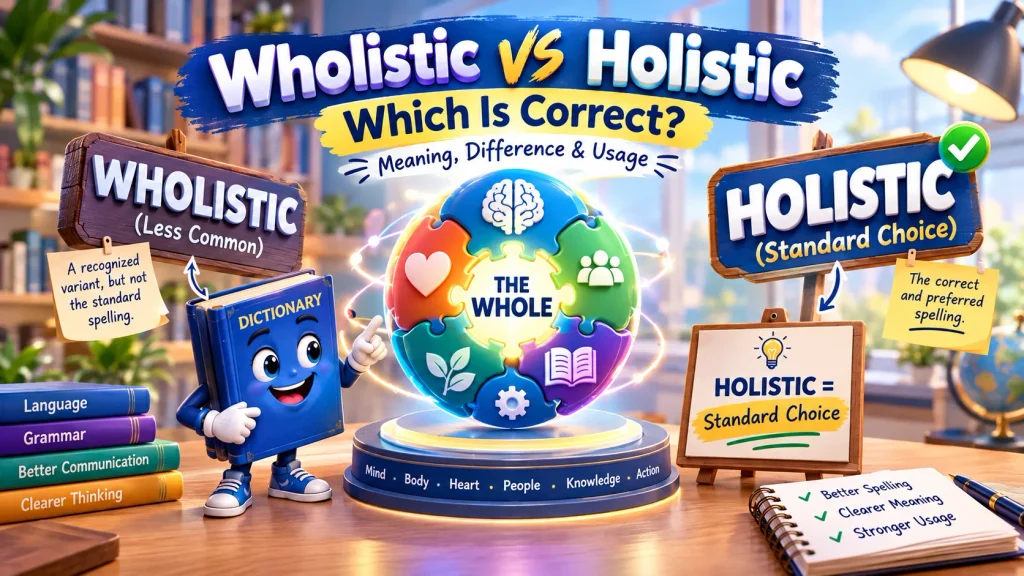
What Does Holistic Mean?
Holistic is an adjective meaning that something is considered or treated as a whole rather than only as separate or isolated parts.
Cambridge defines holistic in terms of dealing with or treating the whole of something or someone rather than only a part. Dictionary.com similarly connects the word with the idea of considering the whole.
Simple definition
Holistic = considering the entire person, system, problem, or situation rather than focusing on only one part.
For example:
- The doctor takes a holistic approach to patient care.
- The school promotes holistic development.
- We need a holistic solution to the environmental problem.
- The company needs a holistic strategy.
- Researchers took a holistic view of the problem.
The central idea is wholeness, integration, and interconnectedness.
Instead of asking only:
“What is happening to this individual part?”
A holistic approach asks:
“How does this part relate to the entire system?”
That is why holistic appears across healthcare, education, psychology, business, environmental studies, social sciences, wellness, and other fields.
What Does Wholistic Mean?
Wholistic generally communicates the same broad idea as holistic: considering something as a whole instead of focusing only on individual components.
Collins explicitly defines wholistic as a variant spelling of holistic, while Dictionary.com also lists it as a variant.
Examples include:
- The organization uses a wholistic approach to community development.
- The program promotes wholistic well-being.
- The framework takes a wholistic perspective.
- The institution describes its model as wholistic.
The important point is that wholistic is considerably less common than holistic.
Therefore, if you are choosing a spelling yourself and do not have a specific reason to use wholistic, holistic is the better choice.
Wholistic vs Holistic: What’s the Difference?
For most contexts, the two words express essentially the same basic concept.
The major differences are spelling, frequency, conventionality, and context.
| Aspect | Holistic | Wholistic |
| Meaning | Considering the whole | Generally considering the whole |
| Status | Standard form | Recognized variant |
| Frequency | Very common | Less common |
| General English | Preferred | Uncommon |
| Formal writing | Preferred | Usually not preferred |
| Academic writing | Preferred | Rare |
| Healthcare | Established | Sometimes used |
| Organizational terminology | Common | Sometimes deliberately selected |
So the most useful rule is:
Holistic is the normal English choice; wholistic is a recognized but uncommon alternative.
That is more precise than saying “wholistic is always wrong.”
Is Wholistic a Correct Word?
Yes, but with an important qualification.
Wholistic is recognized as a variant of holistic by dictionaries including Collins and Dictionary.com. The U.S. National Center for Complementary and Integrative Health also explicitly notes that holistic is sometimes spelled wholistic.
However, being recognized as a variant does not mean that it is equally common or equally advisable in every situation.
If you are writing:
- a school assignment,
- a university essay,
- an academic paper,
- a business report,
- a professional email,
- a website,
- an educational article,
- a formal document,
holistic is normally the better choice.
On the other hand, if wholistic appears in:
- an organization’s official terminology,
- a framework name,
- a quotation,
- a community-specific usage,
- a brand or program name,
you should not automatically change it.
Why Is Holistic Spelled Without a W?
This is the part that causes much of the confusion.
It seems logical to write wholistic because the meaning is closely related to the English word whole.
But holistic was not formed simply by taking the English word “whole” and adding a suffix.
The standard word is connected to holism, which is associated with the Greek word holos, meaning “whole.” The spelling therefore reflects the history of holism, rather than the modern English spelling of whole.
Think of the relationship this way:
holos → holism → holistic
rather than:
whole → wholistic
This explains why the standard spelling does not contain a w.
Easy way to remember it
Holistic comes from holism, not from the spelling of “whole.”
So if you are unsure, remember:
holism → holistic → holistically
Holistic vs Wholistic: Origin and Etymology
The concept of holism is strongly associated with South African philosopher and statesman Jan Christian Smuts, whose 1926 work Holism and Evolution developed the concept.
The terminology is connected with the Greek holos, meaning “whole.” The English word whole, however, has a separate historical development.
This distinction matters because modern spelling is not always predictable from modern meaning.
Although whole and holistic are closely related semantically, holistic is historically connected to holism.
Therefore:
holistic ≠ whole + istic
Instead, its word history is associated with:
holism → holistic
That is why the absence of w is not a spelling mistake.
Holistic vs Wholistic in Dictionaries
Dictionary evidence is particularly useful because many online grammar pages make overly absolute claims about wholistic.
Collins Dictionary
Collins explicitly identifies wholistic as a variant spelling of holistic.
Dictionary.com
Dictionary.com lists wholistic as a variant of holistic and provides wholistically as its adverbial form.
Cambridge Dictionary
Cambridge establishes holistic as the standard dictionary entry and defines it in terms of treating or considering the whole rather than only a part.
National Center for Complementary and Integrative Health
The U.S. NCCIH notes that holistic is sometimes spelled wholistic, particularly when discussing approaches that consider the whole person.
What the evidence tells us
Taken together, these sources support the following conclusion:
Holistic is the standard and preferred form, while wholistic exists as a recognized variant.
This is a stronger and more accurate conclusion than claiming that wholistic is never a legitimate English form.
When Should You Use Holistic?
Use Holistic whenever you want the standard form that readers are most likely to expect.
1. In general English
We need a Holistic understanding of the problem.
2. In academic writing
The researchers adopted a holistic approach to the study.
3. In business writing
The company needs a holistic strategy for improving customer experience.
4. In education
The school focuses on holistic student development.
5. In healthcare
The clinic takes a holistic approach to patient care.
6. In professional communication
We need a holistic assessment before making a final decision.
In virtually all ordinary writing situations, holistic is the safest choice.
When Might You See Wholistic?
There are legitimate situations where wholistic is used intentionally.
Some organizations use the spelling because they want to make the connection with the concept of the whole especially visible.
For example, an Australian Centre for International Agricultural Research methodology explicitly explains why it uses wholistic rather than holistic. Its framework uses the spelling to emphasize consideration of participants in their entirety, including factors such as land, climate, age, gender, family, finances, beliefs, and cultural circumstances.
This demonstrates an important principle:
A less common spelling can sometimes carry intentional conceptual meaning within a particular framework.
There are also documented uses of wholistic in Indigenous health and educational contexts. A Canadian resource, for example, discusses holistic and wholistic views of Indigenous ways of knowing and describes the interconnectedness of physical, emotional, spiritual, and intellectual dimensions with relationships, communities, and land.
Therefore, you should not automatically “correct” every instance of wholistic without checking its context.
Holistic vs Wholistic in Formal and Academic Writing
For conventional formal and academic English, holistic is the preferred form.
Compare:
The researchers adopted a holistic approach to the problem.
This is the natural standard form.
By contrast:
The researchers adopted a wholistic approach to the problem.
This may be understandable, but many readers and editors will find the spelling unusual.
Best rule for academic writing
Use holistic unless a source, institution, framework, or established terminology specifically uses wholistic.
If you are quoting or describing an organization’s terminology, preserve its spelling.
For example:
The organization describes its methodology as “wholistic.”
In this sentence, changing wholistic to holistic would misrepresent the organization’s chosen terminology.
Holistic vs Wholistic in Healthcare
Holistic is particularly common in healthcare and wellness language.
A holistic approach may consider multiple dimensions of a person’s circumstances rather than concentrating solely on a disease, symptom, or isolated physical problem.
Depending on the context, these may include:
- physical health,
- mental health,
- emotional well-being,
- lifestyle,
- environment,
- social circumstances,
- sleep,
- diet,
- stress.
The NCCIH describes holistic as considering the whole person, including body, mind, emotions, and spirit.
Example
The physician takes a holistic approach to patient care.
Should you write “wholistic healthcare”?
You may encounter wholistic in healthcare writing, but holistic is the conventional default.
Use wholistic when it is part of a specific organization’s, practitioner’s, community’s, or framework’s terminology.
Holistic vs Wholistic in Education
In education, holistic is the conventional spelling.
A holistic educational approach may consider more than academic grades, including:
- intellectual development,
- emotional development,
- social development,
- personal growth,
- practical skills,
- well-being.
Example
The university takes a holistic approach to student development.
However, educational organizations may intentionally use wholistic as part of a particular framework or cultural approach.
Again, context matters.
Holistic vs Wholistic in Business
In business writing, holistic is strongly preferred.
Common expressions include:
- holistic strategy
- holistic approach
- holistic solution
- holistic business model
- holistic customer experience
- holistic analysis
- holistic view
- holistic assessment
Example
The company needs a holistic view of customer behavior.
Using wholistic in an ordinary business report may look unusual because most readers expect holistic.
Wholistically vs Holistically
The same spelling issue occurs with the adverbial forms.
Standard form
Holistically
Less common variant
Wholistically
Dictionary.com lists wholistically as an alternative form, while Cambridge uses holistically as the standard adverbial form.
Examples:
The issue should be examined holistically.
The patient was treated holistically.
The organization evaluates problems holistically.
For standard writing, holistically is the better choice.
Quick comparison
| Adjective | Adverb |
| holistic | holistically |
| wholistic | wholistically |
If you are writing formal English, prefer:
holistic → holistically
Example Sentences
Holistic examples
- The doctor takes a holistic approach to patient care.
- The school supports holistic development.
- We need a holistic solution to the problem.
- She follows a holistic approach to wellness.
- The company adopted a holistic strategy.
- Researchers examined the issue from a holistic perspective.
- The program provides holistic support for students.
- Environmental problems often require holistic thinking.
- The manager conducted a holistic assessment of the project.
- The therapist considers the patient’s circumstances holistically.
Wholistic examples
- The organization describes its model as wholistic.
- The program uses a wholistic approach to community development.
- The institution promotes wholistic well-being.
- The framework was designed to provide a wholistic perspective.
- The organization deliberately chose the term wholistic to emphasize the whole person.
The second group illustrates an important point: wholistic can occur legitimately when it is an intentional variant or part of particular terminology.
Common Spelling Mistakes
Several incorrect or less-preferred forms can appear because the word is difficult to spell from pronunciation alone.
| Common form | Standard form |
| wholistic | holistic |
| wholistically | holistically |
| hollistic | holistic |
| hollystic | holistic |
| holystic | holistic |
However, remember the nuance:
wholistic is not always an “incorrect word.”
If you are simply trying to write the standard English form, use:
holistic
Why Do People Spell It Wholistic?
The confusion is understandable.
1. The meaning suggests “whole”
The word means considering something as a whole, so writers naturally connect its spelling to whole.
2. The words sound alike
Holistic and wholistic are pronounced similarly enough that the difference may not be noticeable in conversation.
3. English spelling is not always predictable
English contains many words whose spelling cannot be reliably predicted from pronunciation or modern meaning.
4. Wholistic actually appears in real writing
Because dictionaries recognize it as a variant and organizations sometimes use it intentionally, readers may encounter wholistic in legitimate sources.
So the confusion is not entirely unreasonable.
Easy Memory Trick
Use this simple rule:
Holistic comes from holism, so spell it without the W.
Remember:
holism → holistic → holistically
Quick memory sentence
“Holistic comes from holism—not from the spelling of whole.”
If you have no special reason to use the variant, drop the W.

Is Holistic the Same as Whole?
Not exactly.
The concepts are closely related, but the words have different linguistic histories.
| Word | Basic idea |
| whole | Complete or entire |
| holism | A framework emphasizing wholes and relationships among parts |
| holistic | Concerned with the whole rather than isolated parts |
So:
whole describes completeness, while holistic describes an approach that considers something as an integrated whole.
This distinction explains why holistic does not need the w from whole.
Is Wholistic a Misspelling?
Sometimes, but not necessarily.
If a writer accidentally adds w because they assume holistic comes directly from whole, then the spelling may be an error.
But if a dictionary, organization, framework, or community deliberately uses wholistic, automatically changing it may be inappropriate.
A more accurate statement is:
Wholistic is a less common variant of holistic, while holistic is the standard spelling most writers should use.
This distinction is more linguistically precise than saying:
“Wholistic is always wrong.”
Can Holistic and Wholistic Be Used Interchangeably?
In many ordinary contexts, yes.
Both generally communicate the idea of considering something as a whole.
However, they are not equally common.
Holistic is the normal choice for:
- essays,
- reports,
- websites,
- academic writing,
- business documents,
- general communication.
Wholistic may be appropriate when:
- an organization specifically uses it,
- a framework defines it that way,
- a source uses it intentionally,
- a cultural or community context gives the spelling particular significance,
- you are preserving an official name or quotation.
So they can be semantically interchangeable in many sentences, but they are not interchangeable in every editorial context.
Explore More: https://wordminto.com/trys-or-tries/
Holistic vs Wholistic: Decision Guide
Use this quick decision framework:
Choose holistic if:
- You are unsure which spelling to use.
- You are writing a school assignment.
- You are writing an academic paper.
- You are writing a professional report.
- You are writing business content.
- You are writing general educational content.
- You want the standard spelling.
- You are writing for a broad international audience.
Consider wholistic if:
- A specific organization uses it officially.
- A framework deliberately defines it.
- You are quoting a source.
- You are discussing a community-specific usage.
- The spelling itself is part of the terminology.
Golden rule
When in doubt, use holistic. When context deliberately requires wholistic, preserve wholistic.
Holistic vs Wholistic: Formal Writing Comparison
| Writing situation | Recommended spelling |
| School essay | Holistic |
| University paper | Holistic |
| Research article | Holistic |
| Business report | Holistic |
| Professional email | Holistic |
| General website | Holistic |
| Healthcare article | Holistic |
| Educational content | Holistic |
| Quoting an organization | Preserve original spelling |
| Official framework | Follow framework |
| Brand/program name | Preserve official spelling |
| Specialized terminology | Check the source |
Practice Exercise
Choose holistic or wholistic in each sentence.
Exercise 1: Fill in the blanks
- The doctor takes a ______ approach to patient care.
- The school emphasizes ______ student development.
- The company needs a ______ strategy.
- The organization officially describes its framework as ______.
- Researchers examined the problem ______.
- The university adopted a ______ approach to education.
- The program’s official name uses the spelling ______.
- The manager wanted a ______ understanding of the situation.
Answers
- holistic
- holistic
- holistic
- wholistic — if that is the organization’s official terminology
- holistically
- holistic
- wholistic — if that is the official spelling
- holistic
The important lesson is that the answer is not determined only by the meaning.
Context and established terminology matter.
Multiple-Choice Questions
1. Which is the standard spelling?
A. Whollistic
B. Holystic
C. Holistic
D. Wholystic
Answer: C. Holistic
2. What does holistic generally mean?
A. Focusing on only one part
B. Considering something as a whole
C. Avoiding analysis
D. Ignoring individual components
Answer: B. Considering something as a whole
3. Is wholistic a recognized form?
A. No, it has never been used
B. Yes, it is recognized as a variant
C. Only in mathematics
D. Only as a verb
Answer: B. Yes, it is recognized as a variant.
4. Which is normally better for academic writing?
A. Wholistic
B. Holistic
C. Whollistic
D. Holystic
Answer: B. Holistic
5. Why does holistic not contain a W?
A. The W was removed recently
B. It comes from a different historical formation associated with holism
C. The W is silent
D. It is an abbreviation
Answer: B. It comes from a different historical formation associated with holism.
Sentence Correction
Correct the following sentences using standard English.
1. The hospital provides a wholistic approach to patient care.
Preferred correction:
The hospital provides a holistic approach to patient care.
2. The researchers examined the issue wholistically.
Preferred correction:
The researchers examined the issue holistically.
3. The company needs a hollistic business strategy.
Correction:
The company needs a holistic business strategy.
Important qualification
If wholistic is the official terminology of the organization or framework being described, it may be appropriate to retain it.
Quick Revision Box
Holistic = standard and preferred
Wholistic = recognized but uncommon variant
Holistically = standard adverb
Wholistically = less common variant
Best default choice = holistic
Remember:
holism → holistic → holistically
Exam Tip
For competitive exams, spelling tests, sentence correction, and standard-English questions, Holistic is generally the safer answer.
If a question asks:
Which is the standard spelling?
Choose:
Holistic
If the question asks whether wholistic exists as a word or variant, the more precise answer is:
Yes, it is recognized as a variant, but it is much less common than holistic.
Do not confuse “less common” with “nonexistent.”
People Also Ask
Holistic is the standard and preferred spelling. Wholistic is a recognized but much less common variant.
Yes. Wholistic is a recognized variant spelling of holistic in dictionaries such as Collins and Dictionary.com.
It can be used as a variant spelling, but holistic is the safer and more conventional choice in standard formal writing.
It generally means considering something as a complete whole rather than focusing only on separate parts.
Holistic describes an approach that considers the whole person, system, problem, or situation rather than isolated components.
Because holistic is connected with holism, which is associated with the Greek holos, meaning “whole.” It was not simply formed by adding a suffix to the English word whole.
Final Verdict: Wholistic vs Holistic
If you need to choose one spelling for ordinary English, choose holistic.
It is the standard, familiar, and widely preferred form in general English, academic writing, professional communication, education, healthcare, and business.
But do not automatically label wholistic as a nonexistent or universally incorrect word. Collins and Dictionary.com recognize it as a variant, and the NCCIH explicitly acknowledges the alternative spelling.
The most accurate rule is:
Holistic = standard and preferred
Wholistic = recognized but uncommon variant
If you are writing an essay, article, report, email, research paper, or professional document and you have no special reason to use the alternative, holistic is the right choice.
If you encounter wholistic in an established organizational, cultural, academic, or specialized framework, however, check the context before “correcting” it.
The one-line answer
Use “holistic” for standard English; recognize “wholistic” as a legitimate but much less common variant that may be intentional in specific contexts.











2 thoughts on “Wholistic vs Holistic: Which Is Correct? Meaning, Difference & Usage”