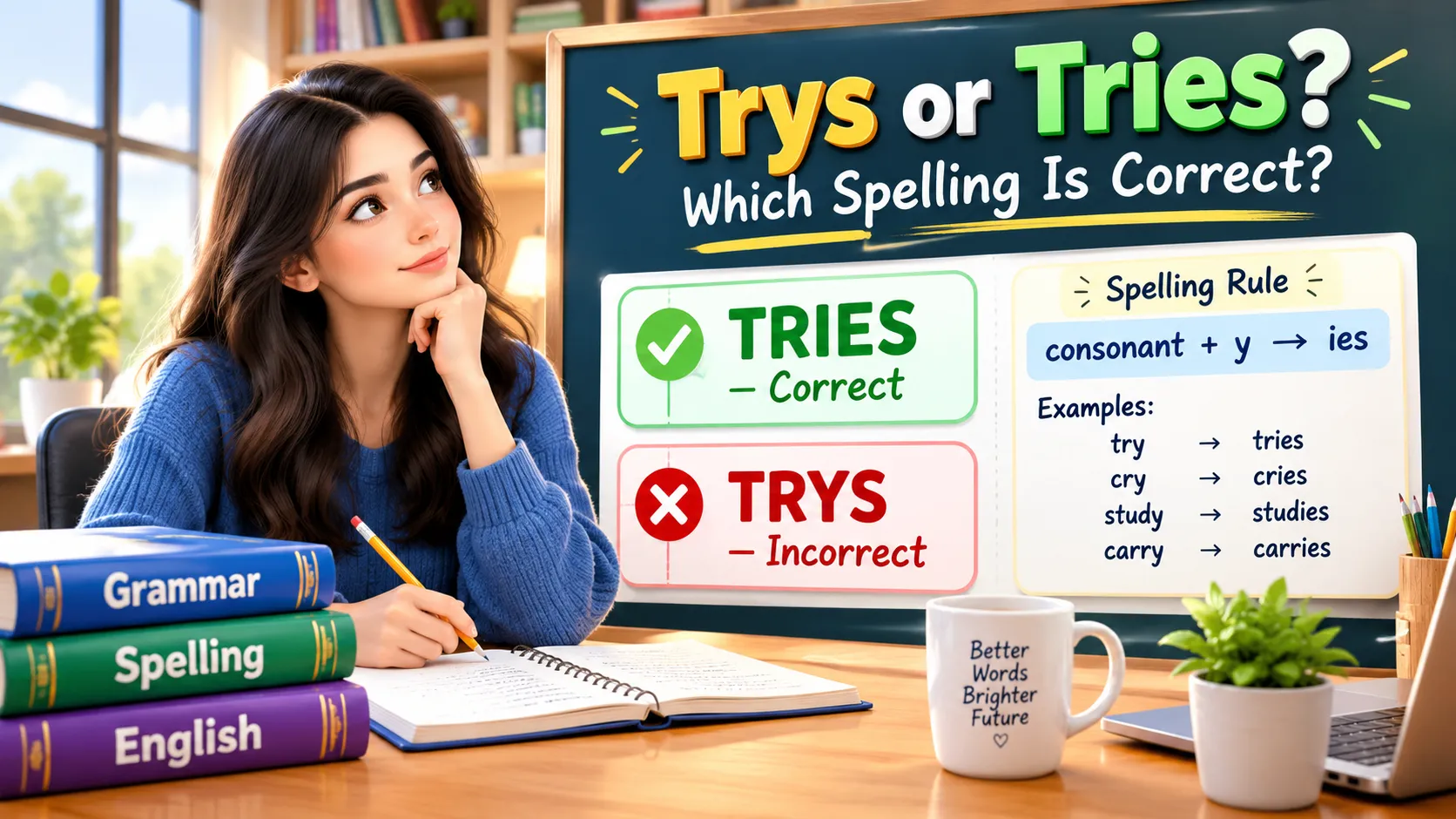
Tries is the correct spelling. Trys is not the standard English spelling.
Use tries in two main situations:
- As the third-person singular present-tense form of the verb try:
- He tries to help.
- She tries her best.
- It tries to connect.
- As the plural noun of try:
- I gave it three tries.
- She succeeded after several tries.
The spelling changes because try ends in a consonant followed by y. In the third-person singular present tense and in the plural of the noun, the y changes to i before -es:
try → tries
This is the same spelling pattern found in words such as cry → cries, fly → flies, study → studies, and carry → carries. Major Dictionaries list tries as the standard form of try.
Trys or Tries: Quick Answer
| Form | Correct? | Example |
| trys | ❌ No | She trys to help. |
| tries | ✅ Yes | She tries to help. |
| try | ✅ Yes | I try to help. |
| tried | ✅ Yes | She tried to help. |
| trying | ✅ Yes | She is trying to help. |
If you are choosing between trys and tries, choose tries.
Correct
He tries to finish his work early.
Incorrect
He trys to finish his work early.
The incorrect form trys is easy to produce because learners may assume that the third-person singular of every verb is formed by simply adding -s. However, verbs ending in consonant + y follow a different spelling pattern.
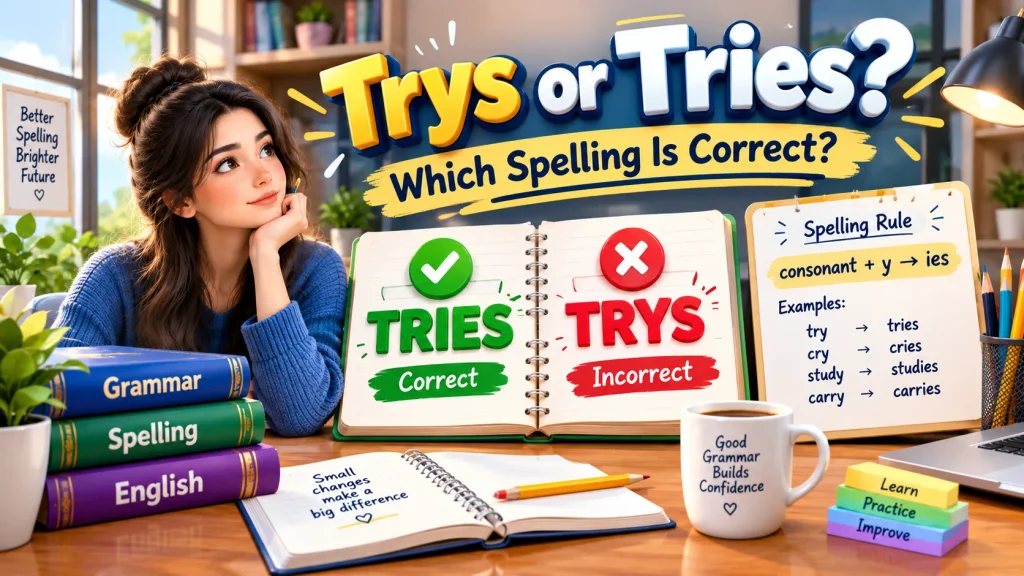
Why Is “Tries” Correct?
The base form is try.
When try is used with a singular third-person subject such as he, she, or it in the simple present, its spelling changes:
try → tries
The final y changes to i, and -es is added.
For example:
- try → tries
- cry → cries
- dry → dries
- fly → flies
- reply → replies
- study → studies
- carry → carries
- worry → worries
- copy → copies
Merriam-Webster gives the standard forms of try as tried and trying, while Oxford lists tries as the third-person singular present form.
So:
I try every day.
but:
She tries every day.
What Is the Consonant + Y Rule?
A useful spelling rule is:
When a word ends in a consonant + y, the y usually changes to i before -es in the third-person singular present form.
The basic pattern is:
consonant + y → ies
Examples:
| Base Verb | Third-Person Singular |
| try | tries |
| cry | cries |
| fly | flies |
| study | studies |
| carry | carries |
| hurry | hurries |
| reply | replies |
| identify | identifies |
Example
I study every evening.
With a third-person singular subject:
She studies every evening.
Likewise:
I try my best.
becomes:
He tries his best.
Important distinction
The rule is not simply “every word ending in y becomes ies.” The letter immediately before y matters.
Compare:
- try → tries
- study → studies
- carry → carries
with:
- play → plays
- enjoy → enjoys
- stay → stays
When Does Y Stay the Same?
When a verb ends in a vowel + y, the y normally stays unchanged when forming the third-person singular present.
| Base Verb | Correct Form |
| play | plays |
| enjoy | enjoys |
| stay | stays |
| obey | obeys |
| employ | employs |
Notice:
She plays tennis.
not:
She plaies tennis.
And:
He enjoys the movie.
not:
He enjoies the movie.
Compare this with:
She tries to help.
Here, the letter before y is r, a consonant.
Easy comparison
Consonant + y:
try → tries
Vowel + y:
play → plays
This distinction is particularly useful when learning English spelling patterns.
Try vs. Tries: What Is the Difference?
Both try and tries are correct English words. The difference is mainly grammatical.
In the simple present:
- I try
- you try
- we try
- they try
- he tries
- she tries
- it tries
Subject–verb agreement table
| Subject | Correct Form | Example |
| I | try | I try every day. |
| You | try | You try very hard. |
| He | tries | He tries every day. |
| She | tries | She tries her best. |
| It | tries | It tries to restart. |
| We | try | We try again. |
| They | try | They try to solve it. |
Therefore:
He tries.
not:
He trys.
And:
They try.
not:
They tries.
This is why the question is not only about spelling. It is also about subject–verb agreement.
Try, Tries, Tried, and Trying: Complete Word Forms
Understanding the complete set of forms makes the spelling much easier to remember.
| Form | Grammatical Function | Example |
| try | Base form | I try every day. |
| tries | Third-person singular present | She tries every day. |
| tried | Past tense/past participle | She tried yesterday. |
| trying | -ing form | She is trying now. |
Oxford gives the same core conjugation: try, tries, tried, trying.
Try
Use try as the base form:
I try to stay positive.
It also follows modal verbs:
She can try again.
You should try another method.
They will try tomorrow.
Tries
Use tries with a third-person singular subject:
He tries to understand.
She tries a different approach.
The computer tries to reconnect.
Tried
The past form is:
tried
not tryed.
Examples:
She tried to call me.
We tried several solutions.
Trying
The -ing form is:
trying
not trying.
Examples:
He is trying to improve.
They are trying again.
Notice that the y remains in trying.
How to Use “Tries” in a Sentence
“Tries” as a verb
Use tries when a singular third-person subject performs the action.
- He tries to arrive on time.
- She tries to eat healthy food.
- The dog tries to open the door.
- My brother tries to help everyone.
- The machine tries to restart automatically.
- Sarah tries a new recipe every weekend.
- The student tries to answer every question.
- The company tries to reduce costs.
“Tries” as a noun
Tries can also mean multiple attempts:
- It took three tries to open the lock.
- She passed after several tries.
- He had two tries at the competition.
- After many tries, they solved the puzzle.
- I gave it a few tries before giving up.
So tries can have two grammatical functions:
Verb: She tries to help.
Noun: She made three tries.
The surrounding sentence tells you which meaning is intended. Cambridge explicitly lists tries as the plural noun form of try.
He Tries or He Trys?
The correct form is:
He tries.
The incorrect form is:
❌ He trys.
Because he is a third-person singular subject, the verb try takes its third-person singular form:
try → tries
Correct examples
- He tries his best.
- He tries to learn quickly.
- He tries again.
- He tries every possible solution.
- He tries to finish before dinner.
Incorrect examples
- ❌ He trys his best.
- ❌ He trys to learn quickly.
- ❌ He trys again.
She Tries or She Trys?
The correct spelling is:
She tries.
Not:
❌ She trys.
Examples:
- She tries to stay calm.
- She tries a new method.
- She tries to improve her writing.
- She tries again after making a mistake.
- She tries to solve the problem herself.
The same spelling rule applies to he, she, and it.
They Try, or They Tries?
This is another common mistake.
The correct sentence is:
They try their best.
Not:
❌ They tries their best.
Why? Because they take the base form try in the simple present.
Compare:
She tries her best.
They try their best.
The distinction is grammatical:
Singular third person → tries
I/you/we/they → try
Is “Tries” Also a Noun?
Yes.
Try can be a noun meaning an attempt, and its plural form is tries. Cambridge lists try as a noun with tries as its plural.
Singular
Give it one try.
Plural
Give it several tries.
More examples:
- I gave the puzzle three tries.
- She succeeded after several tries.
- He had one more try.
- They made five tries before finding the solution.
Therefore, tries is not exclusively a verb.
It can be:
- A third-person singular present verb
- A plural noun
Explore More: https://wordminto.com/bmw-or-mercedes/
What Does “Try” Mean?
The word try has several meanings depending on context.
1. To make an attempt
I will try to finish the project.
2. To test something
Try this new method.
3. To taste or experience something
Try the soup.
4. To attempt to achieve something
She tried to win the competition.
5. To test someone’s patience
You’re trying my patience.
Cambridge defines try as both an attempt and an action undertaken to test whether something works or is suitable.
Try to + Verb
One of the most common structures is:
try + to + base verb
Examples:
- I try to study every day.
- She tries to understand the lesson.
- He tries to help his friends.
- They try to solve the problem.
With a third-person singular subject:
She tries to learn English.
Not:
❌ She tries to learns English.
After to, use the base form of the verb.
Try to vs. Try + -ing
These structures can express slightly different ideas.
Try to open the door.
This emphasizes the attempt to perform the action.
Try opening the door.
This suggests opening the door as a possible method or solution.
Cambridge provides examples of both try to + verb and try + -ing constructions.
Try + -ing
Use:
try + verb-ing
When suggesting an action as a possible solution or experiment.
Examples:
- Try using a different password.
- Try opening the window.
- Try taking a short break.
- Try changing the settings.
- Try restarting the computer.
Compare:
Try to restart the computer.
This focuses on the attempt.
Try restarting the computer.
This suggests restarting as a possible solution.
Try Out, Try On, and Try For
The word try also appears in several common expressions.
Try out
Try out means to test or use something to see how well it works.
I want to try out this new software.
She tries out different techniques.
Try on
Try on means to put on clothing to see whether it fits or looks suitable.
She tries on several dresses.
I want to try on these shoes.
Try for
Try for means to attempt to obtain or achieve something.
He will try for the championship.
She tries for a promotion every year.
These expressions are especially useful for ESL learners because the form of try still changes according to the grammatical structure.
Modal Verbs: Use “Try,” Not “Tries”
A particularly common error occurs after modal verbs.
After modal verbs such as can, could, should, would, may, might, must, and will, use the base form try.
Correct
She can try again.
He should try harder.
They will try tomorrow.
You might try another approach.
Incorrect
She can tries again.
He should tries harder.
They will tries tomorrow.
The modal verb is followed by the base form of the main verb.
So remember:
can try
should try
will try
not:
can tries
should tries
will tries
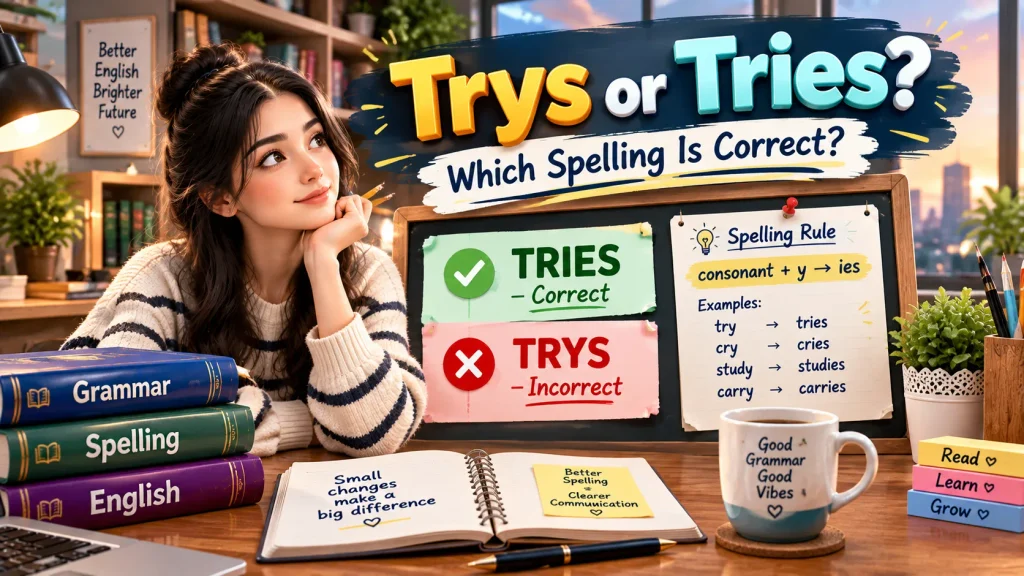
Common Mistakes With Try and Tries
Mistake 1: Writing “trys”
❌ She trys to help.
✅ She tries to help.
Mistake 2: Writing “tryed”
❌ He tryed to call.
✅ He tried to call.
Mistake 3: Writing “triing”
❌ They are triing again.
✅ They are trying again.
Mistake 4: Using “tries” with plural subjects
❌ They tries their best.
✅ They try their best.
Mistake 5: Using “tries” after a modal
❌ She will tries again.
✅ She will try again.
Mistake 6: Forgetting the third-person change
❌ He try every day.
✅ He tries every day.
Trys or Tries in British and American English
There is no British-versus-American spelling difference between trys and tries.
Both British and American English use:
tries
and not:
trys
Oxford lists tries as the third-person singular form, while Cambridge gives the same standard form across its British and American dictionary resources.
So:
- American English: tries
- British English: tries
- Canadian English: tries
- Australian English: tries
The difference between try and tries is grammatical, not regional.
Is “Trys” a Word?
In standard English, trys is not the standard spelling of the ordinary third-person singular form of try or its plural noun form.
Use:
tries
instead.
For example:
✅ She tries again.
✅ He made three tries.
❌ She trys again.
❌ He made three trys.
If you encounter trys online, it will generally be a misspelling or nonstandard use rather than the standard form of try. Current dictionary entries identify tries as the established verb and noun form.
Trys or Tries in a Sentence
| Incorrect | Correct |
| He trys hard. | He tries hard. |
| She trys again. | She tries again. |
| It trys to work. | It tries to work. |
| They tries again. | They try again. |
| I tries every day. | I try every day. |
| She will tries again. | She will try again. |
| He tryed yesterday. | He tried yesterday. |
| She is triing again. | She is trying again. |
This table highlights an important point: not every incorrect sentence should simply be changed from trys to tries. The correct form depends on the subject, tense, and grammatical structure.
How to Remember “Try → Tries”
Use this simple memory rule:
Consonant + Y → IES
Therefore:
TRY → TRIES
A useful group to memorize is:
- cry → cries
- fly → flies
- dry → dries
- try → tries
- study → studies
- carry → carries
Another easy memory trick
Remember this sentence:
She tries, but they try.
It helps you remember both the spelling and subject–verb agreement.
- She → tries
- They → try
Trys or Tries: Quick Grammar Test
Choose the correct answer.
1. She ___ to improve every day.
A. trys
B. tries
Answer: B — tries
She tries to improve every day.
2. They ___ to arrive early.
A. try
B. tries
Answer: A — try
They try to arrive early.
3. He ___ his best.
A. trys
B. tries
Answer: B — tries
He tries his best.
4. We ___ several times.
A. try
B. tries
Answer: A — try
We try several times.
5. It ___ to restart.
A. trys
B. tries
Answer: B — tries
It tries to restart.
6. She ___ again tomorrow.
A. will try
B. will tries
Answer: A — will try
She will try again tomorrow.
7. He ___ yesterday.
A. tryed
B. tried
Answer: B — tried
He tried yesterday.
8. They are ___ again.
A. triing
B. trying
Answer: B — trying
They are trying again.
People Also Ask
Tries is correct. Trys is not the standard English spelling.
Because try ends in a consonant followed by y. In the third-person singular present form, the y changes to i and -es is added:
try → tries
Not as the standard spelling of the ordinary verb or plural noun forms of try. In standard English, use tries.
The plural noun is tries.
She had three tries.
The third-person singular present form is tries.
He tries.
She tries.
It tries.
No.
The correct form is:
He tries.
Is “she trys” correct?
No.
The correct form is:
She tries.
Final Answer: Trys or Tries?
The correct spelling is tries.
Trys is not the standard English form.
Use tries:
- with he, she, or it in the simple present;
- as the plural noun form of try.
Examples:
He tries his best.
She tries again.
It tries to connect.
They made three tries.
The most important spelling pattern is:
consonant + y → ies
Therefore:
TRY → TRIES
Once you understand this pattern, similar forms such as cry → cries, fly → flies, study → studies, and carry → carries become easier to recognize.
Bottom line: tries is correct; trys is not.









2 thoughts on “Trys or Tries: Which Spelling Is Correct?”