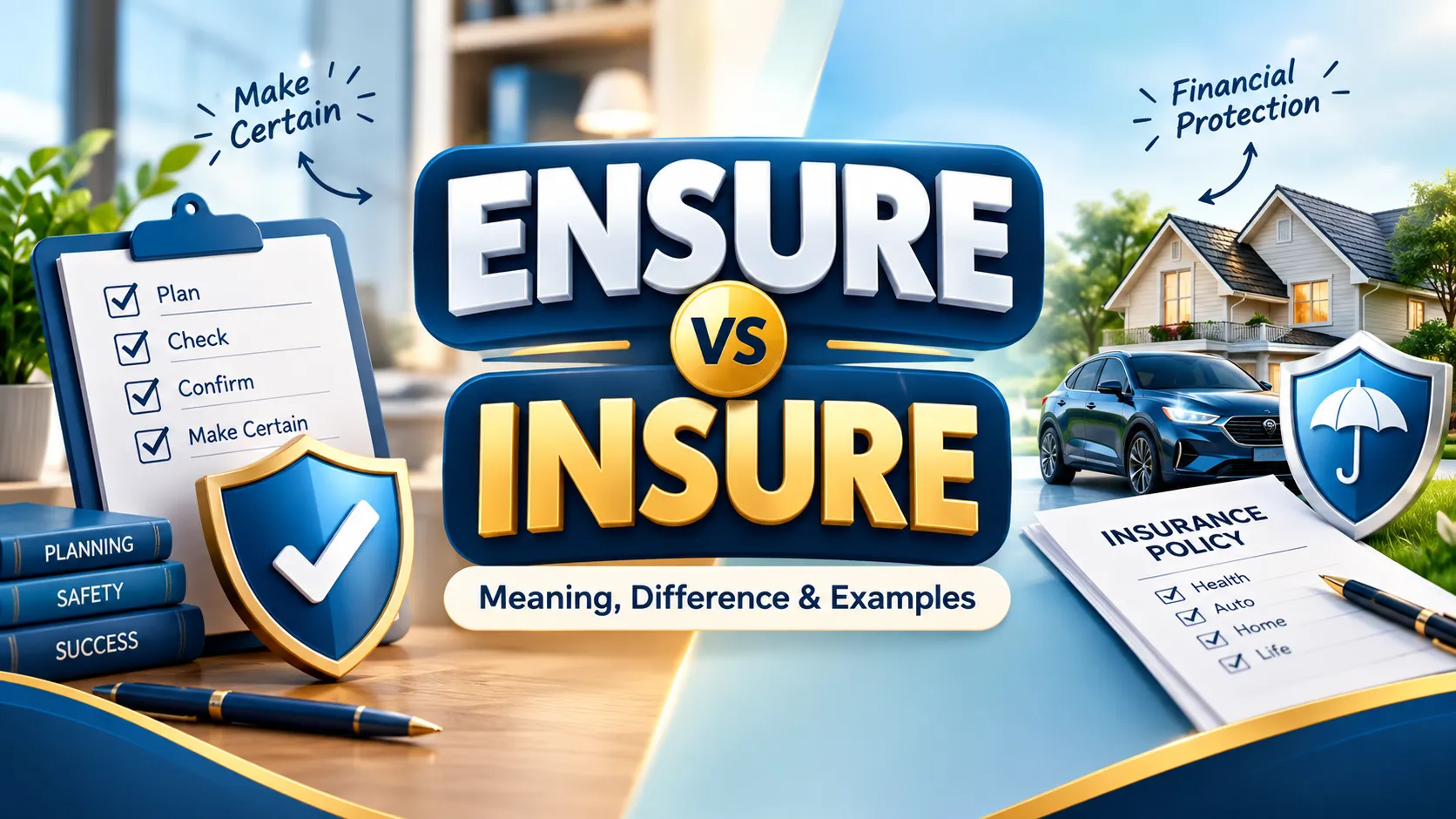
Ensure vs Insure: Ensure and insure are commonly confused English verbs because they look and sound very similar. The difference is mainly about meaning and context.
The easiest modern rule is:
Ensure = make certain or make sure
Insure = provide or obtain insurance
For example:
- Please ensure that the door is locked.
- You should insure your car against theft.
There is one important exception: American English dictionaries also recognize insure as a spelling/variant of ensure in the “make certain” sense.
So, while the simple rule is useful, understanding the regional usage will help you avoid misleading advice.
Quick Answer: Ensure vs. Insure
| Word | Main meaning | Typical context | Example |
| Ensure | Make certain; make sure | Results, safety, accuracy, compliance | Please ensure that the form is complete. |
| Insure | Provide or obtain insurance | Cars, homes, property, risks | We need to insure the vehicle. |
The 2-second rule
Make sure → ENSURE
Insurance → INSURE
That distinction is the clearest choice for most formal, academic, business, and international writing.
What Does “Ensure” Mean?
Ensure is a verb meaning to make something certain or make sure that something happens.
Cambridge defines ensure as making something certain to happen and gives constructions such as ensure that and ensure something for someone.
Examples of “ensure”
- Please ensure that all windows are closed.
- Double-check the figures to ensure accuracy.
- The new system will ensure faster processing.
- We took precautions to ensure everyone’s safety.
- Good planning can ensure a successful launch.
- Please ensure the information is correct.
In these examples, ensure has nothing to do with an insurance policy. It is about certainty, conditions, or results.
Common collocations with “ensure”
You will often see ensure with words such as:
- ensure safety
- ensure success
- ensure accuracy
- ensure quality
- ensure compliance
- ensure security
- ensure fairness
- ensure delivery
- ensure access
- ensure consistency
- ensure reliability
- ensure that something happens
For example:
The checklist helps ensure accuracy.
The company introduced new procedures to ensure compliance.
Please ensure that every field is completed.
How to Use “Ensure” in a Sentence
1. Ensure + noun
Use ensure + noun when you mean making a condition or result certain.
- The new procedure will ensure safety.
- The software helps ensure accuracy.
- The policy is designed to ensure fairness.
- Regular inspections help ensure quality.
2. Ensure + that-clause
This is one of the most common structures.
ensure + that + subject + verb
Examples:
- Please ensure that the door is locked.
- We must ensure that everyone receives the correct information.
- She checked the schedule to ensure that no appointments overlapped.
- The teacher explained the rule to ensure that every student understood it.
3. Ensure + object + result
Ensure can also take an object followed by a result or condition.
- The victory ensured the team a place in the final.
- The changes ensured everyone had equal access.
- The agreement ensured the company continued access to the service.
The central idea remains making something certain.
What Does “Insure” Mean?
Insure is primarily a verb connected with insurance and financial protection against risk.
When you insure something, you arrange insurance coverage for it. An insurance company can also insure a person or property by providing that coverage.
Cambridge’s main English definition connects insure with protecting against risk through insurance, including constructions such as insure against and insure for.
Examples of “insure”
- We need to insure the car.
- She decided to insure her house against fire.
- The company insures valuable equipment.
- The painting was insured for $2 million.
- They want to insure the property against theft.
- Many businesses insure their buildings.
Insurance vocabulary is a strong clue
When you see words such as:
policy → premium → coverage → claim → loss → damage → insurer → insurance
the verb insure is usually the appropriate choice.
How to Use “Insure” in a Sentence
Insure + person or property
- We should insure the house.
- They insured the vehicle.
- The company insured its equipment.
- She decided to insure the artwork.
Insure + against + risk
The pattern is:
insure + something + against + risk
Examples:
- We insured the house against fire.
- They insured the vehicle against theft.
- The business insured itself against certain risks.
- The company insured its equipment against accidental damage.
Insure + for + amount
Use for when specifying the insured amount.
- The artwork was insured for $500,000.
- The company insured the equipment for $100,000.
- The house is insured for $2 million.
Passive forms
- The car is insured.
- The building is fully insured.
- The equipment was insured against damage.
- The property is insured for $1 million.
Ensure vs Insure: Side-by-Side Comparison
| Feature | Ensure | Insure |
| Part of speech | Verb | Verb |
| Main meaning | Make certain | Provide or obtain insurance |
| Core idea | Certainty | Financial/risk protection |
| Common contexts | Safety, accuracy, success, quality | Cars, homes, property, equipment |
| Common pattern | ensure that… | insure against… |
| Example | Ensure that the door is locked. | Insure the house against fire. |
| Memory clue | sure | insurance |
Compare these sentences
Please ensure the documents are complete.
This means:
Please make sure the documents are complete.
But:
Please insure the documents against loss.
This means:
Obtain insurance protection for the documents.
The spelling is similar, but the meaning changes substantially.
Ensure vs Insure for Safety?
This is a common source of confusion.
When you mean make safety certain or take steps to maintain safety, use ensure.
Correct
- The guards are there to ensure safety.
- Follow the instructions to ensure your safety.
- The regulations are designed to ensure workplace safety.
- Staff training helps ensure employee safety.
Do not choose insure simply because the sentence involves risk.
Risk does not automatically mean “insure”
Compare:
The new procedures will ensure safety.
Here, the procedures are intended to make a safe condition more certain.
But:
The company will insure its employees.
Here, the company is providing or arranging insurance coverage.
The key question is:
Are you talking about making something certain, or obtaining insurance protection?
Ensure vs Insure for a Car?
The correct word depends on your intended meaning.
Use “ensure” when you mean “make certain”
Please ensure that the car is locked.
Meaning:
Please make sure the car is locked.
Use “insure” when you mean insurance
We need to insure the car.
Meaning:
We need to obtain insurance coverage for the car.
Compare
| Sentence | Meaning |
| Ensure that the car is locked. | Make certain the car is locked. |
| Insure the car. | Obtain insurance coverage for the car. |
| Ensure the car is properly maintained. | Make certain it is maintained properly. |
| Insure the car against theft. | Obtain insurance protection against theft. |
The same distinction applies to:
- houses
- boats
- buildings
- equipment
- artwork
- businesses
- valuables
Can “Insure” Mean “Make Certain”?
Yes. This is the important nuance many simplified explanations leave out.
Cambridge’s American Dictionary explicitly lists insure as meaning “make something certain” and identifies ensure as an alternative.
For example:
The new measures will insure accuracy.
In this American-English usage, insure means make certain, not purchase an insurance policy.
Cambridge also labels insure as an American spelling/variant in its entry for ensure.
So is “insure” interchangeable with “ensure”?
Sometimes, particularly in American English—but not in every context.
For contemporary general writing, especially when your audience is international, the clearest convention is:
Ensure = make certain
Insure = insurance
This removes ambiguity and makes your intended meaning immediately obvious.
Ensure vs Insure in American and British English
Regional usage matters.
British English
The practical distinction is generally:
- ensure = make certain
- insure = provide or obtain insurance
Examples:
Please ensure that the information is correct.
You should insure the vehicle.
American English
American English commonly uses the same distinction:
- ensure = make certain
- insure = provide or obtain insurance
However, American dictionaries also recognize insure in the “make certain” sense. Cambridge explicitly documents this usage.
Best choice for international writing
If your readers may come from different English-speaking regions, use:
Ensure = make certain
Insure = insurance
This convention is especially useful for:
- academic writing
- business communication
- technical documentation
- educational content
- professional correspondence
- international websites
Ensure vs Insure vs Assure
There is a third commonly confused word: assure.
A useful way to separate the three is:
| Word | Meaning | Think of |
| Assure | Give someone confidence or remove doubt | A person |
| Ensure | Make something certain | An outcome |
| Insure | Provide or obtain insurance | A risk/property |
Assure
I assure you that everything is ready.
You are giving a person confidence.
Ensure
Please ensure that everything is ready.
You are making an outcome or condition certain.
Insure
We need to insure the equipment.
You are arranging financial protection.
The three-word memory sentence
I assure you that I will ensure the car is insured.
Break it down:
- assure you → give a person confidence
- ensure → make something certain
- insured → covered by insurance
Easy formula
Assure a person.
Ensure an outcome.
Insure against risk.
Common Mistakes With Ensure vs Insure
Mistake 1: “Please insure that the door is locked.”
If you mean make sure, use:
Please ensure that the door is locked.
Mistake 2: “We need to ensure the car.”
If you mean obtain insurance:
We need to insure the car.
Mistake 3: “The policy will insure customer satisfaction.”
If you mean guarantee customer satisfaction:
The policy will ensure customer satisfaction.
Mistake 4: “The house is ensured against fire.”
For insurance protection, use:
The house is insured against fire.
Mistake 5: “I insure you that everything is fine.”
When giving confidence to someone, use:
I assure you that everything is fine.
Explore More: https://wordminto.com/login-or-log-in/
30+ Examples of Ensure vs Insure
Examples with “Ensure”
- Please ensure that the door is closed.
- Check the figures to ensure accuracy.
- We must ensure customer safety.
- The system helps ensure reliability.
- These rules ensure fairness.
- Please ensure that everyone has arrived.
- The checklist helps ensure consistency.
- They took precautions to ensure success.
- The training is designed to ensure quality.
- Double-check the address to ensure delivery.
- The company introduced measures to ensure compliance.
- We need to ensure that the information is correct.
- The new process should ensure faster service.
- Good preparation can ensure a smooth presentation.
- The lock helps ensure security.
Examples with “Insure”
- We need to insure the car.
- She insured her house against fire.
- The company insured its equipment.
- They insured the vehicle against theft.
- The painting was insured for $1 million.
- The business insures commercial properties.
- Make sure your valuables are insured.
- The homeowner insured the property against damage.
- The company decided to insure its fleet.
- They insured the boat before taking it to sea.
- The artwork is fully insured.
- The property was insured against flooding.
- The business insured its expensive machinery.
- He forgot to insure the new vehicle.
- The policy insures the building against certain risks.
Ensure or Insure: A Simple Substitution Test
When you are unsure, mentally replace the word.
Test 1: Can you replace it with “make sure”?
If yes, ensure is usually the clearest choice.
Please ___ that the report is complete.
Replace it:
Please make sure that the report is complete.
Therefore:
Please ensure that the report is complete.
Test 2: Can you replace it with “provide insurance”?
If yes, use insure.
We need to ___ the property.
Replace it:
We need to provide insurance for the property.
Therefore:
We need to insure the property.
The two-second rule
Make sure → ENSURE
Insurance → INSURE
Memory Tricks for Ensure vs. Insure
Trick 1: Ensure contains “sure”
Look at the spelling:
en + sure = ensure
Think:
Ensure = make sure.
Trick 2: Insure resembles “insurance”
Think:
Insure → insurance
If the sentence contains a policy, coverage, premium, claim, loss, or insured property, insure is likely the word you need.
Trick 3: Remember all three
Assure a person. Ensure an outcome. Insure against risk.
This gives you a practical distinction among the three confusing verbs.
Word Forms of Ensure vs Insure
Understanding their forms helps you recognize them in different sentences.
Ensure
| Form | Word |
| Base form | ensure |
| Third-person singular | ensures |
| Past tense | ensured |
| Past participle | ensured |
| Present participle | ensuring |
Examples:
The procedure ensures accuracy.
They ensured that everyone was informed.
We are ensuring compliance with the rules.
Insure
| Form | Word |
| Base form | insure |
| Third-person singular | insures |
| Past tense | insured |
| Past participle | insured |
| Present participle | insuring |
Examples:
The company insures commercial vehicles.
They insured the building.
The company is insuring the equipment.
Related insurance vocabulary
In the insurance sense, you may also encounter:
- insurance
- insurer
- insured
- insurable
- uninsured
- underinsured
These words strongly signal the insurance-related meaning.
Pronunciation: Ensure vs. Insure
Pronunciation contributes to the confusion because the words are very similar in sound.
Cambridge lists pronunciation information for both words and shows regional pronunciation differences.
In many varieties of English, the words are pronounced very similarly, so context is more reliable than sound when distinguishing them.
That means you should focus on:
- spelling
- meaning
- grammatical context
- surrounding vocabulary
rather than trying to hear a major pronunciation difference.
Ensure or Insure in Academic Writing
Academic writing often uses ensure when describing procedures designed to produce a reliable result.
Examples
The researchers followed a standardized procedure to ensure consistency.
Multiple checks were performed to ensure accuracy.
The researchers introduced controls to ensure data quality.
Use insure when the subject is actual insurance:
The laboratory equipment was insured against accidental damage.
For academic writing, choosing the word that makes the intended meaning immediately clear is especially important.
Ensure or Insure in Business Writing
Business English frequently uses ensure with words describing processes, standards, and outcomes.
Common combinations include:
- ensure quality
- ensure compliance
- ensure accuracy
- ensure security
- ensure customer satisfaction
- ensure timely delivery
- ensure consistency
- ensure business continuity
- ensure safety
- ensure reliability
Examples
Please ensure that the invoice is approved before payment.
The company introduced new controls to ensure compliance.
The quality team checks every product to ensure consistency.
Use insure when discussing actual insurance:
The company decided to insure its warehouse.
The business insured its vehicles against theft.
Ensure vs Guarantee
.
Ensure and guarantee are related, but they are not identical in every context.
.
Ensure means to make something certain or make sure something happens.
Guarantee can mean to promise or provide certainty about an outcome.
Compare:
The procedure helps ensure accuracy.
The manufacturer guarantees the product for two years.
In many sentences, ensure can be paraphrased as make sure, while guarantee may involve a promise, assurance, or formal commitment.
Is “Ensure” a Verb?
Yes.
Ensure is a transitive verb. It commonly takes an object, complement, or that-clause.
Examples:
- ensure safety
- ensure accuracy
- ensure quality
- ensure compliance
- ensure that the work is complete
You normally would not use ensure as a noun.
Is “Insure” a Verb?
Yes.
Insure is also a verb.
Examples:
- insure the car
- insure the house
- insure the equipment
- insure against theft
- insure for $500,000
Related words include:
- insurance — noun
- insurer — company/person providing insurance
- insured — person or property covered by insurance
Quick Revision Box
Ensure
Meaning: make certain; make sure
Common patterns:
- ensure safety
- ensure accuracy
- ensure quality
- ensure compliance
- ensure that…
Example:
Please ensure that the report is complete.
Insure
Meaning: provide or obtain insurance
Common patterns:
- insure a car
- insure a house
- insure property
- insure against theft
- insure for $500,000
Example:
We insured the house against fire.
Assure
Meaning: give someone confidence
Example:
I assure you that everything is ready.
Quick Practice Quiz: Ensure or Insure?
Choose ensure or insure.
1. Please _____ that all doors are locked.
2. We need to _____ the new vehicle.
3. These measures will _____ workplace safety.
4. The homeowner decided to _____ the house against fire.
5. Check the information to _____ accuracy.
6. The company wants to _____ its expensive equipment.
7. Please _____ that the package is delivered on time.
8. The business _____ its property against theft.
Answers
- ensure
- insure
- ensure
- insure
- ensure
- insure
- ensure
- insures
The underlying distinction is:
certainty/outcome → ensure
insurance/protection → insure
People Also Ask
Both are correct English words, but they normally have different meanings.
Use ensure for “make certain” and insure for insurance.
Please ensure that the door is locked.
We need to insure the car.
Ensure means to make something certain. Insure generally means to provide or obtain insurance protection against loss, damage, injury, or risk.
Yes. American English dictionaries document insure with the “make certain” meaning.
However, ensure is generally the clearer choice when you mean “make certain,” especially in international or formal writing.
Use:
ensure safety
when you mean making safety certain or taking steps to maintain safety.
Use insure when you mean arranging insurance coverage.
If you mean insurance coverage:
insure the car
If you mean making certain something about the car is true:
ensure that the car is locked
Final Rule: Ensure or Insure?
If you remember only one thing, remember this:
Ensure means “make sure.”
Insure means “provide or obtain insurance.”
Use “ensure” for:
- safety
- accuracy
- success
- quality
- compliance
- security
- delivery
- fairness
- results
- conditions
Use “insure” for:
- cars
- houses
- property
- equipment
- businesses
- valuables
- insurance policies
- financial protection
- covered risks
And remember the third member of the group:
Assure a person. Ensure an outcome. Insure against risk.
There is one important qualification: American English dictionaries recognize insure with the “make certain” meaning as well. So it would be inaccurate to say that insure can never mean ensure.
For clear modern writing, however, the practical rule remains:
Make certain → ensure
Insurance → insure
When you are deciding between ensure or insure, ask:
Am I making something certain, or am I talking about insurance?
If you mean make certain, choose ensure for maximum clarity.
If you mean insurance protection, choose insure.