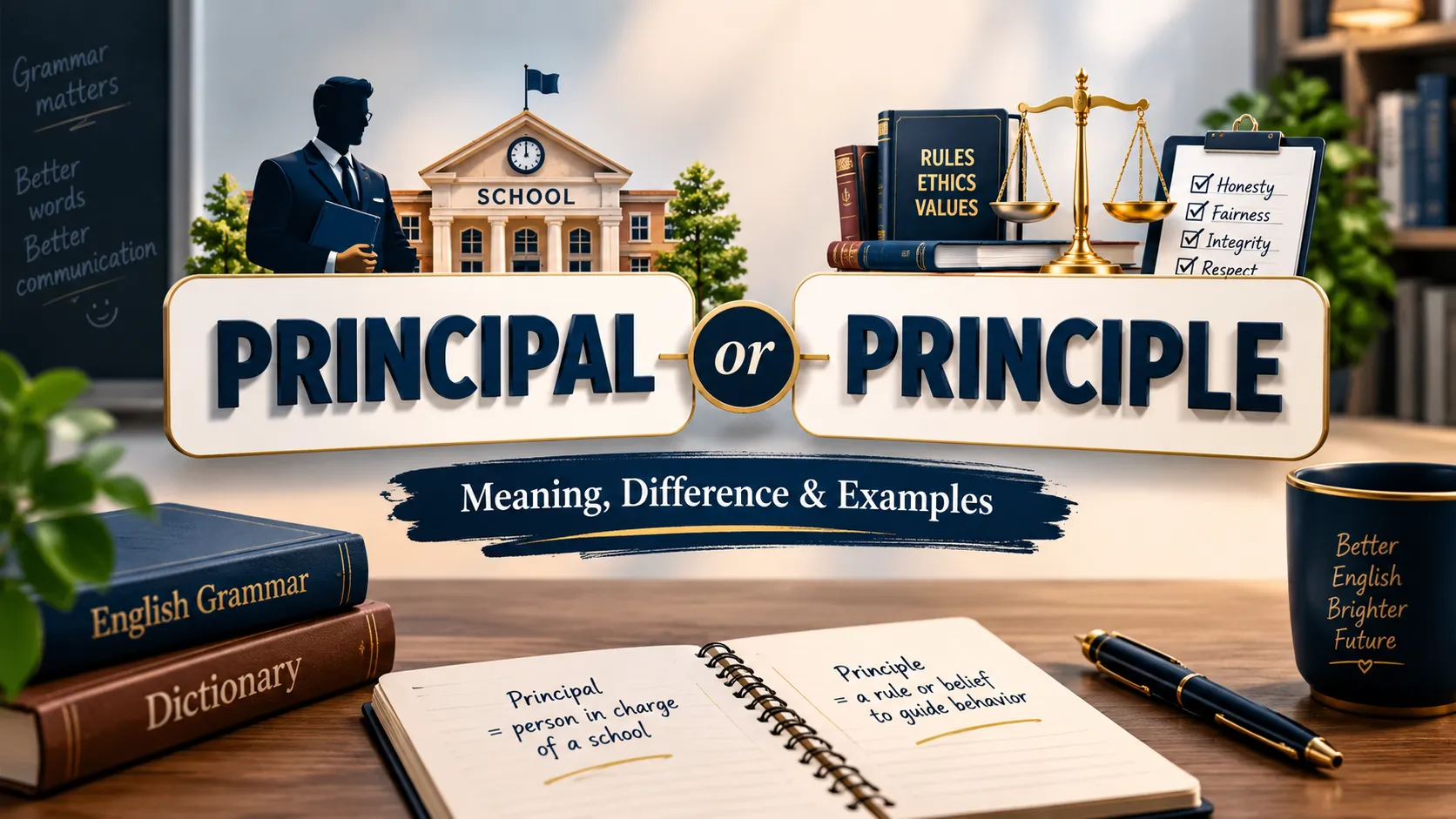
Principal or Principle: Principal and principle are commonly confused English words because they look almost identical and sound the same in standard English. However, their meanings and grammatical functions are different.
The easiest way to remember the distinction is:
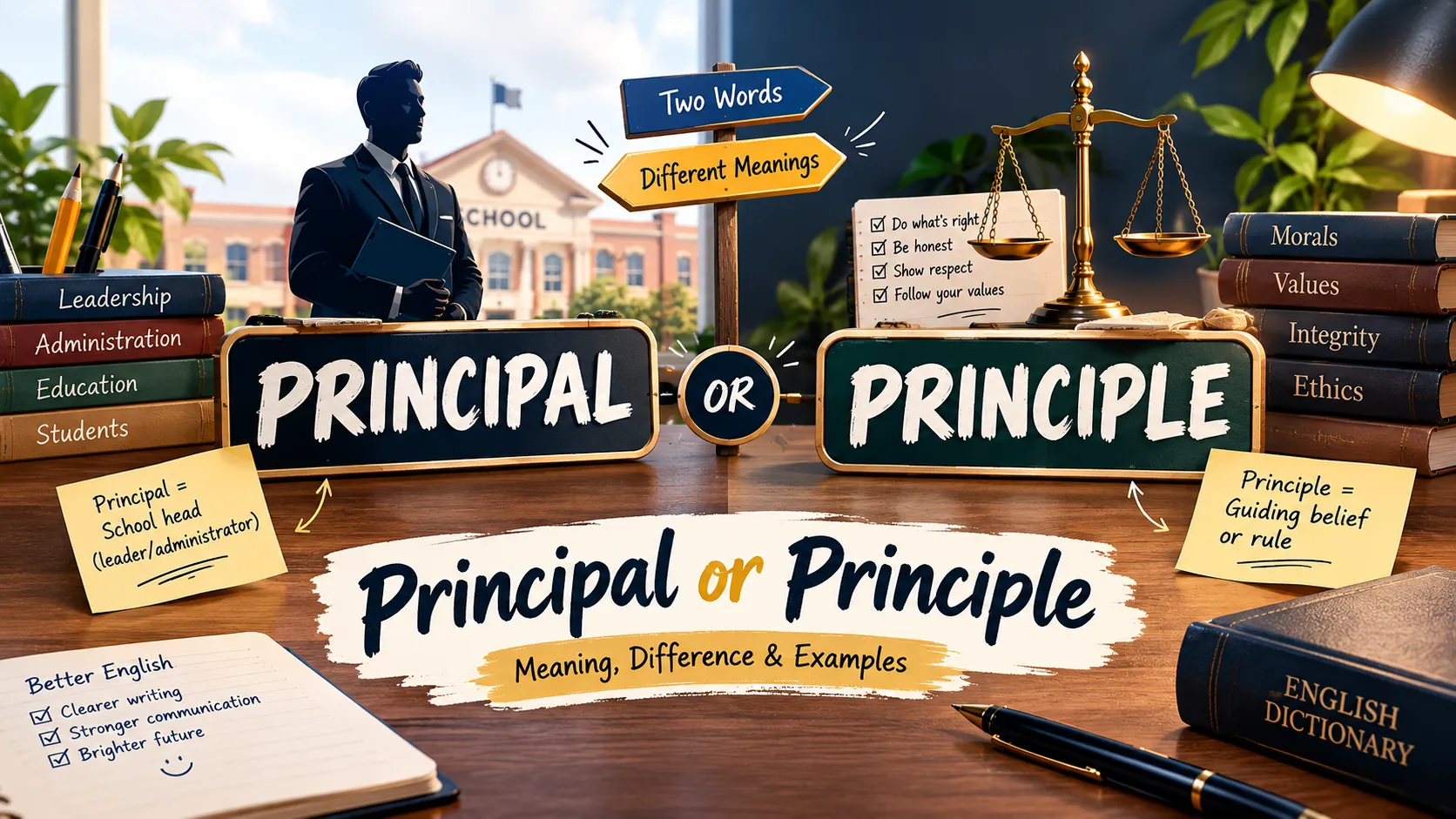
Principal = person, main thing, or money.
Principle = rule, belief, standard, or fundamental idea.
Compare these examples:
- The principal welcomed the students.
- Safety is our principal concern.
- She paid down the loan principal.
- Honesty is an important principle.
- The machine operates according to a scientific principle.
- I agree with the proposal in principle.
The key is to focus on meaning and context, not pronunciation.
Principal or Principle: What Is the Difference?
The primary difference between principal and principle is what each word means.
Principal can be a noun or an adjective. As a noun, it can refer to a person in a leading position or the original amount of money borrowed or invested. As an adjective, it means main, chief, primary, or most important.
Principle is a noun. It refers to a rule, belief, standard, moral guideline, fundamental truth, or basic idea.
| Word | Part of Speech | Main Meaning | Example |
| principal | Noun | Person in charge | The principal addressed the students. |
| principal | Adjective | Main or most important | Safety is our principal concern. |
| principal | Noun | Original amount of money | She paid the loan principal. |
| principle | Noun | Rule or belief | Honesty is an important principle. |
| principle | Noun | Fundamental truth or idea | The machine works according to a basic principle. |
Quick rule
Use principal when you mean:
- a person in charge
- main
- primary
- most important
- an original loan or investment amount
Use principle when you mean:
- a rule
- belief
- standard
- moral value
- guiding idea
- fundamental truth
This meaning-based distinction is the central rule behind the two spellings.
Principal vs. Principle at a Glance
A quick way to visualize the difference is:
Principal → Person, Primary, or Principal Money
Principle → Rule, Belief, or Basic Truth
Consider these sentences:
Person
The principal welcomed the new students.
Here, principal means the person in charge of a school.
Main or most important
The principal reason for the change was cost.
Here, principal means main or most important.
Money
The principal on the loan is $20,000.
Here, principal refers to the original amount of money.
Moral rule
Honesty is an important principle.
Here, principle means a moral value or rule.
Fundamental idea
The machine operates according to a basic principle.
Here, principle refers to a fundamental rule or idea.
What Does Principal Mean?
Principal has several meanings, but its uses are connected by the ideas of being first, main, primary, or leading.
It can function as both a noun and an adjective.
Principal as a Person
A principal is commonly the person who leads a school.
For example:
- The principal welcomed the new students.
- The teacher spoke with the principal about the issue.
- The principal’s office is on the second floor.
- The principal announced the new school policy.
The simplest distinction is:
principal = person
principle = idea or rule
Therefore:
The principal called my parents. ✓
Not:
The principle called my parents. ✗
Principal as an Adjective
Principal can also be an adjective meaning main, chief, primary, or most important.
Examples:
- Cost was the principal reason for the decision.
- Her principal goal is to finish the project.
- The principal concern is safety.
- Water is the principal ingredient in the mixture.
- Communication was the principal problem.
The “main” replacement test
When you are unsure, try replacing principal with main or primary.
For example:
The principal reason for leaving was the long commute.
Replace principal with main:
The main reason for leaving was the long commute.
The meaning remains essentially the same, so principal is correct.
This is one of the most useful practical tests because it focuses on meaning rather than spelling.
Principal as a Noun in Finance
Another important use of principal occurs in finance.
In financial contexts, principal generally means the original amount of money that is borrowed, lent, or invested, excluding interest.
For example, if you borrow $10,000, the original $10,000 is the principal. Interest is calculated separately.
Examples:
- I made an extra payment toward the principal of my mortgage.
- The bank calculated interest on the loan principal.
- Paying down the principal can reduce future interest costs.
- The investment returned the original principal plus additional earnings.
Principal vs. interest
| Term | Meaning |
| Principal | Original amount borrowed, lent, or invested |
| Interest | Additional amount charged or earned based on the principal |
For example:
She borrowed $20,000 and paid interest on the principal.
Here, principal has nothing to do with a school leader. It is a financial term.
Principal in Other Contexts
The noun principal can also refer to someone or something occupying a leading or primary position.
You may encounter expressions such as:
- principal investor
- principal actor
- principal researcher
- principal party
- principal defendant
Examples:
She became the principal investor in the company.
The principal researcher presented the findings.
In these contexts, principal generally communicates the idea of being primary, leading, or directly involved.
What Does Principle Mean?
Principle is a noun referring to a rule, standard, belief, fundamental truth, or basic idea.
It can appear in many fields, including:
- morality
- ethics
- science
- law
- Education
- business
- everyday conversation
Examples:
- Honesty is an important principle.
- The system operates according to a basic principle.
- She refused to compromise her principles.
- The decision was based on a legal principle.
- Scientists studied the underlying principles of the process.
Unlike principal, principle is not used to mean a school leader.
Principle as a Moral Rule or Belief
A principle can be a personal, professional, or social standard that guides behavior.
Examples:
- He believes honesty is a fundamental principle.
- She refused to lie because it went against her principles.
- Fairness is one of the organization’s guiding principles.
- They made the decision based on principle.
Depending on context, principle can be closely related to:
- belief
- value
- standard
- moral rule
- guideline
- conviction
Example
She refused the offer on principle.
This means she refused because accepting it would conflict with her beliefs or standards.
Principle as a Scientific or Fundamental Rule
Principle is not limited to morality or personal beliefs.
It can also describe a fundamental idea, rule, or truth that explains how something works.
Examples:
- The machine operates according to a basic principle of physics.
- Students learned the principles of mathematics.
- The experiment demonstrates an important scientific principle.
- The design follows the principles of engineering.
In these examples, principle means a fundamental rule, concept, or idea.
Principal vs. Principle Examples
Seeing the words in different contexts makes the distinction easier to remember.
School
The principal addressed the students.
Meaning: The person in charge of the school.
Importance
Safety is our principal concern.
Meaning: Safety is our main or most important concern.
Finance
She paid an additional amount toward the principal.
Meaning: The original amount of money owed.
Morality
Honesty is one of his strongest principles.
Meaning: Moral beliefs or standards.
Science
The device works according to a simple principle.
Meaning: A fundamental rule or idea.
Business
Customer satisfaction is a principal objective of the company.
Meaning: A main or primary objective.
Professional ethics
The organization operates according to several ethical principles.
Meaning: Guiding rules or standards.
Explore More: https://wordminto.com/ensure-vs-insure/
Principal or Principle: Which One Should You Use?
When you are unsure, ask yourself four questions.
1. Is it a person in charge?
Use principal.
The school principal called a meeting.
2. Does it mean main, primary, or most important?
Use principal.
This is our principal objective.
3. Does it mean a rule, belief, standard, or fundamental truth?
Use principle.
Respect is an important principle.
4. Does it mean the original amount of money?
Use principal.
He made a payment toward the loan principal.
This four-part test covers most situations in which writers confuse the two words.
Principal vs. Principle Common Phrases
Learning common word combinations can make the distinction almost automatic.
Common phrases with principal
Principal reason
Cost was the principal reason for the decision.
Meaning: Main reason.
Principal concern
Safety remains our principal concern.
Meaning: Main concern.
Principal objective
The principal objective is to improve efficiency.
Meaning: Primary objective.
School principal
The school principal spoke at the assembly.
Meaning: Person in charge.
Principal amount
The bank calculated interest on the principal amount.
Meaning: Original amount of money.
Principal investor
She became the principal investor in the company.
Meaning: Primary or leading investor.
Common phrases with principle
Basic principle
This is a basic principle of economics.
Guiding principle
Transparency is our guiding principle.
Moral principle
The decision conflicted with his moral principles.
Scientific principle
The experiment demonstrates a basic scientific principle.
Legal principle
The court considered an established legal principle.
On principle
She refused to participate on principle.
In principle
I agree with the proposal in principle.
“In Principle” vs. “In Principal”
One of the most common mistakes is writing in principal when the intended phrase is in principle.
The established expression is:
in principle ✓
In principle generally means in theory, generally, or as an idea. It can indicate agreement with a basic proposal without necessarily indicating agreement with every practical detail.
For example:
I agree with the proposal in principle, but we need to examine the costs.
The speaker agrees with the basic idea but may still have concerns about how it would work in practice.
Incorrect
I agree with the proposal in principal. ✗
Correct
I agree with the proposal in principle. ✓
Memory tip
Think:
Principle = idea or rule
Therefore:
in principle = in theory or in general
Common Mistakes With Principal and Principle
Mistake 1: Using “principle” for a school leader
Incorrect:
The principle spoke to the students.
Correct:
The principal spoke to the students.
A school leader is a principal.
Mistake 2: Using “principal” for a moral rule
Incorrect:
Honesty is an important principal.
Correct:
Honesty is an important principle.
A moral rule or belief is a principle.
Mistake 3: Writing “principle reason”
Incorrect:
That was the principle reason for the change.
Correct:
That was the principal reason for the change.
Here, the intended meaning is main reason, so principal is correct.
Mistake 4: Confusing “principal amount”
Principal amount is a normal financial expression.
The principal amount of the loan was $50,000.
Here, principal means the original amount of money.
If you are discussing a rule or fundamental idea, however, you need principle, not principal.
Mistake 5: Writing “in principal”
Incorrect:
In principal, the plan sounds reasonable.
Correct:
In principle, the plan sounds reasonable.
The established phrase is in principle.
How to Remember Principal vs. Principle
Several memory tricks can help you distinguish these homophones.
Trick 1: Principal Has “Pal”
Look at:
principal
The ending can remind you of pal, meaning a person or friend.
So:
Principal → pal → person
This is especially useful for remembering the school meaning:
The school principal is a person.
However, remember that principal has other meanings too.
Trick 2: Principle Ends Like “Rule”
Look at:
principle
You can associate -le with the ending of rule as a simple memory aid.
So:
Principle → rule
A principle can be a rule, standard, or guiding belief.
Trick 3: Use the Replacement Test
Instead of relying only on spelling mnemonics, ask what the word means.
If you can replace it with:
main/primary
choose principal.
If you can replace it with:
rule/belief/standard
choose principle.
For example:
The principal problem was cost.
Replace it:
The main problem was cost.
Therefore, principal is correct.
Now:
Honesty is an important principle.
Replace it:
Honesty is an important rule/value.
Therefore, principle is correct.
Principal vs. Principle in American and British English
The distinction between principal and principle remains important in both American and British English.
There is, however, some regional variation in educational terminology.
In American English, principal is commonly used for the person in charge of a school.
In British English, headteacher is commonly used for the head of a school, although principal is also used in some educational contexts, particularly for colleges and universities.
The spelling distinction itself remains:
principal → main, primary, person, financial amount
principle → rule, belief, fundamental idea
Principal and Principle Pronunciation
In standard English, principal and principle are homophones: they have the same pronunciation even though they have different spellings and meanings.
That is one major reason they are frequently confused.
When someone says either word aloud, context usually tells the listener which meaning is intended.
For example:
“The principal addressed the students.”
The context suggests a school leader.
But:
“The principle explains how the system works.”
The context indicates a fundamental rule or idea.
This distinction becomes especially important in writing because pronunciation cannot help you choose the spelling.
Principal vs. Principle: Side-by-Side Comparison
| Feature | Principal | Principle |
| Part of speech | Noun and adjective | Noun |
| Person in charge | Yes | No |
| Main or primary | Yes | No |
| Original loan/investment amount | Yes | No |
| Moral rule | No | Yes |
| Guiding belief | No | Yes |
| Scientific fundamental rule | No | Yes |
| Basic idea | Sometimes, when referring to a primary concept | Yes |
| “In principle” | No | Yes |
| Example | The principal called. | Honesty is a principle. |
Principal or Principle in Sentences
Examples with Principal
- The principal announced the new school policy.
- Safety was our principal concern.
- She is the company’s principal investor.
- The principal amount of the loan was $30,000.
- His principal reason for leaving was the long commute.
- The principal objective is to improve quality.
- The college principal welcomed the visitors.
- The company identified its principal source of revenue.
Examples with Principle
- Honesty is an important principle.
- The machine operates according to a scientific principle.
- She refused to compromise her principles.
- Fairness is a central principle of the organization.
- The theory is based on several fundamental principles.
- He acted according to his moral principles.
- The court applied an established legal principle.
- I agree with the idea in principle.
Principal vs. Principle: Easy Examples
Here are some especially simple examples for beginners.
| Sentence | Correct Word | Why? |
| The school ___ spoke to us. | principal | Person in charge |
| Honesty is an important ___. | principle | Moral rule/value |
| Safety is our ___ concern. | principal | Main concern |
| He paid the loan ___. | principal | Original money amount |
| The machine follows a scientific ___. | principle | Fundamental rule |
| Her ___ goal is graduation. | principal | Main goal |
| Fairness is a basic ___. | principle | Guiding standard |
| The ___ reason was cost. | principal | Main reason |
Principal or Principle: Practice Quiz
Choose principal or principle to complete each sentence.
1. The school ______ welcomed the new students.
2. Honesty is an important ______.
3. Safety is our ______ concern.
4. She made an additional payment toward the loan ______.
5. The machine works according to a basic scientific ______.
6. He refused to compromise his ______.
7. The company’s ______ objective is to improve customer service.
8. I agree with the proposal in ______.
9. The ______ spoke at the graduation ceremony.
10. Fairness is a fundamental ______ of the organization.
Answers
- principal — a school leader
- principle — a moral rule or value
- principal — means main or primary
- principal — the original amount of the loan
- principle — a fundamental scientific rule
- principles — beliefs or moral standards
- principal — means primary or main
- principle — the established phrase is “in principle”
- principal — person in charge
- principle — a fundamental rule or standard
Principal vs. Principle: Exam-Style Questions
Question 1
Choose the correct word:
The ______ reason for the delay was bad weather.
A. principle
B. principal
C. principally
D. principled
Answer: B. principal
Here, principal means main or most important.
Question 2
Choose the correct word:
The company operates according to several ethical ______.
A. principals
B. principles
C. principels
D. principal
Answer: B. principles
The sentence refers to ethical rules or standards.
Question 3
Choose the correct word:
The school ______ addressed the parents.
A. principle
B. principal
C. principally
D. principled
Answer: B. principal
The word refers to the person in charge of the school.
Question 4
Choose the correct word:
She made a payment toward the loan ______.
A. principle
B. principal
C. principled
D. principles
Answer: B. principal
In finance, principal refers to the original amount borrowed.
Question 5
Choose the correct expression:
I agree with the proposal ___.
A. in principal
B. on principal
C. in principle
D. in principals
Answer: C. in principle
The expression means agreement with the basic idea or proposal, without necessarily agreeing with every practical detail.
Quick Revision Box
Remember:
PRINCIPAL
- Person in charge
- Main
- Primary
- Most important
- Original loan/investment amount
PRINCIPLE
- Rule
- Belief
- Moral standard
- Guiding value
- Scientific rule
- Fundamental idea
IN PRINCIPLE
- In theory
- Generally
- As a basic idea
The fastest memory rule
Main, person, or money → PRINCIPAL
Rule, belief, or fundamental idea → PRINCIPLE
People Also Ask
Both are correct words, but they have different meanings.
Use principal for a person in a leading position, something main or primary, or an original amount of money.
Use principle for a rule, belief, standard, or fundamental truth.
The correct spelling is principal.
The school principal spoke to the students.
A common mnemonic is:
Principal has “pal.”
This can remind you that a principal can be a person.
For principle, associate it with a rule or standard.
Principal can be both a noun and an adjective.
As a noun:
The principal spoke to the students.
As an adjective:
Safety is the principal concern.
Principle is a noun.
It can refer to a rule, belief, standard, fundamental truth, or guiding idea.
In finance, principal generally refers to the original amount borrowed, lent, or invested, excluding interest or other additional amounts.
Principal or Principle: Final Rule
When you are unsure whether to use principal or principle, focus on the meaning of the sentence.
Choose PRINCIPAL when you mean:
- a school leader
- a person in a leading position
- main
- primary
- most important
- original loan amount
- original investment amount
Choose PRINCIPLE when you mean:
- a rule
- a belief
- a moral standard
- a guiding value
- a scientific rule
- a fundamental truth
- a basic idea
The simplest test is:
Main, person, or money? → principal.
Rule, belief, or fundamental idea? → principle.
Once you connect each spelling with its meaning, principal vs. principle becomes much easier to use correctly in school, professional, academic, financial, and everyday writing.









2 thoughts on “Principal or Principle: Meaning, Difference & Examples”