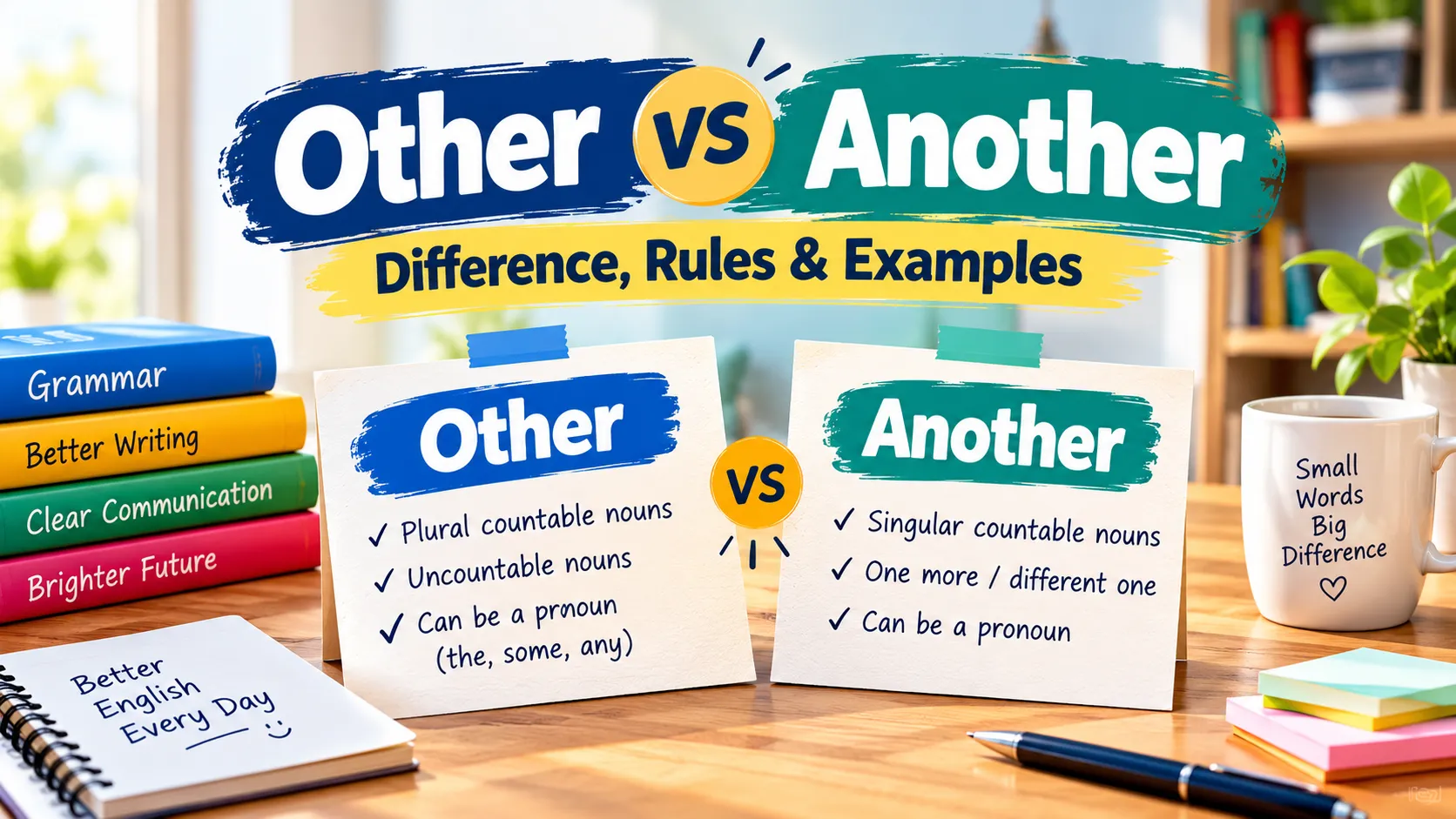
Other vs Another is a common English grammar topic that confuses students, English learners, writers, and even fluent speakers. Both words refer to something different or additional, but they follow different grammatical rules.
Use another with a singular countable noun when you mean one more or a different one. Use other with plural countable nouns and uncountable nouns. You can also use other as a pronoun with words such as the, some, and any.
For example:
- Can I have another cup of coffee?
- Do you have other questions?
- We need other information before making a decision.
Understanding the difference between other and another will help you write clearer sentences, speak more naturally, and avoid common grammar mistakes.
What Is the Difference Between Other and Another?
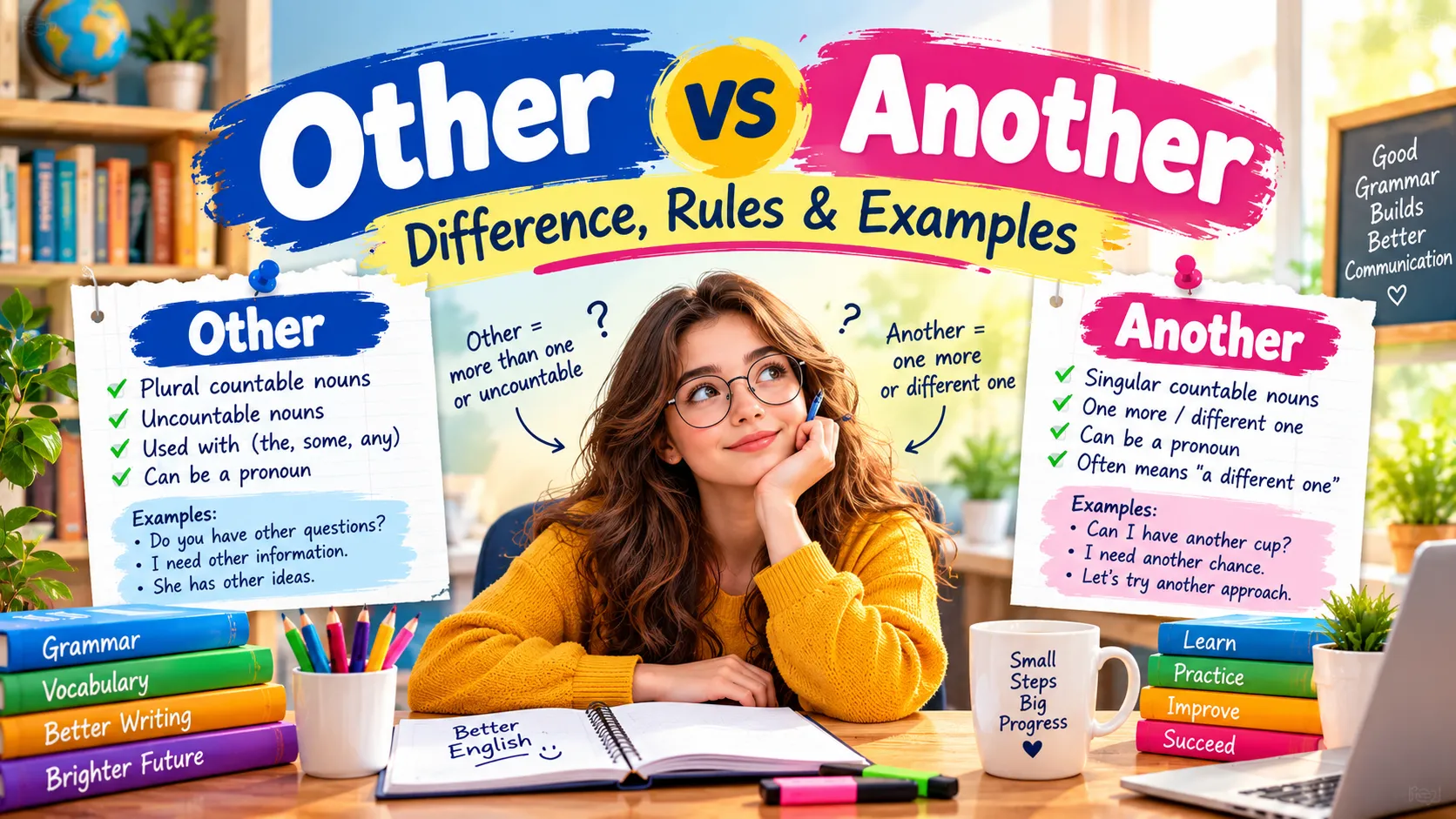
The main difference between other and another involves the number and type of noun that follows each word.
| Word | Meaning | Common Usage | Example |
| Another | One more or a different one | Singular countable nouns | I need another pen. |
| Other | Additional or different | Plural countable nouns and uncountable nouns | I need other pens. |
| The other | The remaining one or group | Singular or plural nouns | The other door is locked. |
| Others | Additional or different people or things | Pronoun without a following noun | Some students passed; others failed. |
Quick rule: Use another + singular countable noun, other + plural countable noun, and other + uncountable noun.
Examples:
- I want another sandwich.
- I want other sandwiches.
- I need other advice.
Explore More: https://wordminto.com/direct-vs-indirect-speech/
What Does Another Mean?
Another is a determiner or pronoun that means “one more,” “an additional one,” or “a different one.”
It combines the meaning of an and other. For this reason, we generally use another directly before a singular countable noun.
Examples of Another in Sentences
- Can I have another glass of water?
- She bought another dress for the party.
- We need another day to finish the project.
- Please give me another example.
- He wants another chance to prove himself.
- Would you like another cup of tea?
- I read another chapter before bed.
- Let’s try another method.
In each sentence, another refers to one additional item, opportunity, or unit.
Another as a Pronoun
You can use another without repeating a noun when the meaning remains clear.
Examples:
- This pen does not work. Please give me another.
- I do not like this seat. Can I take another?
- One student answered the question, and another asked a follow-up question.
In the first two examples, another replaces a singular countable noun.
Can Another Mean Different?
Yes. Another can mean a different one, not just an additional one.
Examples:
- This restaurant is too crowded. Let’s try another.
- I do not like this design. Show me another.
- We should consider another approach.
Here, the speaker wants a different restaurant, design, or approach.
Explore More: https://wordminto.com/sentence-fragments/
What Does Other Mean?
Other is a determiner or adjective-like modifier that refers to additional people or things, or people or things that differ from those already mentioned.
Unlike another, other commonly appears before plural countable nouns and uncountable nouns. It can also appear before a singular noun when a determiner such as the, my, or any comes before it.
Examples of Other in Sentences
- I have other plans for the weekend.
- She enjoys reading other types of books.
- We need other information to complete the report.
- Do you have other questions?
- He prefers other brands of coffee.
- Other students arrived late.
- I have other responsibilities at work.
- They explored other parts of the city.
These examples refer to additional plans, information, questions, students, and things.
Other Before Singular Nouns
You can use other before a singular countable noun when another determiner comes first.
Examples:
- The other student knows the answer.
- My other brother lives abroad.
- Any other person can apply.
- This other option costs less.
Notice that we say the other student, not other student, when we mean one specific student.
Explore More: https://wordminto.com/quotation-marks-rules/
Other vs Another: Key Grammar Rules
Rule 1: Use Another With Singular Countable Nouns
Use another when you refer to one additional or different person or thing.
Correct examples:
- I need another pencil.
- She wants another opportunity.
- He ordered another burger.
- We have another meeting tomorrow.
Incorrect: I need another pencils.
Correct: I need another pencil.
Correct alternative: I need other pencils.
Rule 2: Use Other With Plural Countable Nouns
Use other before plural countable nouns when you refer to additional or different items or people.
Examples:
- We visited other countries.
- She bought other shoes.
- Other employees attended the meeting.
- They considered other solutions.
Incorrect: She bought other shoe.
Correct: She bought other shoes.
If you mean one specific remaining shoe, you can say the other shoe.
Rule 3: Use Other With Uncountable Nouns
Use other with uncountable nouns such as information, advice, furniture, equipment, and money.
Examples:
- I need other information.
- She gave me other advice.
- We purchased other equipment.
- They need other furniture for the office.
Avoid using another directly before an uncountable noun in its ordinary sense.
Incorrect: I need another information.
Correct: I need other information.
You can also say another piece of information because piece is a singular countable noun.
Rule 4: Use The Other for a Specific Remaining Item
Use the other when you mean the remaining person or thing in a known set, or a particular alternative.
Examples:
- I have two bags. One is black, and the other is white.
- She held a book in one hand and a phone in the other.
- One child stayed home, while the other child went to school.
Use the others when you refer to the remaining people or things in a plural group.
Example: Three students left early, but the others stayed until the end.
Rule 5: Use Others Without a Noun
Others is a plural pronoun. It replaces a plural noun, so you do not normally place a noun directly after it.
Examples:
- Some people like tea; others prefer coffee.
- A few students finished early, while others needed more time.
- Some products are expensive, but others are affordable.
Incorrect: Others students arrived late.
Correct: Other students arrived late.
Correct: Others arrived late.
Use other students when a noun follows, and others when the pronoun stands alone.
Rule 6: Use Another With Numbers and Measurements
You can use another before a number or quantity to express an additional amount of time, distance, or a similar unit.
Examples:
- We need another two hours.
- The hotel is another five miles away.
- She stayed for another three days.
- Please wait another ten minutes.
Although the number refers to multiple units, another means an additional amount or period.
Explore More: https://wordminto.com/speak-vs-talk/
Other vs Another vs The Other vs Others
These four expressions have related meanings, but their grammatical roles differ.
| Expression | Main Meaning | Example |
| Another | One more or a different one | I need another chair. |
| Other | Additional or different | I need other chairs. |
| The other | A specific remaining one or group | The other chair is broken. |
| Others | Additional or different people or things | Some chairs are new; others are old. |
| The others | The remaining people or things in a known group | Two chairs are missing; the others are here. |
Compare the Examples
Another: I have one notebook, but I want another notebook.
This means you want one additional notebook.
Other: I have some notebooks, but I want other notebooks.
This means you want different or additional notebooks.
The other: I have two notebooks. One is blue, and the other is red.
This identifies the second notebook in a set of two.
Others: Some notebooks have lined pages; others have blank pages.
This uses others to replace the noun notebooks.
The others: Five notebooks were on the table. Two were mine, and the others belonged to my classmates.
This identifies the remaining notebooks.
Explore More: https://wordminto.com/me-vs-i/
Other vs Another in Everyday English
Restaurant
- Could I have another glass of water?
- Do you have other vegetarian options?
- The other table is available.
- Some guests ordered coffee; others ordered tea.
School
- I need another notebook.
- The teacher gave us other exercises.
- The other student answered correctly.
- Some students chose science; others chose mathematics.
Work
- We need another meeting.
- Please review the other documents.
- The other manager will contact you.
- Some employees work remotely; others work in the office.
While Shopping
- Can I try another size?
- Do you have other colors?
- The other pair of shoes is cheaper.
- Some customers prefer online shopping; others visit physical stores.
These examples show how the correct expression depends on whether you mean one more item, multiple items, a specific remaining item, or a group of people or things.
Common Mistakes With Other and Another
English learners often confuse these words because both can describe something additional or different. The following mistakes illustrate their correct usage.
Mistake 1: Using Another With a Plural Noun
Incorrect: I bought another books.
Correct: I bought other books.
Correct alternative: I bought another book.
Explanation: Another normally takes a singular countable noun, while other can modify plural countable nouns.
Mistake 2: Using Other Without a Determiner Before a Singular Noun
Incorrect: I spoke to other teacher.
Correct: I spoke to another teacher.
Correct alternative: I spoke to the other teacher.
Explanation: Use another teacher for one additional or different teacher. Use the other teacher for a particular teacher identified by the context.
Mistake 3: Using Another With an Uncountable Noun
Incorrect: Please give me another advice.
Correct: Please give me other advice.
Correct alternative: Please give me another piece of advice.
Explanation: Advice is uncountable in standard English. Use other advice or add a countable unit such as piece.
Mistake 4: Using Others Before a Noun
Incorrect: Others people disagree.
Correct: Other people disagree.
Correct alternative: Others disagree.
Explanation: Other modifies a noun, while others functions as a pronoun.
Mistake 5: Confusing The Other and Another
Incorrect for two known options: One road leads to the station, and another leads to the airport. (This sentence can be grammatical, but it does not specifically identify the second road as the remaining one.)
Clearer when referring to two known roads: One road leads to the station, and the other leads to the airport.
Explanation: The other identifies the remaining member of a known set. Another introduces an additional or different option.
Mistake 6: Forgetting the Before Other
Incorrect: Other side of the road is closed.
Correct: The other side of the road is closed.
Explanation: Use the when you identify a specific side of a known road.
Is Another Singular or Plural?
Another normally takes a singular countable noun, but it can appear before a plural quantity.
Examples:
- I need another ticket.
- We need another three tickets.
- She will stay another two weeks.
In the first sentence, another modifies the singular noun ticket. In the other sentences, another means an additional quantity of three tickets or two weeks.
Is Other Singular or Plural?
Other itself does not have a fixed singular or plural form in every construction. Its use depends on the noun and any determiner that precedes it.
Examples:
- Other students arrived. — plural noun
- Other information is available. — uncountable noun
- The other student arrived. — singular noun
- My other friend called. — singular noun
- The other students arrived. — plural noun
Remember that other can modify a singular noun when a determiner such as the, my, or any comes before it.
Can You Say Another One?
Yes. Another one is grammatically correct and very common in everyday English.
Examples:
- This cookie tastes great. Can I have another one?
- I lost my pen, so I bought another one.
- That movie was boring. Let’s watch another one.
Here, one replaces a singular countable noun. The phrase avoids repeating the noun while keeping the meaning clear.
You can also say the other one when you mean a specific remaining item.
Example: I have two keys. One opens the front door, and the other one opens the garage.
Other vs Another: Quick Comparison
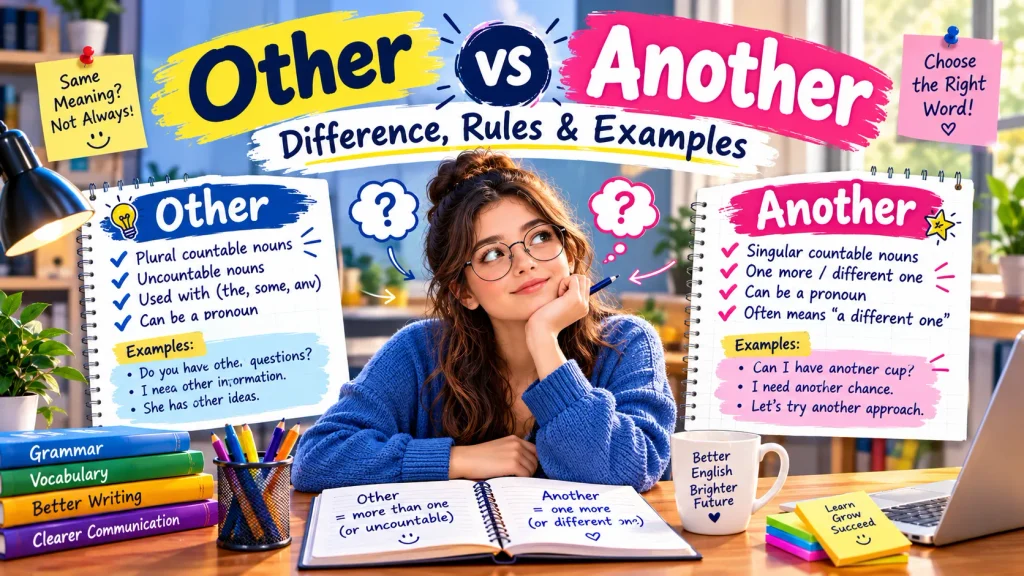
Use this table to review the main rules.
| Situation | Correct Expression | Example |
| One additional book | Another book | I need another book. |
| Several different books | Other books | I want other books. |
| One specific remaining book | The other book | The other book is mine. |
| Additional information | Other information | We need other information. |
| One additional piece of information | Another piece of information | Please share another piece of information. |
| Additional people without a noun | Others | Some left; others stayed. |
| Remaining people in a known group | The others | The others are waiting. |
| One additional two-hour period | Another two hours | We waited another two hours. |
Practice Exercises: Other vs Another
Choose the correct word or expression to complete each sentence.
- I would like ______ cup of coffee.
- She has ______ friends in London.
- One shoe is black, and ______ shoe is white.
- We need ______ information about the course.
- Some children were playing outside; ______ were reading.
- Could you give me ______ example?
- The first restaurant was crowded, so we tried ______ restaurant.
- Three students left early, but ______ stayed.
- I have two phones. One is new, and ______ is old.
- Please show me ______ options.
- We need ______ five minutes to finish.
- I bought ______ piece of furniture for the living room.
Answers and Explanations
- Another — Cup is a singular countable noun.
- Other — Friends is a plural countable noun.
- The other — It identifies the remaining shoe in a pair.
- Other — Information is uncountable.
- Others — The pronoun replaces children.
- Another — Example is a singular countable noun.
- Another — It introduces a different restaurant.
- The others — It identifies the remaining students in the group.
- The other — It identifies the second phone in a set of two.
- Other — Options is a plural countable noun.
- Another — It expresses an additional period of five minutes.
- Another — Piece is a singular countable noun, so another piece of furniture is correct.
People Also Ask
Another means one more or a different one and normally comes before a singular countable noun. Other refers to additional or different things and commonly comes before plural countable nouns or uncountable nouns.
Examples: another student, other students, and other information.
Other people is correct when you mean additional or different people.
Example: Other people may have different opinions.
Use another person when you mean one additional or different individual.
Other information is correct because information is uncountable.
You can also say another piece of information.
Yes, in certain constructions, another can precede a number and a plural noun.
Examples:
Another three students arrived.
We need another two days.
However, do not use another directly before a plural noun without this quantity construction. Say another student or other students.
Other normally modifies a noun, while others replaces a plural noun.
Examples:
Other students passed the exam.
Some students passed the exam; others failed.
Conclusion
The difference between Other vs Another becomes simple when you focus on meaning, noun type, and context. Use another for one additional or different item; other for additional or different things and uncountable nouns; the other for a specific remaining item or group, and others when a plural pronoun replaces a noun.
Remember these examples:
- I need another pen.
- I need other pens.
- The other pen is blue.
- Some pens are blue; others are black.
Practice these patterns in your writing and everyday conversations to use both words accurately and confidently.










3 thoughts on “Other vs Another: Difference, Meaning, Rules, and Examples”