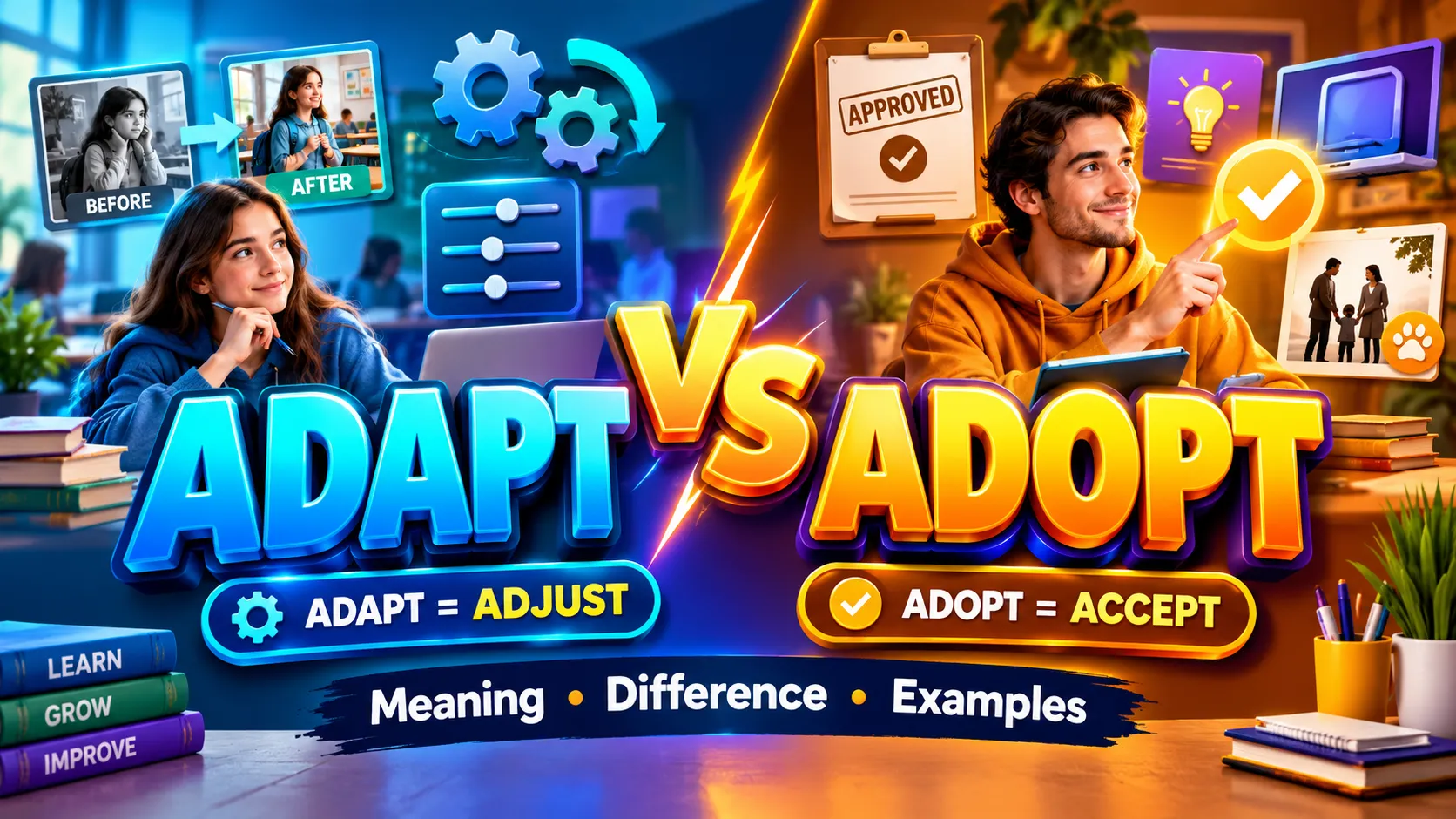
Adapt vs Adopt: “Adapt” and “adopt” look similar and sound somewhat alike, but they have different meanings. Adapt means to change something or adjust to a new situation, while adopt means to accept, choose, or begin using something.
Writers and English learners often confuse these verbs because both describe responding to something new. However, each verb serves a different purpose in everyday conversations, academic writing, business communication, and formal English.
In this guide, you will learn the difference between adapt and adopt, their definitions, grammar rules, examples, common mistakes, and practical exercises.
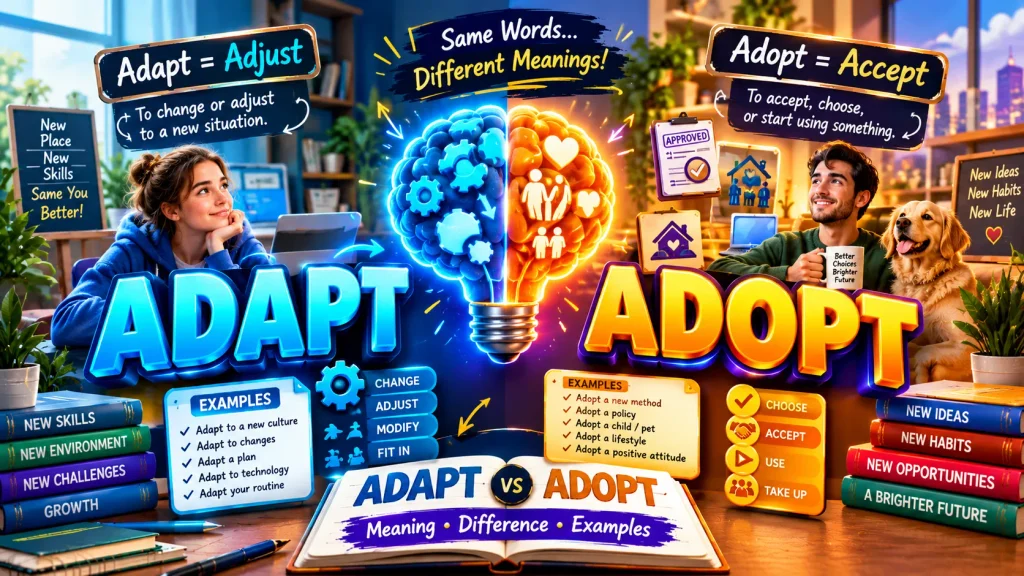
Adapt vs Adopt: Quick Difference
| Word | Meaning | Example |
| Adapt | To change or adjust to a situation | We must adapt to new technology. |
| Adopt | To accept, choose, or start using something | We decided to adopt new technology. |
Easy way to remember:
- Adapt = Adjust. You change to fit a situation.
- Adopt = Accept. You choose or take something as your own.
For example, a student may adapt to a new school schedule but adopt a new study method.
Explore More: https://wordminto.com/can-vs-could/
What Does Adapt Mean?
Adapt means to change something or adjust yourself to suit new conditions, circumstances, or requirements.
You can use “adapt” when a person, animal, organization, or object changes to fit a different environment or purpose.
Examples of Adapt in Sentences
- Children adapt quickly to new environments.
- I had to adapt to my new job.
- Plants adapt to different weather conditions.
- The company adapted its strategy to meet customer needs.
- The director adapted the novel for television.
- We must adapt our teaching methods to help different learners.
In these examples, someone or something changes, adjusts, or modifies an approach to suit a particular need.
Common Uses of Adapt
1. Adapt to a situation
Use this expression when someone adjusts to new conditions.
- She adapted to life in a new country.
- Employees must adapt to workplace changes.
- It took me a few weeks to adapt to my new routine.
2. Adapt something for a purpose
Use this expression when someone modifies something to make it suitable for a particular use.
- The teacher adapted the lesson for younger students.
- We adapted the design for mobile devices.
- The author adapted the story for the stage.
3. Adapt something to something
Use this structure when you change something to meet particular needs or conditions.
- The school adapted its rules to local requirements.
- The engineer adapted the equipment to the project’s needs.
Explore More: https://wordminto.com/other-vs-another/
What Does Adopt Mean?
Adopt means to accept, choose, take up, or begin using something. It can also mean to legally become the parent of a child.
Use “adopt” when a person or organization accepts an idea, method, policy, practice, or responsibility. You can also use it when someone legally takes a child into their family.
Examples of Adopt in Sentences
- Our company adopted a new marketing strategy.
- She adopted a healthier lifestyle.
- The school adopted a new teaching method.
- They decided to adopt a child.
- The committee adopted the proposed resolution.
- He adopted a positive attitude toward learning.
In these sentences, someone chooses, accepts, or takes on something rather than simply adjusting to it.
Common Uses of Adopt
1. Adopt an idea or method
Use this expression when someone accepts or begins using an idea, approach, or technique.
- The team adopted a different approach.
- Many teachers adopt interactive learning methods.
- We adopted a new system to manage our work.
2. Adopt a policy or rule
Use this expression when an organization officially accepts a policy, rule, or proposal.
- The government adopted a new policy.
- The school adopted stricter safety rules.
- The board adopted the proposal unanimously.
3. Adopt a child or animal
Use this expression when someone legally takes a child into their family or gives an animal a permanent home through adoption.
- They hope to adopt a child next year.
- We adopted a dog from an animal shelter.
- My neighbors adopted two kittens.
4. Adopt an attitude or behavior
Use this expression when someone begins to show a particular attitude or behavior.
- She adopted a calm attitude during the crisis.
- He adopted a more professional manner at work.
Explore More: https://wordminto.com/direct-vs-indirect-speech/
Adapt vs Adopt: Key Differences
Although both words describe responses to new circumstances, they emphasize different actions.
| Feature | Adapt | Adopt |
| Main meaning | Change or adjust | Accept or take up |
| Main action | Modify something or adjust yourself | Choose or begin using something |
| Common structure | Adapt to change | Adopt a method |
| Personal example | Adapt to a new culture | Adopt new habits |
| Business example | Adapt a product for customers | Adopt a new business strategy |
| Family example | Adapt to parenthood | Adopt a child |
Compare These Examples
1: Technology
- We adapted to the new software. (We learned to work with it.)
- We adopted the new software. (We chose to start using it.)
2: Education
- The teacher adapted the lesson for beginners. (The teacher modified the lesson.)
- The teacher adopted a new teaching method. (The teacher chose to use a different method.)
3: Lifestyle
- He adapted to life in the city. (He adjusted to city life.)
- He adopted a healthier lifestyle. (He began following healthier habits.)
These examples show that the same topic can work with both verbs, but each verb communicates a different action.
Explore More: https://wordminto.com/sentence-fragments/
Adapt vs Adopt: Grammar Rules
Both “adapt” and “adopt” function as verbs. They can take objects, and “adapt” commonly appears with the preposition “to.”
1. Adapt + to + Noun
Use this structure when someone adjusts to a situation, environment, or change.
Structure: Subject + adapt + to + noun
Examples:
- I adapted to the new schedule.
- She adapts to change easily.
- They will adapt to their new surroundings.
2. Adapt + Object
Use this structure when someone changes or modifies something.
Structure: Subject + adapt + object
Examples:
- We adapted the plan.
- The editor adapted the article.
- They adapted the equipment.
You can also use “adapt something for” or “adapt something to” when you explain its intended purpose or requirements.
- We adapted the room for wheelchair access.
- The company adapted the product to local needs.
3. Adopt + Object
Use this structure when someone accepts, chooses, or begins using something.
Structure: Subject + adopt + object
Examples:
- They adopted a new policy.
- I adopted a better study routine.
- The organization adopted the proposal.
4. Adapt and Adopt in Different Tenses
| Tense | Adapt | Adopt |
| Present | I adapt quickly. | I adopt new methods. |
| Past | I adapted quickly. | I adopted a new method. |
| Present perfect | I have adapted well. | I have adopted a new method. |
| Future | I will adapt soon. | I will adopt the policy. |
| Present continuous | I am adapting to change. | I am adopting a new approach. |
Remember that both verbs form their simple past and past participle by adding -ed.
- Adapt → adapted → adapted
- Adopt → adopted → adopted
Explore More: https://wordminto.com/quotation-marks-rules/
Adapt vs Adopt: Common Mistakes
English learners sometimes choose the wrong verb because the words share similar spelling. Here are common errors and their corrections.
Mistake 1: Using Adopt Instead of Adapt
Incorrect: She adopted to her new school.
Correct: She adapted to her new school.
Why? “Adapt to” means to adjust to a new situation. “Adopt to” does not work in this context.
Mistake 2: Using Adapt Instead of Adopt
Incorrect: The company adapted a new policy.
Correct: The company adopted a new policy.
Why? The company accepted and began using the policy, so “adopted” is the correct choice.
Mistake 3: Confusing Changes with Choices
Incorrect: We adopted the training material to suit beginners.
Correct: We adapted the training material to suit beginners.
Why? The team modified the material to make it suitable for beginners.
Mistake 4: Confusing Adjustment with Acceptance
Incorrect: The school adapted a new code of conduct.
Correct: The school adopted a new code of conduct.
Why? The school accepted the code. If the school changed an existing code to meet specific needs, “adapted” could be correct.
Mistake 5: Using the Wrong Verb for Habits
Incorrect: He adapted a healthier lifestyle.
Correct: He adopted a healthier lifestyle.
Why? He began following a healthier way of living rather than adjusting an existing lifestyle to new conditions.
Explore More: https://wordminto.com/speak-vs-talk/
Adapt vs Adopt in Everyday English
These verbs appear in many areas of everyday life. Understanding their context makes the difference easier to remember.
Education
- Students adapt to a new learning environment.
- Students adopt effective study habits.
- Teachers adapt lessons to students’ needs.
- Schools adopt new educational policies.
Business
- Businesses adapt to changing market conditions.
- Companies adopt new technologies.
- Managers adapt their communication styles to their teams.
- Organizations adopt new workplace policies.
Technology
- Users adapt to a redesigned interface.
- Businesses adopt cloud-based software.
- Developers adapt applications for mobile devices.
- Companies adopt stronger cybersecurity practices.
Personal Life
- People adapt to living in a new city.
- Individuals adopt healthier habits.
- Families adapt to changing circumstances.
- Couples may adopt new routines to manage their time.
Nature
- Animals adapt to their environments over generations.
- Farmers may adopt sustainable farming practices.
- Plants adapt to environmental conditions.
- Conservation organizations adopt new protection strategies.
In biological contexts, adaptation can describe inherited changes across generations. Individual organisms can also adjust their behavior or physiology within their lifetimes.
Explore More: https://wordminto.com/me-vs-i/
Adapt vs Adopt: Examples in Sentences
Review these examples to see how the words work in different contexts.
Adapt Examples
- She adapted to her new responsibilities quickly.
- We need to adapt our plans because of the weather.
- The company adapted its services to customer demands.
- Children often adapt to new routines with time.
- The filmmaker adapted the book into a movie.
- He found it difficult to adapt to working remotely.
- The school adapted the examination for students with specific needs.
- Businesses must adapt to changing consumer preferences.
- The animal adapted to its surroundings.
- I adapted my writing style for a younger audience.
Adopt Examples
- The company adopted a new marketing strategy.
- They decided to adopt a rescue cat.
- Our school adopted a revised attendance policy.
- She adopted a more positive attitude.
- The committee adopted the recommendation.
- He adopted a daily reading habit.
- Many organizations adopt digital tools to improve efficiency.
- The couple plans to adopt a child.
- The team adopted a practical approach to problem-solving.
- The government adopted new environmental regulations.
Adapt vs Adopt: How to Remember the Difference
Use these simple memory tricks to choose the correct word.
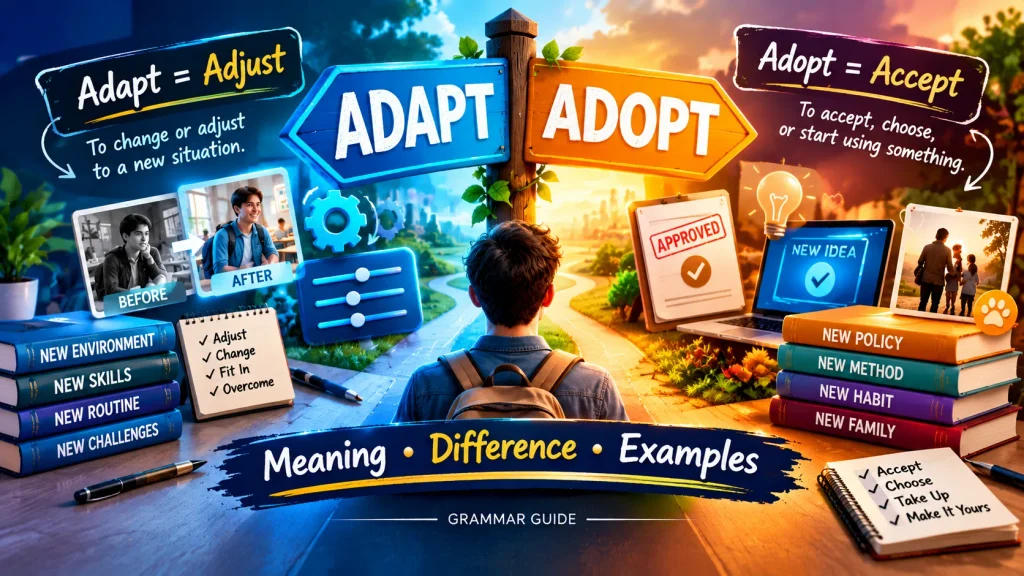
Adapt = Adjust
Both words begin with “A,” but focus on the shared idea of adjustment to remember “adapt.”
Example: You adapt to a new job by learning its routines and responsibilities.
Adopt = Accept
Think of adopting a new idea as accepting it and beginning to use it.
Example: You adopt a new work schedule when you decide to follow it.
A Simple Question to Ask Yourself
Before choosing a word, ask:
- Am I changing or adjusting something? Use adapt.
- Am I accepting, choosing, or beginning to use something? Use adopt.
Compare:
- She adapted to the new rules. (She adjusted to them.)
- She adopted the new rules. (She accepted or implemented them.)
The context determines which verb fits.
Adapt vs Adopt: Synonyms
Synonyms can help you understand each word’s meaning, but not every synonym works in every sentence.
| Adapt synonyms | Adopt synonyms |
| Adjust | Accept |
| Modify | Embrace |
| Alter | Choose |
| Accommodate | Implement |
| Tailor | Take up |
| Revise | Make one’s own |
For example, you can modify a lesson, so “adapt” may fit. You can accept a proposal, so “adopt” may fit.
However, “implement” usually refers to putting a plan or policy into action, while “adopt” can refer to accepting it in the first place.
Adapt vs Adopt: Practice Exercises
Test your understanding by choosing the correct word in each sentence.
Choose the correct word
0 of 8
1. It took Maria several weeks to ___ to her new workplace.
adapt
adopt
2. The school decided to ___ a new attendance policy.
adapt
adopt
3. We need to ___ this lesson for younger students.
adapt
adopt
4. They hope to ___ a child next year.
adapt
adopt
5. Many businesses ___ new technologies to improve efficiency.
adapt
adopt
6. Animals must ___ to changes in their environment.
adapt
adopt
7. He decided to ___ a healthier lifestyle.
adapt
adopt
8. The publisher will ___ the novel for younger readers.
adapt
adopt
Check answers
People Also Ask
Adapt means to change or adjust to new conditions. Adopt means to accept, choose, or begin using something. For example, you adapt to a new job but adopt a new work routine.
Use adapt to when you mean adjust to a situation.
Correct: She adapted to her new environment.
“Adopt” usually takes a direct object when it means accept or begin using something.
Correct: She adopted a new approach.
Yes. You can adopt a new system and then adapt to it.
Example: “The company adopted new software, and its employees adapted to the new system.”
Not exactly. Adopt generally means accept, choose, or begin using something. Adapt means change or adjust something to suit new conditions.
Businesses adapt when they adjust their strategies, products, or operations to changing conditions. They adopt when they accept or begin using a new policy, technology, or business practice.
The past tense of adapt is adapted, and the past tense of adopt is adopted.
Examples:
We adapted to the new schedule.
We adopted a new schedule.
Conclusion
The difference between Adapt vs Adopt becomes simple when you focus on the action each word describes. Adapt means to change or adjust to new circumstances, while adopt means to accept, choose, or begin using something.
Remember these examples: you adapt to change, adapt a lesson, adopt a policy, and adopt a habit.
Use “Adapt” when adjustment or modification matters. Use “Adopt” when acceptance or choice matters. With regular practice, you can use both verbs confidently in conversations, academic assignments, and professional writing.











2 thoughts on “Adapt vs Adopt: Meaning, Difference, Examples, and Usage”