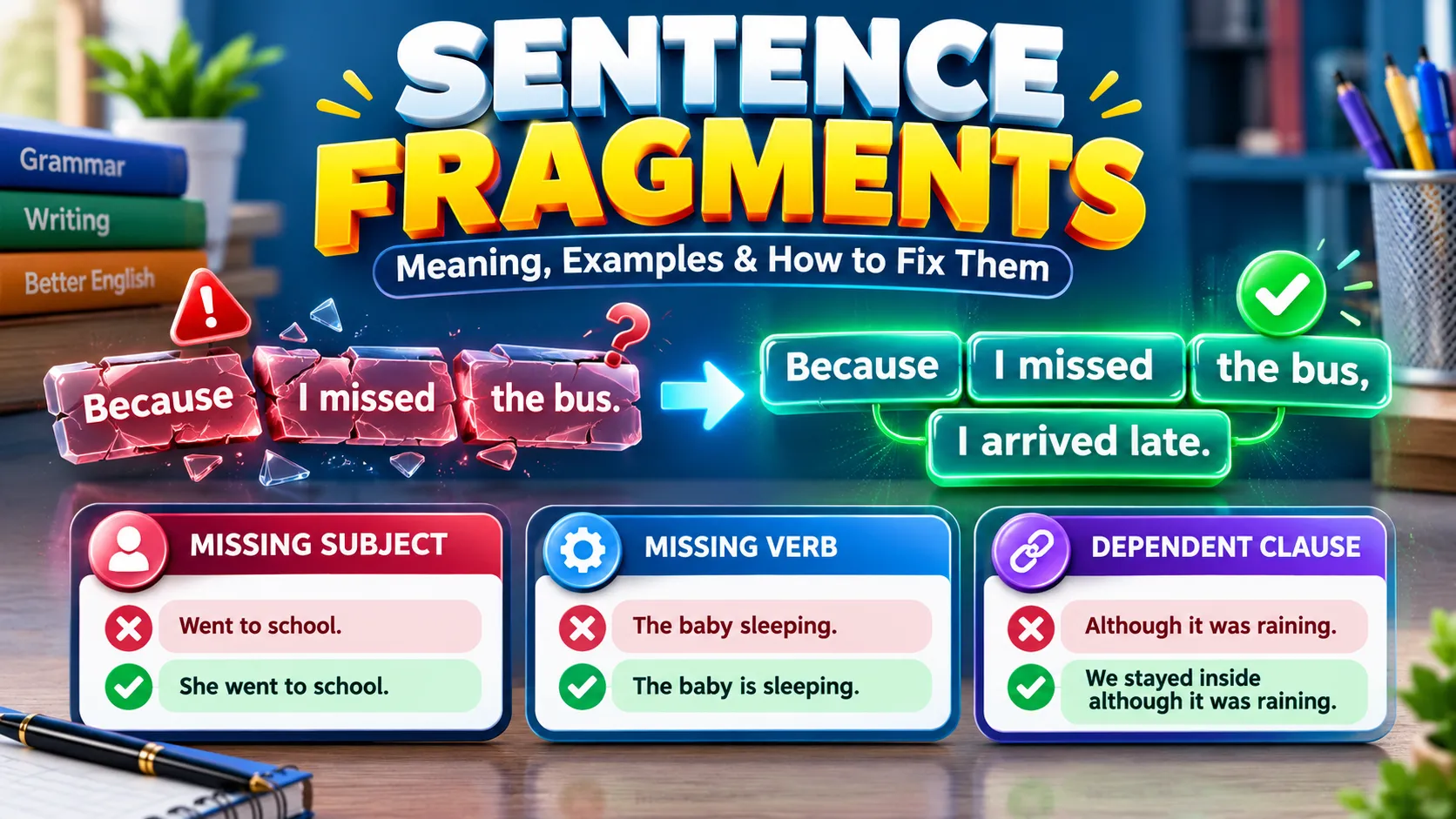
Sentence Fragments: A sentence fragment is a group of words that looks like a complete sentence but does not express a complete thought. It may lack a subject, a main verb, or an independent clause. Writers often use sentence fragments accidentally in essays, academic assignments, professional emails, and everyday writing.
For example:
- Sentence fragment: Because I missed the bus.
- Complete sentence: Because I missed the bus, I arrived late for school.
The first example leaves the reader wondering what happened because the writer has not completed the thought. The second example adds an independent clause and communicates a complete idea.
Understanding sentence fragments helps students, teachers, ESL learners, and professional writers improve sentence structure, clarity, and grammatical accuracy. This guide explains sentence fragments, their types, how to identify them, common mistakes, and practical ways to correct them.
What Is a Sentence Fragment?
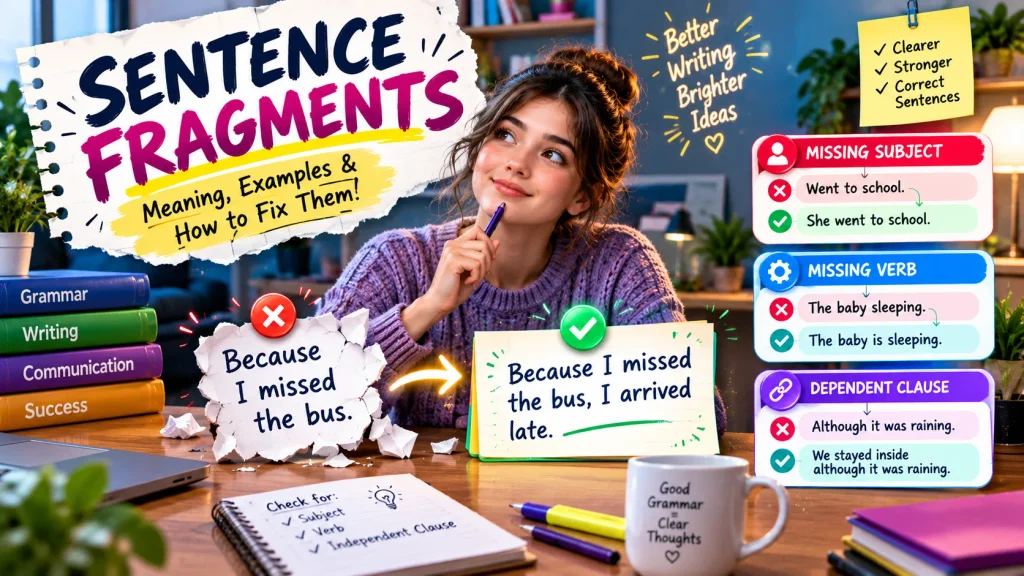
A sentence fragment is an incomplete sentence that cannot stand alone as a grammatically complete statement in its intended context. It often lacks a subject, a complete verb, or a complete independent clause.
A complete sentence generally expresses a complete thought and contains an independent clause with a subject and a predicate.
Examples:
| Sentence fragment | Correct sentence |
| Running through the park. | The children are running through the park. |
| When the teacher arrived. | Everyone became quiet when the teacher arrived. |
| The girl with the red backpack. | The girl with the red backpack won the race. |
| Because he was tired. | He went to bed early because he was tired. |
| Waiting for the train. | We were waiting for the train. |
A fragment may contain several words and communicate some meaning, but it still fails to function as a complete sentence in standard formal writing.
Explore More: https://wordminto.com/quotation-marks-rules/
What Is the Difference Between a Sentence and a Sentence Fragment?
A complete sentence expresses a finished idea, while a sentence fragment leaves an essential part of the idea missing.
Consider these examples:
- Complete sentence: Maria finished her homework before dinner.
- Sentence fragment: Before dinner.
- Complete sentence: The dog barked loudly at the stranger.
- Sentence fragment: Barked loudly at the stranger.
- Complete sentence: Although the weather was cold, we went outside.
- Sentence fragment: Although the weather was cold.
The key difference is grammatical completeness, not length. A short sentence such as “Stop!” is complete because it contains an understood subject (you) and expresses a complete command. A long group of words can still be a fragment if it does not form an independent clause.
Types of Sentence Fragments
Writers create sentence fragments in several ways. Recognizing each type makes it easier to correct incomplete sentences.
1. Subject Fragments
A subject fragment names a person, place, thing, or idea but does not provide a complete predicate that tells the reader something about it.
Examples:
- Fragment: The tall building near the river.
- Correct: The tall building near the river overlooks the city.
- Fragment: My younger brother, who lives in London.
- Correct: My younger brother, who lives in London, visits us every summer.
- Fragment: The students in the back row.
- Correct: The students in the back row asked several questions.
How to fix it: Add a complete predicate that tells the reader what the subject does, what happens to it, or what it is.
2. Verb Fragments
A verb fragment lacks a complete verb or uses a verb form that cannot independently function as the main verb of a sentence.
Examples:
- Fragment: The baby sleeping peacefully.
- Correct: The baby is sleeping peacefully.
- Fragment: She walking to the market.
- Correct: She is walking to the market.
- Fragment: They been waiting for an hour.
- Correct: They have been waiting for an hour.
A verb ending in -ing often needs a helping verb, such as is, are, was, or were, to form a complete progressive verb phrase.
However, not every verb ending in -ing creates a fragment. In “Swimming improves your health,” the word swimming functions as the subject, and the sentence expresses a complete thought.
3. Dependent Clause Fragments
A dependent clause contains a subject and a verb, but it cannot stand alone as a complete sentence because it depends on another clause to complete its meaning.
Common subordinating conjunctions include because, although, since, when, while, if, unless, before, and after.
Examples:
| Fragment | Correct sentence |
| Because I forgot my keys. | I could not enter the house because I forgot my keys. |
| Although she studied hard. | Although she studied hard, she found the exam difficult. |
| When the movie ended. | We went home when the movie ended. |
| If you need any help. | Call me if you need any help. |
| While everyone was sleeping. | The phone rang while everyone was sleeping. |
How to fix it: Connect the dependent clause to an independent clause that completes the thought.
Remember that words such as because and although do not always create fragments. They create dependent clauses when they introduce subordinate clauses, so check whether the entire sentence contains an independent clause.
4. Participial Phrase Fragments
A participial phrase begins with a participle, often an -ing form or a past-participle form. It describes a noun or pronoun but does not usually express a complete independent thought by itself.
Examples:
- Fragment: Walking along the beach at sunset.
- Correct: We enjoyed walking along the beach at sunset.
- Fragment: Exhausted after the long journey.
- Correct: Exhausted after the long journey, the travelers rested at the hotel.
- Fragment: Carrying a heavy suitcase.
- Correct: Daniel was carrying a heavy suitcase.
How to fix it: Attach the phrase to a complete independent clause or add a subject and a complete verb.
5. Infinitive Phrase Fragments
An infinitive phrase usually begins with to followed by the base form of a verb, such as to learn, to study, or to succeed. It can function as a noun, adjective, or adverb, but it does not normally form an independent sentence by itself.
Examples:
- Fragment: To improve my English grammar.
- Correct: I practice every day to improve my English grammar.
- Fragment: To win the competition.
- Correct: Our team trained hard to win the competition.
- Fragment: To finish the assignment before Friday.
- Correct: She worked late to finish the assignment before Friday.
How to fix it: Add an independent clause that explains who acts or why the action matters.
6. Appositive Phrase Fragments
An appositive identifies or describes a noun or pronoun. An appositive phrase alone does not usually form a complete sentence.
Examples:
- Fragment: My best friend, a talented musician.
- Correct: My best friend, a talented musician, performs at local events.
- Fragment: Mr. Ahmed, our English teacher.
- Correct: Mr. Ahmed, our English teacher, explained the lesson clearly.
- Fragment: Paris, the capital of France.
- Correct: Paris, the capital of France, attracts millions of visitors.
How to fix it: Add a main verb and the rest of the predicate needed to complete the thought.
7. Prepositional Phrase Fragments
A prepositional phrase begins with a preposition, such as in, on, at, under, beside, after, or during. It provides information about location, time, direction, or relationships, but it cannot usually function as a complete sentence by itself.
Examples:
- Fragment: Under the old wooden bridge.
- Correct: The children played under the old wooden bridge.
- Fragment: After the final examination.
- Correct: We celebrated after the final examination.
- Fragment: In the middle of the classroom.
- Correct: A large table stood in the middle of the classroom.
How to fix it: Add a complete independent clause that explains what happened, where something exists, or what someone did.
Explore More: https://wordminto.com/speak-vs-talk/
Common Causes of Sentence Fragments
Sentence fragments often occur when writers mistake a phrase or dependent clause for a complete sentence.
The following table summarizes the most common causes.
| Cause | Example of a fragment | Correction |
| Missing subject | Went to the library. | She went to the library. |
| Missing main verb | The children in the garden. | The children are in the garden. |
| Missing helping verb | He working on his project. | He is working on his project. |
| Dependent clause alone | Because it was raining. | We stayed inside because it was raining. |
| Participial phrase alone | Covered in fresh snow. | The mountains were covered in fresh snow. |
| Infinitive phrase alone | To achieve her goals. | She worked hard to achieve her goals. |
| Prepositional phrase alone | Near the main entrance. | The office is near the main entrance. |
Explore More: https://wordminto.com/me-vs-i/
How to Fix Sentence Fragments
You can correct most sentence fragments by adding missing information or connecting the fragment to a complete sentence. Choose the correction that preserves your intended meaning.
Method 1: Add a Missing Subject
A sentence needs a subject, either explicitly stated or understood from the grammatical construction.
Incorrect: Went to the grocery store to buy milk.
Correct: My mother went to the grocery store to buy milk.
The corrected version identifies the person who acted.
Method 2: Add a Complete Verb
Sometimes a group of words names a subject but does not tell the reader what the subject does or what happens to it.
Incorrect: The little boy with the blue shoes.
Correct: The little boy with the blue shoes won the race.
The verb won completes the predicate and turns the fragment into a sentence.
Method 3: Connect a Dependent Clause to an Independent Clause
A dependent clause needs a main clause when you intend to express a complete sentence.
Incorrect: Although the restaurant was crowded.
Correct: Although the restaurant was crowded, we found a table.
You can also reverse the clause order:
Correct: We found a table although the restaurant was crowded.
Both versions express a complete thought.
Method 4: Add a Helping Verb
An -ing verb form often needs a helping verb to function as the main verb of a progressive sentence.
Incorrect: The children playing outside.
Correct: The children are playing outside.
Other helping verbs include am, is, are, was, were, has, have, and had. Select the appropriate form based on the subject, tense, and intended meaning.
Method 5: Combine the Fragment With a Related Sentence
When a fragment relates closely to the preceding sentence, combining the two can improve flow and eliminate unnecessary repetition.
Incorrect:
I bought a new laptop. Because my old computer stopped working.
Correct:
I bought a new laptop because my old computer stopped working.
The corrected version connects the reason to the action it explains.
Method 6: Rewrite the Fragment as a Complete Sentence
You do not always need to preserve the original structure. Rewriting can produce a clearer result.
Incorrect: After finishing the project.
Correct: After finishing the project, Sara submitted her report.
Another option is:
Correct: Sara submitted her report after she finished the project.
Choose the version that best fits the surrounding paragraph.
Explore More: https://wordminto.com/look-vs-see-and-watch/
Sentence Fragments vs Run-On Sentences
Sentence Fragments and run-on sentences represent opposite problems. A fragment lacks a complete independent clause, while a run-on sentence improperly joins independent clauses.
| Feature | Sentence fragment | Run-on sentence |
| Main problem | Incomplete thought or clause | Incorrectly joined independent clauses |
| Example | Because I was hungry. | I was hungry I made a sandwich. |
| Correction | I made a sandwich because I was hungry. | I was hungry, so I made a sandwich. |
A comma splice is a related error that occurs when a writer joins two independent clauses with only a comma.
Comma splice: I was hungry, I made a sandwich.
Correct: I was hungry, so I made a sandwich.
Understanding these differences helps you diagnose sentence-level errors more accurately.
Sentence Fragments vs Complete Sentences
Consider the following examples to see how small grammatical changes can determine whether a sentence expresses a complete thought.
Fragment
The teacher explaining the lesson.
The phrase lacks a complete main verb.
Complete sentence
The teacher is explaining the lesson.
The subject and complete verb phrase form an independent clause.
Fragment
If we arrive before noon.
The conditional clause needs a main clause.
Complete sentence
If we arrive before noon, we can visit the museum.
The independent clause completes the conditional thought.
Can a Sentence Fragment Ever Be Correct?
Yes. Writers sometimes use intentional fragments in creative writing, advertising, dialogue, headlines, and informal communication.
For example:
- “What a beautiful day!”
- “No problem.”
- “Absolutely amazing!”
- “Never again.”
- “A moment to remember.”
These expressions can work as intentional fragments because context supplies the missing information or because the writer wants a particular stylistic effect.
However, you should distinguish intentional fragments from accidental grammatical errors. In formal essays, academic assignments, reports, and professional documents, use complete sentences unless the context calls for a deliberate fragment.
Also, not every short expression is grammatically incomplete. “Stop!” is a complete imperative sentence because English grammar allows an understood subject (you).
Sentence Fragments in Academic Writing
Sentence fragments can weaken academic writing because they interrupt the logical relationship between claims, evidence, and explanations.
Consider this example:
Incorrect:
The experiment produced unexpected results. Because the temperature changed during the test.
Correct:
The experiment produced unexpected results because the temperature changed during the test.
Another correct version is:
The temperature changed during the test. As a result, the experiment produced unexpected results.
The first correction combines the cause and result into one sentence. The second uses two complete sentences and makes the logical relationship explicit.
When proofreading academic writing, pay particular attention to sentences that begin with subordinating conjunctions, participial phrases, or infinitive phrases. These structures frequently create accidental fragments.
How to Identify Sentence Fragments
Use this practical checklist when reviewing your writing.
- Identify the subject of each sentence.
- Find the main verb or complete verb phrase.
- Check whether the sentence expresses a complete thought.
- Look for subordinating conjunctions such as because, although, when, and if.
- Check whether an -ing phrase lacks a helping verb or a main clause.
- Make sure descriptive phrases connect to an appropriate independent clause.
- Read the paragraph aloud to identify incomplete thoughts.
- Review each sentence in context before deciding whether to combine or rewrite it.
Important: Do not rely only on sentence length or punctuation. A period does not automatically make a group of words a complete sentence.
Common Mistakes With Sentence Fragments
Mistake 1: Assuming Every Group of Words With a Period Is a Sentence
Incorrect: The man standing near the door.
Correct: The man is standing near the door.
A period marks the end of a sentence, but it cannot supply a missing main verb.
Mistake 2: Starting a Sentence With “Because” Without Completing the Thought
Incorrect: Because she wanted to improve her grades.
Correct: She studied every evening because she wanted to improve her grades.
Starting a sentence with because is perfectly acceptable when the sentence also contains an independent clause.
Mistake 3: Confusing a Phrase With an Independent Clause
Incorrect: After the meeting ended.
Correct: We returned to our offices after the meeting ended.
The phrase after the meeting ended contains a dependent clause, not a complete independent clause.
Mistake 4: Using an -ing Form Without a Complete Verb Phrase
Incorrect: My friends watching a football match.
Correct: My friends are watching a football match.
However, the -ing form can also function as a noun or part of a descriptive phrase. Always examine the grammatical role of the word rather than correcting every -ing form automatically.
Mistake 5: Treating Every Short Sentence as a Fragment
Correct examples:
- Birds fly.
- She smiled.
- Come here.
- Who knows?
Each example can function as a complete sentence. A sentence needs grammatical completeness, not a minimum number of words.
Sentence Fragments Exercises
Test your understanding by identifying whether each example contains a complete sentence or a fragment. Then review the answers and explanations.
Practice quiz
0 of 10 answered
1. Because the train was late.
Complete sentence
Sentence fragment
2. The children played in the garden.
Complete sentence
Sentence fragment
3. Walking along the river at sunset.
Complete sentence
Sentence fragment
4. Although he felt nervous, he gave the speech.
Complete sentence
Sentence fragment
5. My sister studying for her examination.
Complete sentence
Sentence fragment
6. Please close the window.
Complete sentence
Sentence fragment
7. The book on the kitchen table.
Complete sentence
Sentence fragment
8. We stayed home because it was snowing.
Complete sentence
Sentence fragment
9. To finish the assignment before midnight.
Complete sentence
Sentence fragment
10. The baby cried loudly throughout the night.
Complete sentence
Sentence fragment
Check answers
Sentence Fragments Worksheet: Correct the Errors
Rewrite each fragment as a complete sentence. Suggested answers follow.
- Because I forgot my homework.
- The girl wearing a yellow dress.
- Walking to school every morning.
- Although the weather was very hot.
- To learn a new language.
- My father is working in the garden.
- After we finished our lunch.
- The old house at the end of the street.
- While the students were taking the test.
- Hoping to win the final match.
Answer Key
- I received a warning because I forgot my homework.
- The girl wearing a yellow dress won the competition.
- I enjoy walking to school every morning.
- Although the weather was very hot, we continued playing.
- She practices every day to learn a new language.
- My father is working in the garden.
- After we finished our lunch, we went for a walk.
- The old house at the end of the street belongs to my uncle.
- While the students were taking the test, the teacher checked their attendance.
- Hoping to win the final match, the players practiced for hours.
These answers provide one possible correction for each fragment. You can create other grammatically correct sentences that preserve the intended meaning.
People Also Ask
A sentence fragment is an incomplete sentence that does not express a complete thought in its intended context. For example, “Because I was tired” is a fragment when it stands alone. “I went to bed because I was tired” is a complete sentence.
Three common types are subject fragments, verb fragments, and dependent clause fragments. Writers also create fragments with participial phrases, infinitive phrases, appositives, and prepositional phrases.
Add the missing subject or verb, attach the fragment to a related independent clause, or rewrite it as a complete sentence. Choose the method that communicates your intended meaning clearly.
No. A sentence can start with because and remain grammatically complete if it includes an independent clause.
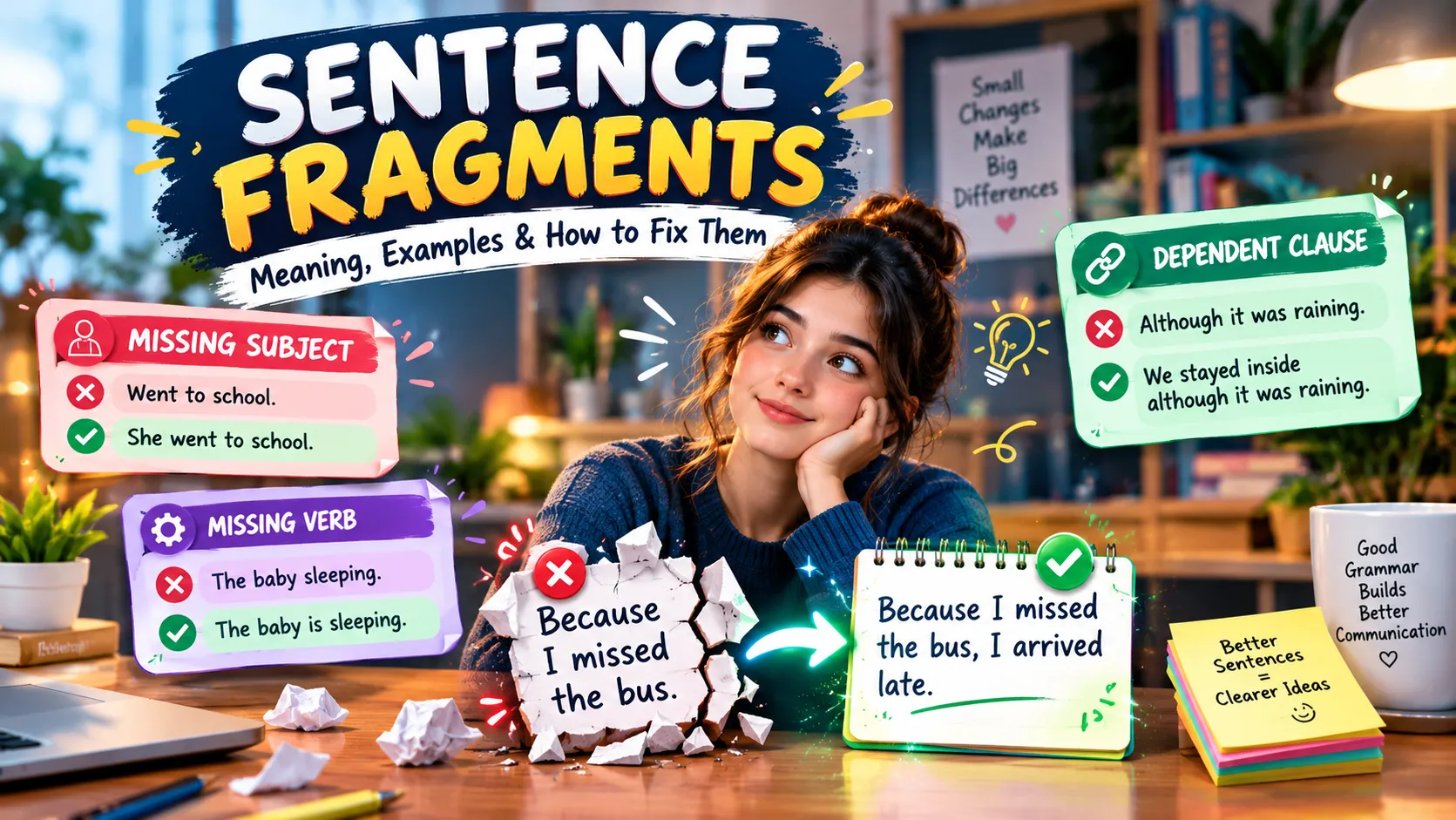
Fragment: Because I missed the bus.
Complete: Because I missed the bus, I arrived late.
Yes. Commands such as “Stop!” and “Run!” are complete imperative sentences because the subject you remains understood. Some other short expressions, such as “Thanks!” and “Yes,” also function as complete conversational utterances.
Conclusion
Sentence Fragments occur when a writer presents an incomplete grammatical structure as a complete sentence. They commonly involve missing subjects, incomplete verb phrases, dependent clauses, or phrases that lack an independent clause.
To correct sentence fragments, identify the main subject and verb, check whether the clause expresses a complete thought, and connect dependent material to an appropriate independent clause when necessary. With regular practice, you can recognize fragments more quickly, improve sentence structure, and write clearer, more effective English.
The most important rule is simple: check grammatical completeness rather than relying on punctuation or sentence length.











2 thoughts on “Sentence Fragments: Meaning, Rules, Examples, and How to Fix Them”