
A Misplaced Modifier is a word, phrase, or clause that appears too far from the word it describes or modifies. This incorrect placement can make a sentence confusing, unclear, or unintentionally funny.
Writers should place modifiers as close as possible to the words they modify to make their meaning clear.
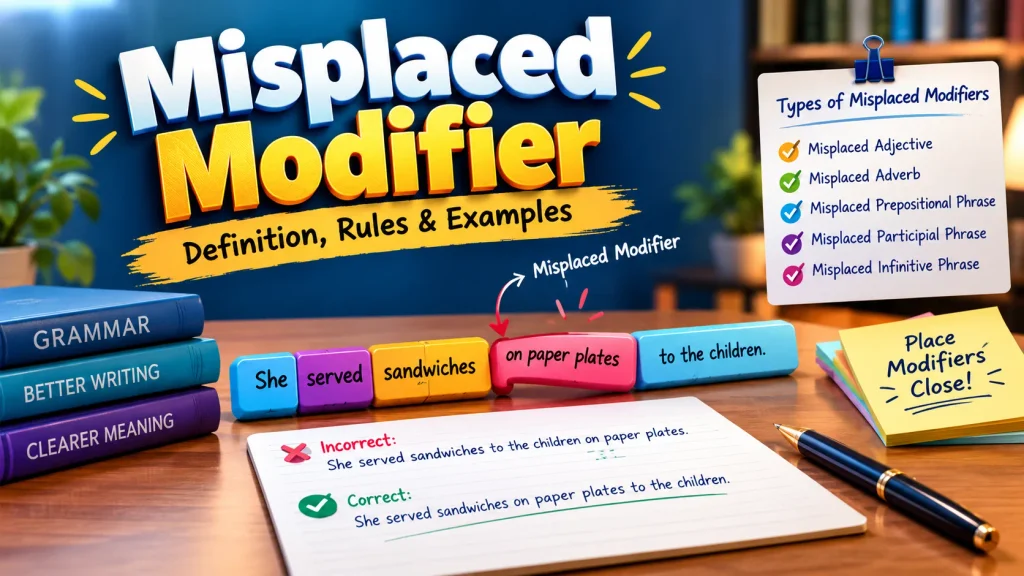
Example of a misplaced modifier:
- Incorrect: She served sandwiches to the children on paper plates.
- Correct: She served sandwiches on paper plates to the children.
In the incorrect sentence, the phrase “on paper plates” appears to describe the children rather than the sandwiches. The corrected sentence places the phrase closer to the word it modifies.

What Is a Modifier in Grammar?
A modifier is a word, phrase, or clause that provides additional information about another word or part of a sentence. Modifiers describe qualities, actions, conditions, locations, times, and other details.
Consider these examples:
- The beautiful garden attracted many visitors.
- He ran quickly toward the bus.
- After finishing her homework, Maria watched television.
First example, “beautiful” modifies the noun “garden.” In the second, “quickly” modifies the verb “ran.” In the third, the introductory phrase explains when Maria watched television.
A modifier becomes misplaced when its position creates confusion about what it describes.
Explore More: https://wordminto.com/squinting-modifier/
How to Identify a Misplaced Modifier
You can identify a misplaced modifier by checking whether the descriptive word or phrase appears near the correct word.
Follow these steps:
- Identify the modifier in the sentence.
- Determine which word or idea the modifier describes.
- Check whether the modifier appears close to that word.
- Look for any unintended meaning caused by its position.
- Rewrite the sentence to make the intended meaning clear.
Example:
Incorrect: I bought a bicycle from a man with a broken wheel.
Correct: I bought a bicycle with a broken wheel from a man.
The incorrect sentence suggests that the man has a broken wheel. The corrected sentence makes it clear that the bicycle has the broken wheel.
Explore More: https://wordminto.com/setup-or-set-up/
Types of Misplaced Modifiers
Misplaced modifiers can occur in several forms, depending on the type of word or phrase and its position in a sentence.
1. Misplaced Adjective
An adjective modifies a noun or pronoun. When an adjective appears near the wrong noun, it can change the intended meaning.
Incorrect: The teacher spoke to the students who were angry in a calm voice.
Correct: The teacher spoke in a calm voice to the students who were angry.
The corrected sentence makes the intended relationship clearer, although the original sentence may also be interpreted correctly in context.
Another example:
- Incorrect: She bought a wooden table for her office that was expensive.
- Correct: She bought an expensive wooden table for her office.
The corrected version clearly identifies the table as expensive.
2. Misplaced Adverb
An adverb modifies a verb, adjective, or another adverb. Its position can change the meaning of a sentence.
Incorrect: She almost drove her children to school every day.
Correct: She drove her children to school almost every day.
In the incorrect sentence, “almost” suggests that she nearly drove the children but perhaps did not. In the corrected sentence, “almost every day” describes how frequently she drove them.
More examples:
- Incorrect: He only eats vegetables on weekdays.
- Clearer: He eats vegetables only on weekdays.
- Incorrect: She nearly worked for ten hours.
- Clearer: She worked for nearly ten hours.
The placement of “only” and “nearly” affects the intended meaning.
3. Misplaced Prepositional Phrase
A prepositional phrase begins with a preposition, such as in, on, at, with, under, or near. It can function as an adjective or adverb.
Incorrect: The woman saw a dog walking through the park with a telescope.
Correct: With a telescope, the woman saw a dog walking through the park.
The corrected sentence indicates that the woman used a telescope.
Another example:
- Incorrect: He found a wallet walking along the street.
- Correct: He found a wallet while walking along the street.
The revised sentence clarifies that he was walking when he found the wallet.
4. Misplaced Participial Phrase
A participial phrase begins with a present participle ending in -ing or a past participle, such as running, smiling, exhausted, or broken. It describes a noun or pronoun.
Incorrect: Walking through the garden, the flowers looked beautiful.
Correct: Walking through the garden, I thought the flowers looked beautiful.
The incorrect sentence suggests that the flowers were walking through the garden. The corrected sentence identifies the person performing the action.
More examples:
- Incorrect: Covered in chocolate, the children ate the cake.
- Correct: The children ate the cake covered in chocolate.
The second sentence places the descriptive phrase next to the cake, although the exact meaning still depends on context.
5. Misplaced Infinitive Phrase
An infinitive phrase commonly begins with to followed by a base verb, such as to learn, to win, or to improve. Its placement can obscure the intended meaning.
Incorrect: She promised to study hard to her parents.
Correct: She promised her parents to study hard.
A more natural revision is:
She promised her parents that she would study hard.
The revised sentence clearly identifies the people who received the promise.
6. Misplaced Relative Clause
A relative clause usually begins with a relative pronoun such as who, whom, whose, which, or that. It provides information about a noun.
Incorrect: I returned the book to the librarian that had missing pages.
Correct: I returned the book that had missing pages to the librarian.
The relative clause “that had missing pages” now clearly describes the book.
Another example:
- Incorrect: The boy spoke to the woman who wore a red jacket in the library.
- Clearer: In the library, the boy spoke to the woman who wore a red jacket.
The revised sentence clarifies the location of the conversation, though context determines the exact intended meaning.
Explore More: https://wordminto.com/adapt-vs-adopt/
Misplaced Modifier vs Dangling Modifier
Misplaced and dangling modifiers both create unclear relationships between modifiers and the words they describe. However, they differ in an important way.
| Feature | Misplaced Modifier | Dangling Modifier |
| Definition | The modifier appears in the wrong position. | The modifier lacks a clear or appropriate word to describe. |
| Main problem | Incorrect placement | Missing or unsuitable subject |
| Example | She saw a dog in the garden with a collar. | Walking to school, the rain started. |
| Correction | She saw a dog with a collar in the garden. | Walking to school, I got caught in the rain. |
Remember: A misplaced modifier usually has a word it can modify, but the sentence places it incorrectly. A dangling modifier has no clear grammatical target or appears to describe the wrong subject.
Misplaced Modifier vs Squinting Modifier
A squinting modifier is a modifier positioned between two parts of a sentence, so readers cannot easily determine which part it modifies.
| Misplaced Modifier | Squinting Modifier |
| The modifier sits too far from its intended target or next to the wrong word. | The modifier appears between two possible targets. |
| Example: She served food to the guests on trays. | Example: Students who study occasionally get better grades. |
| Revision: She served food on trays to the guests. | Revision: Students who occasionally study get better grades. |
The squinting example means that students who study from time to time get better grades. Another possible interpretation is that students get better grades occasionally. Repositioning “occasionally” removes the ambiguity.
Explore More: https://wordminto.com/can-vs-could/
Common Misplaced Modifier Examples
The following examples demonstrate how modifier placement can affect sentence meaning.
| Incorrect Sentence | Corrected Sentence |
| I saw a man riding a horse with binoculars. | With binoculars, I saw a man riding a horse. |
| She almost spent $100 on shoes. | She spent almost $100 on shoes. |
| He served sandwiches to the children on paper plates. | He served sandwiches on paper plates to the children. |
| The girl wore a hat walking down the street. | The girl wore a hat while walking down the street. |
| We watched a movie about dinosaurs in the classroom. | In the classroom, we watched a movie about dinosaurs. |
| She gave a toy to her brother made of plastic. | She gave her brother a toy made of plastic. |
| The manager discussed the project with the employees that was delayed. | The manager discussed the project that was delayed with the employees. |
| He nearly drove 200 miles every weekend. | He drove nearly 200 miles every weekend. |
| I found a wallet in the park belonging to my neighbor. | In the park, I found a wallet belonging to my neighbor. |
| She bought a dress for her sister with blue flowers. | She bought a dress with blue flowers for her sister. |
Some original sentences may have more than one possible interpretation. The corrected versions aim to make the intended meaning explicit.
Why Should You Avoid Misplaced Modifiers?
Misplaced modifiers can weaken communication in academic, professional, and everyday writing. Correct modifier placement improves sentence clarity and helps readers understand your intended meaning.
1. They Create Confusion
Readers may misunderstand which noun or action a modifier describes.
Example:
- Unclear: He saw a woman walking her dog with a camera.
- Clear: Using a camera, he saw a woman walking her dog.
2. They Can Change the Intended Meaning
A misplaced adverb can change the emphasis of a sentence.
Example:
- He almost failed every exam.
- He failed almost every exam.
The first sentence suggests that he came close to failing every exam, whereas the second indicates that he actually failed most of them.
3. They Can Make Writing Sound Unprofessional
Misplaced modifiers can distract readers in essays, reports, business emails, and formal documents.
Example:
- Unclear: We reviewed the proposal prepared by the consultant yesterday.
- Clearer: Yesterday, we reviewed the proposal that the consultant prepared.
The clearer sentence specifies when the review happened, although a different revision may be necessary if “yesterday” describes when the consultant prepared the proposal.
4. They Can Create Unintentionally Funny Sentences
Incorrect modifier placement sometimes produces humorous images.
Example:
- Incorrect: I saw a cat driving down the road.
- Correct: While driving down the road, I saw a cat.
The first sentence suggests that the cat was driving.
Explore More: https://wordminto.com/other-vs-another/
Rules for Correct Modifier Placement
Follow these rules to avoid misplaced modifiers in your writing.
Rule 1: Place Modifiers Near the Words They Describe
Keep descriptive words and phrases close to their intended targets.
Incorrect: She served a meal to her guests that was delicious.
Correct: She served her guests a delicious meal.
Rule 2: Place Adverbs Carefully
Words such as only, almost, nearly, just, and even can change a sentence’s meaning depending on their position.
Incorrect: He only called his mother on Sunday.
Clearer: He called his mother only on Sunday.
The revised sentence means Sunday was the only day he called her. If you mean he did nothing except call his mother, you would place “only” differently.
Rule 3: Make Introductory Phrases Refer to the Correct Subject
An introductory participial phrase should describe the grammatical subject that follows it.
Incorrect: After completing the assignment, the television was turned on.
Correct: After completing the assignment, Sara turned on the television.
Rule 4: Keep Relative Clauses Next to Their Nouns
Place clauses beginning with who, which, or that next to the nouns they describe.
Incorrect: We met the author at the event who wrote the novel.
Correct: At the event, we met the author who wrote the novel.
Rule 5: Rewrite Ambiguous Sentences
Sometimes moving a modifier is not enough. You may need to restructure the entire sentence.
Unclear: She told her friend that she had won the competition yesterday.
Clearer: Yesterday, she told her friend that she had won the competition.
This revision makes it clear that she told her friend yesterday. If the competition happened yesterday, use: “She told her friend that she had won the competition the previous day.”
How to Fix a Misplaced Modifier
Use this practical method when proofreading sentences.
- Find the modifier: Identify the word, phrase, or clause that adds descriptive information.
- Identify its target: Decide exactly which noun, verb, or idea it should describe.
- Check the placement: See whether the modifier appears close enough to its target.
- Move the modifier: Place it beside the word or phrase it modifies.
- Rewrite if necessary: Change the sentence structure if moving the modifier does not eliminate ambiguity.
- Read the sentence again: Confirm that the revised sentence communicates your intended meaning.
Example
Original: The student submitted an essay to the teacher with excellent grammar.
1: Identify the modifier — “with excellent grammar.”
2: Identify its target — “essay.”
3: Check the placement — the phrase appears to describe the teacher.
4: Move the modifier.
Corrected: The student submitted an essay with excellent grammar to the teacher.
This revision places the descriptive phrase beside “essay,” making the intended meaning clearer.
Misplaced Modifier Exercises
Test your understanding with the following questions. Identify the misplaced modifier and choose the clearest correction.
1. Which sentence places the modifier correctly?
She almost ate all the cookies.
She ate almost all the cookies.
Almost she ate all the cookies.
2. Choose the best correction: “Walking into the room, the lights seemed bright.”
Walking into the room, I thought the lights seemed bright.
Walking into the room, the lights were bright.
The lights, walking into the room, seemed bright.
3. Which sentence clearly describes the bicycle as broken?
He saw a boy with a broken bicycle.
He saw a broken boy with a bicycle.
With a boy, he saw a bicycle broken.
4. Choose the clearest sentence.
She gave a book to her sister with a red cover.
.
She gave her sister a book with a red cover.
.
She gave with a red cover a book to her sister.
5. Which sentence correctly places “only” if Sunday was the sole day he called?
He only called his father on Sunday.
He called his father only on Sunday.
Only he called his father on Sunday.
Score: 0 of 5
Reset Quiz
People Also Ask
A misplaced modifier is a descriptive word, phrase, or clause that appears in the wrong position in a sentence, making its meaning unclear or misleading.
“ She almost drove her children to school every day” is an example. It suggests that she nearly drove them but perhaps did not. “She drove her children to school almost every day” clearly describes how often she drove them.
Move the modifier closer to the word it describes. If the sentence remains unclear, rewrite it to express the intended meaning directly.
A misplaced modifier appears in the wrong position relative to its intended target. A dangling modifier lacks a clear or appropriate word to modify.
Yes. For example, “She almost spent $100” means she came close to spending that amount, while “She spent almost $100” means she spent an amount close to $100.
Conclusion
A Misplaced Modifier occurs when a descriptive word, phrase, or clause appears in a position that creates confusion or changes a sentence’s intended meaning. You can avoid this error by identifying the modifier, determining what it describes, and placing it near its intended target.
Practice recognizing misplaced modifiers in everyday sentences, essays, and professional writing. With consistent practice, you can write clearer, more accurate, and more effective English sentences.










2 thoughts on “Misplaced Modifier: Definition, Rules, Examples, and Exercises”