
Run-on Sentences Rules: Are common grammar mistakes that occur when writers join two or more independent clauses incorrectly. These errors can make writing confusing, difficult to read, and less effective. Learning run-on sentence rules helps students, teachers, ESL learners, and professional writers create clear, grammatically correct sentences.
In this guide, you will learn what a run-on sentence is, explore its main types, understand the rules for correcting it, review common mistakes, and practice with exercises and answers.
What Is a Run-On Sentence?
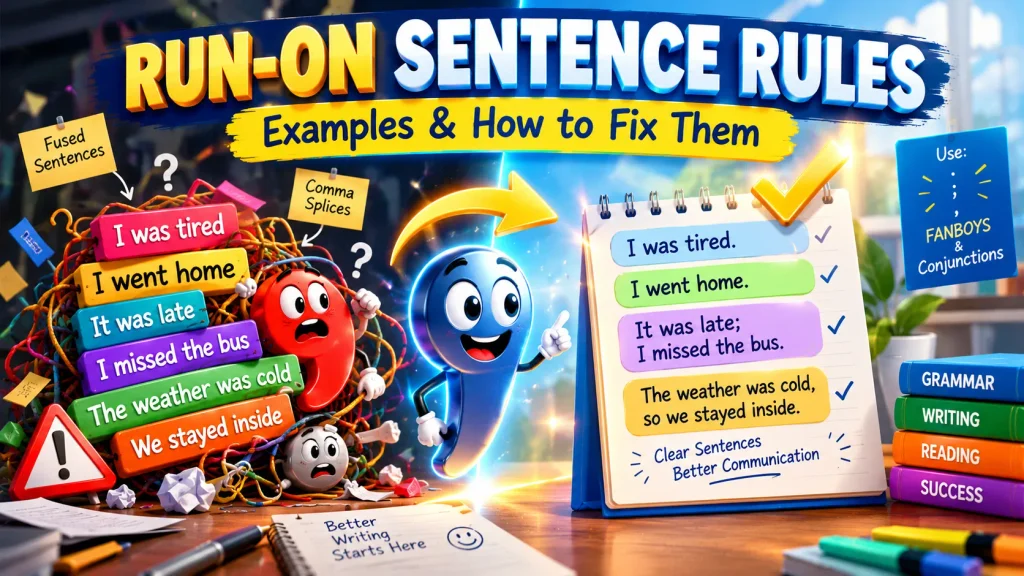
A run-on sentence occurs when two or more independent clauses appear together without the correct punctuation or connecting words.
An independent clause contains a subject and a verb and expresses a complete thought. When two independent clauses appear together, writers must connect them correctly.
Incorrect example:
– I was tired I went to bed early.
This sentence contains two independent clauses:
- I was tired.
- I went to bed early.
The writer must use appropriate punctuation or a conjunction to connect these ideas.
Correct examples:
- I was tired, so I went to bed early.
- I was tired. I went to bed early.
- I was tired; I went to bed early.
Each corrected version follows a standard rule for joining independent clauses.
Explore More: https://wordminto.com/dangling-modifier/
Why Are Run-On Sentence Rules Important?
Run-on sentence rules help you organize ideas and communicate meaning clearly. Without proper punctuation and conjunctions, readers may struggle to understand where one thought ends and another begins.
Correct sentence structure improves:
- Clarity: Readers understand your ideas more easily.
- Grammar: Your writing follows standard English conventions.
- Readability: Sentences flow naturally.
- Academic writing: Essays, reports, and assignments become more effective.
- Professional communication: Emails, articles, and business documents look polished.
Understanding these rules also helps you recognize the difference between a run-on sentence, a comma splice, and a sentence fragment.
Explore More: https://wordminto.com/misplaced-modifier/
Types of Run-On Sentences
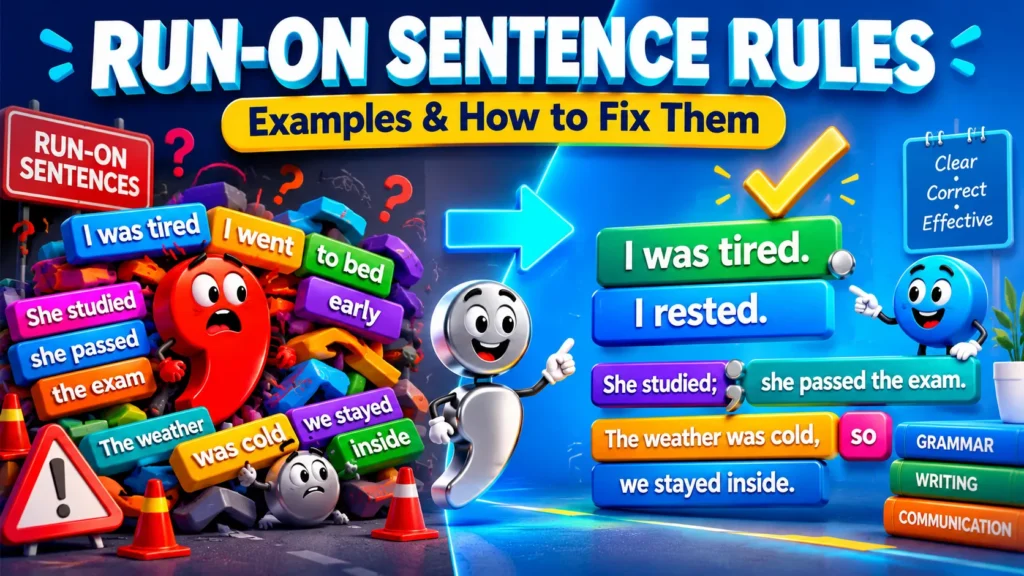
Writers commonly make two types of run-on sentence errors: fused sentences and comma splices.
1. Fused Sentences
A fused sentence joins two independent clauses without any punctuation or connecting word.
Incorrect examples:
- The weather was cold we stayed inside.
- Sarah likes coffee she drinks it every morning.
- The students finished their work they left the classroom.
- I missed the bus I arrived late.
Each sentence contains two complete thoughts, but the writer fails to separate them correctly.
Correct examples:
- The weather was cold, so we stayed inside.
- Sarah likes coffee, and she drinks it every morning.
- The students finished their work. They left the classroom.
- I missed the bus, so I arrived late.
Rule: Never place two independent clauses together without an appropriate connector or punctuation mark.
2. Comma Splices
A comma splice occurs when a writer joins two independent clauses using only a comma.
Incorrect examples:
- I enjoy reading, my brother enjoys writing.
- The movie was interesting, we watched it twice.
- She studied all night, she passed the exam.
- The store was closed, we returned home.
A comma alone cannot normally connect two independent clauses in standard written English.
Correct examples:
- I enjoy reading, and my brother enjoys writing.
- The movie was interesting, so we watched it twice.
- She studied all night; she passed the exam.
- The store was closed, so we returned home.
Rule: Do not use a comma alone to join two independent clauses. Add a suitable coordinating conjunction, use a semicolon, or separate the clauses into two sentences.
Explore More: https://wordminto.com/squinting-modifier/
Essential Run-On Sentence Rules
The following rules will help you correct run-on sentences and avoid common punctuation errors.
Rule 1: Use a Period to Separate Independent Clauses
A period provides the simplest way to correct a run-on sentence. Use it when each idea can stand alone as a complete sentence.
Incorrect: Tom plays football he practices every day.
Correct: Tom plays football. He practices every day.
More examples:
| Incorrect sentence | Correct sentence |
| I love music I listen every day. | I love music. I listen every day. |
| The baby was hungry she started crying. | The baby was hungry. She started crying. |
| We arrived early the doors were locked. | We arrived early. The doors were locked. |
Remember: A period works especially well when the clauses express separate ideas.
Rule 2: Use a Comma and a Coordinating Conjunction
You can join two closely related independent clauses with a comma followed by a coordinating conjunction.
English has seven common coordinating conjunctions, often remembered through the acronym FANBOYS.
| Conjunction | Meaning or use | Example |
| For | Gives a reason | I stayed inside, for the weather was terrible. |
| And | Adds information | Mia cooked dinner, and Leo washed the dishes. |
| Nor | Adds a negative idea | He did not call, nor did he send a message. |
| But | Shows contrast | I was tired, but I continued working. |
| Or | Presents a choice | We can walk, or we can take a taxi. |
| Yet | Shows contrast | The task was difficult, yet she completed it. |
| So | Shows a result | It started raining, so we went indoors. |
Incorrect: I wanted to sleep I had to finish my homework.
Correct: I wanted to sleep, but I had to finish my homework.
Rule: When a coordinating conjunction joins two independent clauses, place a comma before the conjunction.
However, you generally do not need a comma when a conjunction joins only words or phrases rather than two independent clauses.
- Correct: I bought apples and oranges.
- Correct: She opened the door and walked inside.
Rule 3: Use a Semicolon Between Closely Related Independent Clauses
A semicolon can connect two independent clauses when their meanings relate closely.
Incorrect: The train was late, we missed the meeting.
Correct: The train was late; we missed the meeting.
More examples:
- The exam was difficult; several students struggled.
- I enjoy traveling; my sister prefers staying home.
- The sun had set; the streets became quiet.
- Daniel studied carefully; he answered every question.
Rule: Use a semicolon between two independent clauses without adding a coordinating conjunction.
Do not use a semicolon to join an independent clause directly to a dependent clause or an incomplete phrase.
Rule 4: Use a Subordinating Conjunction
A subordinating conjunction connects a dependent clause to an independent clause. Common examples include because, although, since, when, while, if, and unless.
Incorrect: I was hungry I made a sandwich.
Correct: Because I was hungry, I made a sandwich.
Other examples:
- Although it was raining, we went outside.
- I called my friend because I needed help.
- When the bell rang, the students left.
- We will start the meeting if everyone arrives on time.
Rule: A dependent clause cannot normally stand alone as a complete sentence. Connect it to an independent clause to form a complete sentence.
Punctuation depends on clause order:
- Dependent clause first: Because I was tired, I went to bed.
- Independent clause first: I went to bed because I was tired.
When the dependent clause comes first, a comma usually separates it from the independent clause. When it comes second, a comma is generally unnecessary.
Rule 5: Use a Conjunctive Adverb Correctly
Conjunctive adverbs include however, therefore, moreover, consequently, instead, and nevertheless. They show relationships between ideas, but they do not function like coordinating conjunctions.
Incorrect: It was raining, however, we continued playing.
Correct options:
- It was raining; however, we continued playing.
- It was raining. However, we continued playing.
- Although it was raining, we continued playing.
Rule: When a conjunctive adverb connects two independent clauses, use a period or a semicolon before it. A comma usually follows the conjunctive adverb when it appears at the beginning of the second clause.
More examples:
- She forgot her umbrella; therefore, she got wet.
- The task was challenging; nevertheless, we completed it.
- He missed the bus. Consequently, he arrived late.
Rule 6: Avoid Joining Too Many Ideas Without Clear Structure
Long sentences are not automatically run-on sentences. However, sentences that contain several independent clauses can become confusing when writers fail to use appropriate punctuation and conjunctions.
Incorrect: I woke up late I missed breakfast I ran to school I arrived after the bell rang.
Correct: I woke up late, missed breakfast, and ran to school, but I arrived after the bell rang.
Another correct version:
I woke up late. I missed breakfast and ran to school, but I arrived after the bell rang.
Rule: Organize related ideas logically and use punctuation to make the relationships between clauses clear.
Rule 7: Do Not Confuse a Long Sentence With a Run-On Sentence
A sentence can contain many words and still follow correct grammar rules. A run-on sentence depends on how independent clauses connect, not on the sentence’s length.
Correct long sentence:
Although the weather was cold and the wind was strong, we continued walking because we wanted to reach the village before sunset.
This sentence contains a dependent clause and an independent clause structure with appropriate connections.
Incorrect sentence:
The weather was cold the wind was strong we continued walking.
Corrected sentence:
The weather was cold, and the wind was strong, but we continued walking.
Rule: Focus on clause structure and punctuation rather than counting words.
Explore More: https://wordminto.com/setup-or-set-up/
How to Fix a Run-On Sentence: Step-by-Step Guide
Follow these steps whenever you identify a possible run-on sentence.
Step 1: Find the independent clauses
Identify each subject and verb combination that expresses a complete thought.
Example: Emma cooked dinner she washed the dishes.
- Emma cooked dinner.
- She washed the dishes.
Step 2: Identify the connection error
Check whether the clauses lack punctuation or use only a comma.
Example: Emma cooked dinner, she washed the dishes.
The comma alone creates a comma splice.
Step 3: Choose the correct correction
Use a period, a semicolon, a comma with a coordinating conjunction, or a subordinating conjunction.
Example: Emma cooked dinner, and she washed the dishes.
Step 4: Read the corrected sentence
Check that the sentence communicates your intended meaning and follows standard punctuation rules.
Explore More: https://wordminto.com/adapt-vs-adopt/
Run-On Sentences vs Comma Splices vs Sentence Fragments
These three grammar problems often confuse English learners, but each has a different cause.
| Grammar problem | Definition | Incorrect example |
| Run-on (fused sentence) | Two independent clauses have no proper separation. | I called her she answered. |
| Comma splice | Two independent clauses use only a comma. | I called her, she answered. |
| Sentence fragment | A group of words lacks an independent clause or does not express a complete thought. | Because I called her. |
How to Correct Each Error
- Fused sentence: I called her. She answered.
- Comma splice: I called her, and she answered.
- Sentence fragment: Because I called her, she answered.
Notice that a sentence fragment may contain a subject and a verb but still fail to express a complete thought. For example, Because I called her leaves the reader waiting for the main idea.
Explore More: https://wordminto.com/can-vs-could/
Common Run-On Sentence Mistakes
Avoid these frequent errors to improve your writing.
1. Using a Comma Without a Conjunction
Incorrect: The food was delicious, everyone enjoyed it.
Correct: The food was delicious, and everyone enjoyed it.
A comma alone cannot normally join two independent clauses.
2. Using a Conjunction Without Necessary Punctuation
Incorrect: I wanted to go outside but it started raining.
Correct: I wanted to go outside, but it started raining.
When but joins two independent clauses, place a comma before it.
3. Using a Comma Instead of a Semicolon
Incorrect: She was exhausted, she went to sleep.
Correct: She was exhausted; she went to sleep.
A semicolon can connect closely related independent clauses without a conjunction.
4. Using a Conjunctive Adverb as a Coordinating Conjunction
Incorrect: He practiced daily, therefore, he improved.
Correct: He practiced daily; therefore, he improved.
Words such as therefore and however require different punctuation from coordinating conjunctions when they connect independent clauses.
5. Making Every Sentence Too Short
Correcting run-on sentences does not mean that you must separate every idea with a period. You can combine related ideas with suitable conjunctions or punctuation.
Choppy version: The alarm rang. I woke up. I left home.
Smoother version: The alarm rang, so I woke up, got dressed, and left home.
Writing tip: Aim for a natural mix of sentence lengths while keeping every clause connection grammatically correct.
Run-On Sentence Examples With Corrections
Study these examples to recognize common errors and understand how to correct them.
| Incorrect sentence | Correct sentence |
| The sun was shining we went swimming. | The sun was shining, so we went swimming. |
| I like English, it is my favorite subject. | I like English because it is my favorite subject. |
| Mark was sick he stayed home. | Mark was sick, so he stayed home. |
| She opened the window, the room was hot. | She opened the window because the room was hot. |
| We wanted to help, we did not know how. | We wanted to help, but we did not know how. |
| The bus arrived late, therefore, I missed class. | The bus arrived late; therefore, I missed class. |
| He likes football his brother likes cricket. | He likes football, while his brother likes cricket. |
| The teacher explained the lesson the students took notes. | The teacher explained the lesson, and the students took notes. |
| I finished my work, I went home. | I finished my work. I went home. |
| It was getting dark we returned to the hotel. | It was getting dark, so we returned to the hotel. |
Some of these corrections allow more than one grammatically correct version. Choose the structure that best expresses the relationship between your ideas.
Run-On Sentence Rules for Students
Students can use these simple rules as a quick reference when writing essays, assignments, and examination answers.
- Identify each independent clause.
- Never join independent clauses without proper punctuation or a suitable connector.
- Do not use a comma alone between two independent clauses.
- Use a comma before FANBOYS when a coordinating conjunction joins two independent clauses.
- Use a semicolon between closely related independent clauses when no coordinating conjunction follows it.
- Use subordinating conjunctions to connect dependent clauses to independent clauses.
- Use a period when two ideas work better as separate sentences.
- Review your writing to check punctuation and sentence completeness.
Run-On Sentence Exercises
Test your understanding with the following practice questions. Identify the run-on sentences and choose the best correction.
Practice quiz
0 of 8 answered
Select one answer for each question, then check your results.
I was hungry I made a sandwich.
.
I was hungry, I made a sandwich.
.
I was hungry, so I made a sandwich.
.
I was hungry because.
2. Which sentence contains a comma splice?
She smiled, and I waved.
She smiled. I waved.
She smiled, I waved.
3. Choose the correct semicolon sentence.
It was late; we went home.
.
It was late; and we went home.
.
It was late,; we went home.
4. Choose the correctly punctuated sentence.
I studied hard therefore I passed.
.
I studied hard; therefore, I passed.
.
I studied hard, therefore, I passed.
5. Which option correctly fixes this sentence: ‘Although it rained we played outside.’?
Although it rained, we played outside.
.
Although, it rained we played outside.
.
Although it rained we, played outside.
6. Which sentence is a fused sentence?
The baby cried, so I picked her up.
The baby cried. I picked her up.
The baby cried I picked her up.
7. Choose the correct sentence.
Maya cooked dinner, her brother set the table.
.
Maya cooked dinner, and her brother set the table.
.
Maya cooked dinner her brother, set the table.
8. Is this sentence a run-on? ‘We bought bread and milk.’
Yes, it is a fused sentence.
Yes, it is a comma splice.
No, it is grammatically correct.
Check results
People Also Ask
A run-on sentence occurs when two or more independent clauses connect without appropriate punctuation or a suitable conjunction. For example, I was tired I went to sleep is a run-on sentence.
The two main types are fused sentences and comma splices. A fused sentence joins independent clauses without punctuation, while a comma splice joins them with only a comma.
You can correct a run-on sentence by using a period, a semicolon, a comma with a coordinating conjunction, or an appropriate subordinating conjunction.
Example:
Incorrect: She was happy she won the prize.
Correct: She was happy because she won the prize.
Yes. A comma splice is a type of run-on sentence. It occurs when a writer joins two independent clauses with only a comma.
Yes. Sentence length alone does not determine whether a sentence is a run-on. A long sentence can be grammatically correct if it connects all clauses properly.
Conclusion
Run-on Sentence Rules help you write clear, organized, and grammatically correct English. Remember that a run-on sentence occurs when independent clauses connect incorrectly, either without punctuation or with only a comma.
To fix these errors, use periods to separate complete thoughts, commas with coordinating conjunctions, semicolons between closely related independent clauses, or subordinating conjunctions to show relationships between ideas.
With regular practice, you can recognize fused sentences, correct comma splices, and improve your writing for school, work, examinations, and everyday communication.







2 thoughts on “Run-On Sentence Rules: Meaning, Types, Examples, and How to Fix Them”