
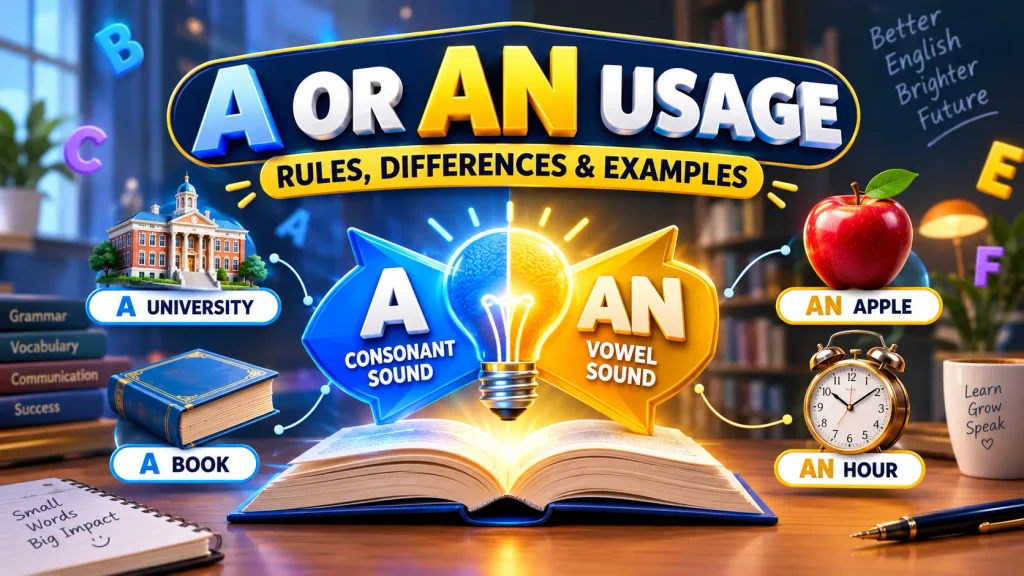
A or An Usage: “A” and “An” are indefinite articles in English grammar. We use them before singular countable nouns when we refer to a person, place, animal, object, or idea in a general way. Although both articles have the same basic meaning, their usage depends on the first sound of the word that follows them, not simply its first letter.
For example:
- I saw a cat in the garden.
- She ate an apple after lunch.
- He is a university student.
- She waited for an hour.
Many English learners confuse “a” and “an” because English spelling does not always match pronunciation. This guide explains the difference between “a” and “an,” the essential grammar rules, common mistakes, exceptions, and practice exercises with answers.
What Is “A” in English Grammar?
“A” is an indefinite article that we use before a singular countable noun when the next word begins with a consonant sound.
Examples:
- I bought a book yesterday.
- She has a dog.
- He is a teacher.
- We live in a small house.
- I need a pencil.
In these examples, “a” introduces a noun without identifying a particular person or thing.
When Do We Use “A”?
Use “A” before words that begin with consonant sounds.
| Example | Reason |
| A car | “Car” begins with a /k/ sound. |
| A boy | “Boy” begins with a /b/ sound. |
| A teacher | “Teacher” begins with a /t/ sound. |
| A university | “University” begins with a /y/ sound. |
| A European country | “European” begins with a /y/ sound. |
| A one-time offer | “One” begins with a /w/ sound. |
Remember that the sound matters more than the spelling. Words such as “university” and “European” begin with vowel letters, but their initial sounds are consonant sounds.
Explore More: https://wordminto.com/modal-verb-rules/
What Is “An” in English Grammar?
A or An Usage
“An” is an indefinite article that we use before a singular countable noun when the next word begins with a vowel sound.
The common vowel sounds begin with /a/, /e/, /i/, /o/, or /u/, although English pronunciation includes many variations.
Examples:
- She ate an orange.
- He bought an umbrella.
- I saw an elephant.
- She is an artist.
- We waited for an hour.
In each example, “an” makes the transition into the following word natural and easy to pronounce.
When Do We Use “An”?
Use “An” before words that begin with vowel sounds.
| Example | Reason |
| An apple | “Apple” begins with a vowel sound. |
| An egg | “Egg” begins with a vowel sound. |
| An idea | “Idea” begins with a vowel sound. |
| An office | “Office” begins with a vowel sound. |
| An umbrella | “Umbrella” begins with a vowel sound. |
| An honest person | The “h” in “honest” is silent. |
| An MBA student | “M” is pronounced /em/. |
The same principle applies to words whose spelling may seem confusing. Always consider how you pronounce the word in context.
Explore More: https://wordminto.com/run-on-sentence-rules/
What Is the Difference Between “A” and “An”?
A or An Usage
The main difference between “A” and “An” is the sound that follows the article. Both have the same general meaning, but they follow different pronunciation rules.
| A | An |
| Use before a consonant sound. | Use before a vowel sound. |
| A banana | An apple |
| A uniform | An umbrella |
| A useful tool | An unusual tool |
| A European city | An African city |
| A hotel | An hour |
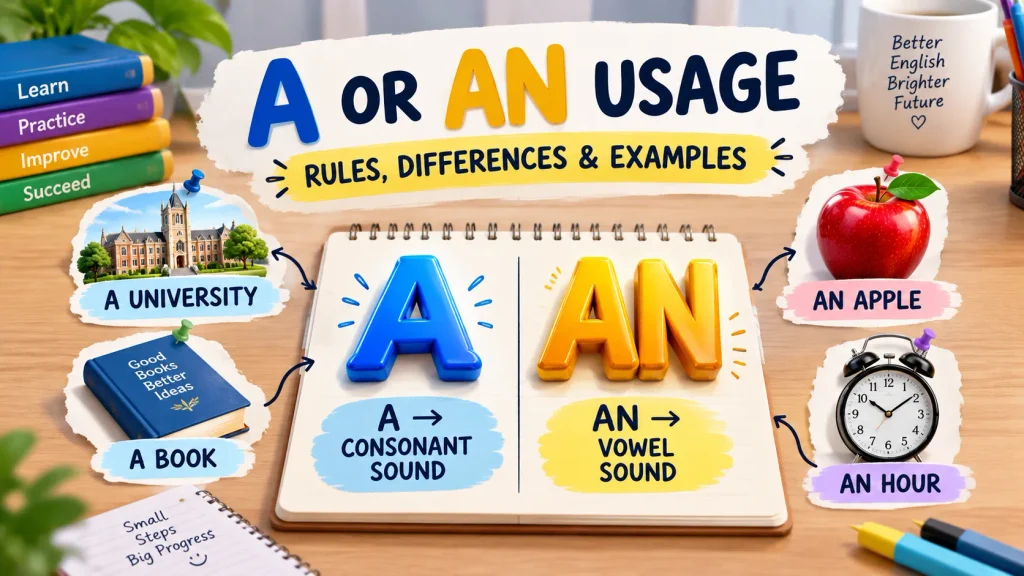
Easy rule: Use “a” before a consonant sound and “an” before a vowel sound.
Explore More: https://wordminto.com/dangling-modifier/
Rules for Using A and An
A or An Usage
Rule 1: Use “A” Before a Consonant Sound
Place “A” before a word that begins with a consonant sound.
Examples:
- She owns a bicycle.
- He adopted a puppy.
- I need a new phone.
- They visited a museum.
- He wants to become a doctor.
The first sound of each noun is a consonant sound, so “A” is correct.
Rule 2: Use “An” Before a Vowel Sound
Place “An” before a word that begins with a vowel sound.
Examples:
- I ate an egg.
- She bought an expensive dress.
- He gave me an invitation.
- We saw an owl in the tree.
- She wants to become an engineer.
Remember that pronunciation determines the article, not the first letter alone.
Rule 3: Choose A or An Before an Adjective
When an adjective comes before a noun, choose the article according to the sound at the beginning of the adjective.
Examples:
- A car → a red car
- An apple → a green apple
- A student → an intelligent student
- An animal → a wild animal
- A house → an old house
Notice that “A green apple” is correct because the first word after the article is “green,” which begins with a consonant sound.
Similarly, “An old house” is correct because “old” begins with a vowel sound.
Rule 4: Use “A” Before Words That Begin With a “Y” Sound
Some words begin with the vowel letter “U” or “E” but start with a consonant-like /y/ sound.
Examples:
- A university
- A uniform
- A useful book
- A unique opportunity
- A European country
- A eulogy
For example:
- She studies at a university.
- He wears a uniform at work.
- This is a useful website.
These words begin with a /y/ sound, so “A” is correct.
Rule 5: Use “An” Before Words With a Silent H
Some English words begin with the letter “h,” but speakers do not pronounce it. In these cases, use “An” because the word begins with a vowel sound.
Examples:
- An hour
- An honest person
- An honor
- An heir
Example sentences:
- We waited for an hour.
- She is an honest woman.
- It was an honor to meet the professor.
- He became an heir to the property.
However, use “a” when you pronounce the “h” sound.
Examples:
- A house
- A horse
- A hospital
- A happy child
Important: “A hotel” is standard when the “h” is pronounced, as it usually is in modern English.
Rule 6: Use A or An Before Abbreviations According to Pronunciation
Abbreviations can create confusion because their first written letters do not always indicate their initial sounds.
Choose the article according to how you pronounce the abbreviation.
| Correct phrase | Explanation |
| An MBA student | “M” sounds like “em.” |
| An FBI agent | “F” sounds like “ef.” |
| An X-ray | “X” sounds like “ex.” |
| A USB cable | “U” sounds like “you.” |
| A URL | When pronounced “you-are-ell,” it begins with a /y/ sound. |
| An SOS signal | When pronounced letter by letter, “S” sounds like “ess.” |
A or An Usage
Examples:
- She is an MBA student.
- We called an FBI agent.
- The doctor ordered an X-ray.
- I need a USB cable.
Some abbreviations have more than one common pronunciation. The correct article may change with the pronunciation.
Rule 7: Use A or An Before Singular Countable Nouns
“A” and “An” usually appear before singular countable nouns when we mention something in a general or nonspecific way.
Examples:
- I bought a pen.
- She has an idea.
- He saw a bird.
- We need an assistant.
A singular countable noun generally needs a determiner, such as “a,” “an,” “the,” “this,” or “my,” when it appears in ordinary singular noun phrases.
Incorrect: She bought book.
Correct: She bought a book.
Incorrect: He is teacher.
Correct: He is a teacher.
Rule 8: Use A or An to Describe Someone’s Job
Use “A” or “An” before a singular job title when you describe a person’s profession or occupation.
Examples:
- He is a lawyer.
- She is an architect.
- My brother is a mechanic.
- Her mother is an accountant.
- I want to become a pilot.
Incorrect: My sister is engineer.
Correct: My sister is an engineer.
Incorrect: He works as an actor in a theater.
Correct: He works as an actor in a theater.
Rule 9: Use A or An When Mentioning Something for the First Time
Use an indefinite article when you introduce a person or thing that your reader or listener does not yet know about.
Example:
– I saw a dog outside my house. The dog followed me to the gate.
The first sentence uses “a dog” because the dog is being introduced. The second sentence uses “the dog” because both people now know which dog the speaker means.
Another example:
– She bought an umbrella yesterday. The umbrella is blue.
This rule helps readers understand whether you are introducing something new or referring to something specific.
Rule 10: Use A or An to Express Frequency or Rate
Use “A” or “An” in many expressions that describe how often something happens or how much occurs in a particular period.
Examples:
- Three times a day
- Twice a week
- Sixty kilometers an hour
- Fifty dollars a month
- One at a time
Example sentences:
- I exercise twice a week.
- The car travels at 80 kilometers an hour.
- She earns $500 a month.
In these expressions, “a” or “an” often carries the meaning of “per.”
Rule 11: Use A or An in Exclamations With Singular Countable Nouns
Use “A” or “An” in exclamatory expressions with “what” before a singular countable noun.
Examples:
- What a beautiful day!
- What an amazing idea!
- What a wonderful surprise!
- What an interesting story!
Choose the article according to the sound of the word immediately following it.
Explore More: https://wordminto.com/misplaced-modifier/
When Should You Not Use A or An?
A or An Usage
Although “A” and “An” appear frequently in English, they do not work with every noun.
1. Do Not Use A or An Before Plural Nouns
Incorrect: I bought a books.
Correct: I bought books.
Incorrect: She has an apples.
Correct: She has apples.
“A” and “an” refer to one countable item, so they do not directly modify plural nouns.
2. Do Not Use A or An Directly Before Uncountable Nouns
Uncountable nouns refer to substances, concepts, or things that English speakers do not normally count as individual units.
Examples include water, information, advice, furniture, and knowledge.
Incorrect: She gave me an advice.
Correct: She gave me some advice.
Incorrect: I need a water.
Correct: I need some water.
You can use “a” or “an” when you add a suitable countable unit or container.
- A glass of water
- A piece of advice
- A piece of furniture
- An item of information
3. Do Not Normally Use A or An Before Proper Nouns
Proper nouns identify particular people, places, or organizations. They generally do not need “A” or “An.”
Examples:
- Sarah is my friend.
- Pakistan is a country in South Asia.
- London attracts many visitors.
- Google offers various online services.
However, certain expressions can use an indefinite article before a proper name to mean a person of that name or something associated with that name.
Example: A Mr. Ahmed called you this morning.
Here, “a Mr. Ahmed” means a person named Mr. Ahmed whose identity is not known or established to the speaker.
4. Do Not Use A or An When Another Determiner Already Fills the Same Role
Do not normally place “A” or “An” directly before possessives or demonstratives.
Incorrect: A my friend
Correct: My friend
Incorrect: An this apple
Correct: This apple
Other examples:
- Her book
- Their house
- That car
- These students
These determiners already identify the noun phrase, so you do not add “a” or “an” before them.
Explore More: https://wordminto.com/squinting-modifier/
A vs An: Commonly Confused Words
A or An Usage
The following examples demonstrate how pronunciation changes the correct article.
A
A university
The word begins with a /y/ sound.
Example: She attends a university.
An
An umbrella
The word begins with a vowel sound.
Example: I carried an umbrella.
A
A European
The initial sound is /y/.
Example: He is a European citizen.
An
An honest person
The initial “h” is silent.
Example: She is an honest person.
A
A one-way street
“One” begins with a /w/ sound.
Example: We turned into a one-way street.
Explore More: https://wordminto.com/setup-or-set-up/
Difference Between A, An, and The
A or An Usage
“A,” “An,” and “the” are articles, but they serve different purposes.
| Article | Usage | Example |
| A | Before a consonant sound; nonspecific singular noun | I saw a bird. |
| An | Before a vowel sound; nonspecific singular noun | I saw an eagle. |
| The | Refers to a specific or identifiable noun | The bird was blue. |
Use “a” or “an” when you introduce a nonspecific singular countable noun. Use “the” when the listener or reader can identify which person or thing you mean.
Examples:
- I need a pen. (Any suitable pen.)
- I need an eraser. (Any suitable eraser.)
- Please give me the pen on your desk. (A specific pen.)
Common Mistakes With A and An
A or An Usage
English learners often choose an article according to spelling rather than pronunciation. Here are some frequent mistakes and their corrections.
| Incorrect | Correct | Explanation |
| An university | A university | “University” begins with a /y/ sound. |
| A apple | An apple | “Apple” begins with a vowel sound. |
| An European city | A European city | “European” begins with a /y/ sound. |
| A hour | An hour | The “h” is silent. |
| An house | A house | The “h” is pronounced. |
| A MBA student | An MBA student | “M” sounds like “em.” |
| An useful tool | A useful tool | “Useful” begins with a /y/ sound. |
| A honest man | An honest man | The “h” is silent. |
| An one-time event | A one-time event | “One” begins with a /w/ sound. |
| An USB drive | A USB drive | “U” sounds like “you.” |
Tip: Say the word aloud if you are unsure. Listening to the first sound often helps you select the correct article.
A or An Practice Exercises
A or An Usage
Test your understanding by choosing the correct article for each sentence. Select your answers before checking the solutions.
Practice quiz
10 questions
Choose “a” or “an” for each blank.
1. She ate ___ orange.
a
an
2. He studies at ___ university.
a
an
3. We waited for ___ hour.
a
an
4. My brother is ___ doctor.
a
an
5. She is ___ honest person.
a
an
6. I need ___ useful dictionary.
a
an
7. He bought ___ umbrella.
a
an
8. She is ___ MBA student.
a
an
9. We saw ___ European tourist.
a
an
10. He found ___ old coin.
a
an
Check answers
A or An Exercises With Answers
A or An Usage
Here are additional examples to reinforce the rules.
- She wants to buy ___ new laptop.
- I saw ___ elephant at the zoo.
- He is ___ excellent student.
- We visited ___ historic building.
- She gave me ___ useful suggestion.
- He waited for ___ hour and a half.
- My cousin is ___ engineer.
- They live in ___ small apartment.
- I need ___ USB cable.
- She told us ___ interesting story.
Answers and Explanations
- A new laptop — “New” begins with a consonant sound.
- An elephant — “Elephant” begins with a vowel sound.
- An excellent student — “Excellent” begins with a vowel sound.
- A historic building — In standard modern pronunciation, “historic” usually begins with a pronounced /h/. Some speakers use “an historic” with a weak or omitted /h/.
- A useful suggestion — “Useful” begins with a /y/ sound.
- An hour and a half — “Hour” begins with a vowel sound because its “h” is silent.
- An engineer — “Engineer” begins with a vowel sound.
- A small apartment — “Small” follows the article and begins with a consonant sound.
- A USB cable — “U” is pronounced “you.”
- An interesting story — “Interesting” begins with a vowel sound.
People Also Ask
Use “a” before a consonant sound and “an” before a vowel sound. For example, say “a book” but “an apple.”
The correct phrase is a university. The word “university” starts with a /y/ sound, even though its first letter is “u.”
The correct phrase is an hour because the “h” in “hour” is silent, so the word starts with a vowel sound.
The correct phrase is a European because “European” starts with a /y/ sound.
The correct phrase is an honest person because the “h” is silent.
No. “A” and “an” normally precede singular countable nouns. Say “a book” or “books,” not “a books.”
Conclusion
“A” and “An” are essential parts of English grammar. Both articles introduce singular countable nouns, but their usage depends on the sound at the beginning of the next word.
Use “A” before consonant sounds, as in “A Book,” “A University,” and “A Useful Idea.” Use “An” before vowel sounds, as in “An Apple,” “An Hour,” and “An Engineer.”
Practice these rules with everyday sentences, pay attention to pronunciation, and review the exercises above to improve your accuracy. Once you understand the difference between sounds and letters, choosing between “A” and “An” becomes much easier.










2 thoughts on “A or An Usage: Meaning, Difference, Rules, and Examples”