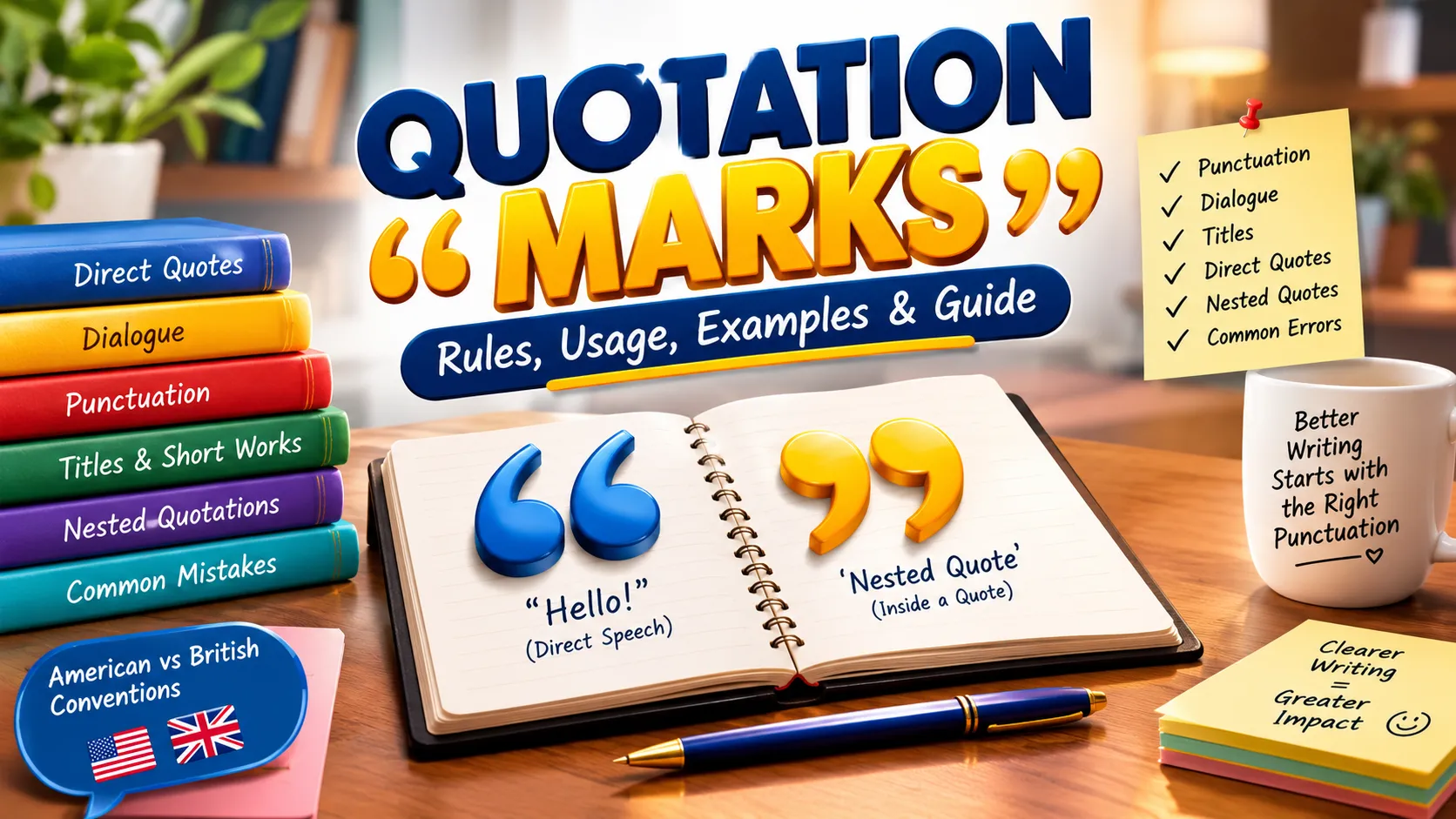
Quotation Marks Rules explain how to use quotation marks correctly in English writing. Quotation marks show a speaker’s exact words, identify quotations from other sources, mark certain titles, and indicate words used in special ways. The main types include double quotation marks (“ ”) and single quotation marks (‘ ’).
Writers often struggle with quotation marks because American and British English follow different punctuation conventions. Understanding these rules helps students, teachers, English learners, and professional writers avoid common grammatical mistakes.
This guide covers quotation mark rules, punctuation placement, dialogue examples, direct quotations, titles, nested quotations, and common errors.
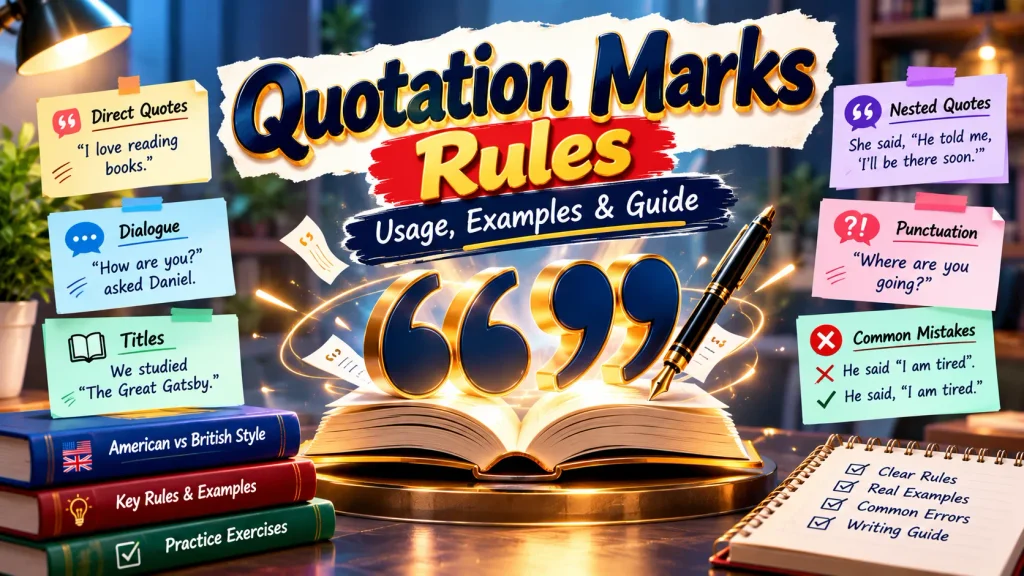
What Are Quotation Marks?
Quotation marks are punctuation marks that surround words or phrases to show that someone has spoken them, that a writer has taken them from another source, or that the writer uses them in a particular way.
English uses two main types of quotation marks:
- Double quotation marks (“ ”): Writers commonly use these for direct quotations in American English.
- Single quotation marks (‘ ’): Writers commonly use these for quotations inside other quotations in American English and for direct quotations in many British English styles.
Examples:
- Maria said, “I love reading books.”
- The teacher asked, “Did you finish your homework?”
- She called the movie “remarkable.”
Quotation mark conventions can vary by style guide and region, so writers should follow one consistent style.
Quotation Marks Rules 1: Use Quotation Marks for Direct Quotations
Use quotation marks to show the exact words someone has spoken or written. A direct quotation reproduces the original wording rather than summarizing the message.
Examples:
- James said, “I will call you tomorrow.”
- Sarah asked, “Where is my notebook?”
- The teacher announced, “The examination starts at nine.”
- My father told me, “Always speak the truth.”
- Emily said, “I cannot attend the meeting today.”
Each example preserves the speaker’s exact words.
Incorrect: James said that “he would call me tomorrow” when those were not his exact words.
Correct: James said, “I will call you tomorrow.”
If you report the meaning without using the speaker’s exact words, you generally do not need quotation marks.
Example:
James said that he would call me the following day.
Rule 2: Use Quotation Marks in Dialogue
Quotation marks help readers identify the exact words characters speak in stories, novels, scripts, and other forms of writing.
Examples:
- “How are you?” asked Daniel.
- “I am fine,” replied Emma.
- “Where are you going?” my brother asked.
- “I am going to the library,” I answered.
- “Please close the door,” she said.
Start a new paragraph when a different character begins speaking in conventional prose dialogue.
Example:
“Are you ready?” asked Olivia.
“Yes, I am ready,” replied Noah.
“Then let’s leave,” Olivia said.
This format helps readers follow conversations without confusing the speakers.
Rule 3: Put Commas and Periods Inside or Outside Quotation Marks
The placement of commas and periods depends on the style of English you follow.
American English
American English generally places commas and periods inside closing double quotation marks, even when the punctuation is not part of the original quotation.
Examples:
- She said, “I am tired.”
- “We should leave now,” he said.
- My favorite word is “serendipity.”
- “I enjoyed the book,” Maria explained.
British English
British English often follows a logical punctuation approach. Writers place punctuation inside quotation marks when it belongs to the quoted material and outside when it belongs to the surrounding sentence. House styles may vary.
Examples:
- She said, ‘I am tired.’
- Did he really describe the result as ‘remarkable’?
- The word ‘serendipity’ means finding something valuable by chance.
British publishers also use double quotation marks, so the choice of single or double marks depends on the style guide.
Important: Choose American or British punctuation conventions based on your audience or publication requirements, and apply them consistently.
Rule 4: Place Question Marks Correctly
A question mark belongs inside quotation marks when the quoted words form the question. It belongs outside when the entire sentence asks a question about a quoted word or phrase.
When the quotation is a question
Examples:
- She asked, “Where are you going?”
- “Why are you laughing?” he asked.
- The teacher asked, “Have you completed the assignment?”
When the entire sentence is a question
Examples:
- Did she say “the meeting is canceled”?
- Who wrote “Pride and Prejudice”?
- Have you read the article titled “How to Learn English”?
In the second group, the surrounding sentence asks the question, so the question mark falls outside the quotation marks under standard American conventions.
Rule 5: Place Exclamation Marks Correctly
An exclamation mark belongs inside quotation marks when the quoted words express strong emotion. Place it outside when the surrounding sentence expresses the emotion.
Examples:
- She shouted, “Watch out!”
- “That is fantastic!” exclaimed Liam.
- I cannot believe she called the performance “perfect”!
- Did you hear him yell, “Stop!”?
In the final example, the quoted command includes an exclamation mark, while the surrounding sentence is a question. Both marks serve different purposes.
Rule 6: Use Quotation Marks for Quotations Within Quotations
When one quotation appears inside another, use a different style of quotation marks for the inner quotation.
In American English, writers generally use double quotation marks for the outer quotation and single quotation marks for the inner quotation.
Examples:
- Olivia said, “Daniel told me, ‘I will arrive early.’”
- The teacher announced, “The student asked, ‘May I leave the room?’”
- “I heard her say, ‘This is wonderful!’” James explained.
In British English, writers often reverse the pattern: single quotation marks on the outside and double quotation marks on the inside.
Example:
– Olivia said, ‘Daniel told me, “I will arrive early.”’
The main principle is to make the boundaries of each quotation clear.
Rule 7: Use Quotation Marks for Short Titles
Writers commonly use quotation marks for the titles of shorter creative works and individual pieces within larger publications.
These include:
- Short stories
- Poems
- Songs
- Magazine articles
- Newspaper articles
- Chapters
- Individual episodes of television series
Examples:
- We studied “The Road Not Taken” in class.
- I read “The Tell-Tale Heart” last night.
- Her favorite song is “Imagine.”
- I found an interesting article titled “The Benefits of Reading.”
- Our teacher assigned Chapter 3, “The Structure of Sentences.”
Longer works, such as books, films, albums, and full-length plays, usually take italics in standard American publishing style.
Examples:
- Pride and Prejudice
- The Lion King
- Harry Potter and the Philosopher’s Stone
If italics are unavailable, some styles permit alternative formatting. Follow the relevant style guide.
Rule 8: Use Quotation Marks to Identify Words as Words
Quotation marks can distinguish a word or expression from the rest of a sentence when the writer discusses its meaning, spelling, or usage.
Examples:
- “Beautiful” is an adjective.
- The word “quickly” functions as an adverb.
- “Their” and “there” have different meanings.
- The spelling “accommodate” contains two c’s and two m’s.
However, writers do not need quotation marks every time they mention a word. Italics or plain text may work better, depending on the style guide and context.
Example:
The word quickly functions as an adverb.
Consistency matters more than adding quotation marks unnecessarily.
Quotation Marks Rules 9: Use Quotation Marks for Unusual or Specially Used Expressions
Writers sometimes place quotation marks around a word or phrase to signal irony, skepticism, informality, or an unusual meaning. These marks are sometimes called scare quotes.
Examples:
- He offered his “expert” advice without understanding the problem.
- The company promised a “quick” repair that took three weeks.
- She described the experience as “interesting.”
In the first two examples, the quotation marks may suggest that the writer doubts the description.
Use this technique sparingly. Excessive scare quotes can make writing sound sarcastic or undermine the writer’s credibility.
Rule 10: Use Quotation Marks for Direct Speech After a Reporting Clause
A reporting clause identifies the person speaking or the act of speaking. Common reporting verbs include said, asked, replied, explained, and whispered.
Examples:
- David said, “I need some help.”
- “I need some help,” David said.
- “Can you help me?” David asked.
- “Of course,” replied Sarah.
Notice how the comma separates the reporting clause from the quotation when the sentence follows the usual American dialogue convention.
When the quoted sentence ends with a question mark or exclamation mark, do not add an unnecessary comma after that mark.
Incorrect: “Where are you going?,” she asked.
Correct: “Where are you going?” she asked.
Quotation Marks Rules 11: Capitalize the First Word of a Quotation Correctly
Capitalize the first word of a complete direct quotation when it begins a sentence or is presented as a complete sentence.
Examples:
- She said, “We should start now.”
- He asked, “Are you feeling better?”
- The coach shouted, “Keep moving!”
However, a quotation integrated into the grammar of a larger sentence may begin with a lowercase letter.
Examples:
- She described the task as “extremely difficult.”
- The teacher said that “practice improves performance.”
- He called the experience “a valuable lesson.”
If you quote only part of a sentence, preserve the capitalization that the context and applicable style guide require.
Rule 12: Use Quotation Marks When Quoting Sources
Academic writers, journalists, and researchers use quotation marks to identify exact words taken from another source.
Examples:
- According to the author, “Education is the foundation of progress.”
- The report states, “The results show a significant improvement.”
- The article describes the process as “a major breakthrough.”
When you quote a source, identify it with an appropriate citation. Quotation marks alone do not give credit to the original author.
For example, APA style generally requires the author, publication year, and a page number or another appropriate locator for a direct quotation when available.
Important: Do not place quotation marks around a paraphrase as if it reproduces the source’s exact words. Paraphrases require appropriate attribution but generally do not use quotation marks.
Rule 13: Use Quotation Marks for Interrupted Quotations
A speaker’s sentence may include a reporting clause in the middle. Quotation marks show where the speech pauses and resumes.
Examples:
- “I think,” Maria said, “we should leave early.”
- “If you study regularly,” the teacher explained, “you will improve.”
- “This book,” Daniel remarked, “is worth reading.”
When the reporting clause interrupts a single sentence, the punctuation and capitalization should reflect the sentence’s structure.
Compare:
- “I am ready,” she said, “but I need five more minutes.”
- “I am ready,” she said. “I can leave now.”
The first example contains one sentence interrupted by a reporting clause. The second contains two complete sentences.
Quotation Marks Rules 14: Use Quotation Marks with Ellipses and Omissions
An ellipsis consists of three dots (…) and can indicate omitted words in a quotation or a pause in dialogue.
Examples:
- The report states, “The results … support the original hypothesis.”
- “I thought … perhaps we could try again,” she said.
When you omit words from a source, make sure the omission does not distort the original meaning. Academic style guides have specific rules for ellipses, spacing, and sentence-ending punctuation.
Do not use ellipses casually to change the meaning of a quotation or conceal important context.
Rule 15: Use Quotation Marks with Brackets and Editorial Changes
Square brackets identify words or explanations that a writer adds to a quotation to clarify its meaning or adjust a grammatical detail.
Examples:
- The witness stated, “She [the manager] approved the request.”
- The report explained, “They [the researchers] completed the experiment.”
- The author wrote, “It [the proposed solution] may reduce costs.”
Brackets distinguish the writer’s additions from the source’s original wording.
Use editorial changes carefully. Do not change a quotation in a way that misrepresents the original speaker or author.
Quotation Marks Rules 16: Do Not Use Quotation Marks for Indirect Speech
Indirect speech reports what someone said without reproducing the exact words. It usually does not require quotation marks.
Examples:
Direct speech: Emma said, “I am hungry.”
Indirect speech: Emma said that she was hungry.
More examples:
- Direct: He said, “I will help you.”
- Indirect: He said that he would help me.
- Direct: Sarah asked, “Where do you live?”
- Indirect: Sarah asked where I lived.
Indirect speech often requires changes to pronouns, verb tenses, and time expressions.
Avoid placing quotation marks around a reported statement unless you are quoting the exact words.
Rule 17: Avoid Unnecessary Quotation Marks
Quotation marks can confuse readers when writers use them without a clear purpose.
Incorrect: Please bring your “books” to class.
Correct: Please bring your books to class.
Incorrect: Our store offers “discounts” every weekend.
Correct: Our store offers discounts every weekend.
Incorrect: Turn left at the “next street.”
Correct: Turn left at the next street.
Use quotation marks when you quote exact words, identify a title under the applicable style, discuss a word as a word, or intentionally signal a special meaning. Do not use them simply to add emphasis. Bold or italics may serve that purpose more clearly.
Quotation Marks Rules 18: Understand American and British Quotation Mark Styles
American and British English often differ in their preferred quotation marks and punctuation conventions.
| Feature | American English | British English |
| Common primary quotation marks | Double “ ” | Single ‘ ’ |
| Quotation within a quotation | Single ‘ ’ | Double “ ” |
| Commas and periods | Generally inside closing marks | Often follow logical placement |
| Direct dialogue | Commonly uses double marks | Commonly uses single marks |
| Short work titles | Usually quotation marks | Depends on publication style |
These are general tendencies, not absolute rules. Publishers, universities, newspapers, and style guides may follow different conventions.
For academic writing, use the style guide your institution requires, such as APA, MLA, or Chicago.
Rule 19: Use Quotation Marks Correctly in Lists and Signs
Quotation marks may appear in signs, labels, and lists when they reproduce someone’s exact words or identify a particular expression.
Examples:
- The sign read, “Employees Only.”
- The teacher wrote “noun,” “verb,” and “adjective” on the board.
- The instructions said, “Keep the door closed.”
However, ordinary labels and headings do not automatically need quotation marks.
For example:
- Store Hours
- Emergency Exit
- Reading List
Use quotation marks only when they serve a clear grammatical or contextual purpose.
Rule 20: Distinguish Quotation Marks from Apostrophes
Quotation marks and apostrophes look similar, but they perform different grammatical functions.
Quotation marks identify direct speech, quotations, and certain titles or expressions.
Examples:
- She said, “I agree.”
- We read “The Raven” in class.
Apostrophes commonly show possession or omitted letters in contractions.
Examples:
- Sarah’s book is on the desk.
- I don’t know the answer.
- They’re going home.
Do not confuse an apostrophe with an opening or closing quotation mark. Typography may vary, but each punctuation mark has a distinct function.
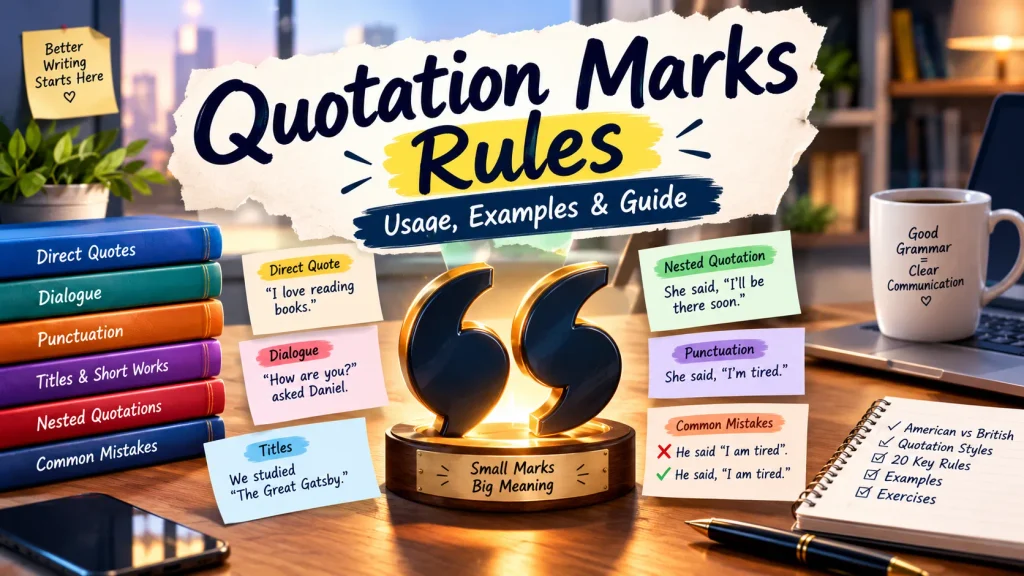
Common Quotation Marks Mistakes
| Incorrect | Correct | Explanation |
| She said “I am happy”. | She said, “I am happy.” | Standard American punctuation places the period inside the closing mark. |
| “Where are you going?,” he asked. | “Where are you going?” he asked. | Do not add a comma after a question mark. |
| He said that “he was tired.” | He said that he was tired. | Indirect speech normally does not require quotation marks. |
| She called it a “wonderful” idea. | She called it a wonderful idea. | Remove unnecessary quotation marks unless you intend a special meaning. |
| “I love reading, she said.” | “I love reading,” she said. | The reporting clause belongs outside the quotation marks. |
| She asked, “Are you ready”. | She asked, “Are you ready?” | A quoted question needs a question mark. |
| He said, ‘I agree.’ | He said, “I agree.” | This follows the common American double-quotation convention. |
Remember that punctuation placement may differ in British English and under specialized editorial styles.
Quotation Marks Rules for Students
Students can use the following simple checklist when writing essays, stories, and answers.
- Use quotation marks around the exact words someone says.
- Put a comma before a direct quotation when the sentence structure calls for one.
- Use the correct question mark or exclamation mark.
- Distinguish direct speech from indirect speech.
- Use a different style of quotation marks for a quotation inside another quotation.
- Follow your teacher’s preferred American or British English conventions.
- Cite the source when you use someone else’s exact words.
- Remove unnecessary quotation marks.
- Check capitalization at the beginning of a quotation.
- Apply the same punctuation style throughout your work.
Quotation Marks Exercises
Test your understanding by choosing the correct punctuation in each sentence.
Practice quiz
0 of 6 answered
1. Which sentence uses quotation marks correctly in standard American English?
She said, “I am ready”.
.
She said, “I am ready.”
.
She said “I am ready.”
2. Which sentence correctly punctuates a quoted question?
He asked, “Where are you going?”
.
He asked, “Where are you going?”.
.
He asked, “Where are you going?,”
3. Which sentence uses indirect speech correctly?
She said, “that she was tired.”
.
She said that she was tired.
.
She said that “she was tired.”
4. How should an inner quotation appear in standard American English?
“She said, ‘I agree.’”
.
‘She said, “I agree.”’
.
“She said, “I agree.””
5. Which sentence avoids unnecessary quotation marks?
Please read your “textbook.”
.
Please read your textbook.
.
Please “read” your textbook.
6. Which sentence correctly punctuates dialogue?
“I am hungry,” she said.
.
“I am hungry”, she said.
.
“I am hungry,” She said.
Check answers
People Also Ask
The main rules include using quotation marks for direct speech and exact quotations, distinguishing nested quotations, punctuating dialogue correctly, and following the appropriate conventions for titles and special expressions. Writers should also cite quoted sources and avoid unnecessary quotation marks.
In standard American English, periods generally go inside closing quotation marks. British English often uses logical punctuation, placing periods inside or outside depending on whether they belong to the quoted material.
American English generally places commas inside closing quotation marks. British English often places them according to the meaning and structure of the sentence, although publishers may follow different house styles.
American English commonly uses double quotation marks for primary quotations and single marks for quotations inside quotations. British English commonly reverses this pattern. Follow the style guide required for your writing.
Short works, such as poems, songs, short stories, and articles, commonly take quotation marks. Full-length books and other major works generally use italics in standard American publishing style.
Conclusion
Quotation marks help writers communicate exact words, identify quotations, format dialogue, and distinguish certain titles and expressions. Correct usage depends on the purpose of the quotation and the punctuation conventions of the chosen style.
To master quotation mark rules, practice direct and indirect speech, learn where commas and periods belong, and understand the difference between American and British English conventions. Consistent punctuation makes your writing clearer, more professional, and easier to read.










