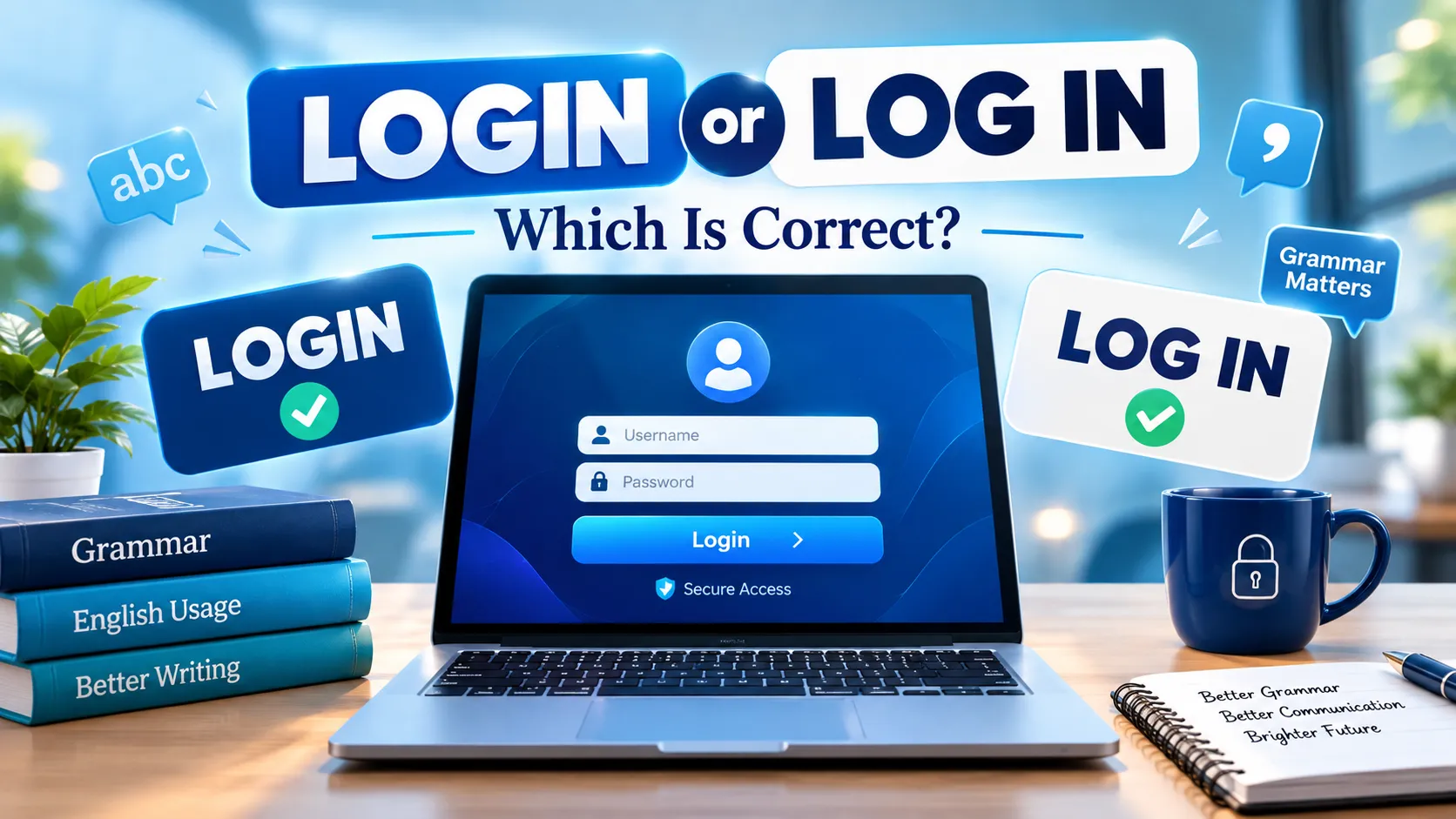
Login or log in? Both forms are correct, but they are not normally interchangeable because they serve different grammatical functions.
Use log in as a verb when you mean to enter or connect to a computer, website, app, or online account.
Use login primarily as a noun when referring to the act of accessing a system, the credentials used to access it, or a place/interface where access occurs. Cambridge lists login as a noun and log in as a phrasal verb.
Quick answer
| Form | Part of speech | Main use | Example |
| log in | Verb / phrasal verb | To access an account or system | Please log in to your account. |
| login | Noun | An account-access action, credential/name, or access point | I forgot my login. |
| log-in | Noun | Variant noun form | The log-in process was quick. |
Easy rule:
👉 If you are describing an action, use log in.
👉 If you are naming a thing, credential, process, or access point, use login.
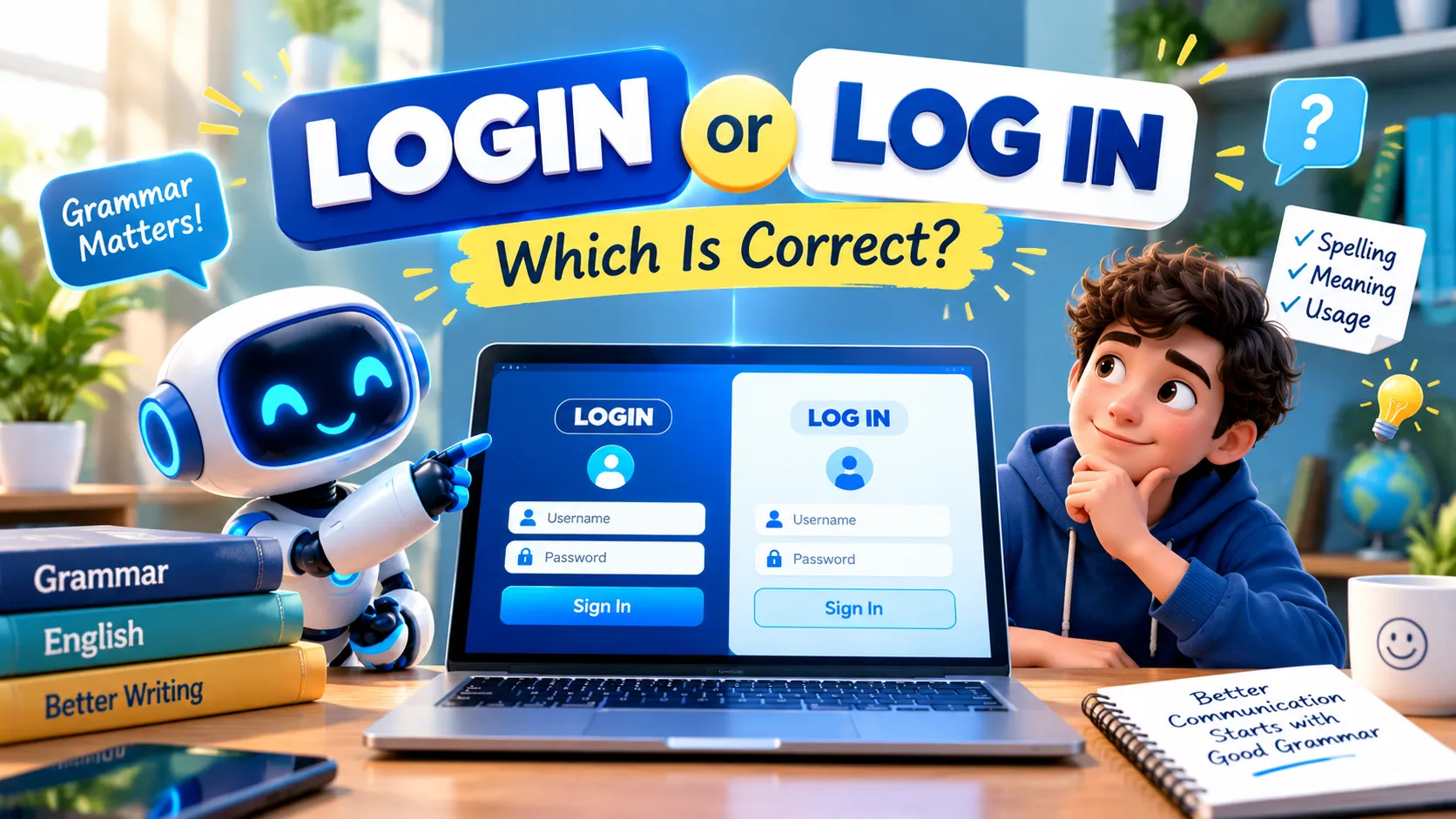
What Does “Log In” Mean?
Log in is a phrasal verb meaning to connect to or enter a computer system, website, application, or account, usually by providing a username, password, or other credentials.
Cambridge defines log in as connecting to a computer system by entering particular information, and gives examples such as “please log in.”
Examples of “log in”
- Please log in to your account.
- I need to log in before I can see my messages.
- She logged in to the website.
- You must log in with your username and password.
- Did you log in this morning?
- Students can log in to the learning portal.
- I couldn’t log in because I forgot my password.
In each sentence, log in describes an action.
What Does “Login” Mean?
Login is primarily a noun.
It can refer to:
- The act of accessing a computer system or account.
- A username or other information used to access a system.
- A place or interface where a user enters credentials.
Cambridge lists these noun uses for login, including an access name, the act of entering it, and a screen or place where the user enters the information.
Examples of “login”
- I forgot my login.
- The website requires a login.
- Your last login was yesterday.
- The system records every login.
- Enter your login and password.
- The login page is not loading.
- We created a new login for the employee.
Here, login functions as a thing or concept, not as the main action.
Login vs. Log In: The Main Difference
The easiest way to understand the difference is to compare noun vs. verb.
Log in = action
Please log in to your account.
Here, log in tells someone what to do.
Login = thing
I forgot my login.
Here, login is the thing the speaker forgot.
Compare:
You need to log in first.
Your login information is incorrect.
The first sentence uses a verb.
The second uses a noun.
When to Use “Log In”
Use log in when the word functions as a verb.
1. Giving an instruction
Please log in to continue.
2. Describing an action
I log in to my account every morning.
3. Talking about past access
She logged in at 9 a.m.
4. Talking about future access
I will log in later.
5. Using an auxiliary verb
You should log in before the meeting.
Can you log in again?
You must log in to view the document.
The grammatical behavior makes the distinction especially clear. You can conjugate the verb:
- log in
- logs in
- logged in
- logging in
Examples
I log in every day.
She logs in from her laptop.
They logged in yesterday.
We are logging in now.
When to Use “Login”
Use login when it is functioning as a noun.
1. Referring to credentials
I forgot my login.
2. Referring to an access attempt
The system recorded the user’s login.
3. Referring to an access page
Go to the login page.
4. Referring to the process
The login was successful.
5. Referring to an account-access requirement
A login is required to access this content.
Cambridge specifically documents login as a noun for an identifying name, an act of entering that information, and an on-screen access point.
Is “Login” a Verb?
This is where the issue becomes slightly more complicated.
In standard edited English, log in is the conventional phrasal-verb form:
Please log in.
Users can log in with their email addresses.
However, login is also widely used as a verb in computing and technology contexts, particularly in informal or product-specific usage. Dictionary.com notes that using login as a verb is common in computer writing, although some organizations deliberately preserve the distinction between the noun login and the verb log in.
For general-purpose formal writing, the clearest choice is:
Verb → log in
Noun → login
So write:
Please log in to your account.
rather than:
Please login to your account.
Is “Log-In” Correct?
Yes.
Log-in is also documented as a noun variant. Cambridge lists log-in as a noun alongside login.
For example:
The log-in process was simple.
I entered my log-in information.
However, modern digital writing frequently uses the closed form login:
The login process was simple.
Visit the login page.
The important distinction remains:
log in → verb
login/log-in → noun
Login or Log In in a Sentence
Here are common examples:
| Incorrect or less preferred in standard usage | Preferred |
| Please login to your account. | Please log in to your account. |
| I need to login first. | I need to log in first. |
| She login every morning. | She logs in every morning. |
| He forgot his log in. | He forgot his login. |
| The log in page is unavailable. | The login page is unavailable. |
| Your login was successful. | Your login was successful. |
| You must log in first. | You must log in first. |
“Log In” as a Verb: More Examples
Present tense
I log in to the platform every morning.
You log in with your email address.
They log in before class.
Third-person singular
She logs in from her phone.
He logs in automatically.
Notice that log takes the -s:
She logs in.
Not:
She login.
Past tense
I logged in yesterday.
She logged in successfully.
Present participle
I am logging in now.
They are logging in to the system.
“Login” as a Noun: More Examples
I forgot my login.
Your login has expired.
The system requires a login.
The administrator created a new login.
My last login was at 8:30 a.m.
The login page is under maintenance.
Please protect your login credentials.
These examples treat login as a noun.
Login Page or Log-In Page?
Both login page and log-in page can be found in English.
Login page is especially common in modern web and software terminology.
Go to the login page.
The login page requires a username and password.
Because login is functioning as a noun used attributively before page, the closed spelling is natural.
Login Information or Log In Information?
The preferred form is generally:
login information
Here, login modifies the noun information.
Other common compounds include:
- login credentials
- login details
- login page
- login screen
- login form
- login process
- login attempt
- login history
- login password
- login ID
But when the phrase is a verb, keep the words separate:
You need to log in first.
Login Credentials vs. Log In Credentials
The distinction is easy:
Noun
Keep your login credentials secure.
Verb
Log in using your credentials.
In the first sentence, login describes the credentials.
In the second sentence, log in is the verb.
Login vs. Sign In
Login and sign in are closely related in modern computing, but they have different grammatical structures.
Verb forms
- log in
- sign in
Noun forms
- login
- sign-in
For example:
Please log in to your account.
Please sign in to your account.
Both are natural.
As nouns:
The login failed.
The sign-in failed.
Login vs. Log On
Log on is another phrasal verb with a similar meaning.
Please log on to the computer.
I logged on to the network.
Cambridge identifies log on as another form related to log in for connecting to a computer system.
The noun forms can be:
- login
- log-in
- logon
- log-on
For contemporary websites and apps, log in and login are extremely common.
Why Do People Confuse “Login” and “Log In”?
The confusion comes from a common English word-formation pattern.
Many English verbs eventually produce closed-form nouns:
- back up → backup
- set up → setup
- sign in → sign-in
- log in → login
This makes it tempting to use login as a verb.
Dictionary.com specifically notes that computer terminology has contributed to widespread use of login as a verb, even though the traditional distinction remains useful.
For clear professional writing, maintaining the distinction eliminates ambiguity.
A Simple Trick to Remember Login vs. Log In
Use this rule:
If you can put “to” before the phrase, use “log in.”
I need to log in.
Not:
I need to login.
If you can put “a,” “the,” “my,” or “your” before it, use “login.”
my login
the login
a login
your login
This is an easy test because articles and possessive determiners naturally identify nouns.
Explore More: https://wordminto.com/restaurant-or-resturant/
Login or Log In: Quick Grammar Test
Choose the correct form.
1. Please ___ to your account.
Answer: log in
Please log in to your account.
2. I forgot my ___.
Answer: login
I forgot my login.
3. She ___ every morning.
Answer: logs in
She logs in every morning.
4. The ___ page isn’t working.
Answer: login
The login page isn’t working.
5. You need to ___ first.
Answer: log in
You need to log in first.
6. The system recorded his last ___.
Answer: login
The system recorded his last login.
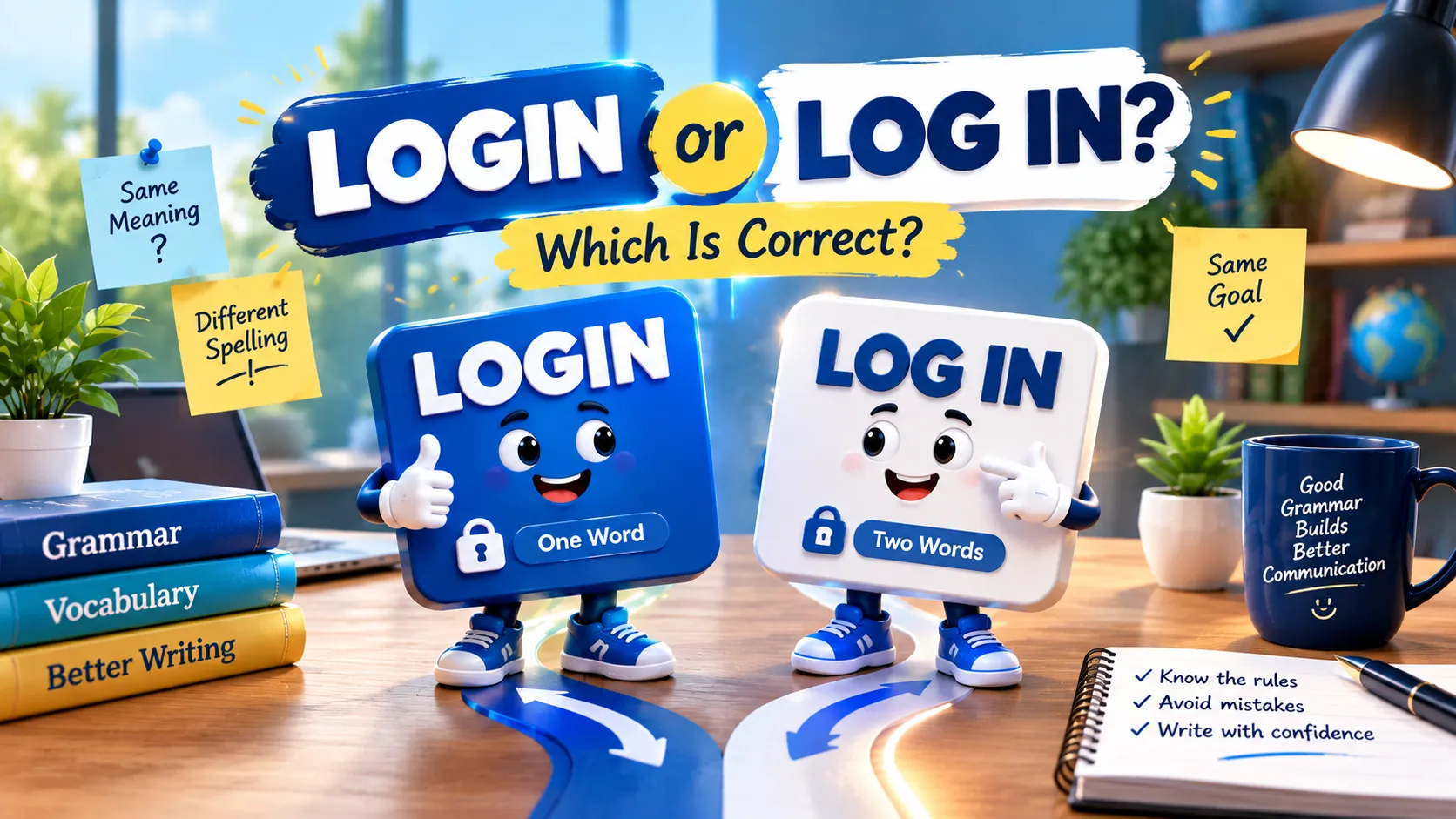
Common Mistakes With Login and Log In
Mistake 1: “Please login”
A common version is:
Please login to continue.
For standard edited English, use:
Please log in to continue.
Here, the phrase is a verb.
Mistake 2: “I forgot my log in”
When referring to a noun, use:
I forgot my login.
or:
I forgot my log-in.
Cambridge recognizes both login and log-in as noun forms.
Mistake 3: “She login every day”
The correct verb form is:
She logs in every day.
The verb needs the third-person singular -s.
Mistake 4: “I am login”
Use the present participle:
I am logging in.
Not:
I am login.
Mistake 5: “Login into your account”
The usual construction is:
Log in to your account.
Not:
Login into your account.
The verb is log in, followed by to when identifying the system/account being accessed.
Login vs. Log In: Formal Writing
For academic, professional, technical, and general-purpose writing, maintaining the traditional distinction is a strong editorial choice:
Verb: log in
Noun: login
For example:
Users must log in before accessing their accounts.
Each login is recorded by the system.
This makes the grammar immediately clear.
Is “Log In” Hyphenated?
As a verb, log in is normally written as two words, without a hyphen.
Please log in.
As a noun, dictionaries also document log-in as a hyphenated form.
However, login is also a standard noun spelling:
Please visit the login page.
So the practical distinction is:
- log in → verb
- login → noun
- log-in → noun variant
Login, Log In, and Logged In
These forms are related but grammatically different.
Log in
Base verb:
Please log in.
Logs in
Third-person singular:
She logs in every evening.
Logged in
Past tense/past participle:
He logged in yesterday.
It can also function adjectivally:
I am logged in.
Logging in
Present participle:
She is logging in now.
Login
Noun:
The login was successful.
Examples in Everyday English
Website
Please log in to view your account.
The login page is unavailable.
Social media
I can’t log in to my account.
My login information has changed.
Online banking
Customers must log in before viewing account details.
The bank records each login attempt.
School
Students can log in to the learning portal.
Your student login is printed on your registration document.
Workplace
Employees must log in before starting work.
The system records each employee’s login time.
Gaming
Players can log in using their game account.
I forgot my login.
People Also Ask
Login is one word when used as a noun. Log in is two words when used as a verb. Dictionaries document login as a noun and log in as a phrasal verb.
Yes. Log in is the standard phrasal-verb form meaning to access a computer system, website, application, or account.
Yes. Login is a standard noun. It can refer to the access credentials, an access event, or a login interface.
For standard edited English, Please log in is the clearer choice because the phrase is functioning as a verb.
It is widely used as a verb in computing and technology contexts, but log in is the conventional phrasal-verb form and is the safer choice for formal/general writing.
Login page is the natural modern form.
Go to the login page.
Final Verdict
The simplest rule is:
Use “log in” for the action and “login” for the noun.
Correct
Please log in to your account.
I forgot my login.
She logged in yesterday.
The login page is unavailable.
Your login credentials are secure.
We need to log in before starting.
Although login is increasingly used as a verb in technology-related writing, the log in / login distinction remains the clearest convention for standard English. Dictionary.com notes that this verb use exists but is not universally preferred, while Cambridge explicitly distinguishes log in as a phrasal verb from login as a noun.
Remember:
LOG IN = VERB → Do it
LOGIN = NOUN → The thing/process/access
Example:
Log in to your account using your login details.
That single sentence captures the difference.










1 thought on “Login or Log In: Which Is Correct?”