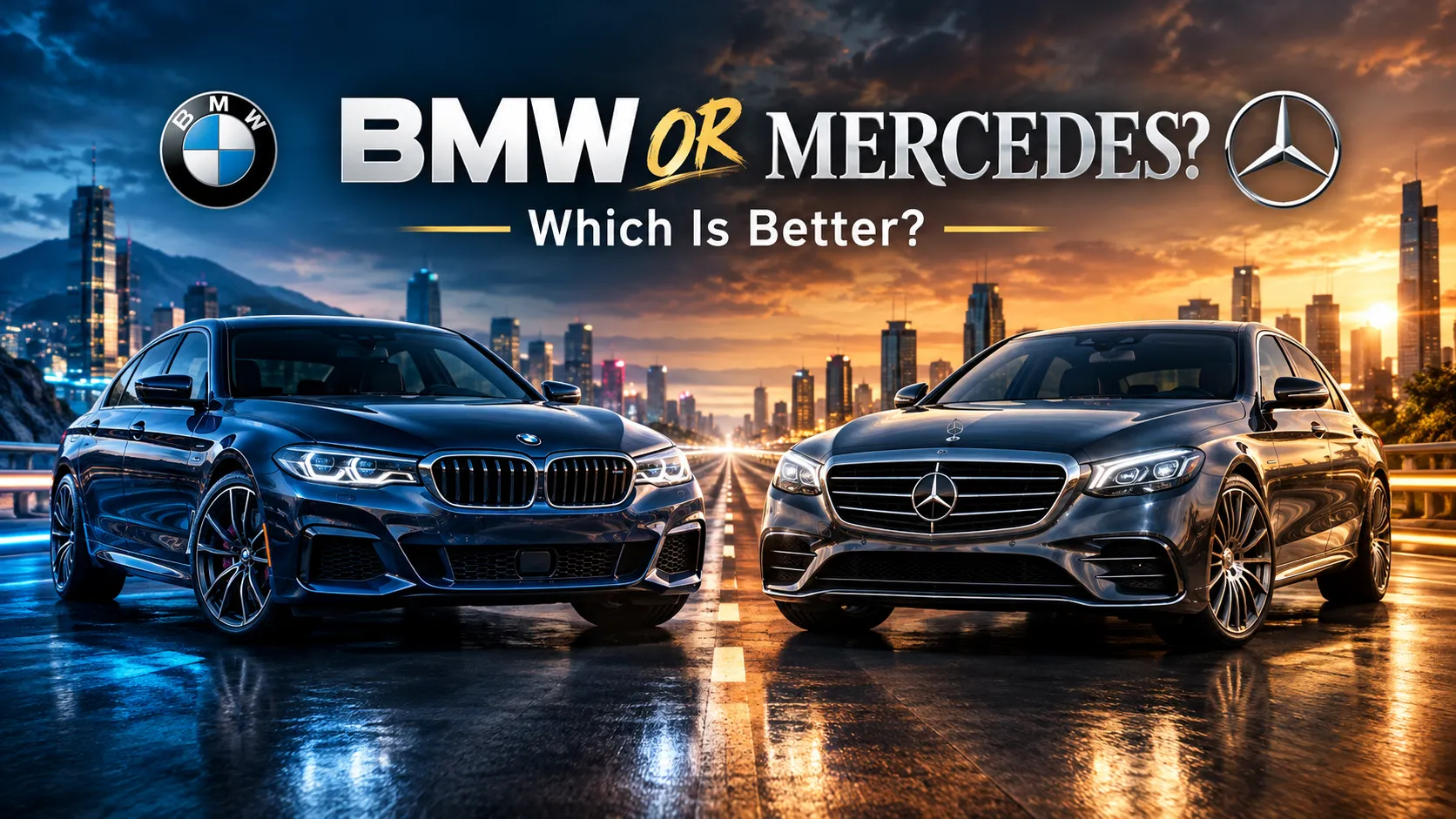
BMW or Mercedes—which luxury car brand is better? It depends on what you want from your car.
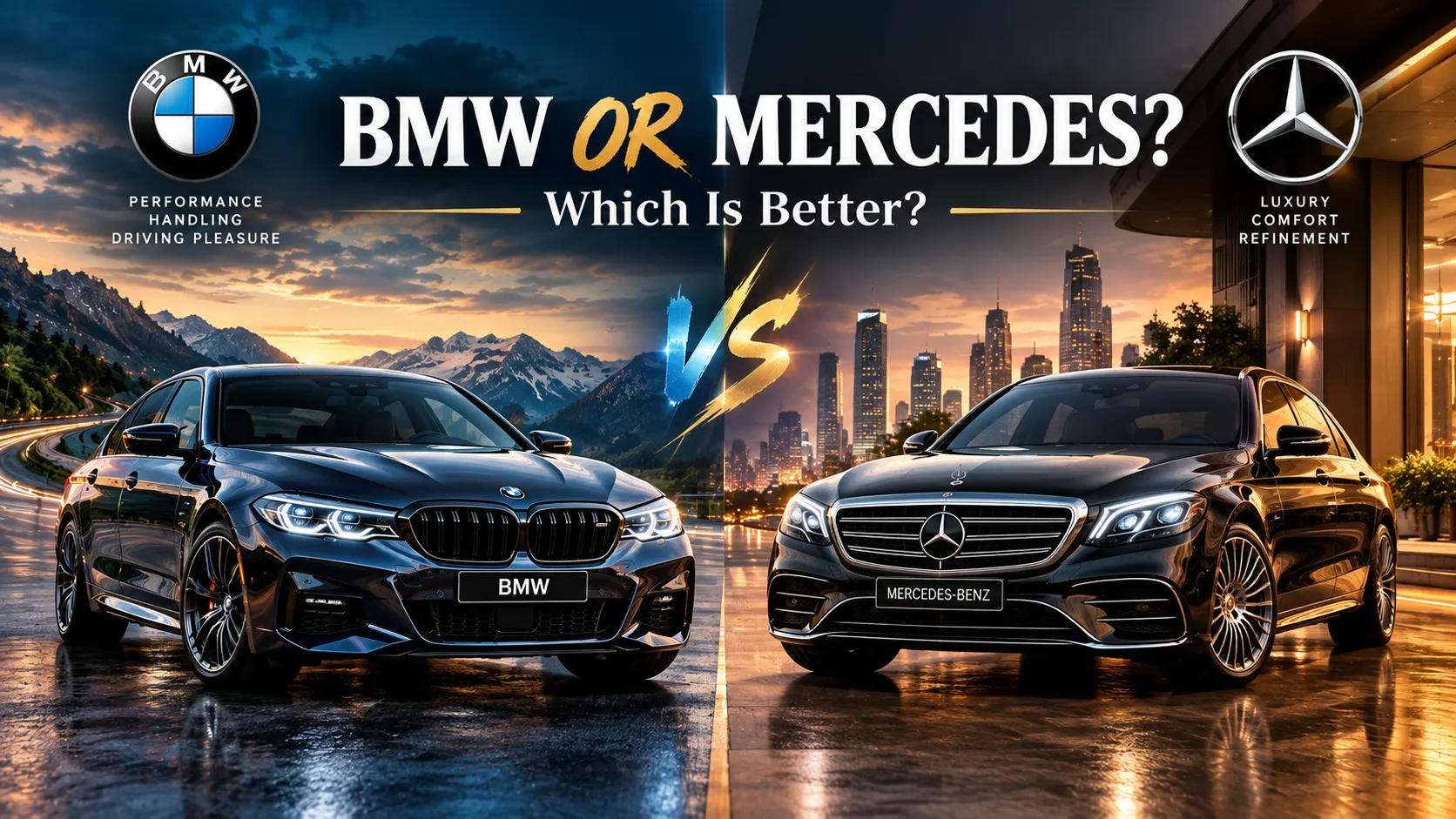
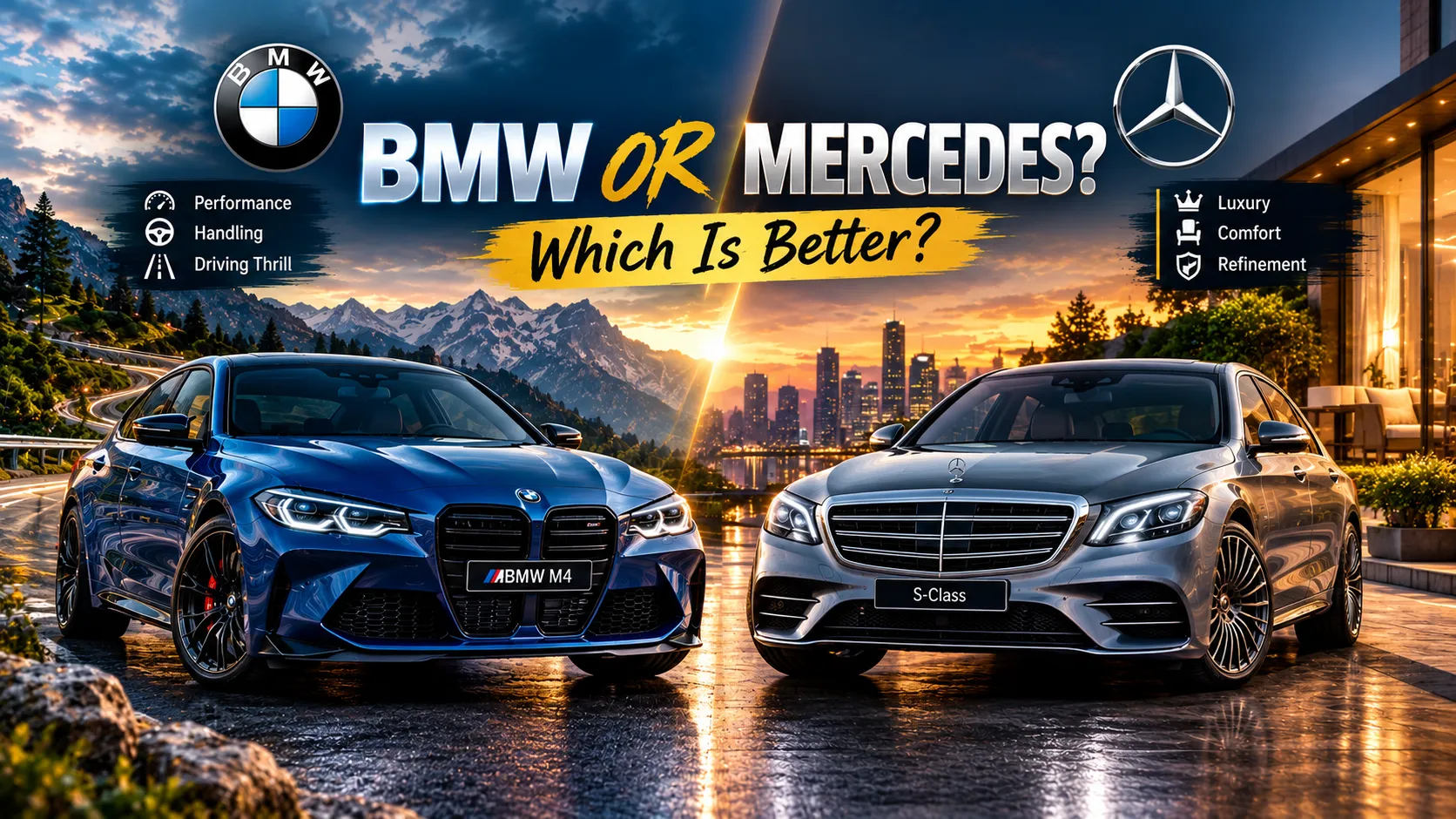
BMW is traditionally associated with sporty handling, driving engagement, performance, and driver-focused engineering, while Mercedes-Benz is better known for comfort, luxury, refinement, and technology. However, modern cars have blurred that distinction. A BMW can be extremely luxurious, while a Mercedes-AMG can deliver serious performance.
For 2026, both brands offer extensive sedan, SUV, performance, hybrid, and electric lineups. BMW’s current range includes models such as the 3 Series, 5 Series, 7 Series, X3, X5, X7, M models, i4, i5, i7, iX, and iX3. Mercedes-Benz likewise competes across the compact, executive, flagship, SUV, AMG, and electric segments.
Quick answer: Choose BMW if driving enjoyment and sporty performance are your priorities. Choose Mercedes if comfort, luxury, and refinement matter more. For a used car, however, the specific model, engine, year, mileage, and maintenance history can matter more than the badge.
BMW vs Mercedes at a Glance
| Category | BMW | Mercedes-Benz |
| Driving experience | Sportier and more engaging | Smooth and refined |
| Handling | Usually stronger | Excellent, especially AMG |
| Ride comfort | Excellent | Usually stronger |
| Interior luxury | Excellent | Usually stronger |
| Technology | Excellent | Excellent |
| Performance models | BMW M | Mercedes-AMG |
| Luxury SUVs | Excellent | Excellent |
| Electric vehicles | Strong and expanding | Strong and expanding |
| Daily driving | Excellent | Excellent |
| Highway comfort | Excellent | Usually stronger |
| Driver involvement | Usually stronger | Strong |
| Best for | Enthusiastic drivers | Comfort-focused luxury buyers |
Important: This is a general brand comparison. A specific BMW may be more comfortable than a specific Mercedes, and a specific Mercedes-AMG may be more performance-focused than a regular BMW.
BMW vs Mercedes: What Is the Main Difference?
The traditional difference can be summarized simply:
BMW focuses more heavily on the driving experience, while Mercedes-Benz traditionally emphasizes luxury and comfort.
BMW has built much of its identity around handling, steering response, chassis balance, acceleration, and driver involvement.
Mercedes-Benz has traditionally focused more strongly on ride quality, cabin refinement, technology, premium materials, and relaxed long-distance driving.
But this distinction is no longer absolute.
Modern BMW models combine sporty dynamics with sophisticated interiors and advanced technology. At the same time, Mercedes-AMG models demonstrate that Mercedes can produce highly performance-oriented vehicles.
Therefore, asking “BMW or Mercedes?” without specifying the model can be misleading.
A better question is:
Which BMW or Mercedes is better for my needs?
BMW vs Mercedes Driving Experience
If you enjoy driving and want your car to feel responsive, BMW usually has the advantage.
BMW’s current lineup includes performance-oriented versions such as the M340i, M3, M5, M2, M4, and high-performance X models.
BMW vehicles are often attractive to drivers who value:
- Responsive steering
- Strong acceleration
- Agile handling
- Sporty suspension tuning
- Cornering ability
- Driver involvement
- Performance-oriented powertrains
Mercedes is also capable of delivering excellent driving dynamics, particularly through its AMG models.
Mercedes-AMG vehicles combine high performance with the brand’s luxury-oriented character.
BMW is generally better for:
- Enthusiastic driving
- Sporty handling
- Driver engagement
- Performance-oriented daily driving
- Back-road driving
- Motorsport-inspired models
Mercedes is generally better for:
- Relaxed cruising
- Smooth driving
- Cabin refinement
- Long-distance comfort
- Luxury-focused driving
Winner for driving involvement: BMW
Winner for relaxed luxury driving: Mercedes
Which Is Faster: BMW or Mercedes?
There is no universal answer.
BMW and Mercedes compete in multiple vehicle classes, and comparing an entry-level BMW with a flagship Mercedes would not produce a meaningful result.
Instead, compare vehicles within the same category.
Examples include:
- BMW 3 Series vs Mercedes C-Class
- BMW 5 Series vs Mercedes E-Class
- BMW 7 Series vs Mercedes S-Class
- BMW X3 vs Mercedes GLC
- BMW X5 vs Mercedes GLE
- BMW X7 vs Mercedes GLS
- BMW M3 vs Mercedes-AMG C-Class
- BMW M5 vs Mercedes-AMG E-Class
Performance depends on the exact engine, electric motor, drivetrain, weight, tires, transmission, and trim.
For example, the 2026 BMW X5 has several powerful configurations, while the Mercedes GLE also offers multiple powertrains and performance versions. Current testing shows that the X5 can be particularly strong in acceleration and fuel economy in comparable configurations.
The answer is therefore model-specific, not brand-specific.
BMW vs Mercedes Comfort
If comfort is your highest priority, Mercedes generally has the stronger reputation.
Mercedes vehicles have traditionally emphasized:
- Smooth suspension tuning
- Quiet cabins
- Comfortable seats
- Refined power delivery
- Long-distance cruising
- Premium passenger experience
BMW has also become increasingly comfortable. Modern BMW models can combine excellent ride quality with strong handling.
For long journeys, however, Mercedes often appeals more strongly to buyers who want the vehicle to isolate them from the road.
Comfort comparison
| Feature | BMW | Mercedes |
| Ride comfort | Excellent | Excellent+ |
| Seat comfort | Excellent | Excellent |
| Cabin quietness | Excellent | Excellent |
| Highway cruising | Excellent | Excellent+ |
| Sporty feel | Excellent+ | Excellent |
| Luxury ambience | Excellent | Excellent+ |
Winner for overall comfort: Mercedes
BMW vs Mercedes Interior and Technology
Interior design is another area where the two brands take different approaches.
Mercedes often creates a more dramatic luxury environment, with extensive digital displays, ambient lighting, premium materials, and technology-focused cabin design.
BMW takes a more driver-oriented approach while also offering sophisticated digital interfaces, connected services, driver assistance, and software features.
BMW’s current lineup includes ConnectedDrive, remote software upgrades, electric vehicles, and advanced driver-assistance technologies.
Mercedes interior strengths
- Luxury atmosphere
- Premium visual presentation
- Ambient lighting
- Advanced digital displays
- Comfortable seating
- Passenger-focused experience
BMW interior strengths
- Driver-focused layout
- Excellent digital displays
- Strong infotainment
- Modern technology
- High-quality materials
- Strong integration of performance controls
Luxury ambience winner: Mercedes
Driver-focused experience winner: BMW
BMW vs Mercedes Reliability
Reliability is one of the most important factors when choosing between these two brands.
There is no accurate rule that says:
“BMW is unreliable.”
There is also no universal rule that says:
“Mercedes always lasts longer.”
Reliability depends on:
- Model
- Model year
- Engine
- Transmission
- Mileage
- Maintenance history
- Previous ownership
- Electronics
- Driving conditions
Current reliability comparisons have given BMW a strong position against Mercedes in several direct model comparisons. However, brand-level rankings should not be treated as guarantees for every vehicle.
The most important used-car rule
Buy the condition, not the badge.
A carefully maintained BMW can be a better purchase than a neglected Mercedes. Likewise, a well-maintained Mercedes can be a better long-term vehicle than a poorly maintained BMW.
Before buying a used luxury vehicle, check:
- Service history
- Oil-change records
- Mileage
- Accident history
- Diagnostic codes
- Warning lights
- Cooling system
- Suspension
- Tires
- Electronics
- Recall history
- Independent inspection
BMW vs Mercedes Maintenance Cost
Neither BMW nor Mercedes should be considered a cheap-to-maintain brand.
Both manufacture technologically sophisticated vehicles with:
- Turbocharged engines
- Advanced transmissions
- Complex electronics
- Numerous sensors
- Driver-assistance systems
- Sophisticated suspension systems
- Expensive luxury components
That means repairs can become expensive, particularly after the warranty period.
The cost also varies considerably by model.
For example, maintaining a compact four-cylinder model is not necessarily comparable with maintaining a high-performance V8 or flagship luxury vehicle.
What affects maintenance costs?
- Engine type
- Vehicle age
- Mileage
- Parts prices
- Labor rates
- Dealer vs independent specialist
- Driving conditions
- Maintenance history
- Performance trim
- Suspension Complexity
Do not assume that the cheapest purchase price equals the lowest ownership cost.
A heavily neglected used BMW or Mercedes can quickly become more expensive than a better-maintained example that initially costs more.
BMW vs Mercedes Fuel Economy and Powertrains
Both manufacturers offer a wide range of powertrains.
BMW’s current U.S. lineup includes gasoline vehicles, plug-in hybrids, and fully electric models such as the i4, i5, i7, iX, and iX3.
Mercedes-Benz also offers conventional, hybrid, performance, and electric vehicles across multiple segments.
Your best choice depends on how you drive.
Choose gasoline if:
- You regularly travel long distances.
- Charging infrastructure is limited.
- You want quick refueling.
- Your driving pattern is unpredictable.
Consider a plug-in hybrid if:
- Most daily trips are short.
- You can charge at home.
- You still need gasoline range for longer journeys.
Consider an EV if:
- You have convenient charging.
- Your daily mileage is predictable.
- You want instant torque.
- You prefer quiet driving.
- You can comfortably manage charging requirements.
BMW vs Mercedes Electric Cars
Electric vehicles have changed the BMW vs Mercedes comparison.
BMW’s electric lineup includes vehicles such as the i4, i5, i7, iX, and the newer iX3.
Mercedes-Benz also has an expanding electric range.
When comparing electric BMW and Mercedes models, look beyond the badge.
Consider:
- Real-world range
- Charging speed
- Home charging
- Public charging access
- Battery warranty
- Software
- Interior technology
- Ride comfort
- Performance
- Long-term ownership support
The best EV is not necessarily the one with the highest claimed range. Charging convenience can be equally important.
BMW vs Mercedes for Daily Driving
Both brands can make excellent daily drivers.
BMW is ideal if you want:
- Sporty handling
- Strong acceleration
- Driver engagement
- A responsive chassis
- A more athletic personality
Mercedes is ideal if you want:
- Comfortable commuting
- Quiet cruising
- Smooth suspension
- A luxurious cabin
- Relaxed Driving
If your commute includes winding roads, BMW may make ordinary driving more enjoyable.
If your commute involves heavy traffic and long highway stretches, Mercedes’ comfort-oriented character may be more appealing.
BMW vs Mercedes for Families
Families should not choose between BMW and Mercedes based only on brand reputation.
Instead, consider:
- Rear-seat space
- Child-seat compatibility
- Cargo capacity
- Number of seats
- Safety technology
- Ride comfort
- Visibility
- Reliability
- Maintenance costs
For SUVs, major comparisons include:
- BMW X3 vs Mercedez GLC
- BMW X5 vs Mercedez GLE
- BMW X7 vs Mercedez GLS
The correct choice depends on how much space your family actually needs.
For family buyers, compare the specific models rather than the brands.
BMW vs Mercedes for Long-Distance Driving
Mercedes has traditionally been particularly strong for long-distance travel.
Its strengths include:
- Comfortable seating
- Quiet cabins
- Smooth ride quality
- Relaxed power delivery
- Strong highway refinement
BMW is also excellent for highway travel, especially for drivers who want more involvement behind the wheel.
Choose Mercedes for:
- Maximum comfort
- Relaxed cruising
- Passenger comfort
- Long highway journeys
Choose BMW for:
- Highway performance
- Driver engagement
- Sportier handling
- More dynamic driving
Long-distance comfort winner: Mercedes
Long-distance driving enjoyment winner: BMW
BMW 3 Series vs Mercedes C-Class
The BMW 3 Series and Mercedes C-Class are among the most recognizable competitors in the compact luxury-sedan segment.
BMW’s 3 Series is positioned strongly around sport-sedan characteristics, while the C-Class combines compact dimensions with Mercedes’ luxury-oriented approach.
Choose BMW 3 Series if you want:
- Sportier handling
- Strong driving involvement
- Responsive performance
- Athletic character
Choose Mercedes C-Class if you want:
- Luxury ambience
- Comfortable driving
- Technology-focused interior
- Refined character
Best for driving: BMW 3 Series
Best for comfort and luxury atmosphere: Mercedes C-Class
BMW 5 Series vs Mercedes E-Class
The BMW 5 Series and Mercedes E-Class compete in the executive-sedan segment.
The BMW 5 Series combines luxury with a stronger emphasis on driving dynamics, while the E-Class is particularly attractive for buyers who value comfort and cabin refinement.
BMW 5 Series
Best for:
- Driver engagement
- Handling
- Performance
- Balanced luxury
Mercedes E-Class
Best for:
- Comfort
- Cabin refinement
- Luxury ambience
- Relaxed driving
If you spend most of your time driving yourself, BMW may be more appealing.
If rear-seat comfort and luxury are major priorities, Mercedes deserves serious consideration.
BMW 7 Series vs Mercedes S-Class
At the flagship level, the difference becomes much smaller.
Both provide:
- Premium materials
- Advanced technology
- Powerful engines
- Sophisticated suspension
- Luxury seating
- Advanced driver assistance
- Excellent highway refinement
BMW 7 Series
Best for buyers who want:
- Flagship luxury
- Technology
- Performance
- Driver involvement
Mercedes S-Class
Best for buyers who want:
- Traditional luxury
- Maximum comfort
- Executive ambience
- Chauffeur-style refinement
Luxury-first choice: Mercedes S-Class
Luxury plus driving character: BMW 7 Series
BMW X3 vs Mercedes GLC
The BMW X3 and Mercedez GLC are direct compact luxury SUV competitors.
BMW X3
Best for:
- Handling
- Sporty driving
- Driver engagement
- Performance
Mercedes GLC
Best for:
- Comfort
- Luxury ambience
- Smooth driving
- Cabin refinement
The X3 is the better fit for drivers who want an SUV that still feels athletic.
The GLC is attractive for buyers who prioritize a softer, more luxury-oriented experience.
BMW X5 vs Mercedes GLE
The BMW X5 and Mercedez GLE are two of the most important luxury SUVs in this comparison.
The 2026 BMW X5 offers multiple powertrains and is highly competitive in performance and efficiency. Current testing from Car and Driver rates the X5 ahead of the GLE in its comparison, although the Mercedes GLE offers an optional third row while the X5 is a two-row SUV.
BMW X5
Best for:
- Sportier handling
- Performance
- Driver engagement
- Highway stability
- Balanced luxury
Mercedes GLE
Best for:
- Ride comfort
- Passenger space
- Luxury atmosphere
- Available third-row practicality
Sportier SUV: BMW X5
Comfort-focused SUV: Mercedes GLE
BMW X7 vs Mercedes GLS
The BMW X7 and Mercedez GLS compete in the large luxury-SUV segment.
Both offer:
- Three-row seating
- Premium interiors
- Powerful engines
- Advanced technology
- High levels of comfort
- Luxury-focused equipment
Choose the BMW X7 if you want more driving involvement.
Choose the Mercedes GLS if comfort and luxury ambience are your priorities.
BMW M vs Mercedes-AMG
The BMW M vs Mercedez-AMG debate is one of the most exciting parts of the comparison.
BMW M vehicles are designed around high-performance driving, while Mercedez-AMG combines performance with Mercedez’ luxury philosophy.
BMW M is ideal for:
- Driving enthusiasts
- Track-oriented performance
- Aggressive handling
- Driver involvement
- Motorsport-inspired engineering
Mercedes-AMG is ideal for:
- High-performance luxury
- Strong acceleration
- High-speed cruising
- Dramatic styling
- Performance combined with comfort
There is no universal winner.
BMW M generally appeals more to the pure driving enthusiast.
Mercedes-AMG is especially compelling for buyers who want performance without giving up a luxury-focused experience.
BMW vs Mercedes: Which Is Better Used?
Buying used changes the entire equation.
A new BMW or Mercedez comes with warranty coverage and predictable initial ownership conditions.
A used luxury vehicle may already have:
- Higher mileage
- Previous owners
- Deferred maintenance
- Worn suspension components
- Aging electronics
- Previous accident repairs
- Expired warranty coverage
Therefore, used buyers should pay close attention to the individual vehicle.
Before buying a used BMW or Mercedes, check:
- VIN and vehicle history
- Service records
- Mileage
- Accident history
- Engine condition
- Transmission behavior
- Oil leaks
- Cooling system
- Suspension
- Electronics
- Tires and brakes
- Recall completion
- Diagnostic scan
- Independent inspection
The golden rule
A well-maintained luxury car is usually a better purchase than a neglected luxury car with a better reputation.
BMW vs Mercedes Resale Value
Resale value depends on more than the manufacturer badge.
Important factors include:
- Model
- Trim
- Engine
- Mileage
- Condition
- Maintenance
- Accident history
- Market demand
- New-model redesigns
- Supply and demand
- Vehicle color and equipment
A popular SUV may retain value differently from a niche luxury coupe.
Likewise, a well-maintained example can command a substantially better price than an identical model with poor service history.
Therefore, do not assume that BMW or Mercedez always has better resale value.
Compare the exact models you are considering.
BMW or Mercedes for a First Luxury Car?
If this is your first luxury car, decide what matters most.
Choose BMW if:
- You enjoy driving.
- You want sporty handling.
- You value performance.
- You prefer a driver-focused character.
- You want access to M performance models.
Choose Mercedes if:
- Comfort is your priority.
- You want a refined ride.
- Interior ambience matters greatly.
- You regularly drive long distances.
- You prefer a traditional luxury character.
Neither brand is automatically the better first luxury car.
The right choice depends on your priorities and budget.
BMW vs Mercedes: Which Brand Has Better Technology?
Both brands offer sophisticated technology.
BMW emphasizes:
- Digital displays
- Connected services
- Remote software upgrades
- Driver assistance
- Smartphone integration
- Digital vehicle functions
Mercedes emphasizes:
- MBUX technology
- Large digital displays
- Voice interaction
- Connected services
- Advanced driver assistance
- Luxury-focused cabin technology
The difference is increasingly about how the technology is presented and integrated, rather than whether one brand has technology and the other does not.
Technology winner: Tie
Explore More: https://wordminto.com/useing-or-using/
BMW vs Mercedes: Which Is Better for Performance?
BMW generally has the advantage if your definition of performance includes:
- Handling
- Steering
- Cornering
- Driver engagement
- Chassis balance
Mercedes-AMG becomes extremely competitive when acceleration and high-performance luxury are the priorities.
Quick performance verdict
Driving dynamics: BMW
High-performance luxury: Mercedes-AMG
Pure enthusiast appeal: BMW M
BMW vs Mercedes: Which Is Better for Comfort?
Mercedes generally wins this category.
Its strongest advantages are:
- Ride quality
- Cabin refinement
- Quietness
- Seating comfort
- Luxury atmosphere
BMW remains very comfortable, but its vehicles often retain a stronger connection to sporty driving.
Winner: Mercedes
BMW vs Mercedes: Which Is More Reliable?
There is no permanent winner.
Current 2026 comparisons can favor BMW in several segments, but reliability should always be evaluated by model, engine, model year, and maintenance history.
For used-car buyers, these factors are more meaningful than a simple brand ranking.
Best approach: compare the exact BMW and Mercedez models you intend to buy.
BMW vs Mercedes: Which Is Cheaper to Maintain?
Neither brand is inexpensive compared with mainstream manufacturers.
Maintenance costs depend on:
- Model
- Engine
- Age
- Mileage
- Labor rates
- Parts
- Dealer vs. independent specialist
- Maintenance history
A compact luxury model may cost considerably less to maintain than a flagship sedan or high-performance SUV.
There is no universal “cheap” winner between BMW and Mercedez.
BMW vs Mercedes: Which Is Better for Families?
For families, compare:
- Seating capacity
- Cargo space
- Child-seat access
- Ride comfort
- Safety equipment
- Reliability
- Maintenance
- Fuel economy
BMW X3, X5, and X7 models compete directly with Mercedes GLC, GLE, and GLS models.
For a family, the specific SUV matters much more than the brand name.
BMW or Mercedes: Which Should You Buy?
Use this quick decision guide.
BMW if you prioritize:
- Driving enjoyment
- Handling
- Performance
- Steering feel
- Sporty design
- Driver engagement
- BMW M models
Mercedes if you prioritize:
- Comfort
- Luxury
- Refinement
- Quietness
- Cabin ambience
- Long-distance cruising
- Mercedes-AMG luxury performance
Neither immediately if:
- You have not compared maintenance costs.
- You are buying used without service records.
- You have not inspected the vehicle.
- You are choosing based only on the badge.
- You have not compared equivalent models.
BMW vs Mercedes: Quick Decision Table
| If your priority is… | Better choice |
| Sporty handling | BMW |
| Driving enjoyment | BMW |
| Driver engagement | BMW |
| Performance models | BMW M / Mercedes-AMG |
| Ride comfort | Mercedes |
| Luxury ambience | Mercedes |
| Long-distance comfort | Mercedes |
| Technology | Tie |
| Luxury SUVs | Depends on model |
| Used-car ownership | Depends on condition |
| Reliability | Model/year dependent |
| Maintenance cost | Model/year dependent |
| Family practicality | Model dependent |
| Electric vehicles | Compare specific models |
| Resale value | Model dependent |
Common Mistakes When Choosing BMW or Mercedes
Mistake 1: Comparing brands instead of models
A BMW X5 and Mercedez C-Class serve completely different purposes.
Always compare equivalent vehicles.
Mistake 2: Assuming one brand is always reliable
Reliability changes by engine, generation, model year, and maintenance.
Mistake 3: Ignoring ownership costs
The purchase price is only one part of the total cost.
Consider:
- Insurance
- Fuel or electricity
- Maintenance
- Tires
- Repairs
- Registration
- Depreciation
Mistake 4: Buying a used luxury car without an inspection
A professional inspection can reveal expensive problems before you purchase.
Mistake 5: Choosing based only on appearance
Both brands produce attractive vehicles, but design should not outweigh reliability, practicality, and ownership cost.
Mistake 6: Treating BMW as only sporty and Mercedes as only comfortable
Modern BMW and Mercedez models overlap considerably.
BMW can be luxurious.
Mercedes can be extremely sporty.
How to Choose Between BMW and Mercedes
Follow these five steps.
Step 1: Decide what type of vehicle you need
Do you need:
- Sedan?
- SUV?
- Coupe?
- Three-row SUV?
- EV?
- Performance car?
Step 2: Select equivalent models
For example:
BMW X5 vs Mercedes GLE
is much more useful than simply comparing:
BMW vs Mercedes
Step 3: Identify your highest priority
Choose your top priority:
- Performance
- Comfort
- Reliability
- Technology
- Luxury
- Fuel economy
- Practicality
- Ownership cost
Step 4: Calculate total ownership cost
Do not stop at MSRP or used-car price.
Step 5: Test-drive both
Drive both vehicles on:
- City roads
- Highway
- Rough pavement
- Curves
- Stop-and-go traffic
The better car is often obvious after a meaningful test drive.
Quick Revision: BMW or Mercedes?
BMW: sporty, engaging, performance-focused, driver-oriented.
Mercedes: comfortable, refined, luxurious, technology-focused.
BMW M: high-performance driving.
Mercedes-AMG: high-performance luxury.
Used BMW/Mercedes: condition and maintenance history matter enormously.
Best overall: there is no universal winner.
People Also Ask
Neither is universally better. BMW is generally the stronger choice for driving dynamics and performance, while Mercedes is generally stronger for comfort, refinement, and luxury ambience.
Reliability varies by model and year. Current comparisons give BMW a strong position in several 2026 comparisons, but buyers should evaluate the exact vehicle rather than relying on the brand alone.
Either can last for many years when properly maintained. Service history, engine choice, mileage, driving conditions, and maintenance quality can have a major effect on longevity.
There is no universal answer. Maintenance costs vary substantially by model, engine, age, mileage, location, parts, and labor.
Mercedes generally has the advantage for ride comfort and luxury-oriented refinement.
It depends on the exact models. BMW M and Mercedes-AMG both offer extremely fast vehicles.
Final Verdict: BMW or Mercedes?
So, BMW or Mercedes—which should you choose?
If you want a luxury vehicle that makes driving more engaging, BMW is usually the better choice. Its strongest qualities include handling, performance, steering response, and driver involvement.
If you want a luxury vehicle that prioritizes comfort, refinement, and a sophisticated cabin experience, Mercedes-Benz is usually the better choice.
But the most accurate answer is more specific:
BMW is generally better for drivers, while Mercedez is generally better for comfort-focused luxury buyers.
For used cars, forget the idea that the badge alone determines quality. A well-maintained BMW can be an excellent long-term purchase, just as a properly serviced Mercedez can be. The individual model, engine, year, mileage, service history, and inspection results should guide the final decision.
The easiest rule to remember:
BMW = Driving
Mercedes = Comfort
BMW M = Performance + Driving
Mercedes-AMG = Performance + Luxury
And when the decision comes down to two specific cars, don’t ask only “BMW or Mercedes?”
Ask:
“Which exact model gives me the best combination of performance, comfort, reliability, technology, practicality, and ownership cost?”
That is the question that leads to the better purchase.











2 thoughts on “BMW or Mercedes: Which Is Better?”