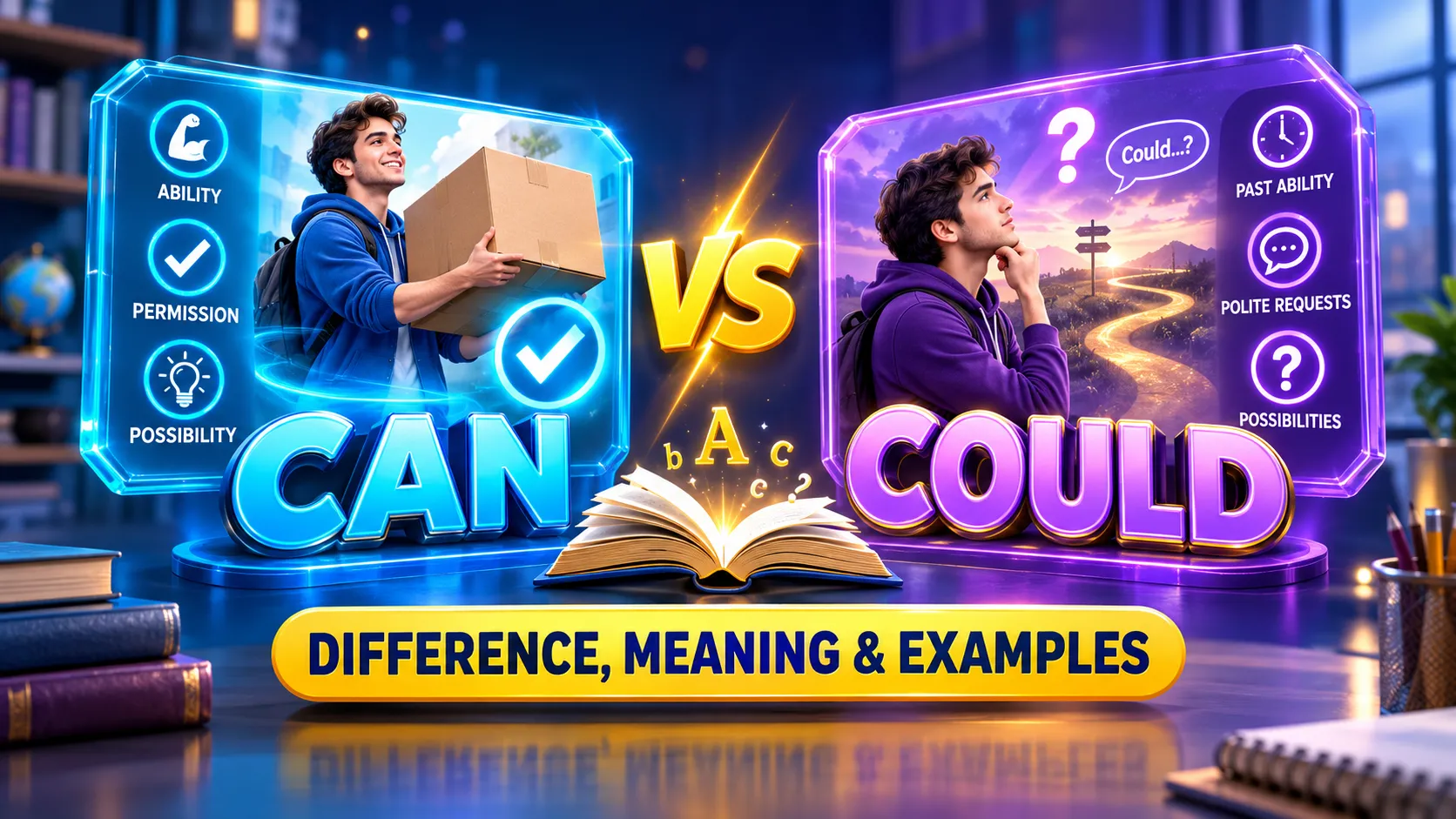
Can vs Could: “Can” and “could” are modal verbs in English grammar. Both verbs express ability, possibility, and permission, but they differ in tense, politeness, certainty, and usage. Can usually describes present ability, general possibility, or informal requests, while could often describes past ability, less certain possibilities, and more polite requests.
For example:
- I can swim. (Present ability)
- I could swim when I was five. (Past ability)
- Can you help me? (Direct request)
- Could you help me? (More polite request)
Although these verbs sometimes express the same idea, you cannot always use them interchangeably. Understanding their differences helps you speak naturally, write clearly, and avoid common grammar mistakes.
In this guide, you will learn the meanings, rules, differences, sentence structures, and examples of “can” vs “could,” along with common mistakes, practice exercises, and answers.

What Is the Difference Between Can and Could?
The main difference between can and could involves the context in which you use each verb.
“Can” commonly expresses present ability, permission, or general possibility. “Could” commonly expresses past ability, polite requests, hypothetical situations, or possibilities that seem less certain.
Compare these examples:
| Can | Could |
| I can drive a car. | I could drive a car when I was 18. |
| Can I use your phone? | Could I use your phone, please? |
| This road can be dangerous. | This road could be dangerous at night. |
| I can help you today. | I could help you if I had time. |
| Can you open the door? | Could you open the door? |
Key takeaway: Use “can” for many present or general situations and “could” for past ability, polite requests, hypothetical situations, and possible outcomes.
Explore More: https://wordminto.com/other-vs-another/
What Does Can Mean?
“Can” is a modal verb that expresses ability, permission, possibility, or willingness in certain contexts. It usually refers to the present or a general situation.
1. Can for Ability
Use “can” to describe something a person knows how to do or can do.
Examples:
- I can speak English.
- She can play the piano.
- They can solve difficult problems.
- My brother can cook delicious meals.
- We can finish this project today.
In these sentences, “can” shows that someone can act.
2. Can for Permission
Use “can” to ask for or give permission in everyday conversations.
Examples:
- Can I sit here?
- Can we leave early?
- You can use my laptop.
- Students can bring their dictionaries.
- You can enter the room now.
Although “can” works naturally in informal situations, “may” sometimes sounds more formal when you ask for permission.
3. Can for Possibility
Use “can” to describe something that sometimes happens or represents a general possibility.
Examples:
- Winters can be extremely cold here.
- Learning a new language can take time.
- Too much sugar can affect your health.
- Mistakes can help us learn.
- This road can become crowded during rush hour.
Here, “can” describes a general possibility rather than a specific prediction.
4. Can for Requests
Use “can” when you want someone to do something.
Examples:
- Can you help me with this assignment?
- Can you close the window?
- Can you send me the document?
- Can you wait for five minutes?
- Can you explain this rule again?
These requests sound natural and direct. You can use “could” when you want a more polite tone.
Explore More: https://wordminto.com/direct-vs-indirect-speech/
What Does Could Mean?
“Could” is a modal verb that expresses past ability, possibility, polite requests, suggestions, and hypothetical situations. It also serves as the past form of “can” in some contexts.
1. Could for Past Ability
Use “could” to describe an ability that someone possessed in the past, particularly a general ability.
Examples:
- I could run very fast when I was younger.
- She could read before she started school.
- My grandfather could speak three languages.
- We could see the mountains from our old house.
- He could solve complex puzzles as a child.
These sentences describe abilities that existed in the past.
Important: For one specific successful action in the past, English often uses “was/were able to” or “managed to” instead of “could.”
For example:
- I was able to fix the computer yesterday.
- She managed to escape the room.
For general past ability, “could” works well: “I could fix computers when I was younger.”
2. Could for Possibility
Use “could” to describe something that may happen or may be true.
Examples:
- It could rain this evening.
- She could be at the library.
- We could miss the train if we leave late.
- This solution could work.
- The new policy could improve the situation.
“Could” often presents a possibility without claiming certainty. However, the exact level of certainty depends on context.
3. Could for Polite Requests
Use “could” to make requests sound more polite or less direct.
Examples:
- Could you help me, please?
- Could you pass me the salt?
- Could you speak a little more slowly?
- Could you send me the report by Friday?
- Could you explain the instructions again?
Compare:
- Can you help me? — Direct and friendly.
- Could you help me? — More polite and slightly less direct.
Both forms are grammatically correct.
4. Could for Suggestions
Use “could” when you suggest an option or possible course of action.
Examples:
- You could try restarting your computer.
- We could visit the museum tomorrow.
- You could ask your teacher for advice.
- They could take a different route.
- You could save money by cooking at home.
These sentences present options rather than commands.
5. Could for Hypothetical Situations
Use “could” to discuss what someone might be able to do under an imagined condition.
Examples:
- I could travel more if I had more money.
- She could become a great writer with regular practice.
- We could win the match if we worked together.
- He could buy a new car if he saved enough money.
- You could improve your English if you practiced every day.
“Could” often appears in conditional sentences with “if” clauses.
Explore More: https://wordminto.com/sentence-fragments/
Can vs Could: Comparison Table
The following table summarizes the main differences between these two modal verbs.
| Usage | Can | Could |
| Present ability | I can swim. | Less common for present ability; possible in context |
| General past ability | Not normally used | I could swim at age six. |
| Permission | Can I leave? | Could I leave early? |
| Requests | Can you help me? | Could you help me? |
| Possibility | It can happen. | It could happen. |
| Suggestions | Less common for tentative suggestions | You could try again. |
| Hypothetical ability | I can do it now. | I could do it if I had time. |
| Negative form | Cannot / can’t | Could not / couldn’t |
Remember that “could” does not always refer to the past. It can also refer to the present or future, especially in polite requests, suggestions, and hypothetical situations.
Explore More: https://wordminto.com/quotation-marks-rules/
When Should You Use Can?
Use “can” when the sentence expresses present ability, everyday permission, a direct request, or a general possibility.
Examples of Can in Sentences
- I can finish this task before lunch.
- She can speak French fluently.
- Can I borrow your pen?
- You can park your car here.
- Exercise can improve your mood.
- Can you help me carry these boxes?
- We can meet after work.
- This machine can produce hundreds of items per hour.
- Anyone can learn basic grammar with practice.
- You can call me whenever you need help.
Can in Negative Sentences
Use “cannot” or “can’t” to express inability, lack of permission, or impossibility in a given context.
Examples:
- I can’t attend the meeting today.
- She cannot drive a manual car.
- You can’t enter this area without permission.
- We can’t finish the project without more information.
- He cannot hear you from this distance.
“Cannot” usually sounds more formal than the contraction “can’t.”
When Should You Use Could?
Use “could” when you describe general past ability, make a polite request, discuss a possibility, suggest an option, or imagine a different situation.
Examples of Could in Sentences
- I could read simple books when I was four.
- Could you open the door, please?
- We could go shopping this weekend.
- It could snow in the mountains tonight.
- She could become a successful entrepreneur.
- Could I ask you a question?
- You could take a short break.
- They could solve the problem with better planning.
- I could help you if I finished my work early.
- He could play football for hours as a child.
Could in Negative Sentences
Use “could not” or “couldn’t” to express an inability in the past, a rejected possibility, or a hypothetical limitation.
Examples:
- I couldn’t understand the instructions yesterday.
- She couldn’t attend the event.
- We couldn’t find the correct address.
- He couldn’t finish the assignment on time.
- They couldn’t see the stage from their seats.
For a specific successful past action, prefer “was/were able to” when appropriate:
– We were able to find the correct address after asking for directions.
Explore More: https://wordminto.com/speak-vs-talk/
Can vs Could for Ability
Both verbs can express ability, but the time reference and context determine which one fits.
Use “can” for present ability:
- I can drive.
- She can swim.
- They can speak Spanish.
Use “could” for general past ability:
- I could drive when I was 17.
- She could swim before she started school.
- They could speak Spanish when they lived abroad.
Compare these sentences:
- I can lift this box. (I have the ability now.)
- I could lift this box when I was younger. (I had the ability in the past.)
Can vs Could for a Specific Past Achievement
English makes an important distinction between general ability and success in one particular situation.
- General past ability: “I could swim when I was six.”
- Specific successful action: “I was able to swim across the river yesterday.”
In affirmative sentences about one particular achievement, “was/were able to” or “managed to” often sounds more natural than “could.”
However, “could” commonly works in negative statements about specific past situations:
– I couldn’t open the door yesterday.
Can vs Could for Permission
Both verbs can ask for permission, but they create different tones.
| Sentence | Tone |
| Can I use your phone? | Casual and direct |
| Could I use your phone? | More polite |
| Can we leave now? | Everyday conversation |
| Could we leave a little earlier? | More tentative or polite |
Examples:
- Can I sit next to you?
- Could I sit next to you, please?
- Can we use this room?
- Could we use this room for a few minutes?
Use “can” with friends, family, and familiar colleagues. Use “could” when you want to sound more considerate or formal.
Can vs Could for Possibility
“Can” and “could” both describe possible situations, but they often emphasize different meanings.
General Possibility: Can
Use “can” to describe something that happens in certain circumstances.
Examples:
- Heavy traffic can cause delays.
- Working late can affect your sleep.
- This road can become slippery in winter.
- Online courses can help students develop new skills.
Could: A Potential Outcome
Use “could” when you discuss a possible event, explanation, or future outcome.
Examples:
- The traffic could delay our arrival.
- She could be waiting outside.
- This change could reduce costs.
- We could finish early if everyone helps.
Compare:
- Exercise can improve your health. (General possibility)
- Exercise could improve your health. (A possible outcome in a particular situation)
These distinctions are common, but context can change the precise meaning.
Explore More: https://wordminto.com/me-vs-i/
Can vs Could in Questions
Both modal verbs appear before the subject in questions.
Structure:
Can/Could + subject + base form of the verb + rest of the sentence?
Examples:
- Can you swim?
- Could you swim when you were younger?
- Can she join us?
- Could she join us tomorrow?
- Can they finish the work?
- Could they finish the work by Friday?
Do not add “to” after “can” or “could” before the main verb.
Incorrect: Can you to help me?
Correct: Can you help me?
Incorrect: Could she goes with us?
Correct: Could she go with us?
Can vs Could in Negative Sentences
To form negative sentences, add “not” after the modal verb.
| Positive | Negative |
| I can swim. | I cannot swim. |
| She can attend. | She cannot attend. |
| He could understand. | He could not understand. |
| They could come. | They could not come. |
Common contractions include:
- Cannot → can’t
- Could not → couldn’t
Examples:
- I can’t answer that question.
- You can’t park here.
- She couldn’t remember his name.
- We couldn’t finish the work yesterday.
Grammar rule: Do not use “do” or “does” to form negatives with modal verbs.
Incorrect: I don’t can swim.
Correct: I can’t swim.
Incorrect: She doesn’t could come.
Correct: She couldn’t come.
Conditional Sentences: Can vs Could
“Can” and “could” frequently appear in conditional sentences, especially when the speaker describes ability, opportunity, or a possible result.
Can in Conditional Sentences
Use “can” when the result describes a realistic ability or opportunity.
Examples:
- If you finish early, you can join us.
- If we leave now, we can catch the bus.
- If she studies regularly, she can improve her grades.
Could in Conditional Sentences
Use “could” to describe a potential result or an imagined situation.
Examples:
- If I had more free time, I could learn another language.
- If we left earlier, we could avoid traffic.
- If he practiced daily, he could become a better player.
Compare:
- If you finish your homework, you can watch TV. (A real opportunity or permission)
- If you finished your homework earlier, you could watch TV with us. (A hypothetical or tentative possibility, depending on context)
Can vs Could for Polite Requests
“Can” and “could” both work in everyday requests, but “could” usually sounds more polite because it makes the request less direct.
Examples:
- Can you help me with my homework?
- Could you help me with my homework, please?
- Can you send me the file?
- Could you send me the file when you have a moment?
- Can you repeat that?
- Could you repeat that, please?
You do not need to use “could” every time you speak politely. Tone, context, and expressions such as “please” also influence politeness.
For example, “Can you help me, please?” is perfectly polite in many everyday situations.
Can vs Could for Offers and Suggestions
“Could” often works well when you offer a possible solution or suggest an action without pressuring someone.
Examples:
- You could speak to your manager.
- We could order food instead of cooking.
- You could try a different study method.
- I could drive you to the station if you want.
- We could meet on Saturday rather than Friday.
“Can” can also express an offer or available option:
- I can help you with your assignment.
- We can meet tomorrow if that suits you.
The difference often comes down to whether you are offering something you can do or suggesting one possible option.
Can vs Could vs May
“Can,” “could,” and “may” sometimes overlap, especially when speakers ask for permission or discuss possibilities.
| Modal verb | Common use | Example |
| Can | Ability, everyday permission | Can I leave now? |
| Could | Past ability, polite requests, possibilities | Could I leave a little early? |
| May | Formal permission or possibility | May I leave now? |
Examples:
- I can swim. (Ability)
- I could swim when I was younger. (Past ability)
- May I enter the room? (Formal request for permission)
In everyday English, “can I” is widely accepted for permission. “May I” often sounds more formal, while “could I” usually sounds polite and conversational.

Can vs Could vs Would
“Could” and “would” can both make requests sound polite, but they do not have the same meaning.
| Modal verb | Main use | Example |
| Can | Ability or direct request | Can you help me? |
| Could | Possibility, ability, polite request | Could you help me? |
| Would | Willingness or polite request | Would you help me? |
Compare:
- Can you open the window? — Asks whether the person can do it.
- Could you open the window? — Makes a polite request.
- Would you open the window? — Asks about willingness and can sound direct or polite depending on tone.
All three forms can work naturally, but the context determines the best choice.
Common Mistakes When Using Can and Could
English learners sometimes confuse these verbs because they share several meanings. Avoid the following mistakes.
Mistake 1: Using “Can” for General Past Ability
Incorrect: I can swim when I was five.
Correct: I could swim when I was five.
Why? “Could” describes general ability in the past.
Mistake 2: Adding “To” After Can or Could
Incorrect: She can to drive.
Correct: She can drive.
Incorrect: He could to help us.
Correct: He could help us.
Why? Modal verbs take the base form of the main verb without “to.”
Mistake 3: Adding -S to the Main Verb
Incorrect: He can speaks English.
Correct: He can speak English.
Incorrect: She could plays tennis.
Correct: She could play tennis.
Why? The main verb remains in its base form after a modal verb.
Mistake 4: Using “Do” With Can
Incorrect: Do you can help me?
Correct: Can you help me?
Why? Form questions by placing the modal verb before the subject.
Mistake 5: Assuming “Could” Always Means Past Time
Incorrect assumption: “Could” only describes past events.
Correct examples:
- Could you help me, please? (Present request)
- We could travel next month. (Future possibility)
- I could swim when I was six. (Past ability)
Why? “Could” expresses different meanings depending on context.
Mistake 6: Confusing “Could” With Guaranteed Results
Incorrect assumption: “It could rain” means rain will definitely occur.
Correct: “It could rain” means rain is possible.
Why? “Could” often indicates uncertainty rather than a guaranteed outcome.
Can vs Could Examples in Everyday English
These examples show how people use the two verbs in common situations.
Home
- I can cook dinner tonight.
- Could you help me clean the kitchen?
- We can watch a movie after dinner.
- Could we invite our friends over?
School
- I can answer this question.
- Could you explain the lesson again?
- Students can use dictionaries during this activity.
- We could study together before the exam.
Work
- I can complete the report today.
- Could you review this document?
- We can discuss the project after lunch.
- The new process could save us time.
While Traveling
- I can drive to the airport.
- Could you tell me where the station is?
- We can take the next train.
- We could visit another city tomorrow.
With Friends
- Can you come to my party?
- Could you bring some snacks?
- We can meet at the café.
- We could go for a walk later.
Can vs Could: Practice Exercises
Test your understanding by choosing the correct modal verb for each sentence.
Choose the correct answer
0 of 10 answered
1. I ___ speak French when I was six.
can
could
2. ___ you please close the door?
Can
Could
3. She ___ play the piano very well now.
can
could
4. It ___ rain later this evening.
could
can to
5. If I had more time, I ___ learn Italian.
could
can to
6. ___ I borrow your notebook?
Can
Do can
7. He ___ understand the instructions yesterday.
couldn’t
doesn’t could
8. My sister ___ drive a car.
can
can drives
9. We ___ go to the park if the weather improves.
could
could to
10. You ___ use my computer if you need it.
can
can to
Check answers
People Also Ask
Usually, “can” expresses present ability, while “could” expresses general past ability. However, “could” also expresses polite requests, hypothetical situations, and present or future possibilities.
Yes, “could” often sounds more polite or less direct when you make requests. For example, “Could you help me?” generally sounds more considerate than “Can you help me?” Both are correct.
Yes. You can use “could” to describe a possible future event or action.
Examples:
We could visit you next weekend.
It could rain tomorrow.
She could join us later.
These sentences describe possibilities, not guaranteed events.
Yes, in some contexts. For example, “With a little help, I could do it now” describes a present possibility or conditional ability. For straightforward present ability, “can” usually works better.
Both sentences are correct. “Can you help me?” sounds direct and natural in everyday conversation. “Could you help me?” often sounds more polite.
Conclusion
Can vs Could: “Can” and “could” are useful modal verbs that help you express ability, permission, possibility, requests, and hypothetical situations. The main difference lies in their meaning and context.
Use can for present ability, everyday permission, direct requests, and general possibilities. Use could for general past ability, polite requests, suggestions, hypothetical situations, and uncertain possibilities.
Remember these simple examples:
- I can swim now.
- I could swim when I was six.
- Can you help me?
- Could you help me, please?
With regular practice, you can use both verbs confidently in conversations, academic writing, and professional communication.











2 thoughts on “Can vs Could: Meaning, Differences, Rules, and Examples”