
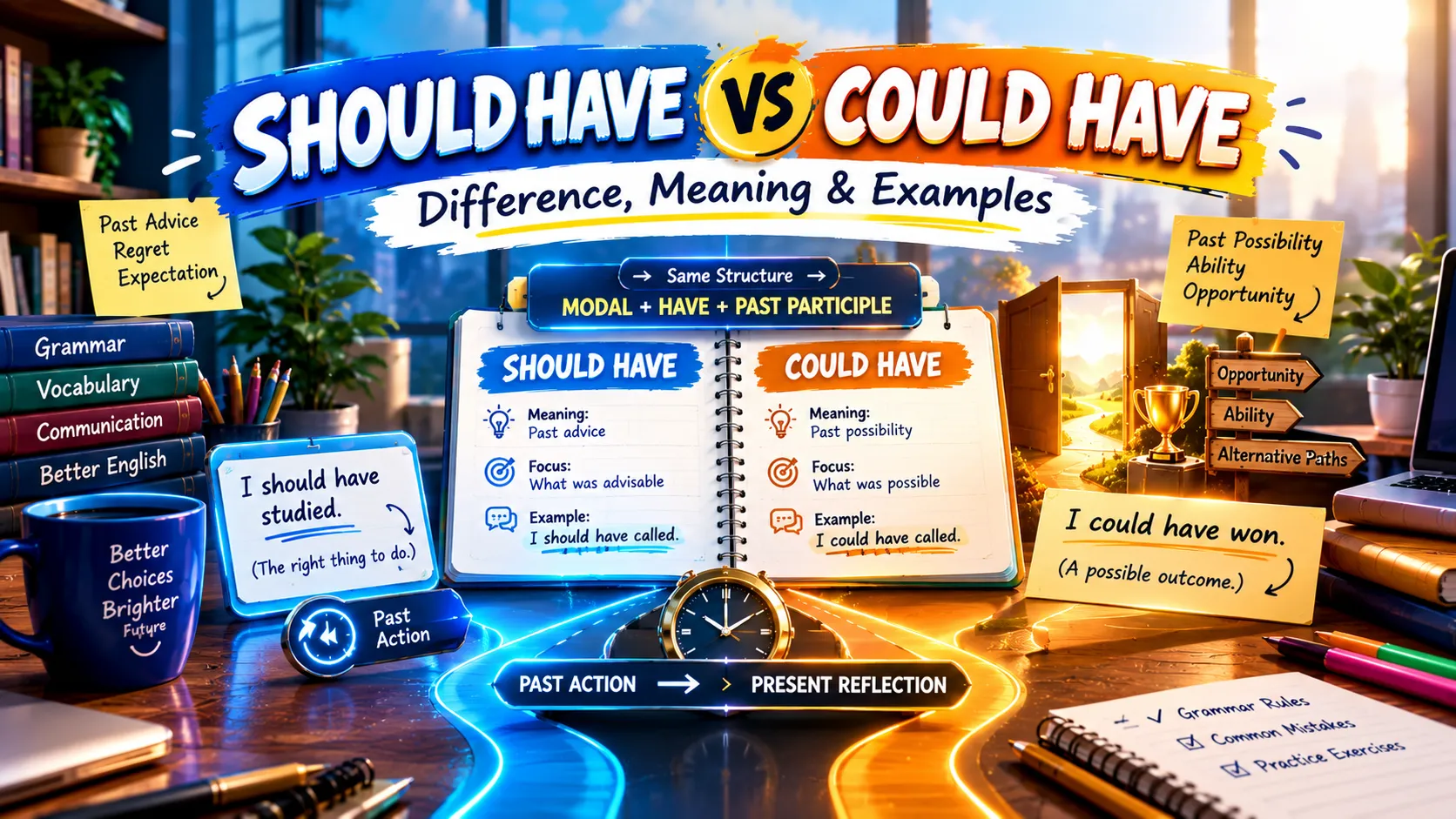
Should Have vs Could Have: “Should Have” expresses a past action that was advisable, expected, or the right thing to do, while “Could Have” expresses a past possibility, ability, or opportunity that someone had but may not have used.
Both phrases use a modal verb followed by “have” and a past participle. However, they communicate different meanings in English grammar.
For example:
- Should Have: I should have studied harder for the exam. (I regret not studying enough.)
- Could Have: I could have studied harder for the exam. (I had the opportunity to study harder.)
In this guide, you will learn the differences between should have and could have, their grammar rules, common mistakes, and examples with practice exercises.
What Does Should Have Mean?
“Should Have” is a modal construction that expresses a past action that was advisable, expected, or the right thing to do. Speakers often use it to express regret, criticism, or an expectation that someone did not meet.
We form “should have” with the modal verb “should,” the base form “have,” and the past participle of the main verb.
Structure: Subject + should have + past participle
Examples:
- I should have called my mother yesterday.
- She should have prepared for the interview.
- You should have followed the instructions.
- They should have arrived by now.
- We should have booked the tickets earlier.
In the first example, the speaker believes calling their mother was the right thing to do but suggests that they did not do it.
When to Use Should Have
Use “should have” in these situations:
1. To express regret
- I should have listened to your advice.
- She should have taken an umbrella.
- We should have left home earlier.
2. To criticize a past action
- You should have told me the truth.
- He should have checked his answers.
- They should have treated the guests politely.
3. To describe an unfulfilled expectation
- The package should have arrived yesterday.
- The meeting should have ended by now.
- She should have received the email already.
Note that “should have” does not always mean someone failed to do something. In expectation statements, the speaker expresses what they believe was likely or expected to happen.
Explore More: FOMO Meaning: What Does FOMO Mean in Text, Slang, and Social Media?
What Does Could Have Mean?
“Could Have” is a modal construction that expresses a past ability, possibility, or opportunity. It often describes something that was possible in the past but did not happen.
Structure: Subject + could have + past participle
Examples:
- I could have won the race.
- She could have called you yesterday.
- We could have taken a taxi.
- He could have become a doctor.
- They could have finished the project earlier.
In these examples, “could have” emphasizes what was possible, available, or achievable in the past. The exact meaning depends on the context.
When to Use Could Have
Use “could have” in these situations:
1. To describe a missed opportunity
- I could have joined the football team.
- She could have applied for the scholarship.
- We could have visited the museum.
2. To describe past ability
- He could have lifted the heavy box with help.
- I could have completed the task if I had more time.
- She could have run faster with proper training.
3. To describe a possible past explanation
- He could have forgotten the appointment.
- She could have missed the bus.
- They could have taken the wrong road.
In the last three examples, the speaker suggests possible explanations without claiming that any of them definitely happened.
Explore More: Aural vs Oral: Meaning, Difference, Examples, and Usage
Should Have vs Could Have: Key Differences
The main difference is that “should have” focuses on what was advisable or expected, while “could have” focuses on what was possible or available.
| Feature | Should Have | Could Have |
| Main meaning | Past advice or expectation | Past possibility or ability |
| Common use | Regret, criticism, expectations | Possibility, ability, missed opportunities |
| Focus | What was right or advisable | What was possible |
| Example | I should have studied. | I could have studied. |
| Implied meaning | Studying was the right choice. | Studying was an available option. |
Should Have vs Could Have Examples
Compare these sentences to understand the difference clearly.
| Should Have | Could Have |
| I should have called her. | I could have called her. |
| Calling her was the right thing to do. | Calling her was possible. |
| He should have saved his money. | He could have saved his money. |
| Saving money was advisable. | Saving money was an available option. |
| We should have left earlier. | We could have left earlier. |
| Leaving earlier was the better decision. | Leaving earlier was possible. |
The two constructions can describe the same situation, but they communicate different attitudes toward it.
Explore More: Everyday vs Daily: Meaning, Difference, and Examples
Should Have vs Could Have in Past Regrets
Both expressions can appear when people discuss past regrets, but they emphasize different things.
Should have often expresses regret about a decision or action that a person believes they ought to have taken.
Examples:
- I should have studied for the test.
- I should have apologized to my friend.
- We should have checked the weather forecast.
Could have often expresses regret about an opportunity that a person had but did not use.
Examples:
- I could have studied abroad.
- I could have accepted the job offer.
- We could have traveled together.
Compare:
- I should have accepted the job. — I believe accepting it was the better decision.
- I could have accepted the job. — Accepting it was an option available to me.
Explore More: Verbless Clauses: Examples, Meaning, Types, Rules, and Usage
Should Have vs Could Have in Questions
You can use both expressions to ask questions about past actions, decisions, and possibilities.
Questions with Should Have
Use “should have” to ask whether a past action was advisable or expected.
Examples:
- Should I have called you earlier?
- Should we have booked a table?
- Should he have told the teacher?
- Should they have waited for us?
Questions with Could Have
Use “could have” to ask about past possibilities, opportunities, or available alternatives.
Examples:
- Could I have done something differently?
- Could she have won the competition?
- Could we have taken another route?
- Could they have finished the work sooner?
Compare:
- Should I have told him? — Was telling him the right thing to do?
- Could I have told him? — Was it possible or an available option for me to tell him?
The second question can also ask whether someone had permission, depending on the context.
Explore More: Predicate Nominatives: Meaning, Rules, Examples, and Exercises
Should Have vs Could Have in Negative Sentences
Both constructions can take “not” to express different meanings.
Should Not Have
“Should not have” expresses that a past action was wrong, unwise, or inadvisable.
Examples:
- You should not have lied to your parents.
- I should not have spent so much money.
- She should not have ignored the warning.
- They should not have driven so fast.
The contractions “shouldn’t have” and “should not have” have the same meaning.
Could Not Have
“Could not have” can express an impossibility, an inability, or the absence of a realistic possibility in the past.
Examples:
- He could not have known the answer without seeing the question.
- She could not have arrived before noon because her flight landed at 1 p.m.
- I could not have completed the project without your help.
The contraction “couldn’t have” has the same meaning as “could not have.”
Important distinction:
- You shouldn’t have opened the door. — Opening it was a bad idea.
- You couldn’t have opened the door. — Opening it was impossible, or you lacked the ability to do so.
Explore More: Council vs Counsel: Meaning, Difference, and Examples
Should Have vs Could Have vs Would Have
These three constructions look similar, but they serve different purposes.
| Expression | Main Meaning | Example |
| Should have | Past advice or expectation | I should have studied. |
| Could have | Past possibility or ability | I could have studied. |
| Would have | An imagined or conditional past result | I would have studied if I had known. |
Should Have Examples
- You should have worn a coat.
- She should have checked the report.
- We should have arrived earlier.
Could Have Examples
- You could have worn my coat.
- She could have checked the report.
- We could have arrived earlier.
Would Have Examples
- I would have worn a coat if I had known it was cold.
- She would have checked the report if you had asked her.
- We would have arrived earlier if the traffic had been lighter.
Remember these simple distinctions:
- Should have: What was advisable?
- Could have: What was possible?
- Would have: What would have happened under a condition?

Grammar Rules for Should Have and Could Have
Both constructions follow the same basic grammatical pattern.
Rule 1: Use a Past Participle
After “should have” and “could have,” use the past participle of the main verb, not its simple past form.
Correct examples:
- I should have gone home.
- She could have written a letter.
- They should have eaten earlier.
- He could have taken the bus.
Incorrect examples:
- I should have went home.
- She could have wrote a letter.
- They should have ate earlier.
- He could have took the bus.
The correct past participles are “gone,” “written,” “eaten,” and “taken.”
Rule 2: Use Have, Not Has or Had
After “should” and “could,” use the base form “have,” regardless of the subject.
Correct:
- She should have called.
- He could have helped.
- They should have arrived.
- I could have stayed.
Incorrect:
- She should has called.
- He could had helped.
- They should has arrived.
Rule 3: Use the Same Pattern with Every Subject
The structure remains the same with I, you, he, she, it, we, and they.
Examples:
- I should have practiced.
- You could have asked.
- He should have waited.
- She could have joined.
- We should have planned ahead.
- They could have helped.
Rule 4: Use Contractions in Informal English
Common contractions include:
- Should have → Should’ve
- Could have → Could’ve
- Should not have → Shouldn’t have
- Could not have → Couldn’t have
Examples:
- I should’ve called you.
- You could’ve told me.
- She shouldn’t have said that.
- He couldn’t have known.
In formal writing, the full forms often provide a more formal tone. Avoid confusing “could’ve” with “could of”: the standard grammatical form is “could have.”
Explore More: LMK Meaning: What Does LMK Mean in Texting and Social Media?
Common Mistakes with Should Have and Could Have
English learners sometimes confuse these constructions because both refer to past situations.
| Incorrect Sentence | Correct Sentence |
| I should have went. | I should have gone. |
| She could have ate. | She could have eaten. |
| He should has studied. | He should have studied. |
| They could of won. | They could have won. |
| I should have to called her. | I should have called her. |
Another common mistake involves choosing the wrong expression for the intended meaning.
- If you mean that an action was advisable, use “should have.”
- If you mean that an action was possible, use “could have.”
For example:
- I should have saved money. — Saving was the sensible choice.
- I could have saved money. — Saving was possible.
Everyday Examples of Should Have vs Could Have
These examples show how speakers use both expressions in common situations.
School
- I should have completed my homework last night.
- I could have asked the teacher for help.
- She should have studied for the final exam.
- He could have joined the science competition.
Work
- We should have prepared the presentation earlier.
- I could have finished the report yesterday.
- She should have informed her manager.
- They could have chosen a better strategy.
Daily Life
- I should have taken an umbrella.
- We could have walked to the store.
- He should have locked the door.
- She could have called a taxi.
Relationships
- I should have listened to you.
- I could have explained my feelings better.
- She should have apologized.
- They could have resolved the disagreement peacefully.
Travel
- We should have booked our hotel earlier.
- We could have taken the train instead.
- He should have checked his passport.
- They could have visited another city.
How to Choose Between Should Have and Could Have
Use this simple decision guide when writing or speaking.
Ask yourself what you want to express.
Was the action advisable, right, or expected?
Use should have.
Example: I should have apologized.
Was the action possible, achievable, or available?
Use could have.
Example: I could have apologized.
Are you imagining a different past outcome under a condition?
Consider would have.
Example: I would have apologized if I had known.
People Also Ask
Both are grammatically correct. Choose “should have” to express past advice, regret, or expectation, and “could have” to express past possibility, ability, or opportunity.
“Should have” focuses on what someone ought to have done or what was expected to happen. “Could have” focuses on what someone was able to do or what was possible in the past.
Yes. You can use both constructions to contrast an advisable action with an available alternative.
Example: “I should have taken the bus, but I could have walked home.”
The sentence suggests that taking the bus was the better choice, although walking was also possible.
Yes. “Could have” can express regret about an opportunity that someone missed.
Example: “I could have become a professional athlete.”
This suggests that the possibility existed, but the outcome did not happen.
No. It can express advice about the past, criticism, or an expectation.
Examples:
You should have checked your work. (Criticism or advice.)
The train should have arrived by now. (Expectation.)
“Should’ve” is the contraction of “should have,” and “could’ve” is the contraction of “could have.” Their meanings remain the same as their full forms.
Conclusion
The difference between Should Have vs Could Have depends on the meaning you want to communicate.
- Should have expresses past advice, regret, criticism, or an expectation.
- Could have expresses past possibility, ability, or an opportunity.
- Would have describes an imagined or conditional past result.
For example, “I should have studied” means studying was the right thing to do, while “I could have studied” means studying was possible. Learning this distinction will help you communicate past decisions, missed opportunities, and hypothetical situations more accurately.











2 thoughts on “Should Have vs Could Have: Meaning, Difference, Rules, and Examples”