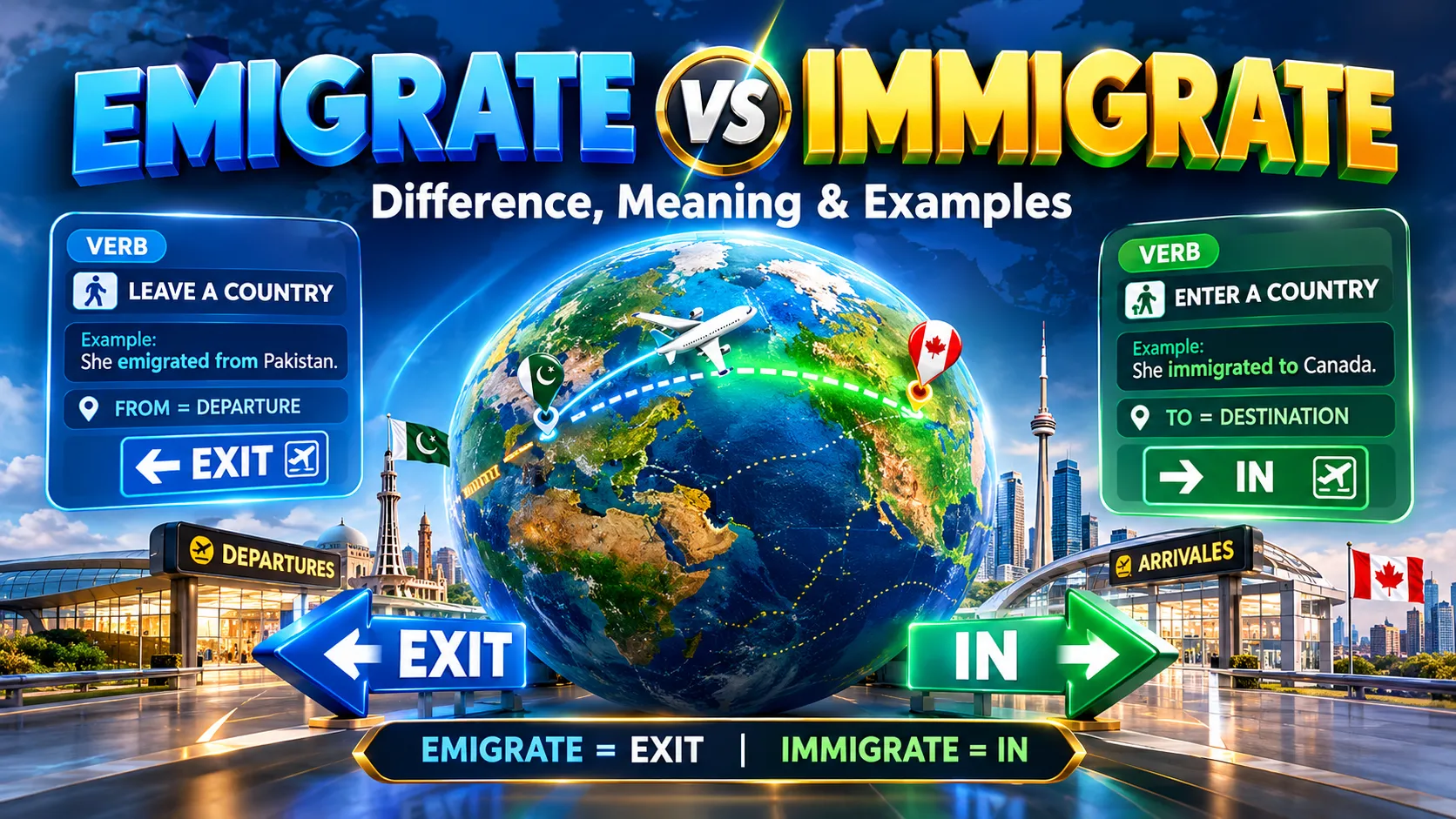
Emigrate vs Immigrate: Both words describe moving from one country to another, but they focus on different perspectives. Emigrate means to leave your home country to live somewhere else, while Immigrate means to enter another country to live there permanently or for an extended period.
For example, if Sara leaves Pakistan to live in Canada, she emigrates from Pakistan and immigrates to Canada.
Understanding this difference helps you choose the correct word in English writing, conversations, exams, and formal documents.
Emigrate vs Immigrate: Quick Difference
| Feature | Emigrate | Immigrate |
| Meaning | To leave a country to live elsewhere | To enter another country to live there |
| Focus | The country you leave | The country you enter |
| Common preposition | From | To |
| Example | He emigrated from Pakistan. | He immigrated to Canada. |
| Noun | Emigration | Immigration |
| Person | Emigrant | Immigrant |
| Related verb form | Emigrated, emigrating | Immigrated, immigrating |
Easy rule to remember: Emigrate = exit; immigrate = enter.

What Does Emigrate Mean?
Emigrate is a verb that means to leave your own country and settle in another country, usually for a long-term period.
People may emigrate for employment, education, family reunification, safety, or a better quality of life.
Examples of Emigrate in Sentences
- My uncle emigrated from Pakistan to Australia.
- Many families emigrate to find better job opportunities.
- She plans to emigrate from her home country next year.
- His grandparents emigrated from Italy in the 1960s.
- They emigrated because they wanted a safer environment for their children.
- The family decided to emigrate after receiving permanent residency approval.
- Thousands of people emigrate from rural areas to other countries each year.
How to Use Emigrate Correctly
Use emigrate when you focus on leaving a country.
- Correct: She emigrated from Bangladesh.
- Correct: They emigrated from Pakistan to the United Kingdom.
- Incorrect: She emigrated to Canada if you intend to emphasize entering Canada rather than leaving her home country.
The last sentence may occur in casual usage, but immigrated to Canada is the clearer and more appropriate choice when the destination is your focus.
Explore More: Should Have vs Could Have: Meaning, Difference, Rules, and Examples
What Does Immigrate Mean?
Immigrate is a verb that means to enter a foreign country to establish a new life there, usually for a long-term period.
People immigrate when they move to a new country for work, education, family, or other reasons.
Examples of Immigrate in Sentences
- My cousin immigrated to Canada last year.
- She hopes to immigrate to Australia after completing her degree.
- Many skilled workers immigrate to countries with strong employment opportunities.
- His parents immigrated to the United States in 1995.
- They immigrated to Germany to join their family.
- The government introduced new rules for people who want to immigrate.
- He immigrated to the United Kingdom and started a new career.
How to Use Immigrate Correctly
Use immigrate when you focus on entering a country.
- Correct: She immigrated to Canada.
- Correct: They immigrated to Australia from Pakistan.
- Incorrect for standard usage: She immigrated from Pakistan, when you mean that she left Pakistan.
Use emigrated from Pakistan to emphasize departure and immigrated to Canada to emphasize arrival.
Explore More: FOMO Meaning: What Does FOMO Mean in Text, Slang, and Social Media?
Emigrate vs Immigrate vs Migrate
These three words describe movement, but they differ in perspective and scope. Emigrate focuses on leaving, immigrate focuses on entering, and migrate describes movement more generally.
| Word | Meaning | Example |
| Emigrate | Leave a country to live elsewhere | She emigrated from India. |
| Immigrate | Enter another country to live there | She immigrated to Australia. |
| Migrate | Move from one place to another | Workers migrate for employment. |
Examples of All Three Words
- Emigrate: Ahmed emigrated from Pakistan in 2024.
- Immigrate: Ahmed immigrated to Canada in 2024.
- Migrate: Many people migrate to find better opportunities.
The first two sentences describe the same move from different perspectives. The third uses a broader term that does not emphasize either departure or arrival.
Explore More: Aural vs Oral: Meaning, Difference, Examples, and Usage
Emigrant vs Immigrant
Emigrant and immigrant are nouns that describe a person who moves between countries. The correct choice depends on the perspective.
| Word | Meaning | Example |
| Emigrant | A person who leaves a country to settle elsewhere | He is an emigrant from Pakistan. |
| Immigrant | A person who enters another country to settle there | He is an immigrant in Canada. |
Remember: The same person can be an emigrant in relation to the country they left and an immigrant in relation to the country they entered.
Emigration vs Immigration
The nouns emigration and immigration refer to the processes of leaving and entering countries.
- Emigration: The act or process of leaving a country to live elsewhere.
- Immigration: The act or process of entering another country to live there.
Examples:
- Emigration from the region increased last year.
- Immigration has contributed to the country’s population growth.
- The government studies emigration trends to understand why residents leave.
- Immigration policies determine the rules for entering and settling in a country.
Explore More: Everyday vs Daily: Meaning, Difference, and Examples
Easy Tricks to Remember Emigrate and Immigrate
Use these three memory tricks to choose the correct word.
E
Emigrate = Exit
Think of the letter E in emigrate and exit. You leave a country.
Example: She emigrated from Pakistan.
I
Immigrate = In
Think of the letter I in immigrate and in. You enter another country.
Example: She immigrated to Canada.
M
Migrate = Move
Think of migrate as the general word for moving from one place to another.
Example: Birds migrate to warmer regions.
Explore More: Verbless Clauses: Examples, Meaning, Types, Rules, and Usage
Common Mistakes When Using Emigrate vs Immigrate
1. Using Immigrate When You Mean Leaving
Incorrect: She immigrated from Pakistan to Canada, when the intended focus is her departure from Pakistan.
Better: She emigrated from Pakistan to Canada.
Note that the original sentence can also be grammatically correct when the writer uses immigrate to emphasize arrival in Canada.
2. Using Emigrate When You Mean Entering
Incorrect for the intended meaning: They emigrated to Canada.
Better: They immigrated to Canada.
In standard usage, emigrate emphasizes departure, while immigrate emphasizes arrival.
3. Confusing Emigrant and Immigrant
Incorrect: He is an emigrant to Canada.
Better: He is an immigrant to Canada.
Use emigrant to describe someone in relation to the country they left and immigrant in relation to the country they entered.
4. Confusing Immigration With Emigration
Incorrect: Immigration from Pakistan describes people leaving Pakistan.
Better: Emigration from Pakistan describes people leaving Pakistan.
Use immigration to Canada to describe people entering Canada.
5. Assuming Both Words Describe Different People
Incorrect: An emigrant and an immigrant must be two different people.
Correct: One person can be both an emigrant and an immigrant, depending on the country and perspective.
Explore More: Predicate Nominatives: Meaning, Rules, Examples, and Exercises

When Should You Use Emigrate vs Immigrate?
Choose the word based on the main idea you want to communicate.
| Situation | Correct word | Example |
| Discussing departure from a home country | Emigrate | She emigrated from Nepal. |
| Discussing arrival in a new country | Immigrate | She immigrated to Japan. |
| Discussing movement without focusing on either end | Migrate | Many workers migrate for better jobs. |
| Describing a person who left a country | Emigrant | He became an emigrant from Italy. |
| Describing a person who entered a country | Immigrant | He became an immigrant in France. |
| Discussing entry policies | Immigration | The country revised its immigration rules. |
| Discussing people leaving a country | Emigration | Emigration increased during the economic crisis. |
People Also Ask
Emigrate means to leave a country to live elsewhere, while immigrate means to enter another country to live there.
Use emigrate from when you emphasize leaving a country. You can also use immigrate from when describing a person’s origin while focusing on their arrival elsewhere, as in “She immigrated to Canada from Pakistan.”
Use immigrate to when emphasizing entry into a destination country. Emigrate to can also be grammatically acceptable when the sentence emphasizes leaving one’s home country for a destination, although emigrate from makes the departure perspective clearer.
Yes. Someone who leaves Pakistan to settle in Canada is an emigrant from Pakistan and an immigrant in Canada.
Immigration focuses on people entering a country to settle there. Emigration focuses on people leaving a country to settle elsewhere.
Migrate is a general term for moving from one place to another. Immigrate specifically focuses on entering another country to live there.
Conclusion
The difference between Emigrate and Immigrate comes down to perspective. Emigrate means to leave a country, while Immigrate means to enter another country to live there. Both words can describe the same move, but each emphasizes a different side of it.
Remember the simple trick: E = Exit, I = In. Use emigrate from Pakistan when discussing departure and immigrate to Canada when discussing arrival. With this distinction in mind, you can use both words accurately in everyday conversations, academic writing, and formal documents.











3 thoughts on “Emigrate vs Immigrate: Meaning, Differences, Rules, and Examples”