
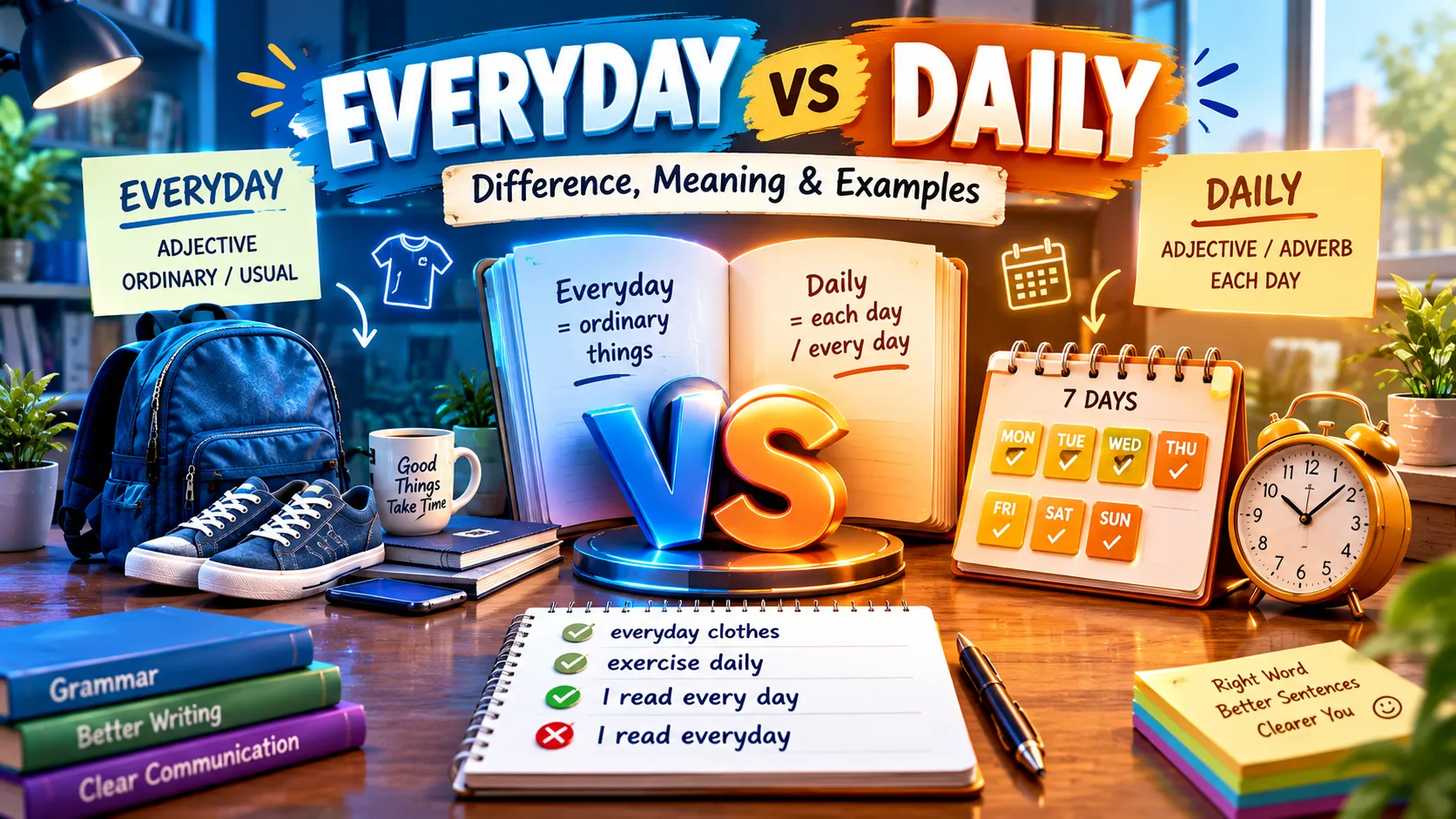
Everyday vs Daily: “Everyday” and “Daily” both describe things that happen regularly or are part of a normal routine. However, they do not always work the same way in a sentence. Everyday usually describes something ordinary or common, while daily means something that happens or occurs each day.
Understanding the difference between everyday and daily helps you write clearer sentences and avoid common grammar mistakes.
In this guide, you will learn the meanings, grammar rules, differences, examples, common mistakes, and practice exercises for everyday vs daily.
Everyday vs Daily: Quick Difference
| Feature | Everyday | Daily |
| Meaning | Ordinary, usual, or common | Happening or occurring each day |
| Part of speech | Adjective | Adjective or adverb |
| Main use | Describes normal things or routines | Describes frequency or something done each day |
| Example | These are my everyday shoes. | I walk daily. |
| Example | Everyday problems can be stressful. | She reads the newspaper daily. |
| Similar words | Ordinary, usual, common | Every day, each day, day-to-day |
Quick tip: Use everyday to describe something ordinary or usual. Use daily when you mean something happens each day.
What Does Everyday Mean?
Everyday is an adjective that describes something ordinary, usual, common, or regularly encountered in daily life.
We usually place everyday before a noun to describe the type of thing we mean.
Examples of Everyday in Sentences
- I wear my everyday clothes at home.
- Cooking is an everyday activity for many people.
- She uses an everyday bag for work.
- We face everyday challenges in life.
- These are my everyday shoes.
- He speaks in everyday English.
- The teacher uses everyday examples to explain grammar.
- Smartphones have become part of everyday life.
- I prefer simple, everyday language.
- Good communication is an everyday necessity.
In these sentences, everyday describes ordinary clothes, activities, challenges, language, and experiences.
Everyday as an Adjective
Use everyday before a noun when you want to describe something ordinary or typical.
Examples:
- Everyday clothes: Clothes you normally wear.
- Everyday language: Language people commonly use.
- Everyday problems: Common problems people experience.
- Everyday life: Normal daily experiences.
- Everyday tasks: Ordinary tasks that form part of a routine.
Notice that everyday describes the noun rather than directly explaining how often an action happens.
Explore More: Verbless Clauses: Examples, Meaning, Types, Rules, and Usage
What Does Daily Mean?
Daily means happening, occurring, or being done each day. It can function as an adjective or an adverb.
As an adjective, daily describes a noun. As an adverb, it tells us how often someone does something.
Examples of Daily in Sentences
- I exercise daily.
- She takes a daily walk.
- He reads the newspaper daily.
- We have a daily meeting at work.
- The doctor checks the patient’s condition daily.
- My daily routine starts at 6 a.m.
- They publish a daily report.
- I practice English daily.
- The shop receives daily deliveries.
- She writes in her journal daily.
These examples show how daily describes activities, schedules, reports, and events that occur each day.
Daily as an Adjective
Use daily before a noun when you describe something that happens or is used each day.
Examples:
- Daily exercise: Exercise performed each day.
- Daily routine: A routine followed each day.
- Daily report: A report produced each day.
- Daily newspaper: A newspaper published each day.
- Daily meeting: A meeting held each day.
Daily as an Adverb
Use daily to explain how frequently someone acts.
Examples:
- I study daily.
- She calls her mother daily.
- We check our emails daily.
- He practices the piano daily.
- They exercise daily.
In these examples, daily answers the question “How often?”
Explore More: Predicate Nominatives: Meaning, Rules, Examples, and Exercises
Everyday vs Daily: Main Differences
Although everyday and daily sometimes describe similar situations, their meanings and grammatical functions differ.
1. Meaning
Everyday emphasizes what is ordinary or typical. Daily emphasizes frequency: something happens each day.
Examples:
- Everyday: I wear everyday shoes to the market.
- Daily: I clean my shoes daily.
The first sentence describes the type of shoes. The second tells us how often the person cleans them.
2. Part of Speech
Everyday functions as an adjective. Daily functions as both an adjective and an adverb.
Examples:
- Everyday problems can be difficult. (Adjective)
- Daily exercise improves fitness. (Adjective)
- I exercise daily. (Adverb)
You cannot normally use everyday as an adverb.
Incorrect: I exercise everyday.
Correct: I exercise daily.
Correct: I exercise every day.
3. Sentence Structure
Everyday normally appears before a noun. Daily can appear before a noun or after a verb.
Examples:
- She wears everyday clothes.
- She practices daily.
- He follows a daily schedule.
- He checks the schedule daily.
4. Meaning in Context
Sometimes both words can describe a similar situation, but they emphasize different ideas.
| Everyday | Daily |
| Everyday activities keep me busy. | I complete these activities daily. |
| She uses everyday English. | She practices English daily. |
| Everyday expenses can add up. | I record my expenses daily. |
| He wears everyday clothes. | He washes his clothes daily. |
The left column describes ordinary things. The right column emphasizes how often an action occurs or an event takes place.
Explore More: Council vs Counsel: Meaning, Difference, and Examples
Everyday vs Every Day vs Daily
A common source of confusion is the difference between everyday, every day, and daily.
| Word or phrase | Meaning | Part of speech | Example |
| Everyday | Ordinary or usual | Adjective | These are my everyday shoes. |
| Every day | Each day | Adverbial phrase | I wear these shoes every day. |
| Daily | Each day; occurring every day | Adjective or adverb | I walk daily. |
Remember: Everyday is one word, while every day is two words. Daily can often replace every day when you mean “each day.”
Examples:
- I practice English every day.
- I practice English daily.
- English is part of my everyday routine.
All three sentences are correct, but they express slightly different ideas.
When Should You Use Everyday?
Use everyday when you describe something normal, common, usual, or ordinary.
Common Uses of Everyday
1. Everyday life
- Everyday life can be unpredictable.
- Technology makes everyday life easier.
2. Everyday activities
- Cooking and cleaning are everyday activities.
- Walking is an everyday activity for many people.
3. Everyday language
- The teacher explained the concept in everyday language.
- Use everyday English when speaking with beginners.
4. Everyday items
- I keep my everyday items in this drawer.
- These everyday products are affordable.
5. Everyday problems
- Everyone faces everyday problems.
- Good planning helps us manage everyday challenges.
Explore More: LMK Meaning: What Does LMK Mean in Texting and Social Media?
When Should You Use Daily?
Use daily when you want to express something that happens, occurs, or is performed each day.
Common Uses of Daily
1. Daily habits
- I drink water regularly throughout the day and exercise daily.
- She practices meditation daily.
2. Daily routines
- My daily routine includes reading and exercise.
- He follows a daily study schedule.
3. Daily activities
- We check the equipment daily.
- The staff cleans the office daily.
4. Daily reports
- The manager reviews the daily report.
- Our team submits daily updates.
5. Daily schedules
- The school publishes a daily schedule.
- The train follows a daily timetable.
Everyday vs Daily: Examples in Different Contexts
The best word depends on what you want to express.
| Context | Correct example | Explanation |
| Clothing | I wear everyday clothes at home. | Describes ordinary clothes. |
| Exercise | I exercise daily. | Describes frequency. |
| Language | She uses everyday English. | Describes common language. |
| Study | He studies daily. | Means he studies each day. |
| Expenses | Everyday expenses can be expensive. | Describes ordinary expenses. |
| Work | We hold a daily meeting. | Describes a meeting scheduled each day. |
| Life | Everyday life has its challenges. | Refers to normal life. |
| Practice | I practice grammar daily. | Explains how often I practice. |
| Tasks | Everyday tasks take time. | Describes ordinary tasks. |
| Reports | She prepares a daily report. | Describes a report produced each day. |
Explore More: BFF Meaning: What Does BFF Mean in Texting, Chat, and Social Media?
Common Mistakes with Everyday and Daily
Learners often confuse these words because their meanings overlap. Here are the most common mistakes to avoid.
Mistake 1: Using Everyday Instead of Every Day
Incorrect: I read everyday.
Correct: I read every day.
Correct: I read daily.
Why? The sentence explains how often you read. You need every day or daily, not the adjective everyday.
Mistake 2: Using Daily When You Mean Ordinary
Incorrect: I prefer my daily clothes to formal clothes.
Better: I prefer my everyday clothes to formal clothes.
Why? The sentence describes ordinary clothes rather than how often you wear them. However, daily clothes can occur in some contexts, particularly when the writer means clothes intended for daily use.
Mistake 3: Writing Everyday Routine Incorrectly
Correct: I follow an everyday routine.
Correct: I follow a daily routine.
Both sentences are grammatical. Everyday routine emphasizes a normal, familiar routine, while daily routine emphasizes a routine followed each day.
Mistake 4: Using Everyday as an Adverb
Incorrect: She practices piano everyday.
Correct: She practices piano every day.
Correct: She practices piano daily.
Why? Everyday is an adjective, not a standard adverb. Use every day or daily to describe the frequency of an action.
Mistake 5: Assuming Everyday and Daily Always Mean the Same Thing
Incorrect assumption: “Everyday” and “daily” are interchangeable in every sentence.
Correct understanding:
- Everyday challenges can be stressful.
- Daily challenges can be stressful.
Both can be correct, but everyday challenges emphasizes ordinary or common challenges, while daily challenges emphasizes challenges encountered each day.

Everyday vs Daily: Synonyms
Learning synonyms can help you choose the right word for your sentence.
Synonyms of Everyday
- Ordinary
- Usual
- Common
- Typical
- Routine
- Day-to-day
Examples:
- Ordinary activities
- Common problems
- Typical experiences
- Day-to-day responsibilities
Synonyms of Daily
- Every day
- Each day
- Day by day (depending on context)
- Once a day (when the intended frequency is exactly one time per day)
Examples:
- I exercise each day.
- She checks her email every day.
- He takes the medication once a day, as prescribed.
Note: These synonyms do not always mean the same thing. Choose the word that matches the intended meaning.
People Also Ask
Everyday is an adjective that means ordinary, usual, or common. Daily means occurring each day and can function as an adjective or an adverb.
Examples:
These are my everyday shoes.
I walk daily.
Everyday is one word when it functions as an adjective meaning ordinary or usual.
Example: Everyday tasks can take up a lot of time.
Use every day as two words when you mean each day.
Example: I complete my tasks every day.
In many contexts, yes. Both can mean something happens each day.
Examples:
I read daily.
I read every day.
Both sentences mean that I read each day.
Not always. Daily can describe frequency, while everyday describes ordinary or usual things.
Correct: I exercise daily.
Correct: Exercise is part of my everyday routine.
Both phrases are correct.
Everyday life emphasizes ordinary, normal experiences.
Daily life emphasizes life as experienced or lived each day.
Their meanings overlap, so the best choice depends on the context.
Conclusion
The difference between Everyday and Daily comes down to meaning and grammatical function. Use everyday to describe ordinary things, such as everyday clothes, everyday problems, and everyday life. Use daily to describe something that happens each day, such as daily exercise, a daily meeting, or a task performed daily.
Most importantly, do not confuse everyday with every day. The one-word form describes something ordinary, while the two-word phrase means each day. Once you understand this distinction, you can use all three expressions accurately in your writing.











2 thoughts on “Everyday vs Daily: Meaning, Difference, and Examples”